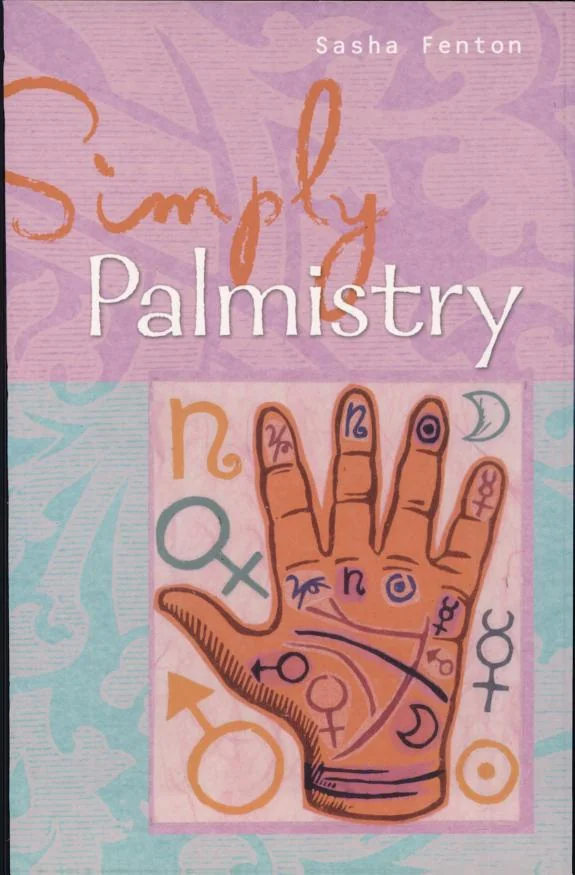
Simply Palmistry
 80
80

Simply Palmistry
Sasha Fenton's Simply Palmistry delivers precisely what its title promises: a straightforward manual for reading hands. The book's strength lies in its clarity; the diagrams are genuinely helpful, and the explanations for the major lines like the Heart Line and Head Line are easy to grasp for the uninitiated. Fenton avoids the overly mystical language that can alienate newcomers, grounding the practice in observable hand features. However, the book’s conciseness is also its primary limitation. While excellent for beginners, it offers little depth for those seeking to explore the subtler nuances or the historical evolution of palmistry beyond basic identification. The section on the mounts, while present, feels somewhat underdeveloped compared to the more detailed analysis of the lines. Nevertheless, for a beginner's first foray into understanding the hand's map, Fenton's work serves as a competent and accessible primer. It is a functional tool for initial exploration.
📝 Description
80
Sasha Fenton's Simply Palmistry, published in 2005, offers a direct guide to hand reading.
This 2005 book by Sasha Fenton takes a straightforward approach to palmistry, also known as chiromancy. It focuses on the physical structure of the hand, treating it as a map of personality and future events. Rather than getting lost in complex theories, Fenton provides a clear system for understanding the hand's lines, mounts, fingers, and thumb. The book includes diagrams to help readers visualize these elements.
Simply Palmistry is designed for people new to palmistry who want a practical guide. It avoids overwhelming beginners with obscure terms or lengthy historical accounts. Instead, it breaks down the fundamentals in an accessible way. Readers interested in using their hands for self-analysis will find its explanations clear and useful.
Palmistry has ancient origins, with significant contributions from Indian and Greek traditions. By the early 20th century, Western esoteric groups, including Theosophists and figures like William Gurney, revived interest in divination. Fenton's 2005 book enters a period where these practices are being reconsidered, sometimes alongside modern psychology or New Age thought. It connects historical palmistry with current interests by presenting its core concepts methodically.
💡 Why Read This Book?
• Learn to identify and interpret the major lines of the hand, such as the Life Line and Heart Line, understanding their direct correlation to personal vitality and emotional expression as detailed in the book’s line diagrams. • Gain practical skills in recognizing the meanings of the finger mounts, like the Mount of Venus and Mount of Jupiter, allowing for a deeper analysis of character traits and inherent potentials described in the text. • Understand the foundational principles of palmistry through clear, accessible language and visual aids, making the complex subject matter of chiromancy approachable from the outset, as presented in its 2005 publication.
⭐ Reader Reviews
Honest opinions from readers who have explored this book.
❓ Frequently Asked Questions
What are the main lines analyzed in Simply Palmistry?
Simply Palmistry focuses on the primary lines: the Life Line (vitality, physical well-being), the Head Line (intellect, mindset), the Heart Line (emotions, relationships), and the Fate Line (destiny, life path). The book provides detailed diagrams for each.
Does Sasha Fenton's book cover the meaning of hand shapes?
While the book primarily details lines, mounts, fingers, and thumbs, it also touches upon general hand shapes as they relate to elemental associations (e.g., Earth, Air, Fire, Water), providing a foundational understanding.
Is Simply Palmistry suitable for absolute beginners?
Yes, the book is specifically designed for beginners. Its direct approach, clear diagrams, and straightforward explanations make it an accessible introduction to the craft of palmistry.
What are the 'mounts' in palmistry according to this book?
The mounts are the fleshy pads at the base of each finger and the thumb. Simply Palmistry explains that these areas correspond to planetary influences and represent specific personality traits and potentials.
When was Simply Palmistry first published?
Simply Palmistry by Sasha Fenton was first published in 2005, making it a relatively modern guide to this ancient practice.
Does the book discuss the thumb's significance?
Yes, Simply Palmistry dedicates attention to the thumb, analyzing its length, flexibility, and the presence of the 'Mount of Venus' at its base, linking these to willpower, logic, and sensuality.
🔮 Key Themes & Symbolism
The Hand as a Map
The central tenet of Simply Palmistry is the hand's function as a detailed cartography of the self. Fenton presents the palm not as a static prediction tool, but as a dynamic representation of innate character, potential, and life experiences. The book meticulously details how the various lines—Life, Head, Heart, and Fate—serve as primary routes on this map, while the mounts, fingers, and thumb offer contextual details about the traveler's nature and disposition. This approach grounds the esoteric practice in tangible anatomy, making the information accessible for practical self-reflection.
Systematic Interpretation
Fenton emphasizes a systematic and logical approach to palmistry, moving away from purely intuitive or mystical interpretations. The book breaks down the complex art into digestible components: the distinct meanings of each line's length, clarity, and shape; the significance of the fleshy mounts corresponding to planets; and the symbolic weight of individual finger lengths and the thumb's angle. This structured methodology ensures that readers can build their understanding incrementally, recognizing patterns and interconnections within the hand's features.
Personality and Potential
Rather than focusing solely on future events, Simply Palmistry highlights how the hand reveals enduring personality traits and inherent potentials. The book explores how the configuration of lines and mounts can indicate predispositions towards certain behaviors, talents, or challenges. For instance, a well-developed Mount of Jupiter might suggest leadership qualities, while the clarity of the Head Line can speak to one's intellectual approach. This focus on character analysis offers a tool for self-awareness and personal development.
Accessible Chiromancy
The core mission of Simply Palmistry is to clarify chiromancy for a modern audience. Fenton achieves this through exceptionally clear language and illustrative diagrams, avoiding obscure terminology. The book functions as a practical handbook, enabling readers to apply the principles immediately to their own hands or those of others. It presents palmistry as an accessible art, learnable through careful observation and consistent application of the provided guidelines.
💬 Memorable Quotes
Direct passages from the work, attributed to the author.
“The Life Line indicates vitality and physical well-being.”
— This concise statement captures the book's direct approach to interpreting the major palm lines. It focuses on the practical, physical implications of a line's appearance rather than studying overly deterministic or fatalistic interpretations.
“The mounts at the base of the fingers relate to planetary influences.”
— This highlights the connection between the physical structure of the hand and the archetypal energies associated with the planets in esoteric traditions. It's a key concept for understanding the broader symbolic language of palmistry.
“The thumb's flexibility can suggest adaptability.”
— This interpretation focuses on a specific physical attribute of the hand—the thumb's mobility—and links it to a relevant personality trait, illustrating the book's method of correlating form with character.
💡 Key Ideas
Editorial paraphrase of the work's core concepts — not direct quotes.
The clarity and depth of the Heart Line reveal emotional capacity.
This paraphrased concept emphasizes how the physical characteristics of a specific line, the Heart Line, are directly tied to an individual's emotional landscape and capacity for connection.
Palmistry offers insights into character through the study of the hand.
This foundational statement summarizes the book's premise: that the intricate details of the hand serve as a key to understanding one's inherent nature and psychological makeup.
🌙 Esoteric Significance
Tradition
Simply Palmistry operates within the broad stream of Western Esotericism, specifically drawing from the tradition of chiromancy that gained prominence in Europe from the Renaissance onward. While not explicitly aligned with Hermeticism or Kabbalah, it utilizes the planetary correspondences that became integrated into these systems during their development. The book's approach is more practical and less theological than strictly Kabbalistic texts, focusing on the direct symbolic interpretation of physical hand features rather than complex metaphysical structures.
Symbolism
The core symbolism revolves around the lines and mounts of the hand. The Heart Line, for instance, symbolizes emotional life and relationships, often linked to Venus or the Moon. The Head Line represents intellect and communication, associated with Mercury. The mounts, such as the Mount of Jupiter (beneath the index finger) signifying ambition and leadership, or the Mount of Venus (at the base of the thumb) representing love and vitality, are treated as localized energy centers reflecting specific archetypal influences.
Modern Relevance
In contemporary practice, works like Simply Palmistry remain relevant for their accessibility. They serve as entry points for individuals exploring self-discovery and personal insight outside of mainstream psychology. While more complex esoteric traditions continue to be studied, Fenton’s book provides a foundational understanding that can complement modern therapeutic approaches, mindfulness practices, or even contemporary divination systems that incorporate elements of hand analysis.
👥 Who Should Read This Book
• Beginners curious about self-analysis through palmistry, seeking a clear, diagram-heavy guide to understanding the basic meanings of hand lines and mounts. • Individuals interested in practical esoteric tools who prefer straightforward, actionable information over dense theoretical frameworks or historical deep dives. • Aspiring practitioners of divination arts looking for a foundational text on chiromancy to complement studies in tarot, astrology, or other symbolic systems.
📜 Historical Context
Sasha Fenton's Simply Palmistry, first published in 2005, entered a landscape where esoteric practices like palmistry were experiencing a curious duality. On one hand, they were integrated into the New Age movement, often embraced for personal growth and self-help. On the other, academic interest in the history of divination and occultism was growing, with scholars like Ronald Hutton examining the roots of such traditions. Fenton’s work positions itself as a practical, accessible guide, likely influenced by the popularization of palmistry seen in the mid-to-late 20th century, which often simplified its interpretations. It contrasts with the more complex, historically-rooted analyses found in older texts or contemporary academic studies of chiromancy. The book appeared decades after the foundational works of figures like Cheiro (Count Louis Hamon), who popularized many modern palmistry concepts in the early 1900s, and amid ongoing interest from practitioners who saw palmistry as a complementary tool to other divination systems or psychological profiling.
📔 Journal Prompts
The shape and clarity of your Head Line, as detailed in the text.
The prominence of your Mount of Venus and its correlation to your thumb.
The inscription and meaning of your Fate Line.
The relative length of your fingers compared to your palm.
The presence and significance of any minor lines on your dominant hand.
🗂️ Glossary
Chiromancy
The art or practice of telling fortunes from the lines and marks on the palm of the hand; also known as palmistry.
Life Line
The semi-circular line encircling the base of the thumb, generally interpreted as relating to physical vitality, health, and major life events.
Head Line
The line running horizontally across the palm, typically below the Heart Line, which is said to indicate intellectual ability, communication style, and thought processes.
Heart Line
The uppermost horizontal line on the palm, usually starting below the little finger and extending towards the index or middle finger, associated with emotions and relationships.
Mounts
The fleshy, raised areas on the palm at the base of the fingers and thumb, each associated with a planet and specific personality traits or potentials.
Thumb
The opposable digit, analyzed for its length, flexibility, and the presence of the Mount of Venus, indicating willpower, logic, and sensuality.
Fate Line
A vertical line running up the palm, often from the wrist towards the middle finger, interpreted as indicating destiny, career, and major turning points.
This book appears in 1 collection
🔮 Readers Also Liked
Browse all →









From the “Palmistry” Collection
View all →







More Free Occult Philosophy Books
View all →