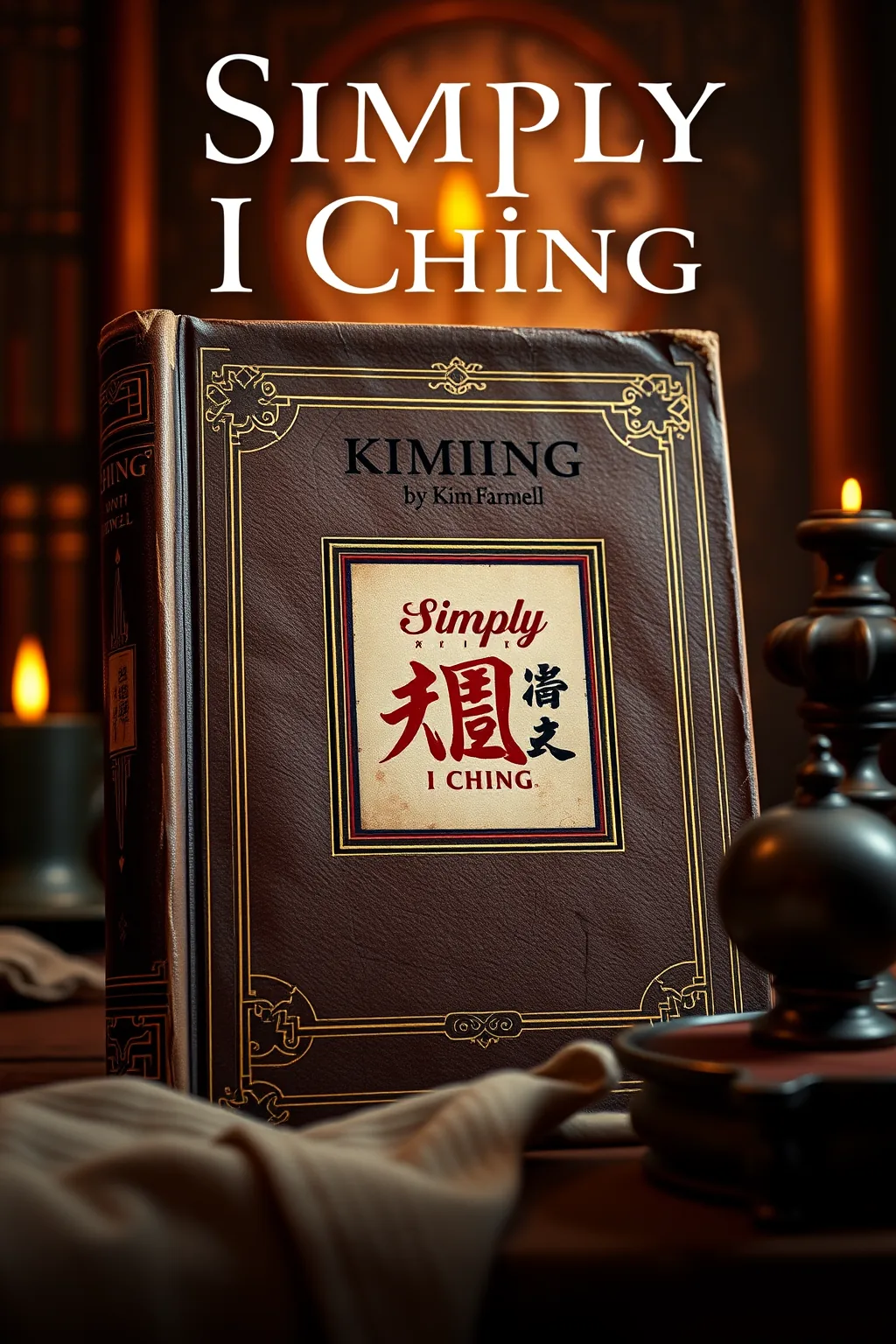
Simply I Ching
 61
61

Simply I Ching



Celeste Moreau, Divination & Symbolism Reviewer — Kim Farnell's 'Simply I Ching' is a masterclass in accessible esoteric knowledge. Farnell possesses a rare gift for distilling the profound complexities of the Yi Jing into a form that is both intellectually rigorous and spiritually resonant. She masterfully navigates the dense symbolism, revealing the interconnectedness of the hexagrams and their archetypal wisdom. This work transcends mere fortune-telling, offering a philosophical lens through which to view life's myriad challenges and opportunities. Its clarity and depth make it an invaluable companion for anyone seeking to understand the subtle energies that shape our world and our inner lives. Highly recommended for practitioners and seekers alike.
📝 Description
61
Kim Farnell's 2011 book, 'Simply I Ching,' explains the Yi Jing's hexagrams as keys to understanding existence.
Kim Farnell's 'Simply I Ching,' published in 2011, aims to make the ancient Chinese Book of Changes accessible. The book breaks down the Yi Jing's 64 hexagrams, moving beyond their use as divination tools. Farnell presents them as a system that reflects the dynamic interplay of Yin and Yang, the fundamental forces shaping all events. The text suggests that understanding these symbols can lead to personal growth and a deeper comprehension of reality.
This work is intended for anyone interested in Chinese philosophy or esoteric studies. It guides readers through the core concepts of the Yi Jing, encouraging contemplation of its patterns. Farnell's approach focuses on the practical application of the text's wisdom for self-discovery and navigating life's changes.
The I Ching, or Book of Changes, is one of the oldest Chinese classical texts, dating back perhaps to the 9th century BCE. It is central to Chinese philosophy and religion, influencing Taoism and Confucianism. Its system of hexagrams, derived from combinations of broken (Yin) and unbroken (Yang) lines, represents a cosmology and a method for understanding change. For centuries, it has been consulted as an oracle and studied for its philosophical insights into natural cycles and human affairs.
💡 Why Read This Book?
Discover the profound, transformative wisdom of the ancient Chinese oracle. 'Simply I Ching' offers a clear, accessible path to understanding life's cycles and your place within them. Ideal for seekers of personal growth, practitioners of divination, and scholars of Eastern philosophy who desire a deeper connection to timeless truths. Unlock potent insights for decision-making and spiritual evolution.
⭐ Reader Reviews
Honest opinions from readers who have explored this book.
❓ Frequently Asked Questions
What is the I Ching and its historical significance?
The I Ching, or Book of Changes, is an ancient Chinese divination text and one of the oldest of the Chinese classics. It's revered for its profound philosophical insights into the nature of change and its use as a tool for understanding cosmic patterns and making wise decisions.
Who is Kim Farnell and what is her approach to the I Ching?
Kim Farnell is an esteemed author known for her insightful interpretations of esoteric traditions. In 'Simply I Ching,' she offers a modern, accessible, yet deeply respectful approach, demystifying its complex symbolism and revealing its practical applications for contemporary life.
Is this book suitable for beginners interested in divination?
Absolutely. Farnell's 'Simply I Ching' is specifically designed to be approachable for newcomers, while still offering the depth required by experienced practitioners. It provides clear explanations and guided interpretations.
How can the I Ching be used for personal growth?
The I Ching serves as a mirror to our inner landscape and external circumstances. By consulting its hexagrams, one can gain clarity on motivations, potential outcomes, and the most harmonious course of action, fostering self-awareness and personal evolution.
What makes this edition stand out from other I Ching translations?
Farnell's 'Simply I Ching' excels in its balance of scholarly accuracy and intuitive understanding. It emphasizes the philosophical and spiritual dimensions, offering a holistic perspective that goes beyond mere predictive mechanics, making it a truly enriching read.
🔮 Key Themes & Symbolism
The Dynamic Nature of Change
At the core of the I Ching lies the universal truth of impermanence. Farnell elucidates how the sixty-four hexagrams represent every possible state of transformation, illustrating the ceaseless flow of energy and the cyclical nature of all things. Understanding these patterns allows one to navigate life's inevitable shifts with greater wisdom and equanimity, recognizing that every ending is a prelude to a new beginning, and every challenge holds the seed of opportunity.
The Harmony of Yin and Yang
This foundational principle, the interplay between the feminine Yin and the masculine Yang, is masterfully explored by Farnell. She reveals how these complementary forces are not in opposition but are interdependent, constantly interacting to create the balance and dynamism of the cosmos. The hexagrams themselves are a symbolic representation of this dynamic equilibrium, offering insights into how to cultivate harmony within oneself and in one's external relationships and circumstances.
Symbolism as Cosmic Language
The I Ching is a profound system of symbolic language, and Farnell acts as an expert guide to its rich lexicon. She clarifies the imagery of the trigrams and hexagrams, showing how they serve as metaphors for archetypal situations and universal principles. By learning to read this ancient symbolic code, practitioners can tap into a deeper understanding of the forces at play in their lives, receiving guidance that is both practical and divinely inspired, fostering intuition and spiritual discernment.
💬 Memorable Quotes
Direct passages from the work, attributed to the author.
“Within stillness, the currents of change are most clearly perceived.”
— This highlights the importance of inner quietude and contemplation as a means to gain clarity and insight into the subtle, ever-present forces of transformation in life.
“The wisdom of the ancients speaks to the present moment.”
— This underscores the enduring relevance and timeless nature of the I Ching's teachings, suggesting that its clear insights are as applicable today as they were millennia ago.
“Each line of a hexagram is a whisper from the universe.”
— This poetic line emphasizes the intricate and detailed guidance available through the I Ching, suggesting that even the smallest component carries significant meaning.
💡 Key Ideas
Editorial paraphrase of the work's core concepts — not direct quotes.
The hexagrams are not mere predictions, but maps of possibility.
This quote emphasizes the proactive and empowering nature of the I Ching, framing it as a tool for understanding potential pathways rather than fixed destinies.
Embrace the fluidity of existence, for resistance breeds stagnation.
This quote expresses the core philosophy of the I Ching: acceptance and adaptation to the natural flow of life lead to growth and vitality, while fighting against it leads to inertia.
🌙 Esoteric Significance
Tradition
The I Ching is deeply rooted in the Taoist and Confucian philosophical traditions of ancient China, yet it transcends simple categorization. Esoterically, it is viewed as a key to understanding the cosmic order (Tao), the principles of change, and the interconnectedness of all phenomena. It serves as a profound meditative tool, a guide for self-cultivation, and a symbolic representation of the universe's dynamic processes, aligning it with broader Hermetic, alchemical, and mystical thought systems that seek to unveil hidden universal laws.
Symbolism
The core symbolism of the I Ching lies in its sixty-four hexagrams, each composed of six lines which are either solid (Yang) or broken (Yin). These lines and their combinations represent archetypal situations, natural phenomena, and stages of transformation. The trigrams (three-line combinations) such as Heaven, Earth, Fire, and Water, further enrich the symbolic language, providing a framework for understanding the fundamental forces of existence and their intricate interplay, offering a visual and conceptual map of reality.
Modern Relevance
In contemporary times, the I Ching remains remarkably relevant as a source of wisdom for navigating complexity and uncertainty. It offers a profound framework for ethical decision-making, personal development, and understanding interpersonal dynamics. Its emphasis on adaptability, balance, and the inevitability of change provides invaluable guidance for individuals seeking to live more consciously and harmoniously in a rapidly evolving world. It continues to inspire spiritual seekers, psychologists, and philosophers alike.
👥 Who Should Read This Book
This book is a treasure for a wide audience. **Beginners** seeking an accessible yet profound introduction to ancient Chinese divination will find Farnell's clear explanations invaluable. **Scholars** of Eastern philosophy and comparative religion will appreciate its depth and scholarly rigor. **Spiritual seekers and practitioners** of divination will discover a powerful tool for self-reflection, guidance, and deeper connection to universal energies. Those interested in personal growth and understanding life's cycles will find actionable wisdom and a transformative perspective within its pages.
📜 Historical Context
The I Ching, or Book of Changes, emerged from the mystical and philosophical currents of ancient China, likely developing over several millennia. Its earliest layers are attributed to the oracle bone inscriptions and early Zhou Dynasty divination practices. By the time of Confucius (c. 551–479 BCE), it had evolved into a complex philosophical text, with commentaries attributed to him and his disciples greatly expanding its interpretative depth. During the Han Dynasty (206 BCE–220 CE), it was canonized as one of the Five Classics of Confucianism, solidifying its status as a foundational text for Chinese thought, governance, and personal cultivation. Its influence extended far beyond China, impacting Korean, Japanese, and Vietnamese cultures, and later resonating with Western thinkers and esoteric traditions in the 20th and 21st centuries, offering a unique bridge between ancient wisdom and modern consciousness.
📔 Journal Prompts
Reflect on a recent significant change in your life. Which hexagrams or lines resonate with your experience, and what lessons do they offer?
Consider a current challenge you are facing. How might the principles of Yin and Yang provide a new perspective on resolving it?
Meditate on the symbolism of one of the core trigrams (e.g., Heaven, Earth, Water, Fire). How does its essence manifest in your daily life?
The I Ching often speaks of timing. What aspect of your life feels ripe for action, and what does the I Ching suggest about the optimal approach?
How can the wisdom of the I Ching be integrated into your decision-making process to foster greater harmony and insight?
🗂️ Glossary
Hexagram
A symbol composed of six stacked lines, each either solid (Yang) or broken (Yin). There are 64 unique hexagrams in the I Ching, representing all possible fundamental situations and transformations.
Trigram
A basic symbol composed of three stacked lines, either solid (Yang) or broken (Yin). The eight trigrams (e.g., Heaven, Earth, Water, Fire) are the building blocks of the hexagrams.
Yang
Represented by a solid line (—), Yang symbolizes the active, masculine, light, and strong principle in Chinese philosophy. It is associated with movement, expansion, and creation.
Yin
Represented by a broken line (--), Yin symbolizes the passive, feminine, dark, and receptive principle. It is associated with stillness, contraction, and nurturing.
Divination
The practice of seeking knowledge of the future or the unknown by supernatural means, in this context, through the symbolic language of the I Ching.
This book appears in 3 collections
🔮 Readers Also Liked
Browse all →









From the “Tarot” Collection
View all →







More Free Divination & Tarot Books
View all →