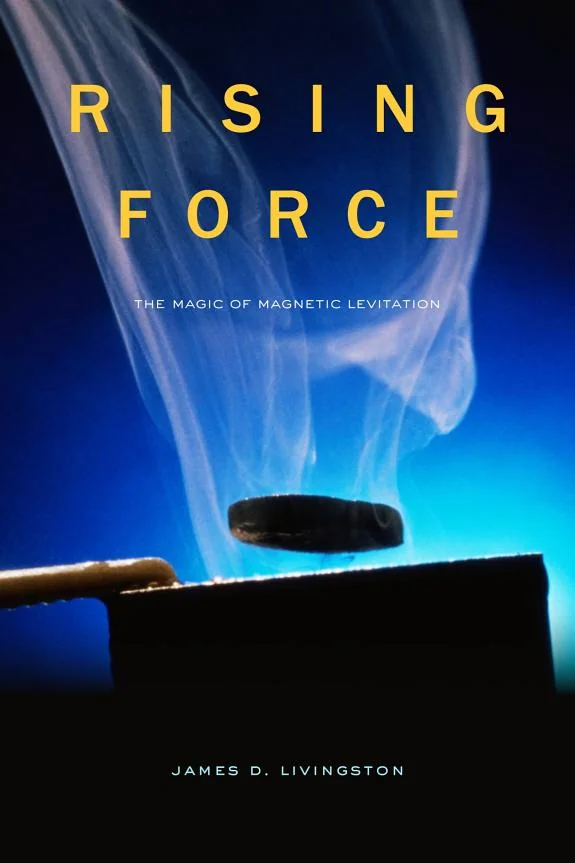
Rising Force
 78
78

Rising Force
Livingston’s "Rising Force" presents a compelling case for the wonder inherent in applied magnetism. His talent lies in translating the often-intimidating physics of maglev into understandable terms, making the leap from theoretical force to tangible 250 mph Chinese trains feel remarkably intuitive. The strength of the book is its ability to reveal the 'magic' in fighting friction by fighting gravity, a concept that bridges scientific inquiry with a sense of awe. However, at times, the popular science approach can feel slightly superficial when discussing the deeper philosophical implications of manipulating fundamental forces. A passage detailing the potential of maglev nanotechnology, for instance, sparks immense curiosity but leaves the reader wanting more on its esoteric applications. "Rising Force" successfully demystifies advanced technology for the layman, offering a glimpse into a world powered by magnetic ingenuity.
📝 Description
78
James D. Livingston's 2011 book, 'Rising Force,' explains magnetic levitation for a general audience.
Published in 2011, James D. Livingston's 'Rising Force' serves as an accessible introduction to magnetic levitation, often called maglev. The book clarifies the principles by which magnetic forces can counteract gravity and reduce friction, making complex scientific ideas understandable for those without advanced physics backgrounds. It moves beyond theoretical discussions to examine practical applications, ranging from nanotechnology to high-speed transit systems. This work is designed for readers curious about the tangible aspects of magnetic forces. Those interested in new technologies, the physics of movement, and engineering innovations will find it informative. It is especially useful for individuals who prefer scientific explanations tied to observable events and future potential, without needing extensive prior scientific knowledge.
Livingston places the development of maglev technology within the larger history of scientific progress and engineering ambition. The text touches on early experiments and the evolution of magnetic principles that laid the groundwork for modern maglev systems. It shows how a solid grasp of fundamental forces, such as magnetism, has consistently spurred technological advancements throughout history, impacting fields from electrical engineering to transportation. The core idea is the use of magnetic repulsion and attraction to achieve levitation and frictionless motion. Livingston details how carefully controlled magnetic fields can suspend objects, removing the need for physical contact.
While 'Rising Force' focuses on the scientific and engineering aspects of magnetic levitation, its underlying principles connect to broader esoteric traditions that explore fundamental forces and unseen energies. Many esoteric systems, from alchemy to certain forms of energy healing, investigate how focused intent or understanding of natural laws can manipulate physical reality. The book's examination of how magnetism negates gravity and friction can be seen as a modern, empirical parallel to ancient concepts of sympathetic magic or the manipulation of subtle energies to achieve seemingly impossible feats. It grounds the idea of 'force' as something that can be understood, controlled, and applied to overcome physical limitations.
💡 Why Read This Book?
• Understand the core principles of magnetic levitation, drawing from Livingston's accessible explanation of how magnetic forces overcome gravity, a concept detailed in the book's exploration of maglev nanotechnology. • Appreciate the historical trajectory of maglev technology, connecting early scientific discoveries to modern feats like the 250 mph Chinese trains mentioned, providing context for technological evolution. • Grasp the fundamental idea of 'fighting friction by fighting gravity,' a unique perspective offered by Livingston that reframes our understanding of motion and energy efficiency.
⭐ Reader Reviews
Honest opinions from readers who have explored this book.
❓ Frequently Asked Questions
What is "maglev" as explained in James D. Livingston's 'Rising Force'?
Maglev, as detailed in "Rising Force," refers to the use of magnetic forces to levitate and propel vehicles or objects, thereby eliminating friction. It's a technology that leverages magnetic repulsion and attraction to achieve high speeds and efficiency, as seen in modern transportation systems.
What are some real-world examples of maglev mentioned in the book?
The book highlights contemporary applications of maglev, including Chinese trains capable of speeds up to 250 mph without touching the tracks. It also touches upon the potential of maglev in nanotechnology, showcasing its diverse applications beyond just transportation.
Who is the intended audience for 'Rising Force'?
"Rising Force" is written for lay readers and anyone curious about the science behind magnetic levitation. It requires no advanced scientific background, making complex concepts accessible to the general public interested in technology and physics.
What is the central idea Livingston explores regarding friction and gravity?
Livingston's central idea is finding a form of 'magic' in 'fighting friction by fighting gravity.' This concept means that by overcoming gravity through magnetic levitation, one simultaneously eliminates physical friction, leading to more efficient and faster motion.
When was 'Rising Force' first published?
James D. Livingston's book 'Rising Force' was first published on May 30, 2011. This publication date places it within a period of significant advancements and public interest in high-speed rail and emerging technologies.
Does the book discuss maglev nanotechnology?
Yes, "Rising Force" explores the applications of maglev principles in nanotechnology. This section of the book illustrates how the fundamental concepts of magnetic levitation can be scaled down for use in advanced material science and microscopic engineering.
🔮 Key Themes & Symbolism
Magnetic Levitation Principles
The core of "Rising Force" lies in its detailed yet accessible explanation of magnetic levitation (maglev). Livingston breaks down how the fundamental forces of magnetic attraction and repulsion can be harnessed to counteract gravity and eliminate friction. He illustrates this through practical examples, demonstrating how precisely controlled magnetic fields enable objects to float unsupported. This exploration examines the physics that makes phenomena like frictionless travel possible, positioning magnetism not just as a force, but as a key to unlocking new modes of existence and movement.
The Interplay of Gravity and Friction
Livingston frames the concept of maglev through a unique lens: 'fighting friction by fighting gravity.' This perspective highlights the inherent relationship between these two forces in conventional motion. By neutralizing gravity's pull, the need for physical contact—and thus friction—is circumvented. The book elucidates how this principle, when applied, leads to radical improvements in efficiency and speed, suggesting a rethinking in how we understand and engineer motion. It presents a compelling argument for viewing gravity not merely as a downward pull, but as a direct contributor to the resistance we experience.
Technological Applications and Future Potential
Beyond the theoretical, "Rising Force" is rich with examples of maglev's real-world impact and future promise. From the high-speed trains traversing landscapes in China at speeds of 250 mph to the nascent possibilities within maglev nanotechnology, Livingston paints a picture of a world increasingly shaped by magnetic forces. The book underscores how this technology is not confined to transportation but extends into microscopic engineering and potentially other fields, hinting at broader implications for human innovation and interaction with the physical world.
Esoteric Undertones of Force Manipulation
While presented as a popular science introduction, "Rising Force" touches upon an almost alchemical aspect of manipulating fundamental forces. The idea of making objects 'float' and move without apparent effort carries a resonance with ancient notions of controlling natural energies. Livingston's description of finding 'magic' in overcoming physical limitations through magnetic fields invites contemplation on humanity's ongoing quest to understand and wield the unseen powers of the universe, connecting scientific advancement with a sense of wonder and possibility.
💬 Memorable Quotes
Direct passages from the work, attributed to the author.
“Maglev nanotechnology”
— This term, mentioned in the book, points to the application of magnetic levitation principles at the nanoscale. It suggests a future where magnetic forces could be used to manipulate matter at the molecular level, opening doors for advanced materials and microscopic engineering.
“Chinese trains that travel at 250 mph without touching the tracks.”
— This concrete example from the book illustrates the practical, high-speed application of maglev technology. It serves as tangible proof of concept, demonstrating the immense potential for frictionless travel and its realization in modern infrastructure.
“A popular introduction to 'maglev'”
— This description highlights the book's primary goal: to make the complex science of magnetic levitation accessible to a general audience. It signifies a departure from highly technical academic texts towards a more engaging and understandable exploration of the subject.
“Overcome gravity and friction”
— This phrase succinctly describes the dual function of maglev technology as presented by Livingston. It emphasizes the power of magnetic forces to negate two of the most fundamental resistances to motion, paving the way for unprecedented speed and efficiency.
💡 Key Ideas
Editorial paraphrase of the work's core concepts — not direct quotes.
He finds magic in 'fighting friction by fighting gravity.'
This paraphrased concept captures Livingston's unique framing of magnetic levitation. It suggests that the true marvel of maglev lies not just in levitation itself, but in the elegant solution it provides to the pervasive problem of friction, achieved by directly addressing gravity's influence.
🌙 Esoteric Significance
Tradition
While "Rising Force" is primarily a work of popular science, its exploration of manipulating fundamental forces like gravity and friction can be seen as resonating with certain Hermetic and alchemical traditions. These traditions often focus on understanding and working with the underlying principles of the cosmos. Livingston's approach, explaining 'magic' through scientific explanation, mirrors the Hermetic tenet of 'As Above, So Below,' applying universal laws to achieve tangible results. It reframes the control of natural forces not as supernatural intervention, but as a deep understanding of universal mechanics.
Symbolism
The primary 'symbol' in "Rising Force" is the magnetic field itself, representing unseen power and influence capable of overcoming physical limitations. Gravity, often perceived as an inescapable downward force, becomes a symbol of resistance and constraint. Friction symbolizes the mundane, everyday impediments to progress and efficiency. By showing how magnetism can negate both, the book symbolically represents the triumph of directed will and understanding over inertia and limitation, a common theme in esoteric thought.
Modern Relevance
Contemporary thinkers and practitioners in fields like quantum mysticism, advanced physics communication, and speculative engineering continue to draw inspiration from works that bridge the gap between the known and the possible. "Rising Force" remains relevant for its accessible portrayal of technologies that push the boundaries of perceived reality. It informs discussions on sustainable transportation, advanced materials science, and the potential for future innovations that might seem like magic today but are rooted in a deep understanding of fundamental forces, aligning with modern esoteric interests in consciousness and reality manipulation.
👥 Who Should Read This Book
• Aspiring engineers and science enthusiasts interested in the practical application of physics, particularly electromagnetism and its role in transportation and nanotechnology. • Readers curious about how complex scientific concepts are made accessible, seeking to understand technologies like high-speed rail without needing a formal science education. • Individuals interested in the philosophical implications of manipulating fundamental forces, exploring how scientific discovery can intersect with a sense of wonder and the overcoming of perceived limitations.
📜 Historical Context
Published in 2011, James D. Livingston's "Rising Force" entered a world where high-speed rail was rapidly advancing, particularly in East Asia. The early 21st century saw significant investment and development in magnetic levitation trains, with Germany and Japan being key players alongside China. Livingston’s work arrived as these technologies were transitioning from ambitious prototypes to operational systems. While the foundational principles of electromagnetism had been understood for over a century, the precise engineering and control systems required for practical maglev were relatively recent achievements. The book’s popular science approach likely aimed to clarify these complex engineering feats for a public increasingly exposed to headlines about super-fast trains. It engaged with the burgeoning field of applied electromagnetism, a domain that also fascinated thinkers like Michio Kaku, who frequently wrote about theoretical physics and future technologies for a broad audience. The reception of such works generally reflected a growing public fascination with scientific progress, though specific academic critiques or controversies surrounding this particular book are not widely documented.
📔 Journal Prompts
The concept of 'fighting friction by fighting gravity' as presented by Livingston.
Real-world applications of maglev, such as the Chinese trains mentioned.
The potential of maglev nanotechnology and its implications.
The idea of finding 'magic' in scientific principles.
How magnetic forces are depicted as overcoming fundamental physical limitations.
🗂️ Glossary
Maglev
An abbreviation for magnetic levitation. It refers to a system that uses magnetic forces to levitate and propel vehicles or objects, eliminating friction with a guideway.
Magnetic Levitation
The process by which an object is suspended with the use of magnetic fields. It relies on the principle that like magnetic poles repel and opposite poles attract, allowing for contactless suspension.
Friction
The force resisting the relative motion of solid surfaces, fluid layers, and sliding objects. In maglev, friction is largely eliminated by the absence of physical contact.
Gravity
The force that attracts a body toward the center of the earth, or toward any other physical body having mass. In maglev, magnetic forces are used to counteract gravity.
Nanotechnology
The branch of technology that deals with the arrangement of molecules and atoms with a goal of creating new materials and devices. The book explores maglev applications at this scale.
Electromagnetism
A branch of physics that deals with the relationship between electricity and magnetism. It is the fundamental science underpinning maglev technology.
High-Speed Rail
A type of rail transport that operates significantly faster than traditional rail, often exceeding 200 mph. Maglev is a prominent technology within this sector.
This book appears in 1 collection
🔮 Readers Also Liked
Browse all →









From the “Levitation” Collection
View all →








More Free Occult Philosophy Books
View all →