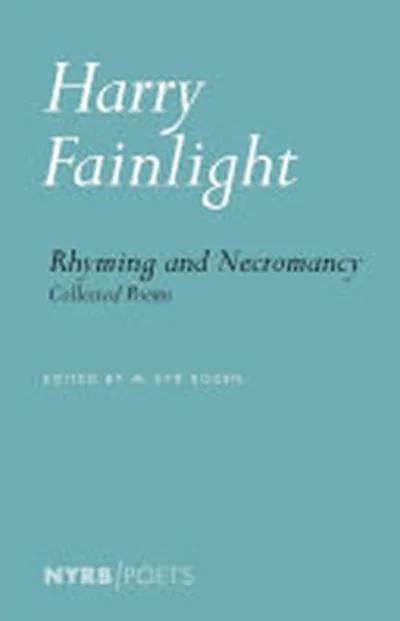
Rhyming and Necromancy
 80
80

Rhyming and Necromancy
Harry Fainlight's 'Rhyming and Necromancy' offers a compelling, if sometimes disorienting, immersion into a poet's life and work. The inclusion of previously unseen material is the collection's undeniable strength, providing rich biographical context that illuminates the poems themselves. Fainlight's sharp, often acerbic observations, particularly concerning his interactions within the New York art scene of the 1960s, crackle with an authentic voice. However, the sheer breadth of unearthed fragments, while valuable, can occasionally feel less curated and more like an archival dump, leaving the reader to piece together connections that Fainlight himself might have refined. A particularly striking aspect is the implicit dialogue with figures like Allen Ginsberg and Andy Warhol, hinting at a complex artistic ecosystem. Ultimately, this collection serves as a vital, if imperfect, reappraisal of a significant, neglected voice in 20th-century poetry.
📝 Description
80
Published posthumously, 'Rhyming and Necromancy' collects writings by poet Harry Fainlight.
This volume gathers previously unpublished work by Harry Fainlight, a poet active in mid-20th-century literary circles. The compilation includes Fainlight's memoirs, manuscripts, and biographical notes, forming a portrait of an artist who moved between New York and England. It offers a look into the life of a figure connected to bohemian and artistic communities.
The book will interest readers drawn to the confluence of poetry, counterculture, and esoteric ideas. It is especially for those interested in artists who received less recognition in the post-war period. Academics studying 20th-century American and British literature, alongside those interested in queer literary history, will find ample material for study.
Fainlight's work emerges from a period where artistic expression often mingled with explorations of consciousness and alternative spiritualities. His engagement with occult philosophies, suggested by the title 'Rhyming and Necromancy,' points to an interest in language's capacity to conjure and transcend mortal concerns. This aligns with traditions that explore the power of words and symbols in ritual and personal transformation.
💡 Why Read This Book?
• Gain insight into the specific milieu of mid-20th-century New York and London bohemian circles, learning about Fainlight's interactions with figures like Allen Ginsberg. • Understand the esoteric undertones suggested by the title 'Rhyming and Necromancy,' exploring how language might be used to invoke or transform consciousness. • Discover the creative process of an under-recognized queer poet, examining how his biographical experiences, including his time in the Lower East Side, shaped his unique artistic output.
⭐ Reader Reviews
Honest opinions from readers who have explored this book.
❓ Frequently Asked Questions
When was Harry Fainlight's 'Rhyming and Necromancy' first published?
The collection 'Rhyming and Necromancy' by Harry Fainlight was first published on November 17, 2026. This release aims to bring his previously under-recognized work to a wider audience.
What kind of biographical material is included in 'Rhyming and Necromancy'?
The book draws from Fainlight's memoirs, unpublished writings, and other biographical pieces, offering a complex portrait of the artist's life and creative journey.
Which artistic and literary movements does Harry Fainlight's work connect to?
Fainlight's life and work intersect with mid-20th-century counterculture, Beat Generation circles, and the avant-garde art scene, particularly in New York's Lower East Side.
Is 'Rhyming and Necromancy' suitable for scholars of queer literature?
Yes, the collection is highly relevant for scholars of queer literary history, offering insights into the experiences and artistic expressions of a queer poet from the mid-20th century.
What is the significance of the title 'Rhyming and Necromancy'?
The title suggests an exploration of poetry's power to evoke, conjure, and perhaps transcend ordinary reality, hinting at occult or mystical dimensions of language and creation.
Where did Harry Fainlight spend his formative years and career?
Harry Fainlight was born in New York, raised in England, and returned to the Lower East Side of New York in the early 1960s, placing him within distinct cultural landscapes.
🔮 Key Themes & Symbolism
Queer Identity and Artistic Expression
This collection intimately explores the experience of being a queer poet in the mid-20th century. Fainlight's work, drawn from personal writings, reflects the challenges and nuances of navigating identity within artistic and social circles of the time. It provides a lens through which to view the construction of self and art against a backdrop of evolving societal attitudes, particularly relevant for understanding marginalized voices in literary history. The biographical elements underscore the inextricable link between lived experience and creative output.
The Occult Dimensions of Language
The title 'Rhyming and Necromancy' itself signals a deep engagement with the potent, almost magical, capabilities of language. Fainlight's poetry and prose explore how words can conjure emotions, memories, and even alter perceptions of reality. This aligns with esoteric traditions that view language not merely as communication but as a force capable of invocation and transformation. The collection implicitly questions the boundaries between the mundane and the mystical, the literal and the symbolic.
Bohemian Life and Counterculture
Fainlight's biography positions him at the nexus of significant cultural movements. His documented associations with figures like Ginsberg and Kerouac, and his presence in the art scene surrounding Warhol, place his work firmly within the context of mid-20th-century bohemianism and counterculture. The writings offer vignettes and reflections on this lifestyle, exploring themes of artistic camaraderie, intellectual ferment, and the pursuit of alternative ways of living and creating outside mainstream norms.
The Artist's Memoir and Legacy
A significant portion of 'Rhyming and Necromancy' is dedicated to Fainlight's own recollections and unpublished works. This focus on memoir and self-reflection allows for an examination of how an artist constructs their own narrative and legacy. The collection acts as a form of posthumous self-archiving, presenting Fainlight's perspective on his life, his relationships, and his creative journey, inviting readers to engage directly with the source material of his artistic identity.
💬 Memorable Quotes
Direct passages from the work, attributed to the author.
“The Lower East Side in the early 1960s was a crucible of artistic energy.”
— This statement captures the vibrant, transformative atmosphere of a specific time and place central to Fainlight's return and creative resurgence, highlighting the neighborhood's role as a catalyst for artistic innovation.
“Poetry as a form of conjuring.”
— An interpretation of the 'Necromancy' aspect of the title, suggesting Fainlight viewed verse not just as expression but as a powerful act of evocation or creation.
“Working through the bohemian circles of New York and London.”
— This highlights Fainlight's immersion in artistic and literary subcultures, emphasizing the social and intellectual exchanges that shaped his work and perspective.
“Unpublished fragments revealing the poet's inner life.”
— This interpretation points to the value of the archival material, suggesting it offers direct access to Fainlight's private thoughts and creative process beyond his published works.
“Feuding with expectations.”
— This phrase captures Fainlight's rebellious artistic spirit and his tendency to challenge conventions, whether societal or within his personal and professional relationships.
🌙 Esoteric Significance
Tradition
While not explicitly aligned with a single formalized esoteric tradition, Fainlight's work, particularly suggested by the title 'Rhyming and Necromancy,' touches upon a broader current of interest in the occult and the magical potential of language that permeated artistic circles in the 20th century. This often drew from Gnostic ideas about hidden knowledge, Hermetic principles of correspondence, and a general fascination with altered states of consciousness and symbolic systems, frequently explored by figures within the Beat and subsequent countercultural movements.
Symbolism
The 'rhyming' aspect can be interpreted as the structured, conventional face of poetry, while 'necromancy' suggests the invocation of spirits, voices from the past, or deeper, hidden aspects of the psyche. This duality points to a symbolic exploration of how language can bridge the visible and invisible worlds. The biographical elements themselves—encounters with Ginsberg, Kerouac, Warhol—can be seen as symbolic representations of different facets of artistic and cultural life Fainlight engaged with.
Modern Relevance
Contemporary poets and artists interested in queer history, the intersections of art and lived experience, and the evocative power of language continue to find resonance in Fainlight's work. His exploration of identity and artistic struggle speaks to current discussions in identity politics and marginalized voices. Furthermore, the interest in 'necromancy' as a metaphor for creative invocation aligns with modern practices in performance art, experimental literature, and spiritual exploration that seek to push the boundaries of conventional expression.
👥 Who Should Read This Book
• Students of 20th-century American and British literature seeking to uncover neglected voices and understand the broader cultural context of the Beat Generation and Pop Art eras. • Readers interested in queer literary history who wish to explore the contributions and experiences of under-recognized LGBTQ+ poets from the mid-20th century. • Those fascinated by the occult or esoteric dimensions of art and language, exploring how poets engage with themes of invocation, consciousness, and hidden realities.
📜 Historical Context
Published in 2026, 'Rhyming and Necromancy' excavates the work of Harry Fainlight, a poet whose career spanned the mid-20th century, a period marked by significant shifts in artistic and literary landscapes. Fainlight’s life narrative intersects with the Beat Generation, notably his documented associations with Allen Ginsberg, and the burgeoning Pop Art movement, including posing for Andy Warhol. His return to New York's Lower East Side in the early 1960s placed him within a dynamic avant-garde scene. This era saw a diversification of poetic forms and thematic concerns, with writers exploring personal experience, sexuality, and spiritual inquiry outside traditional academic or religious frameworks. While figures like Ginsberg achieved wider recognition for their explorations of consciousness and marginalized identities, Fainlight remained comparatively obscure. The book’s posthumous publication addresses this historical oversight, contextualizing his work within the broader currents of post-war American and British literature and countercultural movements.
📔 Journal Prompts
The crucible of the Lower East Side in the early 1960s.
Fainlight's associations with Ginsberg, Kerouac, and Warhol.
The concept of 'Rhyming and Necromancy' in poetic practice.
The role of memoir in constructing an artist's legacy.
The tension between public persona and private creative life.
🗂️ Glossary
Lower East Side (NYC)
A historic neighborhood in Manhattan, New York City, known from the mid-20th century onwards as a hub for artists, musicians, writers, and bohemian subcultures.
Beat Generation
A literary and cultural movement originating in the 1950s, characterized by a rejection of conventional societal norms, experimentation with drugs, exploration of spirituality, and a focus on individual freedom and experience.
An art movement that emerged in the mid-1950s in Britain and the late 1950s in the United States, characterized by imagery drawn from popular and commercial culture, such as advertising and comic books.
Queer Poet
A poet whose work or life experiences are connected to non-heterosexual identities and sexualities, often exploring themes of love, identity, and societal marginalization within their writing.
Necromancy
Historically, a form of magic involving communication with the dead, often interpreted more broadly in literary and esoteric contexts as invoking hidden knowledge, the subconscious, or potent symbolic forces.
Avant-garde
New and experimental ideas and methods in art, music, or literature; those aspects of a movement that are innovative or அளிக்க.
Counterculture
A way of life and set of attitudes opposed to or at variance with the prevailing social norm, particularly prevalent in the 1960s and 1970s.