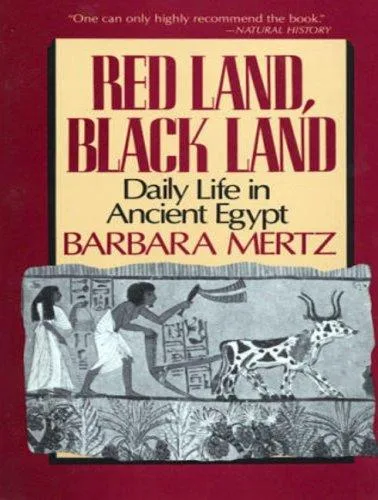
Red Land, Black Land
 83
83

Red Land, Black Land
Barbara Mertz's "Red Land, Black Land" provides a remarkably detailed yet accessible portrayal of ancient Egyptian civilization. What distinguishes it is its focus on the lived experience and the underlying worldview, moving beyond a mere chronology of pharaohs. Mertz excels at weaving together archaeological findings with textual evidence to illuminate daily life, religious belief, and funerary practices. A particular strength lies in her vivid descriptions of the agricultural cycle tied to the Nile, making the environmental context palpable. However, the book's sheer density of information, while a boon for the dedicated student, might occasionally feel overwhelming for the casual reader seeking a lighter introduction. The section on funerary rites, while comprehensive, could benefit from a more direct engagement with the emotional and psychological dimensions of Egyptian eschatology, rather than purely its ritualistic and theological aspects. Ultimately, "Red Land, Black Land" stands as a thoroughly researched and engaging study for those committed to understanding the heart of ancient Egyptian culture.
📝 Description
83
Barbara Mertz's 1990 book offers a comprehensive look at ancient Egyptian life and beliefs.
Barbara Mertz's "Red Land, Black Land" examines ancient Egyptian civilization by focusing on its core elements. The book moves past simple timelines to detail daily life, religious customs, and social structures that endured for thousands of years. Mertz discusses the importance of the Nile river, agricultural rhythms, the Egyptian pantheon, and the complex rituals surrounding death. Using archaeological evidence and written records, the author reconstructs a clear image of this past society.
This book is for anyone seriously interested in ancient Egypt, especially those wanting a thorough overview that connects social history with religious and symbolic ideas. It will appeal to students of history, archaeology, and religion, as well as general readers intrigued by Egyptology. Readers who enjoy detailed accounts of ancient cultures and their belief systems will find "Red Land, Black Land" especially worthwhile. It is for those who wish to grasp not only the actions of the ancient Egyptians but also the reasons behind them.
While "Red Land, Black Land" is primarily a work of history and archaeology, its focus on the underlying belief systems, religious practices, and funerary rites of ancient Egypt touches upon esoteric themes. The book details the Egyptian understanding of the cosmos, the afterlife, and the spiritual significance of rituals, which are often subjects of interest in esoteric traditions. Mertz's work presents these elements not as mere historical facts but as integral components of a worldview that sought to understand and interact with unseen forces and spiritual realities.
💡 Why Read This Book?
• Gain an intimate understanding of the "Red Land" and "Black Land" duality, appreciating how the Nile's annual flood shaped every facet of Egyptian existence, from agriculture to religious cosmology. • Explore the intricate Egyptian pantheon and funerary beliefs, learning about the roles of deities like Osiris and the significance of the Book of the Dead in guiding souls through the Duat. • Grasp the concept of Ma'at, understanding its pervasive influence on Egyptian ethics, law, and the pharaoh's divine responsibility to maintain cosmic balance.
⭐ Reader Reviews
Honest opinions from readers who have explored this book.
❓ Frequently Asked Questions
What distinguishes "Red Land, Black Land" from other books on ancient Egypt?
Barbara Mertz's work excels in its detailed focus on the daily lives, beliefs, and worldview of ancient Egyptians, integrating social history, religion, and symbolism. It moves beyond a simple chronicle of rulers to reconstruct the lived experience of its people.
When was "Red Land, Black Land" first published?
The book was first published in 1990, positioning it within late 20th-century scholarship on ancient Egypt that sought to make complex historical and cultural information accessible to a wider audience.
Who is Barbara Mertz, and what are her credentials?
Barbara Mertz was an Egyptologist with a Ph.D. from the University of Chicago. She also wrote popular fiction under the pseudonyms Barbara Michaels and Elizabeth Peters, bringing her scholarly knowledge into narrative forms.
Does the book cover the Amarna Period or later dynasties?
While "Red Land, Black Land" provides a foundational overview of ancient Egyptian civilization, its primary focus is on the broader cultural and religious underpinnings that span much of Egypt's dynastic history, rather than exclusively later periods like Amarna.
What role does the Nile River play in the book's narrative?
The Nile is central. The book meticulously details the 'Black Land' (kemet) – the fertile river valley – and the 'Red Land' (deshret) – the desert. The annual inundation of the Nile is presented as the lifeblood of Egyptian civilization, influencing its agriculture, religion, and societal structure.
Is "Red Land, Black Land" suitable for absolute beginners to Egyptology?
Yes, it serves as an excellent introduction for those seeking a comprehensive understanding. While detailed, Mertz's writing is clear, making complex topics like religious cosmology and funerary rituals accessible to newcomers.
🔮 Key Themes & Symbolism
The Nile's Primacy
The book consistently emphasizes the Nile as the absolute linchpin of Egyptian existence. It details how the annual inundation of the 'Black Land' (kemet) dictated agricultural cycles, influenced the calendar, and permeated religious thought. The river was not merely a resource but a divine entity, intrinsically linked to creation myths and the concept of cosmic order. Mertz illustrates how this dependence shaped the very worldview of the Egyptians, contrasting the fertile valley with the harsh 'Red Land' (deshret) of the surrounding deserts, a dichotomy fundamental to their understanding of life and the afterlife.
Egyptian Cosmology and the Afterlife
Central to "Red Land, Black Land" is an exploration of the complex Egyptian pantheon and their profound preoccupation with death and the afterlife. Mertz explains the roles of key deities such as Ra, Osiris, and Isis, and how their myths informed Egyptian beliefs about creation, kingship, and the cyclical nature of existence. The intricate details of mummification, tomb construction, and funerary texts like the Book of the Dead are presented not just as rituals, but as vital mechanisms for ensuring the deceased's successful transition and eternal survival in the Duat.
Ma'at: The Concept of Order
The principle of Ma'at – representing truth, justice, balance, and cosmic order – is presented as the ethical and philosophical bedrock of ancient Egyptian society. Mertz demonstrates how Ma'at was not merely an abstract ideal but a governing force that influenced the pharaoh's responsibilities, legal systems, and individual conduct. The concept is explored in relation to the divine judgment of the soul after death, where the heart was weighed against the feather of Ma'at, underscoring its critical importance for achieving eternal life and maintaining the stability of the universe.
Daily Life and Social Structure
Beyond the monumental and the divine, "Red Land, Black Land" offers a rich portrayal of everyday Egyptian life. Mertz details the social hierarchy, from the pharaoh and priests down to farmers and artisans. The book touches upon domestic life, diet, clothing, and the pervasive influence of religion on even the most mundane activities. This focus on the common person, supported by archaeological evidence of settlements and artifacts, provides a grounded perspective on the civilization, illustrating how its grand achievements were built upon the foundations of ordinary existence.
💬 Memorable Quotes
Direct passages from the work, attributed to the author.
“The land of Egypt was divided into two parts: the Red Land and the Black Land.”
— This statement expresses the fundamental geographical and symbolic division that structured ancient Egyptian life and thought. The 'Black Land' represented fertility and life, sustained by the Nile, while the 'Red Land' symbolized the barren desert, a field of chaos and death, yet also a source of minerals and a barrier against invasion.
“The Egyptians believed that death was not an end, but a transition.”
— This highlights the core of Egyptian funerary beliefs. Their elaborate burial practices, mummification, and funerary texts were all designed to facilitate the deceased's journey into the afterlife, ensuring their continued existence and well-being in the next world, mirroring the cyclical nature of the sun god Ra.
“The gods were an integral part of the Egyptian's daily life.”
— This interpretation emphasizes the pervasive nature of religion in ancient Egypt. Deities were not distant figures but active participants in the world, influencing everything from the weather and harvests to personal fortune and the fate of the soul after death, necessitating constant appeasement and veneration.
“The annual flood of the Nile was the source of Egypt's prosperity.”
— This statement underscores the life-giving power of the Nile. The inundation deposited fertile silt, enabling agriculture in an otherwise arid region. This predictable bounty formed the economic and existential foundation of Egyptian civilization, deeply influencing their worldview and religious practices.
💡 Key Ideas
Editorial paraphrase of the work's core concepts — not direct quotes.
Ma'at was the principle of order and justice that governed the universe.
This paraphrased concept underscores the central role of Ma'at in Egyptian ideology. It was the cosmic law that the pharaoh was responsible for upholding on Earth, ensuring societal harmony and preventing the forces of chaos (isfet) from prevailing. It was also the standard by which individuals were judged in the afterlife.
🌙 Esoteric Significance
Tradition
While not strictly confined to a single esoteric lineage, "Red Land, Black Land" draws heavily upon the Hermetic and Gnostic fascination with ancient Egypt as a source of primordial wisdom. The Egyptian emphasis on cosmic order (Ma'at), intricate cosmology, and complex afterlife beliefs aligns with perennialist philosophies that view ancient Egypt as a foundational civilization possessing deep spiritual knowledge. Mertz's work, by presenting these elements in detail, serves as a valuable resource for understanding the symbolic and spiritual frameworks that have influenced Western esotericism, particularly its interest in Egyptian mythology and funerary practices.
Symbolism
The core symbolism revolves around the duality of the "Red Land" (deshret, the chaotic desert) and the "Black Land" (kemet, the fertile Nile valley). This represents the fundamental tension between order and chaos, life and death, which permeates Egyptian thought. The solar disk, associated with Ra, symbolizes creation, life, and cyclical renewal, while the underworld (Duat) and its trials represent the transformative journey of the soul. The hieroglyph for Ma'at, a feather, signifies truth, justice, and cosmic balance, serving as the ultimate standard in both life and the afterlife judgment.
Modern Relevance
Contemporary practitioners of Hermeticism, Chaos Magick, and various forms of modern paganism and Kemeticism continue to draw inspiration from ancient Egyptian symbolism and cosmology as presented in works like Mertz's. The book's detailed exploration of Egyptian deities, rituals, and concepts like Ma'at provides a foundation for modern devotional practices and magical systems that seek to channel or integrate ancient Egyptian energies and archetypes. Scholars and enthusiasts interested in comparative mythology and the historical roots of esoteric thought also find it an indispensable reference.
👥 Who Should Read This Book
• Students of comparative religion and ancient mythologies seeking a deep dive into the religious beliefs, pantheon, and cosmology of one of history's most influential civilizations. • Aspiring Egyptologists and history buffs who desire a comprehensive and well-researched overview of ancient Egyptian culture, moving beyond superficial accounts of pyramids and pharaohs. • Readers interested in the historical roots of Western esoteric traditions, particularly those fascinated by ancient Egyptian symbolism, funerary rites, and concepts of cosmic order like Ma'at.
📜 Historical Context
Published in 1990, "Red Land, Black Land" arrived during a vibrant period for Egyptology, marked by both scholarly advancements and popular fascination. The late 20th century saw a proliferation of accessible works aiming to synthesize complex archaeological and textual data for a broader audience. Barbara Mertz, herself a trained Egyptologist with a Ph.D. from the University of Chicago, brought academic rigor to her accessible writing style, a hallmark also seen in contemporaries like Toby Wilkinson. While not a period of significant academic controversy regarding fundamental Egyptian history, Mertz's work participated in the ongoing effort to present a holistic view of Egyptian civilization, integrating social, religious, and daily life aspects. This contrasted with earlier, more monument-focused or purely dynastic histories. The field was heavily influenced by the legacy of figures like James Henry Breasted and continued discourse around hieroglyphic decipherment and archaeological findings from sites like Thebes and Giza.
📔 Journal Prompts
The duality of the 'Red Land' and 'Black Land': How does this fundamental Egyptian concept inform your own understanding of opposing forces?
Reflect on the Egyptian concept of Ma'at; how might applying its principles of truth and order shape your daily interactions?
Consider the Egyptian journey through the Duat; what symbolic challenges do you face in your own life's transitions?
Analyze the role of the Nile in shaping Egyptian society; how do essential resources shape cultures and belief systems?
Contemplate the Egyptian view of death as a transition; how does this perspective differ from or align with your own beliefs about mortality?
🗂️ Glossary
Deshret (Red Land)
The ancient Egyptian term for the arid desert regions surrounding the Nile Valley. It represented chaos, foreign lands, and danger, contrasting with the fertile 'Black Land' where civilization thrived.
Kemet (Black Land)
The ancient Egyptian name for Egypt itself, referring to the fertile black soil deposited by the Nile's annual flood. This was the land of life, agriculture, and civilization.
Ma'at
The ancient Egyptian concept of truth, balance, order, law, morality, and justice. It was personified as a goddess and represented the fundamental cosmic order that the pharaoh was responsible for maintaining.
Duat
The ancient Egyptian underworld or field of the dead. It was the landscape through which the sun god Ra traveled at night and where the souls of the deceased underwent judgment and transformation.
Osiris
A central deity in ancient Egyptian religion, god of the afterlife, the underworld, and rebirth. He was believed to have been murdered by his brother Set and resurrected by his wife Isis, becoming ruler of the dead.
Ra
The ancient Egyptian sun god, often depicted as a man with the head of a falcon crowned with a sun disk. He was considered the king of the gods and the creator deity, whose daily journey across the sky symbolized cyclical renewal.
Book of the Dead
A collection of ancient Egyptian funerary spells intended to assist a dead person's journey through the Duat (underworld) into the afterlife. It was written on papyrus scrolls and placed in the tomb.
🔮 Readers Also Liked
Browse all →









More by Barbara Mertz, Barbara Michaels
All books →

More Free Occult Philosophy Books
View all →