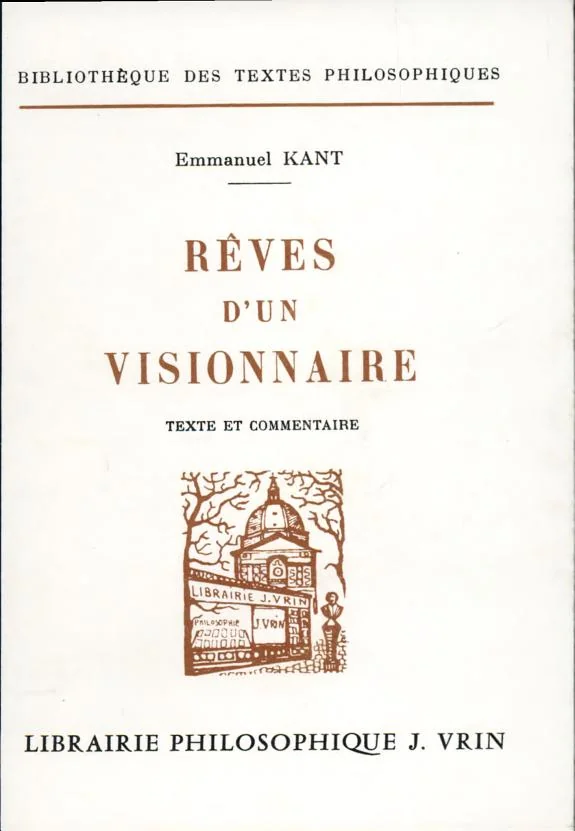
Rêves d'un visionnaire
 82
82

Rêves d'un visionnaire
Kant's "Rêves d'un visionnaire," first published in its current compilation in 2013, offers a unique challenge to the esoteric reader. It is not a book of spells or mystical traditions, but rather a rigorous philosophical examination of the mind's architecture. Its strength lies in Kant's unparalleled clarity in dissecting the mechanisms of human cognition, forcing a re-evaluation of what constitutes 'visionary' experience. The limitation, however, is its sheer density; approaching Kant requires patience and a willingness to grapple with complex arguments, which may deter those seeking immediate esoteric application. A passage concerning the synthetic a priori, for example, requires careful unpacking to see its potential implications for understanding intuitive knowledge. Ultimately, this is a text for the philosopher-mystic, demanding intellectual exertion for potentially deep conceptual reward.
📝 Description
82
Rêves d'un visionnaire collects Immanuel Kant's writings, reinterpreted through an esoteric lens.
Published in 2013, Rêves d'un visionnaire gathers selections from Immanuel Kant's philosophical works. Though Kant's original intent was not esoteric, these texts have been viewed through such a perspective due to their examination of the mind's structure and its capacity for spontaneous or visionary ideas. The book presents Kant's inquiries into the nature of reason, perception, and the boundaries of human understanding. It is aimed at scholars of Kant and those interested in applying his philosophical concepts to esoteric thought. Readers seeking to grasp the philosophical basis of consciousness and the subjective experience of insight will find it valuable, particularly how rational systems can interact with non-rational ways of knowing. The work also appeals to those interested in the history of philosophy and its connections to metaphysical concepts.
Kant's critical philosophy, developed in the late 18th century, aimed to reconcile rationalism and empiricism. His examinations of experience and the mind's inherent structures emerged during the Enlightenment, a period that emphasized reason and science. While Kant was not an esotericist, his detailed analysis of cognitive abilities and the conditions for experience has allowed later interpreters to find spiritual or metaphysical dimensions in his systematic philosophy. His intellectual circle included figures like Johann Gottlieb Fichte and Friedrich Schiller, who also engaged with Kantian ideas in their own philosophical pursuits.
While Immanuel Kant himself was not an esoteric philosopher, his rigorous examination of the mind's structure and the conditions for human experience has been adopted by later esoteric thinkers. His critical philosophy, particularly its focus on how the mind shapes our perception of reality, offered a framework that could be interpreted as describing internal, non-material states of awareness. Scholars interested in the philosophical underpinnings of consciousness and subjective insight find Kant's work a bridge between rational inquiry and mystical or visionary experiences. This collection allows for such an interpretation, positioning Kant's epistemology within broader traditions of metaphysical speculation.
💡 Why Read This Book?
• Gain a structured understanding of how the mind constructs reality, as explored in Kant's transcendental idealism, offering a philosophical bedrock for understanding subjective perception. • Learn about the synthetic a priori judgments, a concept from Kant's 1781 *Critique of Pure Reason*, which can inform how one understands the nature of innate knowledge or intuitive leaps. • Appreciate the historical context of Enlightenment philosophy and how rigorous rational inquiry, as exemplified by Kant, can paradoxically inform later esoteric interpretations of consciousness.
⭐ Reader Reviews
Honest opinions from readers who have explored this book.
❓ Frequently Asked Questions
Is 'Rêves d'un visionnaire' a direct work of esoteric practice by Immanuel Kant?
No, Immanuel Kant's original writings were foundational works of Western philosophy, not esoteric practice guides. 'Rêves d'un visionnaire,' compiled and published later, reinterprets his philosophical inquiries into consciousness and perception through an esoteric lens.
What is transcendental idealism in Kant's philosophy?
Transcendental idealism, a core concept in Kant's work from the late 18th century, posits that our experience of reality is shaped by the mind's innate structures, or categories, rather than being a direct reception of external reality.
When was Immanuel Kant active as a philosopher?
Immanuel Kant was most active in the latter half of the 18th century, with his seminal work, the *Critique of Pure Reason*, first published in 1781.
How does Kant's philosophy relate to 'visionary' experiences?
Kant's exploration of how the mind structures experience and the limits of human understanding provides a framework for analyzing what we consider 'visionary' or intuitive insights, questioning their origin and validity.
Is 'Rêves d'un visionnaire' a difficult book to read?
The book can be challenging due to Kant's dense philosophical arguments. It requires careful reading and engagement with complex epistemological and metaphysical concepts, especially for those new to his critical philosophy.
What is the significance of the synthetic a priori in Kant's thought?
The synthetic a priori refers to judgments that expand our knowledge (synthetic) but are known independently of experience (a priori). Kant argued this was crucial for understanding scientific and mathematical truths, a concept re-examined in esoteric contexts.
🔮 Key Themes & Symbolism
The Architecture of Consciousness
This collection examines Kant's rigorous dissection of the mind's cognitive faculties. It explores how innate structures, or 'categories of understanding,' as posited in his critical philosophy, actively shape our perception of reality. For esoteric readers, this provides a framework for understanding how subjective experience, often deemed visionary, is constructed, prompting questions about the boundaries between external reality and internal cognition. Kant's analysis challenges simplistic notions of passive reception, suggesting the mind is an active participant in creating the experienced world.
Phenomena vs. Noumena
Central to Kant's epistemology is the distinction between the phenomenal world (how things appear to us) and the noumenal world (things-in-themselves, which remain unknowable). This dichotomy is fertile ground for esoteric interpretation, inviting contemplation on the hidden realities that lie beyond our direct sensory and intellectual grasp. The work prompts reflection on the limitations of empirical knowledge and the potential for apprehending truths that transcend the observable, aligning with mystical quests for ultimate reality.
Synthetic A Priori Judgments
The concept of synthetic a priori judgments, which are informative yet known independently of experience, is crucial. Kant used this to explain the possibility of certain knowledge in mathematics and physics. Esoterically, this concept can be reinterpreted to explore the nature of intuition and innate wisdom. It suggests that certain profound truths or insights might not be learned through external observation but are inherent to the structure of consciousness itself, akin to gnosis or direct spiritual apprehension.
Limits of Reason
Kant's philosophical project, particularly his critique of pure reason, meticulously maps the boundaries of what human intellect can reliably ascertain. While a product of the Enlightenment's emphasis on rationality, this exploration of reason's limits opens avenues for considering forms of knowing that lie outside its scope. This appeals to esoteric traditions that acknowledge intuitive, mystical, or revelatory paths of knowledge, suggesting that a complete understanding may require engaging with faculties beyond discursive thought.
💬 Memorable Quotes
Direct passages from the work, attributed to the author.
“The understanding is not to derive its rules from nature, but to prescribe them to nature.”
— This statement highlights Kant's revolutionary view that the mind is not a passive recipient of sensory data but actively structures our experience of the natural world according to its own inherent rules or categories.
“Experience without theory is blind, but theory without experience is mere intellectual play.”
— This emphasizes Kant's synthesis of empiricism and rationalism, suggesting that while empirical data is essential, it requires the organizing principles of reason to become meaningful knowledge.
“The categories of the understanding are the fundamental rules by which the mind organizes sensory input.”
— This interpretation explains Kant's concept of innate mental structures that filter and synthesize raw sensory data, making coherent experience possible and shaping our perception of reality.
💡 Key Ideas
Editorial paraphrase of the work's core concepts — not direct quotes.
We are not here to discover the nature of things-in-themselves, but to understand the conditions under which we experience them.
This paraphrased concept points to Kant's focus on epistemology – the study of knowledge – and his assertion that our knowledge is limited to the phenomenal field of appearances, not the noumenal field of ultimate reality.
Reason can only know what it produces itself according to a plan.
This paraphrased idea underscores Kant's belief that true knowledge arises from the mind's active, structured engagement with concepts and principles, rather than passive observation alone.
🌙 Esoteric Significance
Tradition
While Immanuel Kant was a philosopher of the Enlightenment and not explicitly part of any esoteric tradition, his work on the structure of consciousness and the limits of human knowledge has been retrospectively interpreted through an esoteric lens. His systematic approach to epistemology and metaphysics provides a philosophical scaffolding for understanding concepts found in traditions like Hermeticism and Gnosticism, particularly concerning the mind's role in perceiving or constructing reality. Kant's critique offers a rationalist counterpoint or complement to more direct mystical claims.
Symbolism
Though Kant did not employ overt esoteric symbolism, his philosophical concepts can be seen as symbolic frameworks. The distinction between phenomena and noumena can symbolize the esoteric quest for hidden truths beyond appearances. The 'categories of the understanding' function as symbolic representations of the mind's innate organizing principles, akin to archetypes or divine blueprints that structure the manifest world, providing a rationalist parallel to cosmological ordering principles.
Modern Relevance
Contemporary thinkers in areas such as consciousness studies, phenomenology, and even Jungian psychology, which explores archetypes and the collective unconscious, draw upon Kantian frameworks. His exploration of the mind's active role in constructing reality continues to inform discussions about subjective experience, perception, and the nature of knowledge, providing a philosophical foundation for those who explore the deeper, less empirical dimensions of human awareness and the potential for inner revelation.
👥 Who Should Read This Book
• Students of Western philosophy interested in the transition from Enlightenment rationalism to later metaphysical inquiries, providing a crucial Kantian perspective. • Esoteric practitioners seeking to ground their understanding of consciousness and perception in rigorous philosophical analysis, moving beyond purely intuitive or dogmatic assertions. • Comparative religion scholars examining how secular philosophical frameworks can be reinterpreted or applied to understand mystical and spiritual concepts across different traditions.
📜 Historical Context
Immanuel Kant's philosophical output, primarily in the latter half of the 18th century, was a core part of the Enlightenment's emphasis on reason and systematic inquiry. His critical philosophy sought to reconcile the rationalist and empiricist traditions, establishing the bounds of human knowledge. While Kant himself was a product of this rationalist milieu, his rigorous examination of the mind's structure and its role in shaping experience has provided fertile ground for later esoteric interpretations. Thinkers like Johann Gottlieb Fichte, who followed Kant, further explored transcendental idealism. Kant's work stood in contrast to the burgeoning Romantic movement's emphasis on emotion and intuition, though his own explorations of the sublime hinted at experiences beyond pure logic. His major works, like the *Critique of Pure Reason* (1781), laid out a framework that, while not mystical, allowed subsequent generations to probe the subjective conditions of perception and consciousness from a metaphysical standpoint.
📔 Journal Prompts
The mind's active role in structuring experience, as per Kant's transcendental idealism.
The distinction between phenomena and noumena in your personal understanding of reality.
How 'synthetic a priori' judgments might relate to intuitive leaps or sudden insights.
The limitations of pure reason in grasping ultimate truths.
Reflecting on the source of 'visionary' experiences through a Kantian lens.
🗂️ Glossary
Transcendental Idealism
Kant's philosophical position that the mind actively structures our experience of reality through innate categories, meaning we only know the world as it appears to us (phenomena), not as it is in itself (noumena).
Phenomena
In Kantian philosophy, the world as it appears to us through our senses and understanding; the field of experience and empirical knowledge.
Noumena
In Kantian philosophy, the 'thing-in-itself'; reality as it exists independently of our perception and understanding, which Kant argued is unknowable.
Categories of the Understanding
The innate, a priori concepts or structures of the mind (e.g., causality, substance) that Kant proposed are necessary for organizing sensory experience into coherent knowledge.
Synthetic A Priori
Judgments that are informative about the world (synthetic) but are known independently of experience (a priori), such as those in mathematics and fundamental physics, according to Kant.
Critique of Pure Reason
Immanuel Kant's seminal 1781 work that lays out his epistemological framework, examining the limits and possibilities of human reason and knowledge.
Enlightenment
An 18th-century intellectual and cultural movement emphasizing reason, individualism, and skepticism towards traditional authority, of which Kant was a key figure.
This book appears in 1 collection
🔮 Readers Also Liked
Browse all →






From the “Illuminati” Collection
View all →








More Free Freemasonry & Secret Societies Books
View all →