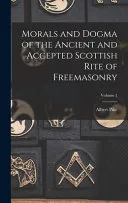
Morals and Dogma of the Ancient and Accepted Scottish Rite of Freemasonry; Volume 1
 81
81

Morals and Dogma of the Ancient and Accepted Scottish Rite of Freemasonry; Volume 1
Albert Pike’s "Morals and Dogma" is less a narrative and more a dense, encyclopedic treatise. Its strength lies in its monumental effort to synthesize disparate philosophical and religious traditions into a coherent framework for Masonic ethics. Pike’s erudition is undeniable, weaving together references from ancient Egypt, Greece, India, and the Kabbalah. However, this very breadth can be a limitation. The text demands considerable intellectual effort and familiarity with esoteric terminology; it is not introductory reading. A passage that stands out is Pike's discussion of the word "Ank" (life) and its connection to the cross, illustrating his method of finding universal symbolism across cultures. While the ambition is admirable, the prose can be archaic and the structure occasionally feels like a series of interconnected lectures rather than a flowing argument. Nevertheless, for those dedicated to understanding the philosophical architecture of the Scottish Rite, it remains an indispensable, albeit challenging, cornerstone.
📝 Description
81
Albert Pike published 'Morals and Dogma' in 1871, outlining Masonic philosophy.
Albert Pike's "Morals and Dogma" is an exposition of Masonic philosophy, compiled for the Southern Jurisdiction of the Scottish Rite. This work details the symbolic meanings and allegorical lessons within the degrees of Freemasonry. It focuses on ethical, philosophical, and spiritual teachings designed to foster a Mason's moral growth and cosmic understanding. The text synthesizes numerous religious, philosophical, and esoteric traditions.
This volume is primarily for Scottish Rite Masons seeking a deeper grasp of their ritual and the Craft's philosophical basis. It also interests scholars of esotericism, comparative religion, and Western mystery traditions interested in Masonic thought's historical development and intellectual origins. Individuals curious about the ethical frameworks and symbolic language of fraternal organizations will find value here.
Pike, a significant figure in the 19th century, drew from Neoplatonism, Kabbalah, Gnosticism, Hermeticism, and Eastern religions. He structured these diverse sources into a unified philosophical system for Freemasonry. The book became a standard text within Masonic communities.
Published in 1871, 'Morals and Dogma' reflects a 19th-century Western interest in ancient philosophies and mystical traditions. Albert Pike integrated elements from Neoplatonism, Kabbalah, Gnosticism, and Hermeticism, alongside Eastern religions. This synthesis aimed to create a comprehensive philosophical framework for Freemasonry, situating it within a broader history of Western esotericism and comparative religion.
💡 Why Read This Book?
• Understand the symbolic language of the 19th-century Scottish Rite, as detailed in the lessons of the 4th Degree, allowing for a unique interpretation of Masonic allegory. • Gain insight into Albert Pike's synthesis of diverse esoteric traditions, including Neoplatonism and Kabbalah, providing context for his philosophical framework established in 1871. • Explore the ethical and moral dimensions of Freemasonry, learning how concepts like the "Grand Architect of the Universe" are presented as universal principles for self-improvement.
⭐ Reader Reviews
Honest opinions from readers who have explored this book.
❓ Frequently Asked Questions
Is "Morals and Dogma" a secret Masonic text?
No, "Morals and Dogma" is a publicly available text, first published in 1871. While it explains the philosophical and moral teachings of the Scottish Rite degrees, it is not considered a secret document and is accessible to anyone interested in its content.
What philosophical traditions does Albert Pike draw upon in "Morals and Dogma"?
Albert Pike synthesized a wide array of traditions, including ancient Egyptian religion, Greek philosophy (especially Neoplatonism), Kabbalah, Hermeticism, Gnosticism, and Eastern philosophies. He aimed to show a universal basis for Masonic morality.
Who was Albert Pike and what was his role in Freemasonry?
Albert Pike (1809-1891) was a prominent figure in American Freemasonry. He served as the Sovereign Grand Commander of the Southern Jurisdiction of the Scottish Rite for over 30 years and was instrumental in revising and codifying its rituals and teachings, culminating in "Morals and Dogma."
Is "Morals and Dogma" suitable for beginners in esotericism?
While foundational, "Morals and Dogma" is a dense and scholarly work. Beginners in esotericism might find it more accessible after gaining some familiarity with the core concepts of Western mystery traditions that Pike discusses.
What is the significance of the "Ancient and Accepted Scottish Rite" mentioned in the title?
The Ancient and Accepted Scottish Rite is one of the major branches of Freemasonry, particularly known for its system of higher degrees (typically 4th through 33rd) which explore deeper philosophical and spiritual themes than the initial degrees.
When was "Morals and Dogma" first published?
The first publication date for "Morals and Dogma" by Albert Pike was in 1871. This edition forms the basis for subsequent printings and the public domain version.
🔮 Key Themes & Symbolism
Symbolic Interpretation of Degrees
Pike's work meticulously unpacks the symbolic meaning embedded within each degree of the Scottish Rite. He posits that the rituals are not mere ceremonies but allegorical narratives designed to impart moral and spiritual lessons. For instance, the symbolism of the Double Eagle in higher degrees is explored not just as an emblem but as representing duality and the integration of opposing forces, crucial for the Mason's internal work. This approach treats Masonic degrees as a progressive system of esoteric education.
Universal Morality and Ethics
A central theme is the universality of moral principles, transcending specific religious doctrines. Pike argues that Freemasonry's teachings are rooted in a common ethical foundation shared across diverse ancient and modern cultures. He uses concepts like the 'Grand Architect of the Universe' to represent a supreme creative power acceptable to men of all faiths, emphasizing shared human values such as justice, truth, and brotherhood as the bedrock of society and personal conduct.
The Pursuit of Light and Knowledge
The journey through the Masonic degrees is framed as a quest for 'Light,' symbolizing enlightenment, wisdom, and spiritual understanding. Pike contrasts this Light with the 'Darkness' of ignorance, superstition, and vice. This pursuit is an active, ongoing process for the Mason, requiring intellectual effort, moral discipline, and the courage to confront one's own limitations. The text encourages a lifelong commitment to self-improvement and the discovery of hidden truths.
Synthesis of Esoteric Traditions
Pike masterfully integrates elements from a vast spectrum of esoteric and philosophical systems. He draws parallels between Masonic symbolism and concepts found in ancient Egyptian mysteries, Greek philosophy (particularly Pythagoreanism and Platonism), Hermeticism, Kabbalah, and Eastern religions. This synthesis suggests that Freemasonry is a repository of ancient wisdom, containing universal truths that have been preserved and transmitted through various historical currents of thought.
💬 Memorable Quotes
Direct passages from the work, attributed to the author.
“Masonry is not a religion, but it is religion that teaches the duty of man to God and man to man.”
— This statement clarifies Pike's view that while Freemasonry does not prescribe specific religious dogma, it is fundamentally concerned with moral and ethical conduct rooted in a spiritual understanding of humanity's place in the cosmos.
“The ignorant man... knows not that the light of the Divine Wisdom shines around him, and that the Universe is a living temple.”
— This highlights the Masonic ideal of overcoming ignorance to perceive the divine presence in the world. It suggests that spiritual truth is accessible to those who cultivate the inner vision and recognize the sacredness inherent in existence.
“Light is the symbol of Truth, and Darkness of Error.”
— A fundamental symbolic equation presented by Pike, this underscores the Masonic emphasis on the pursuit of knowledge and truth as a primary objective, contrasting it with the dangers of deception and misunderstanding.
“The first duty of a Master Mason is to obey the moral law.”
— This emphasizes the practical application of Masonic teachings. It asserts that adherence to ethical principles and a virtuous life are paramount, serving as the foundation upon which further spiritual understanding is built.
“The symbols of Masonry are the hieroglyphs of a divine language.”
— Pike suggests that the symbols used in Masonic rituals are not arbitrary but are part of a universal, ancient language that conveys profound spiritual and philosophical truths, accessible through careful study and contemplation.
🌙 Esoteric Significance
Tradition
This work is firmly rooted in the Western Esoteric Tradition, specifically within the lineage of Masonic Hermeticism and Kabbalah. Pike's project was to demonstrate Freemasonry as a continuation and synthesis of ancient wisdom, drawing parallels between its rituals and symbols and those found in Hermetic philosophy, Gnosticism, and Jewish mysticism. He presents the Scottish Rite not as a new invention but as a custodian of ancient, universal truths, connecting its degrees to historical streams of esoteric thought.
Symbolism
Key symbols explored include the Double Eagle, representing duality and the pursuit of higher knowledge through the integration of opposites; the Blazing Star, symbolizing divine light, truth, and the Gnostic concept of the spark of divinity within humanity; and the Square and Compasses, representing the moral and spiritual discipline required to shape one's life according to divine principles and universal law.
Modern Relevance
Contemporary practitioners of Western Esotericism, particularly those within various Masonic bodies and independent esoteric orders, continue to engage with Pike's interpretations. Thinkers and groups exploring comparative mythology, the history of secret societies, and the philosophical dimensions of ritual often cite "Morals and Dogma" as a significant reference point for understanding 19th-century esoteric thought and its enduring influence on modern spiritual discourse.
👥 Who Should Read This Book
• Masons of the Scottish Rite seeking a comprehensive philosophical and historical explication of their degrees, offering context beyond ritualistic practice. • Students of Western Esotericism interested in how 19th-century figures synthesized ancient traditions like Kabbalah and Hermeticism into structured systems. • Scholars of comparative religion and philosophy who wish to understand the intellectual currents that shaped fraternal organizations and esoteric movements in the 19th century.
📜 Historical Context
Published in 1871, Albert Pike's "Morals and Dogma" emerged during the latter half of the 19th century, a period characterized by a burgeoning interest in spiritualism, occultism, and comparative religion. Following the industrial revolution, many sought meaning beyond purely materialistic explanations. Pike, a scholar and prominent Mason, sought to consolidate the philosophical underpinnings of the Scottish Rite, drawing heavily from sources like the Kabbalah and Neoplatonism, which were experiencing a revival. He aimed to present Freemasonry as a universal system of morality and philosophy, accessible to men of all faiths. This was in contrast to more rigidly denominational religious movements gaining traction. The work's comprehensive scope and erudite synthesis of disparate traditions made it a foundational text within Masonic literature, though its sheer density also presented a challenge to readers.
📔 Journal Prompts
The concept of the "Grand Architect of the Universe" as presented in the early degrees.
The symbolic meaning of "Light" and "Darkness" in relation to personal growth.
Pike's synthesis of Kabbalistic ideas within Masonic allegory.
The ethical duties derived from the "moral law" discussed by Pike.
Reflecting on the "Blazing Star" as a symbol of divine wisdom.
🗂️ Glossary
Grand Architect of the Universe
A non-sectarian term used in Freemasonry to represent a Supreme Being or Creator, emphasizing a universal concept of divinity acceptable to members of all religious faiths.
Kabbalah
A system of Jewish mysticism and esoteric interpretation of the Torah, focusing on divine emanations, the structure of the cosmos, and the relationship between God and creation.
Neoplatonism
A school of philosophy originating in the 3rd century CE, based on the teachings of Plato, emphasizing a transcendent source of all reality (the One) and the soul's journey towards it.
Hermeticism
A philosophical and religious tradition based primarily upon writings attributed to Hermes Trismegistus, advocating principles such as 'as above, so below' and the unity of all things.
Gnosticism
A diverse set of religious beliefs and systems that flourished in the first centuries CE, characterized by the belief that salvation is attained through secret knowledge (gnosis) of the divine.
Double Eagle
A symbol often found in higher degrees of Freemasonry, typically representing duality, balance, and the integration of opposing forces or principles necessary for spiritual advancement.
Degree
In Freemasonry, a specific stage or level of initiation and teaching within a Masonic body, each conveying distinct symbolic lessons and philosophical insights.