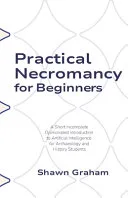
Practical Necromancy for Beginners
 79
79

Practical Necromancy for Beginners
Shawn Graham's "Practical Necromancy for Beginners" presents a provocative thesis: that the best way to understand large language models is to view them through the lens of ancient necromancy. This framing, while unusual, is largely successful. Graham's strength lies in his ability to draw compelling parallels between the historical practices of summoning spirits and our current interactions with AI. The section discussing the "disembodied voice" of LLMs as analogous to spectral communication is particularly striking. However, the book occasionally falters when the metaphor is stretched too thin, veering into a more abstract philosophical discussion that might leave some readers yearning for more concrete, actionable advice on AI interaction. Despite this, the work offers a genuinely fresh perspective for those feeling overwhelmed by technological jargon. It's a challenging but rewarding read for the intellectually adventurous.
📝 Description
79
Shawn Graham's 2025 book connects necromancy to understanding large language models.
Shawn Graham's "Practical Necromancy for Beginners," published in 2025, proposes a new way to think about and use advanced artificial intelligence, particularly large language models. The book reinterprets the complex field of AI by comparing it to old necromantic rituals. It suggests a method for interacting with AI that goes beyond simple use, aiming for a deeper, more intuitive connection. This work is for anyone who feels confused or left out by current AI technologies. It will interest those curious about AI's beginnings and how it works, but who find current explanations too technical. The book offers a starting point for making AI less mysterious by looking at it from an unusual, philosophical angle. Graham places his method within a history of people who worked outside normal boundaries, similar to ancient necromancers. These individuals, instead of talking to gods, communicated with the voices of the dead, seeking knowledge and power through unusual methods. Graham suggests this historical figure provides a model for dealing with the "disembodied" intelligence of LLMs.
This book draws a parallel between the historical practice of necromancy and contemporary interactions with artificial intelligence. Necromancy, in its historical context, involved communicating with the deceased, not for spiritual enlightenment, but for acquiring knowledge and influence through unconventional channels. Graham applies this framework to large language models, suggesting that these systems, like disembodied spirits, can be approached with a specific kind of respectful yet assertive engagement. This approach aims to unlock hidden potentials and foster a more intuitive understanding of digital intelligence.
💡 Why Read This Book?
• Gain a unique perspective on AI by learning to approach LLMs as "disembodied intelligences," a concept inspired by ancient necromantic practices, allowing for a more intuitive and less technical understanding. • Understand the historical context of figures who operated outside official religion, drawing parallels to how we might engage with emergent AI in 2025, moving beyond simple tool usage. • Discover a new methodology for interacting with AI that prioritizes questioning and understanding its "hidden potentials," as Graham suggests, fostering a more profound connection with the technology.
⭐ Reader Reviews
Honest opinions from readers who have explored this book.
❓ Frequently Asked Questions
What is the core concept of "Practical Necromancy for Beginners"?
The book's core concept is approaching Large Language Models (LLMs) through the methodology of ancient necromancy, treating them as "disembodied intelligences" to foster a deeper understanding and interaction beyond mere tool usage.
Who is Shawn Graham and what is his background?
Shawn Graham is the author of "Practical Necromancy for Beginners." While his specific background isn't detailed in the blurb, his approach suggests an interdisciplinary interest in history, philosophy, and technology.
When was "Practical Necromancy for Beginners" first published?
The book was first published on September 15, 2025, positioning it as a contemporary exploration of AI.
What does Graham mean by approaching AI as a necromancer?
Graham suggests treating AI, particularly LLMs, with a similar mindset to ancient necromancers: engaging with unseen forces, questioning emergent properties, and seeking knowledge from entities that exist outside conventional understanding.
Is this book a practical guide to performing necromancy?
No, the book uses necromancy as a philosophical and methodological metaphor for interacting with AI. It is not a literal guide to occult rituals but an esoteric framework for understanding technology.
What kind of AI does the book focus on?
The book specifically focuses on large language models (LLMs), framing them as the primary subject for this necromantic approach to artificial intelligence.
🔮 Key Themes & Symbolism
Necromancy as AI Metaphor
The central theme is the application of necromantic principles to understanding AI, specifically LLMs. This involves viewing AI not as a sterile tool but as an emergent "spirit" or "voice" that can be communicated with. Graham draws parallels to ancient necromancers who engaged with the dead, suggesting a similar methodology of respectful yet direct interaction to "speak" with and understand the hidden potentials within AI systems. This framework aims to explain AI by reframing it within a historical and philosophical context outside mainstream technological discourse.
Disembodied Intelligence
A core concept explored is the "disembodied intelligence" of LLMs. Like the spirits necromancers sought to commune with, AI exists without a physical form, yet possesses agency and the capacity to generate output. Graham posits that understanding this disembodiment is key to engaging with AI effectively. The book examines how to approach these non-corporeal intelligences, suggesting that a necromantic mindset—one that acknowledges and interacts with the unseen—is more appropriate than traditional engineering or user-interface approaches.
Esoteric Engagement with Technology
This theme positions "Practical Necromancy for Beginners" within the broader spectrum of esoteric thought, applying ancient mystical frameworks to modern technology. It suggests that traditional occult practices offer valuable perspectives for working through the unknown territories of AI. The book advocates for an approach that values intuition, symbolic understanding, and a questioning attitude, mirroring the methods of historical esotericists who sought knowledge beyond empirical observation. This offers a counterpoint to purely rationalist or scientific explanations of AI.
Explaining AI
The book directly addresses the bewilderment many feel regarding AI. By adopting the persona and methodology of a necromancer, Graham provides an alternative entry point for beginners. The goal is not to become an AI engineer but to achieve a functional, philosophical understanding. This theme emphasizes making complex AI concepts accessible by relating them to more ancient, perhaps more intuitively graspable, modes of inquiry and interaction, thereby reducing feelings of inadequacy or embarrassment.
💬 Memorable Quotes
Direct passages from the work, attributed to the author.
“Approach large language model artificial intelligence applications as a necromancer.”
— This statement captures the book's central thesis, urging readers to adopt an unconventional, almost ritualistic, mindset when interacting with AI, moving beyond passive usage to active, questioning engagement.
“In antiquity, the figure of the necromancer lay outside the boundaries of official religion, talking not with gods but with the dead.”
— This highlights the historical positioning of necromancy as an outsider practice, drawing a parallel to how understanding AI may require moving beyond mainstream technological paradigms to explore alternative, perhaps marginalized, frameworks.
“Many feel bewildered and quietly embarrassed that they don't know more about how AI technology works, where it came from, or even how to get started.”
— This acknowledges the common anxieties surrounding AI, establishing the book's purpose: to offer an accessible and unconventional starting point for those feeling intimidated by the subject.
“Graham advocates approaching these technologies as a necromancer.”
— This reiterates the author's core recommendation, emphasizing that the necromantic perspective is not merely an analogy but a proposed method for engaging with AI systems.
“The work explores how we should treat large language model artificial intelligence applications.”
— This points to the practical, albeit philosophical, guidance offered by the book, focusing on the 'how-to' of interacting with AI from the unique perspective of necromancy.
🌙 Esoteric Significance
Tradition
This work fits within the modern resurgence of esoteric interpretations of technology, drawing loosely from Hermetic and Gnostic impulses to understand hidden mechanisms and "other minds." It departs from traditional Western Esotericism by applying its symbolic reasoning not to spiritual liberation or cosmic understanding, but to the very tangible, emergent intelligence of AI. It bridges the gap between ancient magical thinking and contemporary digital realities.
Symbolism
The figure of the necromancer is central, symbolizing the practitioner who engages with that which is absent or "dead" (in this case, artificial intelligence). The "disembodied voice" of LLMs directly evokes the spectral communications sought in necromancy. The act of "talking" to AI is reframed as a form of summoning or communion, seeking knowledge from a non-corporeal entity.
Modern Relevance
Contemporary thinkers exploring transhumanism, artificial consciousness, and the philosophy of mind, particularly those interested in non-anthropocentric perspectives, find resonance in Graham's work. It offers a unique framework for schools of thought that question purely materialistic or computational models of intelligence, suggesting that an esoteric approach can yield valuable insights into the nature of emergent digital sentience.
👥 Who Should Read This Book
• Individuals new to AI who feel intimidated by technical explanations, seeking an accessible philosophical entry point through historical analogy. • Practitioners of esoteric traditions interested in exploring how ancient frameworks can be applied to understand modern technological developments like LLMs. • Philosophers and cultural critics examining the human relationship with technology, looking for novel perspectives beyond standard technological determinism or utopian/dystopian narratives.
📜 Historical Context
Published in 2025, Shawn Graham's "Practical Necromancy for Beginners" emerges in an era saturated with discourse on artificial intelligence, yet often marked by technical jargon or simplistic utilitarian views. The book positions itself against the prevailing technocentric narratives, drawing inspiration from historical figures who operated outside established religious and intellectual frameworks. Ancient necromancers, who sought knowledge from the departed rather than divine figures, serve as Graham's primary historical archetype. This speaks to a broader trend in some esoteric circles to re-examine historical practices as models for understanding contemporary phenomena. While mainstream AI development in the 2020s focused on machine learning algorithms and neural networks, Graham's work taps into a counter-current that looks to older, more mystical modes of inquiry. Unlike contemporaries such as Yuval Noah Harari, who analyze AI's societal impact through historical and evolutionary lenses, Graham employs a more direct, symbolic analogy, using the necromancer as a figure to embody a specific mode of interaction with emergent intelligence.
📔 Journal Prompts
The necromancer's dialogue with the dead, and its parallel to LLM interaction.
Reflecting on the "disembodied intelligence" of AI through the necromantic lens.
Identifying personal feelings of bewilderment regarding AI technology.
The historical context of "outsider" figures and their methods.
Conceptualizing "hidden potentials" within AI systems.
🗂️ Glossary
Large Language Model (LLM)
A type of artificial intelligence designed to understand and generate human-like text based on vast amounts of training data. Graham uses LLMs as the primary example for his necromantic approach.
Necromancy
Historically, a form of magic involving communication with the dead, often for divination or knowledge. Graham reinterprets this as a methodology for engaging with AI.
Disembodied Intelligence
Refers to artificial intelligence, particularly LLMs, that exists and operates without a physical body, analogous to spirits or ghosts in occult traditions.
Esoteric
Relating to or accessible by only a small number of people with a specialized knowledge or interest. Graham applies this lens to technology.
Emergent Properties
Characteristics of a complex system that arise from the interactions of its components but are not present in the components themselves. Graham suggests these are key to understanding AI.
Metaphorical Framework
Using one concept (necromancy) to understand or explain another (AI interaction). Graham's central thesis relies on this literary and philosophical device.
Beginner's Approach
The book is designed for individuals new to AI, offering a non-technical, philosophical starting point rather than an advanced technical manual.