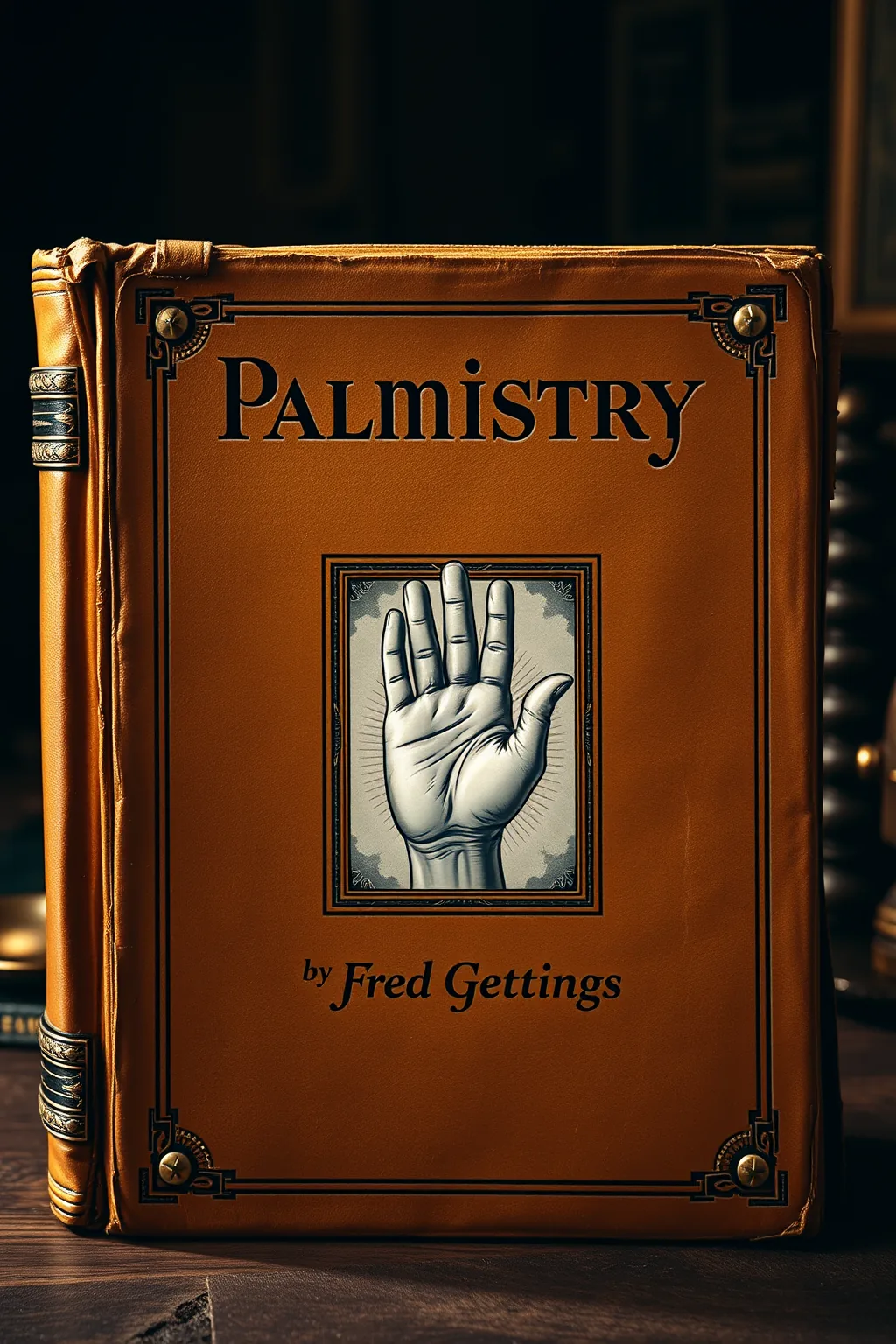
Palmistry
 78
78

Palmistry
Fred Gettings' "Palmistry" distinguishes itself by treating the subject with an academic rigor seldom applied to divinatory arts. The book’s strength lies in its historical breadth, tracing the lineage of chiromancy from ancient times through its various European manifestations. Gettings avoids the sensationalism that often plagues popular palmistry guides, offering instead a detailed cartography of the hand's symbolic terrain. A notable passage details the complex interplay of the Saturnian mount and the Fate line, illustrating how a single aspect is never interpreted in isolation. However, the work’s density, while a virtue for the scholar, may prove daunting for the casual reader seeking simple predictive techniques. Its focus remains firmly on character analysis and psychological portraiture, which, while valuable, sidesteps the more common expectation of future forecasting. Gettings provides a grounded, if at times dry, examination of a practice often relegated to the fringes of occultism.
📝 Description
78
Fred Gettings' 1993 book examines chiromancy as a scholarly discipline, not a superficial guide.
Published in 1993, Fred Gettings' Palmistry is a scholarly examination of hand reading. This work goes beyond simple divinatory techniques to investigate the historical development and philosophical underpinnings of chiromancy. Gettings details the significance of hand mounts, lines, and fingers, presenting them as parts of a complex symbolic language rather than isolated elements. The book traces palmistry's interpretations across various cultures and eras, offering a thorough study for serious students.
This volume appeals to those interested in esoteric traditions, occult history, and divination. It provides a deeper understanding of palmistry than common modern interpretations. Readers studying the historical evolution of Western esotericism, the connections between folklore and divination, or the symbolic language of physiognomy will find substantial material. Gettings' work is for individuals who approach these subjects with an academic mindset, seeking comprehensive knowledge.
Fred Gettings' work situates palmistry within the lineage of Western esoteric movements. The study of chiromancy has roots in ancient India and Greece, appearing in Western thought through medieval and Renaissance texts. By the late 19th century, figures associated with groups like the Hermetic Order of the Golden Dawn revived interest in occult practices. Gettings' book, appearing in the late 20th century, connects this history to post World War II psycho-spiritual inquiry and the broader study of esoteric traditions.
💡 Why Read This Book?
• Gain a nuanced understanding of the planetary influences on the Mounts of the hand, moving beyond simplistic modern interpretations, as detailed in Gettings' analysis of the Mount of Venus. • Learn to interpret the primary palm lines—Life, Head, and Heart—not as static predictions but as dynamic indicators of character and psychological tendencies, a concept explored in Chapter 3. • Appreciate the historical lineage of palmistry from its ancient roots through its resurgence in 19th-century Europe, providing context that distinguishes Gettings' scholarly approach from ephemeral trends.
⭐ Reader Reviews
Honest opinions from readers who have explored this book.
❓ Frequently Asked Questions
When was Fred Gettings' "Palmistry" first published?
Fred Gettings' "Palmistry" was first published in 1993, placing it within the late 20th-century revival of interest in esoteric studies.
Does "Palmistry" by Fred Gettings focus on predicting the future?
While Gettings' "Palmistry" acknowledges predictive elements, its primary focus is on character analysis and psychological understanding derived from hand features, reflecting a more depth-oriented approach.
What are the 'Mounts' in palmistry as discussed by Gettings?
The 'Mounts' in Gettings' "Palmistry" refer to the fleshy pads at the base of each finger and on the palm, each associated with a planet and corresponding psychological traits or influences.
Is this book suitable for absolute beginners in palmistry?
While comprehensive, "Palmistry" by Fred Gettings is more suited for serious students due to its detailed historical and analytical approach, rather than a quick-start guide for absolute novices.
What historical periods or movements does Gettings reference regarding palmistry?
Gettings references ancient Greek and Indian origins, medieval European texts, and the late 19th-century occult revival, providing a broad historical sweep for the practice.
What distinguishes Gettings' "Palmistry" from modern popular palmistry books?
Gettings' work is distinguished by its scholarly tone, historical depth, and focus on psychological interpretation, contrasting with the often superficial or predictive emphasis found in many contemporary palmistry guides.
🔮 Key Themes & Symbolism
The Hand as a Microcosm
Gettings presents the hand not merely as an anatomical feature but as a complex symbolic map reflecting the entirety of an individual's being. The interplay between the mounts, lines, and fingers is depicted as a microcosm of the human psyche and its potential, influenced by planetary correspondences. This perspective elevates palmistry from a simple fortune-telling tool to a sophisticated system of psychological and spiritual insight, deeply rooted in Hermetic principles of correspondence.
Historical Evolution of Chiromancy
The work meticulously traces the development of palmistry across centuries, from its ancient origins in India and Greece through its integration into medieval European occult traditions and its resurgence during the Renaissance and the late 19th-century esoteric revival. Gettings situates the practice within broader intellectual and cultural currents, highlighting how its interpretation and application have shifted over time, offering a critical historical perspective.
Planetary Influences and Symbolism
A core theme is the association of the hand's various features—particularly the mounts—with the seven classical planets. Gettings explores how the energies and archetypes of Mars, Venus, Jupiter, Saturn, Apollo, Mercury, and Luna are believed to manifest in the shape, prominence, and markings of the hand. This planetary symbolism provides a framework for understanding personality traits, innate potentials, and life challenges as presented in the palm.
The Interconnectedness of Lines and Mounts
Contrary to fragmented interpretations, Gettings emphasizes the holistic nature of palmistry, where no single line or mount is analyzed in isolation. The book illustrates how the primary lines (Life, Head, Heart, Fate) interact with and are modified by the underlying mounts and other markings. This interconnectedness highlights the dynamic and complex narrative the hand reveals about an individual's life path and inner landscape.
💬 Memorable Quotes
Direct passages from the work, attributed to the author.
“The Hand is a living map of the soul.”
— This statement expresses Gettings' view of palmistry as a profound tool for self-understanding, suggesting that the physical hand contains symbolic representations of an individual's inner spiritual and psychological landscape.
“Each line and mount speaks in concert with the others.”
— This highlights the book's emphasis on a holistic interpretation of the palm, where individual features are not analyzed in isolation but understood as part of an interconnected symbolic system reflecting the whole person.
“Planetary energies find their expression upon the palm.”
— This reflects the core Hermetic principle of 'As Above, So Below,' as applied to palmistry, where celestial influences are believed to manifest in the physical characteristics and markings of the hand.
“The study of the hand offers a mirror to our potential.”
— This interpretation suggests that palmistry, as presented by Gettings, is less about deterministic fate and more about understanding inherent capacities, psychological tendencies, and the pathways available for personal development.
“From ancient India to Renaissance Europe, the hand has been read.”
— This phrase points to the extensive historical grounding of palmistry, emphasizing its enduring presence across diverse cultures and eras as a significant divinatory and psychological art.
🌙 Esoteric Significance
Tradition
This work fits within the Western Esoteric tradition, particularly its Hermetic and Renaissance magical branches. It draws upon the principle of correspondence, linking celestial bodies (planets) to terrestrial manifestations (the hand). Gettings approaches palmistry not as mere superstition but as a symbolic language reflecting the microcosm (human) in relation to the macrocosm (universe), a hallmark of Hermetic philosophy.
Symbolism
Key symbols include the mounts (e.g., Mount of Jupiter signifying ambition and leadership, Mount of Saturn related to wisdom and melancholy) and the primary lines (Life, Head, Heart), each representing core aspects of human existence. The shape of the hand itself, often categorized by elemental types (Earth, Air, Fire, Water), provides another layer of symbolic interpretation, offering a holistic view of temperament.
Modern Relevance
Gettings' detailed, historical, and psychologically oriented approach influences contemporary practitioners and scholars of esoteric traditions. His work provides a foundation for those studying Western Hermeticism, comparative divination, and the history of occultism, offering a counterpoint to more superficial or New Age interpretations of palmistry prevalent today.
👥 Who Should Read This Book
• Students of Western Esotericism: Those seeking to understand the historical development and philosophical underpinnings of divinatory practices within Hermetic and Renaissance magical traditions. • Aspiring Palmist Scholars: Individuals aiming for a comprehensive and rigorous understanding of chiromancy, moving beyond popular simplifications to grasp its symbolic depth and psychological applications. • Researchers of Occult History: Academics or enthusiasts interested in the evolution of occult arts and their place within broader intellectual and cultural movements from antiquity to the late 20th century.
📜 Historical Context
Fred Gettings' "Palmistry," published in 1993, emerged during a period of renewed academic and popular interest in Western esotericism, following the influential works of scholars like Frances Yates in the mid-20th century. The book engages with a tradition of chiromancy that flourished in Europe from antiquity through the Renaissance, with key figures like Johannes Indagine publishing influential treatises in the 16th century. By the late 19th century, palmistry had been popularized and somewhat sensationalized, but also integrated into more serious occult systems by organizations like the Hermetic Order of the Golden Dawn. Gettings' work sought to provide a more scholarly and psychologically nuanced perspective, situating palmistry within the broader Hermetic and Neoplatonic currents that underpinned much of Western esoteric thought, distinguishing it from the more purely predictive or folk-magic traditions.
📔 Journal Prompts
The Saturnian mount's characteristics and their potential influence on one's sense of responsibility.
Reflecting on the interpretation of the Head Line's slope and its connection to intellectual style.
How the prominence of the Mount of Venus might manifest in one's approach to relationships.
Considering the Fate Line's trajectory and its symbolic representation of life's path.
Analyzing the interplay between your Heart Line and the Mount of Apollo.
🗂️ Glossary
Chirognomy
The study of the shape, size, and general characteristics of the hand and fingers, distinct from chiromancy (the study of palm lines).
Mounts
The fleshy, raised pads at the base of the fingers and the lower palm, each named after and associated with one of the seven classical planets and their corresponding attributes.
Life Line
The major curved line on the palm running from near the thumb towards the wrist, traditionally associated with vitality, physical health, and major life events.
Head Line
The line, usually running horizontally across the palm, that symbolizes mental faculties, intellect, communication style, and cognitive processes.
Heart Line
The upper horizontal line on the palm, typically running from below the little finger towards the edge of the palm below the index finger, related to emotional life and romantic relationships.
Fate Line
A vertical line, not present on all hands, running up the palm towards the base of the middle finger, often interpreted as representing career, life purpose, and significant external influences.
Hermeticism
A philosophical and religious tradition based on writings attributed to Hermes Trismegistus, emphasizing principles like 'As Above, So Below' and the interconnectedness of all things.
🔮 Readers Also Liked
Browse all →








More by Fred Gettings
All books →




More Free Occult Philosophy Books
View all →