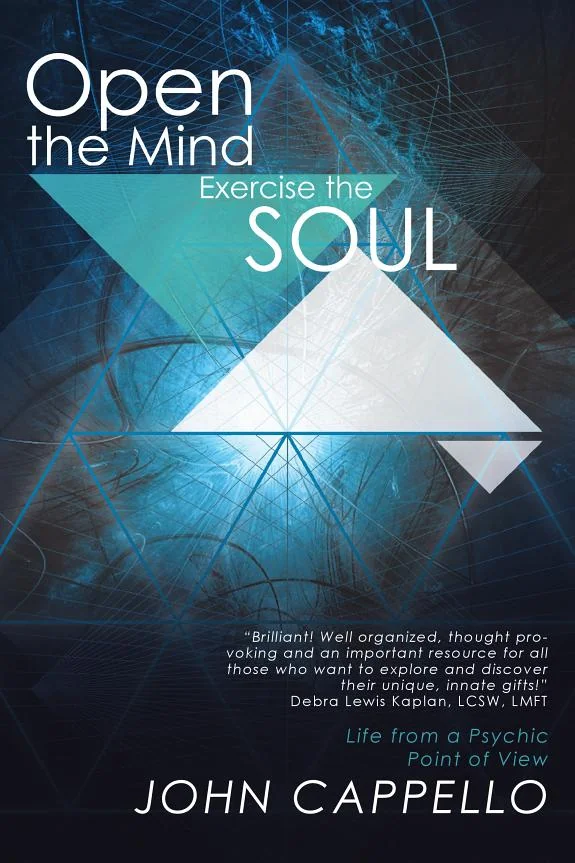
Open the Mind Exercise the Soul
 76
76

Open the Mind Exercise the Soul
John Cappello's "Open the Mind Exercise the Soul" tackles the challenging terrain of psychic phenomena with a commendable blend of personal narrative and intellectual curiosity. The book's strength lies in its accessibility; Cappello avoids overly academic jargon, making complex ideas about the soul and psychic abilities understandable to a general audience. His grounded approach, drawing from his own mediumistic experiences, lends a certain authenticity. However, the work occasionally struggles to provide the concrete, verifiable evidence that skeptics demand, often relying on anecdotal accounts and interpretations of personal encounters. A particularly engaging section discusses the soul's role as a conduit for psychic information, offering a fresh perspective on how consciousness might extend beyond the physical body. While it doesn't offer definitive proof, it succeeds in opening avenues for contemplation and further investigation for those already inclined to explore these subjects. It serves as a thoughtful introduction rather than a definitive treatise.
📝 Description
76
John Cappello's 2012 book explores psychic phenomena through personal experience and philosophical inquiry.
First published in 2012, "Open the Mind Exercise the Soul" by John Cappello is a personal account of psychic phenomena. Cappello aims to connect empirical observation with spiritual experience, tackling common questions about psychic abilities. He works to make these concepts, often on the edges of mainstream discussion, understandable within a wider view of philosophy, religion, and science. The book draws on Cappello's own background as a psychic medium, mixing personal stories with theoretical ideas.
This book is for readers curious about how psychic abilities work and if they are real. It speaks to those who question the sharp division between the physical and non-physical, looking for intellectual support for their spiritual questions. People interested in looking at consciousness, spirituality, and the possible scientific basis for extrasensory perception will find useful information. It also serves those who have had unusual experiences and want a structured way to think about them.
Published in the early 21st century, Cappello's work follows a tradition of integrating esoteric ideas with philosophical and scientific thought, echoing figures like Helena Blavatsky and Edgar Cayce. It taps into a renewed public interest in mediumship and psychic abilities, seeking to bridge these popular fascinations with established academic fields.
💡 Why Read This Book?
• You will learn how John Cappello connects psychic ability to personal experiences and intellectual thought, offering a unique perspective not found in purely academic texts. • You will gain insight into the book's central inquiry regarding the soul's role in manifesting psychic phenomena, a concept explored through Cappello's own mediumistic background. • You will understand the book's attempt to bridge the perceived divide between religion, philosophy, and science concerning controversial subjects like psychic abilities, as discussed since its 2012 publication.
⭐ Reader Reviews
Honest opinions from readers who have explored this book.
❓ Frequently Asked Questions
What is the primary focus of John Cappello's "Open the Mind Exercise the Soul"?
The book focuses on linking psychic ability with personal experiences and intellectual thought. It aims to answer questions about the relationship between religion, philosophy, and science concerning psychic phenomena, offering a new look at these abilities.
When was "Open the Mind Exercise the Soul" first published?
The book was first published on May 1, 2012, marking its initial entry into discussions on psychic abilities and consciousness.
Who is the author, John Cappello?
John Cappello is an internationally known psychic medium. "Open the Mind Exercise the Soul" is his first published book, drawing on his professional experiences.
What types of questions does the book attempt to answer?
It addresses fundamental questions such as why psychic abilities exist, what proof might be available, and what role the soul plays in these phenomena.
What is the intended audience for this book?
The book is for individuals curious about psychic abilities, those seeking to understand the connection between spirituality and intellect, and readers interested in a fresh perspective on the mind-soul relationship.
Does the book offer scientific proof of psychic abilities?
While the book discusses the relationship between science and psychic abilities, it primarily offers an intelligent discussion and personal experiences rather than presenting definitive scientific proof.
🔮 Key Themes & Symbolism
Mind-Soul Connection
The book posits a fundamental connection between the human mind and the soul, suggesting the soul acts as the origin or conduit for psychic abilities. It moves beyond mere cognitive functions to explore consciousness as an entity capable of perceiving beyond the physical senses. Cappello integrates personal accounts to illustrate how this connection manifests, framing psychic perception not as an aberration but as an inherent capacity of the soul. This theme challenges materialistic views by proposing a non-local aspect of consciousness tied to spiritual essence.
Nature of Psychic Abilities
Cappello addresses the existence and purpose of psychic abilities, seeking to clarify them for a broader audience. He argues for their integration within a holistic understanding of human potential, rather than their exclusion as mere superstition or delusion. The work explores the 'why' behind these abilities, suggesting they serve a purpose in spiritual evolution or understanding. By linking them to personal experience and intellectual frameworks, he attempts to legitimize their study and acceptance.
Philosophy of Consciousness
The book engages with perennial philosophical questions about the nature of reality, consciousness, and the self. It navigates the often-contentious territory where science, religion, and philosophy intersect, particularly concerning phenomena that defy conventional scientific explanation. Cappello advocates for an expanded worldview that can accommodate both empirical data and subjective spiritual experiences. This theme encourages readers to reconsider established paradigms and explore alternative models of consciousness and existence.
Integration of Disciplines
A central aim of "Open the Mind Exercise the Soul" is to foster dialogue between seemingly disparate fields: esotericism, psychology, philosophy, and even natural science. Cappello seeks to show how insights from his psychic mediumship can inform and be informed by established intellectual traditions. The book works to dismantle the artificial barriers erected between spiritual inquiry and rational thought, advocating for a unified approach to understanding the human condition and its potential.
💬 Memorable Quotes
Direct passages from the work, attributed to the author.
“Psychic ability is not a random occurrence but an intrinsic function of the soul.”
— This interpretation suggests that Cappello views psychic gifts as inherent qualities of our spiritual essence, rather than external or accidental phenomena. It implies that understanding the soul is key to understanding psychic perception.
“The soul acts as a bridge between the physical world and the non-physical domains of energy and consciousness.”
— Here, the soul is presented as a mediating force. This concept is central to many esoteric traditions, positioning the soul as the vehicle through which we can access or perceive realities beyond our immediate sensory input.
“Intellectual thought and personal experience can both serve as pathways to understanding psychic phenomena.”
— This highlights Cappello's balanced approach, suggesting that both logical reasoning and lived experience are valid tools for exploring the esoteric. It encourages a holistic engagement with the subject matter.
“The perceived conflict between science and spirituality often stems from limited definitions of reality.”
— This interpretation points to a core argument: that the difficulty in reconciling scientific and spiritual perspectives arises from a narrow, materialistic worldview. Cappello likely advocates for an expanded definition of reality.
“Questions about psychic existence are valid inquiries into the nature of consciousness itself.”
— This frames the exploration of psychic abilities not as fringe speculation, but as a legitimate avenue for understanding the fundamental nature of consciousness and our place within the universe.
🌙 Esoteric Significance
Tradition
This work aligns with modern esoteric thought that seeks to integrate spiritual experiences with rational inquiry, drawing loosely from Theosophical and New Thought traditions. It departs from more rigid, dogmatic systems by emphasizing personal experience and an open dialogue between science and spirituality. Cappello’s approach is less about adherence to a specific lineage and more about creating a framework for understanding psychic phenomena as a natural, albeit often misunderstood, aspect of human consciousness.
Symbolism
While the book doesn't heavily rely on traditional esoteric symbolism, the 'mind' and 'soul' themselves function as central symbolic motifs. The mind represents the rational, cognitive aspect, while the soul symbolizes the deeper, intuitive, and spiritual essence. Their 'exercise' and 'opening' suggest a process of spiritual development and expanded awareness, moving beyond the limitations of the purely physical or mundane.
Modern Relevance
Cappello's work remains relevant for contemporary practitioners and thinkers exploring consciousness, mediumship, and the intersection of spirituality and psychology. It informs current discussions in the broader 'spiritual but not religious' movement and can be seen as a precursor to the increased accessibility of psychic development resources online. It provides a foundational perspective for those seeking to understand psychic abilities without necessarily adhering to established religious doctrines.
👥 Who Should Read This Book
• Individuals curious about psychic abilities and mediumship, seeking an accessible introduction that bridges personal experience with intellectual exploration. • Students of comparative religion and philosophy interested in how esoteric concepts of the soul and consciousness intersect with broader metaphysical questions. • Those who have had unexplained experiences and are looking for frameworks to understand them, moving beyond purely materialist explanations.
📜 Historical Context
Published in 2012, "Open the Mind Exercise the Soul" emerged during a period of renewed popular interest in spirituality and consciousness studies, often referred to as the New Age movement's later phase. This era saw a significant increase in accessible literature on topics previously confined to esoteric circles, influenced by figures like Shirley MacLaine and the burgeoning self-help industry. Cappello's work fits within this milieu, seeking to bridge the gap between anecdotal accounts of psychic phenomena and more structured philosophical or psychological inquiry. It arrived at a time when online forums and social media platforms were increasingly facilitating discussions on these subjects, allowing for wider dissemination of ideas that might have faced more resistance in earlier decades. While not directly engaging with academic psychology or parapsychology in a rigorous manner, it tapped into a broader cultural conversation that was more open to exploring the mind-body-spirit connection than perhaps the era of early 20th-century scientific skepticism, which favored thinkers like J.B. Rhine but often with strict experimental controls.
📔 Journal Prompts
The soul's perceived role as a conduit for psychic information.
Personal experiences that challenge the boundary between mind and soul.
The relationship between intellectual thought and intuitive insight in understanding psychic phenomena.
Defining 'proof' in the context of psychic abilities and spiritual experiences.
Exploring the concept of psychic abilities as integral human functions.
🗂️ Glossary
Psychic Ability
The capacity to perceive or influence information or events through means beyond the known human senses, often involving extrasensory perception (ESP) or psychokinesis (PK).
Soul
In the context of the book, the soul is presented as the essential, spiritual part of a person, distinct from the physical body and mind, believed to be the source or medium of consciousness and psychic faculties.
Medium
An individual believed to be able to communicate with spirits or entities from non-physical realms, acting as an intermediary between these realms and the physical world.
Intellectual Thought
The process of reasoning, analysis, and logical deduction, as opposed to intuitive or experiential knowing. The book seeks to integrate this with other forms of understanding.
Personal Experience
Subjective encounters, feelings, or perceptions that an individual has. The book uses such experiences as a basis for exploring psychic phenomena.
Metaphysical
Relating to the fundamental nature of reality, including the relationship between mind and matter, existence and being, that goes beyond the scope of empirical science.
Consciousness
The state of being aware of and responsive to one's surroundings; the mind and its contents. The book explores its potential to extend beyond physical limitations.
This book appears in 1 collection
🔮 Readers Also Liked
Browse all →









From the “Clairsentience” Collection
View all →








More Free Occult Philosophy Books
View all →