On the composition of images, signs & ideas

 71
71

On the composition of images, signs & ideas
Bruno's "On the Composition of Images, Signs & Ideas" is not a light read; it is a dense, intricate examination of the mind's architecture. Its strength lies in its ambitious attempt to map the cosmos through the lens of memory and representation, offering a glimpse into a mind grappling with profound questions about existence and perception. The section detailing mnemonic techniques, while challenging, is particularly illuminating for understanding Renaissance intellectual practices. However, its highly abstract nature and dense philosophical language can be a significant barrier for those unfamiliar with Bruno's unique brand of Neoplatonism and his specific cosmological framework. The work demands considerable patience and prior knowledge. The passage discussing the 'infinite universe' and its implications for divine immanence is a powerful illustration of Bruno's departure from orthodoxy. Ultimately, this is a vital, if demanding, text for understanding the philosophical currents of the late Renaissance and their esoteric dimensions.
📝 Description
71
Giordano Bruno composed 'On the Composition of Images, Signs & Ideas' around 1591, examining knowledge and the universe.
Giordano Bruno's "On the Composition of Images, Signs & Ideas," written in 1591, is a philosophical study concerned with how we know things. Bruno investigates the connections between what we see, how we form abstract thoughts, and the structure of the universe. He wrote this treatise during a time of significant intellectual change in Europe. His ideas, which combined Neoplatonic thought with his own cosmology, pushed against the accepted Aristotelian and Ptolemaic systems.
Bruno's work engaged with figures like Nicolaus Copernicus, whose sun-centered model he supported and developed further. This book reflects the dangers of his unconventional thinking, as he was later condemned by the Roman Inquisition in 1600. It is a text for those studying Renaissance philosophy, the history of science, and the early modern development of memory systems and cosmology.
Bruno's treatise sits within the Renaissance Hermetic tradition, blending Neoplatonic ideas with his own cosmology. He sought to unify natural philosophy with divine principles, seeing the universe as alive and interconnected. His concept of the infinite universe and the divine spark within all things resonated with later occult and esoteric movements that sought hidden correspondences and spiritual unity.
💡 Why Read This Book?
• Grasp Bruno's unique cosmology and its departure from Aristotelian physics, understanding how his concept of the infinite universe challenged contemporary thought. • Learn about the Renaissance 'art of memory' (ars memoriae) as detailed by Bruno, providing insight into historical mnemonic systems and their philosophical basis. • Explore Bruno's Neoplatonic ideas on the divine unity of all things, connecting his philosophical framework to later esoteric traditions.
⭐ Reader Reviews
Honest opinions from readers who have explored this book.
❓ Frequently Asked Questions
When was Giordano Bruno's "On the Composition of Images, Signs & Ideas" first published?
While Giordano Bruno wrote "On the Composition of Images, Signs & Ideas" around 1591, its first widely recognized publication in modern editions occurred much later, with significant scholarly editions appearing in the 20th century, notably in 1991.
What is the 'art of memory' as described by Giordano Bruno?
Bruno's work details the 'art of memory' (ars memoriae), a system that employs visual imagery and spatial organization to improve recollection and facilitate the association of complex ideas, reflecting Renaissance mnemonic techniques.
What philosophical tradition influenced Giordano Bruno in this work?
Bruno's philosophy in "On the Composition of Images, Signs & Ideas" is heavily influenced by Neoplatonism, particularly in its concepts of emanation, the divine unity, and the soul's ascent towards knowledge.
How does Bruno's cosmology differ from prevailing views of his time?
Bruno posited an infinite universe with countless worlds, a radical departure from the finite, Earth-centered (geocentric) model prevalent in the Aristotelian-Ptolemaic system of the late 16th century.
What was the reception of Bruno's ideas during his lifetime?
Bruno's unconventional ideas, including those explored in this work, led to his persecution and eventual execution by the Roman Inquisition in 1600 on charges of heresy.
What is the relationship between images, signs, and ideas in Bruno's philosophy?
Bruno viewed images and signs not merely as representations but as active agents in the composition and retrieval of ideas, forming a complex interconnected system within the human mind and the cosmos.
🔮 Key Themes & Symbolism
The Infinite Cosmos
Bruno radically posits a universe without boundaries, teeming with innumerable worlds. This concept, detailed in "On the Composition of Images, Signs & Ideas," directly challenged the finite, geocentric cosmology of Aristotle and Ptolemy. For Bruno, this infinite expanse was not empty but alive with divine substance, reflecting a pantheistic or panentheistic worldview where God is immanent in all creation. This idea profoundly influenced later thinkers grappling with the scale of the universe and the nature of divinity.
The Art of Memory (Ars Memoriae)
The work meticulously outlines mnemonic techniques, central to Renaissance intellectual practice. Bruno elaborates on the use of vivid imagery, symbolic loci (places), and the association of abstract concepts with concrete representations to enhance memory and facilitate philosophical contemplation. This systematic approach to memory was not merely a practical tool but a philosophical method for ordering knowledge and understanding the interconnectedness of all things through symbolic correspondence.
Divine Immanence and Unity
A core tenet explored is the pervasive presence of the divine within the material world. Bruno interprets the universe as a manifestation of a singular, infinite divine intellect. His philosophy suggests that by understanding the natural world and the mechanisms of thought (like memory and signs), one could achieve a form of union with this divine principle. This concept of immanence is a key departure from more transcendent theological views and aligns with certain esoteric traditions.
Semiotics and Representation
Bruno investigates the power of images and signs as mediators between the external world and internal consciousness. He argues that the composition of images is fundamental to the creation and manipulation of ideas. This exploration of how signs function to represent and construct meaning provides an early framework for semiotic thought, highlighting the active role of perception and symbolic representation in shaping reality.
💬 Memorable Quotes
Direct passages from the work, attributed to the author.
“The universe is one, infinite, immobile... a living infinite, and the infinite is perfect.”
— This statement expresses Bruno's revolutionary cosmology, asserting a boundless and dynamic universe. It suggests a unified, divine essence pervading all existence, a concept that directly opposed the limited, hierarchical cosmos favored by established scholastic thought.
“The image is a mirror of the idea, and the idea is the soul of the image.”
— Bruno articulates a deep connection between the visual and the conceptual. This suggests that images are not mere passive reflections but active participants in the formation and understanding of abstract thought, emphasizing their role in cognition.
“Memory is the treasure of the mind, where all things are kept.”
— This highlights the paramount importance Bruno placed on memory. It's presented not just as a faculty but as a repository of knowledge and experience, essential for intellectual development and philosophical insight.
“There are infinite worlds, just as there is an infinite heaven.”
— This bold assertion directly challenges the single-universe model. It implies a vast, pluralistic cosmos, a concept that was both philosophically stimulating and theologically controversial in the late 16th century.
💡 Key Ideas
Editorial paraphrase of the work's core concepts — not direct quotes.
All things are connected, because all things are one.
This paraphrased concept reflects Bruno's Neoplatonic belief in the fundamental unity of reality. It suggests an underlying principle that binds the diverse elements of the cosmos together, influencing his views on correspondence and symbolic relationships.
🌙 Esoteric Significance
Tradition
Bruno's work is deeply rooted in Neoplatonism and Hermeticism, traditions that emphasize the divine unity of the cosmos and the power of symbolic representation. He sought to synthesize ancient wisdom with contemporary philosophical and scientific inquiries, presenting a unified vision of reality where the material and spiritual are intrinsically linked. His concept of an infinite universe, alive with divine spirit, aligns with panentheistic interpretations found in various esoteric lineages, departing from strict orthodoxies.
Symbolism
Key symbols in Bruno's thought include the 'infinite,' representing the boundless divine intellect and the ultimate reality; 'images,' which act as vehicles for understanding abstract concepts and divine truths; and 'signs,' serving as the connective tissue of knowledge, linking the sensible world to the intelligible. The 'art of memory' itself functions symbolically, representing the mind's capacity to map and work through the cosmos through structured imagination.
Modern Relevance
Contemporary esoteric practitioners and philosophers continue to engage with Bruno's ideas on cosmic unity and the power of symbolic thought. His conception of an infinite, interconnected universe appeals to modern cosmological discussions and ecological philosophies. Thinkers in fields ranging from semiotics to speculative philosophy draw inspiration from his bold intellectual leaps and his attempt to unify diverse modes of knowledge, seeing him as a precursor to more holistic worldviews.
👥 Who Should Read This Book
• Students of Renaissance philosophy and intellectual history seeking to understand the transition from medieval to modern thought. • Scholars of esoteric traditions interested in the Neoplatonic and Hermetic influences on Giordano Bruno's unique cosmological and mnemonic systems. • Researchers in the history of science and memory studies looking for primary source material on early modern mnemonic techniques and cosmological theories.
📜 Historical Context
Giordano Bruno penned "On the Composition of Images, Signs & Ideas" around 1591, a period marked by the waning of the Renaissance and the burgeoning of new scientific and philosophical paradigms. His work emerged within an intellectual milieu dominated by Aristotelian physics and the Ptolemaic geocentric model, which he vigorously challenged. Bruno embraced and expanded upon Nicolaus Copernicus's heliocentric theory, proposing a universe that was not only sun-centered but infinite, containing innumerable worlds. This radical cosmology, intertwined with Neoplatonic philosophy and Hermetic traditions, set him apart from contemporaries like Galileo Galilei, whose more empirical approach would soon redefine science. Bruno's ideas, perceived as heretical by the Roman Inquisition, ultimately led to his condemnation and execution in 1600, making this treatise a proof of the intellectual risks of his era. The book's exploration of memory arts also placed it within a tradition that included thinkers like Giulio Camillo and Lullism.
📔 Journal Prompts
Reflect on Bruno's concept of the 'infinite universe' and its implications for the divine.
Analyze how Bruno's 'art of memory' uses imagery to bridge the gap between abstract ideas and concrete representation.
Consider the role of 'signs' in Bruno's system for composing and understanding knowledge.
Explore the connection Bruno draws between the 'composition of images' and the structure of thought.
Examine the concept of 'divine unity' as presented through Bruno's infinite cosmos.
🗂️ Glossary
Ars Memoriae
Latin for 'art of memory,' a system of mnemonic techniques used in the Renaissance to enhance recollection and organize knowledge through visualization, association, and spatial placement.
Neoplatonism
A philosophical system originating with Plotinus, heavily influenced by Plato, emphasizing the concept of a transcendent, ultimate reality (The One) from which all existence emanates.
Hermeticism
A philosophical and religious tradition based on writings attributed to Hermes Trismegistus, advocating for occult knowledge, divine wisdom, and the interconnectedness of the microcosm and macrocosm.
Cosmology
The study of the origin, evolution, and structure of the universe; Bruno's cosmology proposed an infinite universe with multiple worlds, diverging significantly from the prevailing geocentric models.
Panentheism
A theological concept that views God as both immanent in the universe and transcendent beyond it, suggesting the world is part of God, but God is greater than the world.
Loci
In the context of the 'art of memory,' 'loci' (Latin for 'places') refers to specific locations within a mental or physical space used to associate and store ideas or images.
Semiotics
The study of signs and symbols and their interpretation; Bruno's work contributes to early semiotic thought by exploring how images and signs function in cognition.
🔮 Readers Also Liked
Browse all →![Ancient fragments of the Phœnician, Chaldæan, Egyptian, Tyrian, Carthaginian, Indian, Persian, and other writers; with an introductory dissertation: and an inquiry into the philosophy and trinity of the ancients. By Isaac Preston Cory […]](/img/thumb/ancient-fragments-of-the-ph-nician-chald-an-egyptian-tyrian-carthaginian-indian-persian-and-other-writers-with-an-introductory-dissertation-and-an-inquiry-into-the-philosophy-and-trinity-of-the-ancien.webp)








More by Giordano Bruno
All books →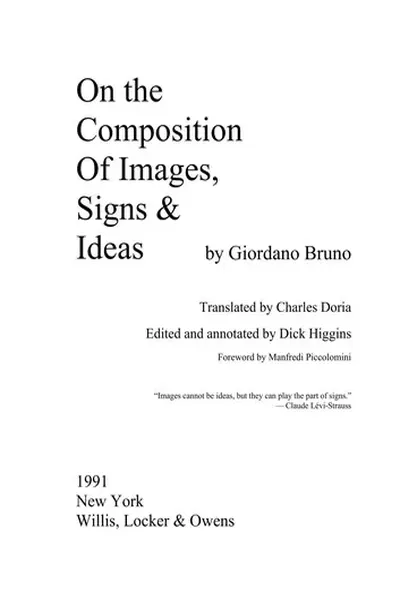

More Free Alchemy & Hermeticism Books
View all →