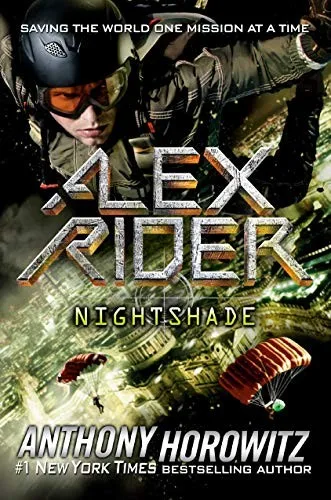
Nightshade
 79
79

Nightshade
Anthony Horowitz’s Nightshade, first published in 2020, presents a narrative that operates with the precision of a clockwork mechanism, each event seemingly placed with deliberate intent. The strength of the novel lies in its meticulously crafted plot, where the unfolding of consequences feels both inevitable and surprising. Horowitz masterfully builds a sense of underlying order, a hidden architect guiding the characters through their predestined paths. This is particularly evident in the way minor occurrences in earlier chapters gain significant weight later on, demonstrating a sophisticated understanding of narrative causality. However, the novel’s very strength can also be its limitation; the pervasive sense of predetermination, while compelling, occasionally overshadows the emotional depth of the characters, making them feel more like pawns in a grand design than fully realized individuals. A passage that exemplifies this is the seemingly coincidental meeting of two characters in a specific London café, an event that later proves pivotal, illustrating the author's penchant for orchestrating fate. Ultimately, Nightshade is a skillfully constructed thriller that offers a compelling, if somewhat detached, examination of destiny.
📝 Description
79
Anthony Horowitz's 2020 novel Nightshade examines the unseen forces shaping human lives.
Nightshade, published in 2020, weaves a narrative that touches on fate and manipulation without overt supernatural elements. The story connects events in a way that suggests a hidden structure guiding the characters. It prompts readers to consider the unseen influences that might direct human destiny, connecting to philosophical questions about determinism and free will. The book's structure itself mirrors the complex, often hidden patterns of existence.
This novel is for readers who enjoy complex plots where causality and consequence are central. Those drawn to psychological thrillers with a philosophical bent will find it engaging. It appeals to readers who pay close attention to detail and consider multiple interpretations of control and influence. Readers expecting explicit supernatural occurrences may find its approach more subtle, focusing on psychological and circumstantial aspects of perceived destiny.
While not a direct treatise on occultism, Nightshade taps into perennial philosophical discussions about hidden influences and predetermined paths. Its exploration of unseen forces echoes ancient Greek Stoic concepts of fate and the tension between human agency and a possibly ordered universe. This aligns with broader esoteric traditions that contemplate the underlying architecture of reality and the subtle ways in which destiny might be orchestrated, often beyond ordinary perception.
💡 Why Read This Book?
• Gain an understanding of narrative causality, observing how Horowitz structures events in Nightshade to create a sense of predetermined outcomes, similar to philosophical discussions on fate versus free will. • Experience a masterclass in plot construction by analyzing the interconnectedness of seemingly minor events, a technique employed throughout the 2020 publication that rewards close reading. • Contemplate the concept of the 'architect' of events, a central theme in the book, and consider its parallels with Jungian synchronicity and the nature of unseen influences on human lives.
⭐ Reader Reviews
Honest opinions from readers who have explored this book.
❓ Frequently Asked Questions
What is the primary genre of Anthony Horowitz's Nightshade?
Nightshade, published in 2020, is primarily a psychological thriller. It engages with themes of fate and hidden influence, offering a subtly complex narrative that rewards careful attention to its intricate plot.
Does Nightshade involve supernatural elements?
While the book explores themes of destiny and unseen forces, it does so through psychological and circumstantial means rather than overt supernatural occurrences. The focus is on the intricate plotting and the feeling of underlying orchestration.
Who is the author of Nightshade?
The author of Nightshade is Anthony Horowitz, a prolific writer known for his work in various genres, including mystery and young adult fiction. This particular novel was first published in 2020.
What are the main themes explored in Nightshade?
The book delves into themes of fate, the consequences of actions (echoes), and the idea of a hidden 'architect' or unseen forces that might guide events, prompting reflection on determinism and agency.
Is Nightshade suitable for readers new to Anthony Horowitz's work?
Yes, Nightshade serves as a good introduction to Horowitz's skill in crafting intricate plots and suspenseful narratives. Its 2020 publication date places it within his more recent works, showcasing his mature storytelling.
What makes the plot of Nightshade unique?
The uniqueness lies in its meticulous construction, where seemingly disparate events are revealed to be interconnected parts of a larger, orchestrated design, creating a compelling sense of inevitability and discovery.
🔮 Key Themes & Symbolism
The Architect of Events
The narrative in Nightshade suggests the presence of an unseen force or entity orchestrating the lives of the characters. This 'architect' manipulates circumstances, combining disparate events to achieve a predetermined outcome. This concept invites comparison to philosophical ideas of determinism and the Stoic notion of fate, where events are seen as following an unavoidable course. The book encourages readers to look beyond surface-level coincidences and consider the possibility of a guiding hand, however subtle its influence might be on the characters' perceived free will.
Elements of Causality
Horowitz masterfully employs the concept of 'echoes' – the lingering and far-reaching consequences of past actions. In Nightshade, decisions made by characters, or even events that befall them, reverberate through the narrative, impacting future occurrences in unexpected ways. This theme highlights the interconnectedness of time and action, suggesting that no event occurs in isolation. It prompts contemplation on responsibility and the enduring impact of choices, mirroring the understanding that present circumstances are often shaped by historical antecedents.
Unseen Threads of Connection
A central motif in Nightshade is the idea of 'unseen threads' that bind characters and plotlines together. These connections are not always apparent to the individuals involved, leading them to perceive events as random or coincidental. The book, however, reveals the underlying structure, demonstrating how fate or design can operate through these subtle links. This exploration speaks to concepts of synchronicity, where meaningful coincidences suggest a deeper, underlying order in the universe, challenging purely materialistic or random explanations of existence.
Perception vs. Reality
Nightshade constantly plays with the reader's perception of reality, contrasting what the characters believe is happening with the underlying truth of their situation. The narrative encourages a critical examination of agency and control. Are the characters truly making choices, or are they merely following a script laid out by the 'architect'? This theme prompts introspection on how our understanding of our own lives and the world around us is shaped by limited information and perspective, urging a deeper inquiry into the nature of freedom.
💬 Memorable Quotes
Direct passages from the work, attributed to the author.
“Every decision cast a long shadow, reaching further than they knew.”
— This captures the essence of the 'elements of causality' theme. It illustrates how actions have unforeseen and far-reaching consequences, suggesting a complex web of interconnectedness where past choices continue to shape the present and future.
“They walked paths laid out by an unseen hand.”
— This statement directly addresses the 'unseen threads' motif. It implies a form of predestination or external control guiding the characters' lives, prompting reflection on the extent of free will versus destiny.
“Coincidence was merely the name given to a pattern not yet understood.”
— This interpretation underscores the theme of perception versus reality. It suggests that what appears to be random chance is, in fact, evidence of an underlying order or design that the characters (and potentially the reader) have yet to fully grasp.
“The architect watched, and the pieces moved.”
— This concise statement expresses the overarching presence of the 'architect' figure. It conveys a sense of passive observation coupled with active manipulation, reinforcing the idea of a controlling force behind the narrative's events.
💡 Key Ideas
Editorial paraphrase of the work's core concepts — not direct quotes.
The meeting in the London café was not chance, but design.
This paraphrased concept highlights the core theme of an 'architect' in the novel. It suggests that events perceived as random by characters are, in fact, part of a larger, orchestrated plan, emphasizing the book's exploration of fate and hidden influence.
🌙 Esoteric Significance
Tradition
Nightshade does not align with a specific historical esoteric tradition like Hermeticism or Gnosticism. Instead, it engages with themes that are broadly resonant within philosophical and psychological inquiry. Its exploration of fate, destiny, and unseen forces can be seen as a secularized interpretation of concepts found in various mystical traditions that posit an underlying order or divine plan governing the cosmos. The work offers a modern, narrative-driven lens through which to consider questions of agency and determinism, without resorting to overt magical or religious frameworks.
Symbolism
While not laden with overt symbolic language, the narrative implicitly uses the 'architect' as a symbol for a controlling principle, whether interpreted as fate, divine will, or a hidden societal structure. The concept of 'echoes' functions symbolically, representing the inescapable reach of consequence and karma, a notion central to many Eastern philosophies and Western esoteric thought. The 'unseen threads' symbolize the interconnectedness of all things, a principle explored in network theory and mystical cosmologies, suggesting that reality is a unified field rather than a collection of disparate events.
Modern Relevance
Contemporary thinkers and practitioners interested in systems theory, chaos theory, and the philosophical underpinnings of free will versus determinism might find Nightshade a compelling case study. Its narrative approach to exploring how seemingly random events can be part of a larger, orchestrated pattern speaks to discussions in fields ranging from psychology (e.g., Jungian synchronicity) to speculative fiction that questions the nature of reality. The book serves as a popular entry point for contemplating complex philosophical questions within an accessible thriller format, prompting reflection on the forces that shape individual lives in the modern era.
👥 Who Should Read This Book
• Readers interested in philosophical thrillers: Those who enjoy narratives that blend suspense with explorations of fate, determinism, and the nature of control will find Nightshade a compelling read. • Fans of intricate plotting: Readers who appreciate meticulously constructed plots where every detail serves a purpose, and consequences unfold with logical precision, will value Horowitz’s craftsmanship. • Inquirers into causality: Individuals curious about the interplay between free will and destiny, and who enjoy contemplating how unseen forces might influence human lives, will find ample material for reflection.
📜 Historical Context
Anthony Horowitz’s Nightshade, published in 2020, emerged during a period where psychological thrillers with intricate plotting and explorations of darker human motivations were highly popular. While not a direct engagement with esoteric philosophy, the novel’s themes of fate, hidden influence, and orchestrated events echo perennial questions that have occupied thinkers for centuries. In the 21st century, authors like Gillian Flynn and Tana French were also dissecting the complexities of human psychology and narrative manipulation, often with a focus on unreliable narrators and twisted realities. Horowitz’s contribution, however, leans into a more structured, almost deterministic view of causality, reminiscent of earlier philosophical debates on free will versus predestination that predate the widespread influence of movements like Theosophy or modern occultism. The contemporary reception of such thrillers in 2020 often highlighted their intricate plotting and suspense, positioning them as intellectual puzzles as much as narrative entertainment.
📔 Journal Prompts
The architect's unseen hand and its perceived influence on character choices.
Reflecting on the 'echoes' of a past decision in your own life.
Identifying the 'unseen threads' that connect seemingly unrelated events in your experience.
Analyzing a moment where perception of reality was challenged by unfolding events.
Considering the balance between agency and external forces in personal narrative.
🗂️ Glossary
The Architect
A conceptual entity or force within the narrative of Nightshade, responsible for orchestrating events and influencing character actions, suggesting a hidden order or predetermined fate.
Elements of Causality
The principle that past actions and events have lasting and often unforeseen consequences that ripple through time, shaping future circumstances within the narrative's framework.
Unseen Threads
Metaphorical connections binding characters and plot points together, often imperceptible to those involved, revealing a deeper, underlying structure to the events.
Synchronicity (implied)
The concept, often associated with Carl Jung, of meaningful coincidences that suggest an underlying order in the universe. Nightshade's plot elements can be interpreted through this lens.
Determinism
The philosophical position that every event, including human cognition, decision, and action, is causally determined by an unbroken chain of prior occurrences. This is a key theme explored implicitly in the book.
Agency
The capacity of an individual to act independently and make their own free choices. Nightshade questions the extent of character agency within its predetermined narrative structure.
Predestination
The doctrine that all events have been willed by God, usually with reference to the eventual fate of the individual soul. The book explores a secular version of this concept through the 'architect'.
🔮 Readers Also Liked
Browse all →









More by Anthony Horowitz
All books →





More Free Occult Philosophy Books
View all →