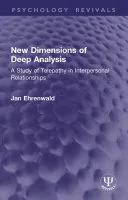
New Dimensions of Deep Analysis
 84
84

New Dimensions of Deep Analysis
Jan Ehrenwald’s *New Dimensions of Deep Analysis* offers a fascinating, albeit dated, look at integrating psi phenomena into mid-20th-century psychoanalysis. The strength of the book lies in Ehrenwald’s meticulous case studies, particularly his analysis of telepathic dreams occurring within the psychoanalytic setting. He attempts a scientific rigor rare for the time when discussing telepathy, defining concepts and presenting observations with a clinical detachment. However, the work’s limitation is precisely its 1954 context; the psychological theories and the very definition of "telepathy" feel anachronistic to contemporary readers. Ehrenwald's detailed examination of a patient's "telepathic dream" concerning his mother’s illness, which he correlates with his own unconscious processes, is a prime example of his method. Ultimately, *New Dimensions of Deep Analysis* is a valuable historical document for understanding the scientific and therapeutic attempts to bridge the psychic and the psychological.
📝 Description
84
Jan Ehrenwald published New Dimensions of Deep Analysis in 1954, examining occult phenomena through dynamic psychiatry.
Originally published in 1954, Jan Ehrenwald's New Dimensions of Deep Analysis offers a systematic examination of phenomena often labeled "occult." The book attempts to integrate telepathic experiences into psychoanalytic theory, moving beyond mere anecdote to structured observation. Ehrenwald sets forth definitions for telepathic phenomena and establishes criteria for their identification within a therapeutic context.
This work is relevant for psychoanalysts, psychiatrists, and researchers interested in the connections between the unconscious mind and telepathic communication. It also appeals to students of parapsychology and those studying the history of psychological thought, particularly its engagement with concepts outside conventional scientific understanding in the mid-20th century. Ehrenwald's effort to incorporate telepathic phenomena into the dominant Freudian and Jungian paradigms of the time was a notable departure from mainstream views, engaging with parapsychology while staying grounded in clinical practice.
Published in 1954, this book emerged during a period when dynamic psychiatry, influenced by Freudian and Jungian thought, was a leading paradigm. Ehrenwald's work engaged with the growing field of parapsychology, a discipline concerned with mental abilities outside the scope of established psychological and scientific understanding. His effort to reconcile these areas with clinical psychoanalytic practice represented a specific approach within the broader esoteric interest in consciousness and psychic phenomena prevalent in the mid-20th century.
💡 Why Read This Book?
• Gain insight into the historical psychiatric approach to telepathic phenomena, specifically Ehrenwald's 1954 framework for analyzing "telepathic dreams" within psychoanalytic sessions. • Understand the concept of "telepathic sensitivity" as explored by Ehrenwald, learning how it was theorized to influence the dynamic between analyst and patient. • Examine case studies of psi phenomena integrated into dynamic psychiatry, providing concrete examples of how these concepts were applied in clinical practice during the mid-20th century.
⭐ Reader Reviews
Honest opinions from readers who have explored this book.
❓ Frequently Asked Questions
What is the primary focus of Jan Ehrenwald's *New Dimensions of Deep Analysis*?
The book focuses on integrating telepathic or psi phenomena into the framework of dynamic psychiatry, using detailed analysis of telepathic dreams observed in psychoanalytic situations.
When was *New Dimensions of Deep Analysis* first published?
The original publication date for *New Dimensions of Deep Analysis* was January 6, 1954.
What kind of evidence does Ehrenwald use to support his theories?
Ehrenwald bases his discussion on detailed analyses of telepathic dreams observed within the psychoanalytic setting, examining communications between analyst and patient, and family members.
Who is the author of *New Dimensions of Deep Analysis*?
The author of *New Dimensions of Deep Analysis* is Jan Ehrenwald.
What is a key concept explored in the book regarding telepathy?
A key concept is "telepathic sensitivity," which Ehrenwald explores as a factor influencing the dynamic between analyst and patient in the psychoanalytic situation.
What historical period does the book reflect?
The book reflects the intellectual climate of the mid-20th century, specifically the era of dynamic psychiatry and the burgeoning field of parapsychology.
🔮 Key Themes & Symbolism
Telepathy in Psychoanalysis
Ehrenwald systematically investigates telepathic experiences as they manifest within the psychoanalytic dyad. He moves beyond mere anecdotal accounts to present structured observations and analyses of "telepathic dreams." The work defines criteria for identifying such phenomena, proposing that these subtle communications are not anomalies but potentially integral aspects of the unconscious interplay between analyst and patient, and even extending to the patient's family dynamics. This challenges the conventional separation of psychic and interpersonal spheres within therapeutic practice.
The Psychoanalytic Dream
The book re-examines the psychoanalytic dream not just as a product of individual unconscious processes but as a potential channel for extrasensory perception. Ehrenwald analyzes specific dream content that appears to reflect external, telepathically received information. This perspective expands the traditional interpretation of dreams, suggesting they can be influenced by or directly convey psychic transmissions from outside the dreamer's immediate awareness, offering a new dimension to dream analysis.
Defining Psi Phenomena
A central aim of *New Dimensions of Deep Analysis* is to define and establish criteria for "so-called telepathic (or psi) phenomena." Ehrenwald attempts to move these concepts from the field of the mystical or pseudoscientific into a more structured, observable framework within clinical psychology. He seeks to provide a systematic approach to understanding and documenting telepathic events, differentiating them from coincidence or projection, and exploring their potential diagnostic and therapeutic significance.
Analyst-Patient Telepathy
Ehrenwald specifically explores the hypothesis of telepathic communication occurring directly between the psychoanalyst and the patient. He presents case material suggesting that the therapist's own unconscious processes might be involved in receiving or interpreting telepathic transmissions from the patient, or vice-versa. This concept challenges the purely objective stance often assumed by the analyst, introducing the possibility of a shared psychic field influencing the therapeutic relationship.
💬 Memorable Quotes
Direct passages from the work, attributed to the author.
“Telepathy between analyst and patient, between mother and child, is not a myth but a clinical fact.”
— This statement expresses Ehrenwald's core thesis: that telepathic communication is a verifiable phenomenon observable within therapeutic and familial contexts, rather than mere superstition or fantasy.
“The criterion of the telepathic dream is its apparent connection with outside events.”
— This highlights Ehrenwald's method for identifying potential telepathic content in dreams, focusing on the correlation between dream imagery and external, unperceived information.
“So-called occult facts can be integrated into dynamic psychiatry.”
— This expresses the book's ambitious goal: to bridge the gap between conventional psychological science and phenomena typically dismissed as paranormal or "occult."
“Telepathic sensitivity plays a role in the analytic situation.”
— This suggests that an individual's capacity to send or receive telepathic impressions is a factor that can influence the therapeutic dynamic and the unfolding of analysis.
“A systematic attempt at integrating facts once misrepresented as 'occult'.”
— This phrase directly addresses the book's purpose, framing its contribution as a scholarly effort to legitimize and understand extraordinary experiences within a scientific paradigm.
🌙 Esoteric Significance
Tradition
While not explicitly aligned with a single esoteric lineage like Hermeticism or Kabbalah, Ehrenwald's work engages with the broader historical tradition of exploring consciousness beyond conventional materialist explanations. It touches upon concepts found in spiritualism and psychical research, common in the early-to-mid 20th century, seeking to harmonize them with the psychological theories of Freud and Jung. His approach represents an attempt to scientize what had often been relegated to mystical or occult belief systems.
Symbolism
The primary "symbol" Ehrenwald engages with is the telepathic dream itself. This motif symbolizes the porous boundary between the individual psyche and external reality, or between different psyches. The dream, traditionally a canvas for personal unconscious material, here becomes a potential interface for extrasensory perception. Other implicit symbols include the analyst-patient relationship as a crucible for these phenomena, and the "occult" itself, redefined not as superstition but as an observable, albeit poorly understood, aspect of human experience.
Modern Relevance
Contemporary interest in consciousness studies, transpersonal psychology, and even certain branches of neuroscience exploring non-local consciousness find echoes in Ehrenwald's work. Thinkers and practitioners who explore the potential for psi phenomena in therapeutic contexts, or who examine the role of intuition and subtle perception in healing, might find his early, systematic attempts at integration relevant. His work serves as a historical reference point for the ongoing dialogue between science and the unexplained aspects of the human mind.
👥 Who Should Read This Book
• Psychoanalysts and psychotherapists interested in the historical attempts to incorporate psi phenomena into clinical practice, offering a different perspective on transference and countertransference. • Researchers in parapsychology and consciousness studies seeking foundational texts that bridge early empirical research with psychoanalytic theory from the 1950s. • Students of the history of psychology and psychiatry looking to understand how unconventional ideas were addressed within the dominant scientific paradigms of the mid-20th century.
📜 Historical Context
In 1954, dynamic psychiatry, under the long shadow of Freud and the growing influence of Jung, dominated psychological discourse. Mainstream academic psychology, particularly in the United States, was increasingly focused on behaviorism and empirical methods, often treating parapsychology with derision. Jan Ehrenwald’s *New Dimensions of Deep Analysis* was a significant, though controversial, intervention. It directly challenged this skepticism by attempting to systematically integrate telepathic phenomena into the established psychoanalytic framework. While figures like J.B. Rhine were conducting laboratory experiments in parapsychology, Ehrenwald’s work was unique in its clinical application within the intimate analyst-patient relationship. His approach was less about statistical proof and more about observable case material and theoretical integration. The reception was divided, with some appreciating the bold attempt to expand psychological understanding, while others dismissed it as unscientific speculation, reflecting the era's entrenched dualism regarding the mind and psychic phenomena.
📔 Journal Prompts
The telepathic dream as a clinical fact within the analytic situation.
Telepathic sensitivity and its role in the analyst-patient dynamic.
Defining criteria for "so-called telepathic phenomena."
The integration of "occult" facts into dynamic psychiatry.
Correlations between a patient's dream content and external events.
🗂️ Glossary
Psi Phenomena
A general term used in parapsychology to denote mental or psychic abilities that are not explained by conventional physical or biological mechanisms, often including telepathy, clairvoyance, and precognition.
Dynamic Psychiatry
A branch of psychiatry that emphasizes the role of unconscious mental processes and the dynamic interplay of psychological forces in understanding and treating mental disorders, largely derived from psychoanalytic theory.
Telepathic Dream
A dream whose content is believed to be influenced by or derived from the thoughts, feelings, or experiences of another person, transmitted extrasensorially.
Analyst-Patient Dyad
The fundamental unit of psychoanalytic therapy, consisting of the relationship and interaction between the psychoanalyst and the patient.
Transference
In psychoanalysis, the unconscious redirection of feelings from one person, typically a parent, to another, such as the analyst.
Occult
In the context of Ehrenwald's work, refers to phenomena or knowledge traditionally considered hidden, mystical, or beyond the scope of conventional scientific understanding.
Telepathic Sensitivity
An individual's presumed capacity to perceive or transmit telepathic communications, considered by Ehrenwald as a factor within the therapeutic relationship.