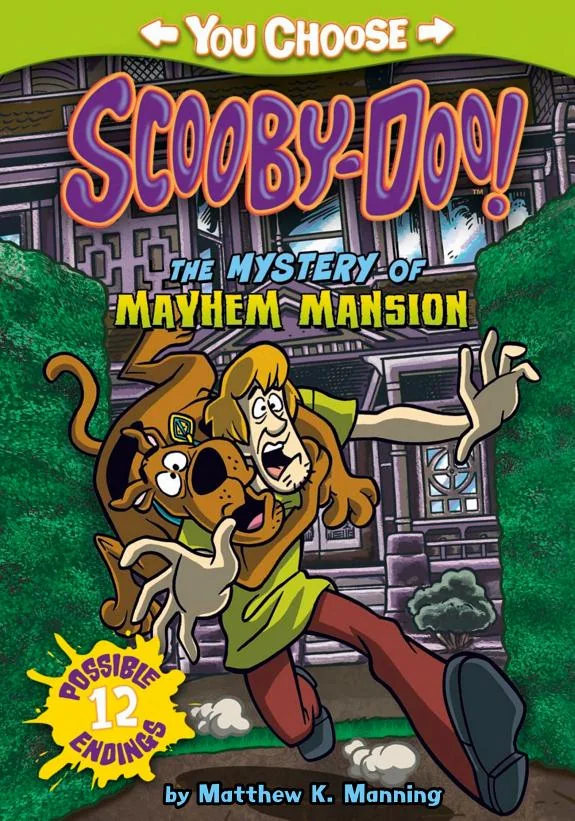
Mystery of the Mayhem Mansion
 83
83

Mystery of the Mayhem Mansion
Matthew K. Manning’s "Mystery of the Mayhem Mansion" offers a playful yet structurally interesting take on the interactive narrative, casting the Scooby-Doo gang into the shadows of a haunted estate. The strength lies in its straightforward branching paths, allowing young readers a tangible sense of control over the mystery's progression. However, the narrative's reliance on familiar Scooby-Doo tropes occasionally limits its surprise factor, adhering closely to established character dynamics and plot devices. A particularly engaging moment involves a choice early on concerning whether to investigate the dusty attic or the creaky cellar, each leading to distinctly different spectral encounters and clues. While the mystery itself is serviceable, the true value is in the mechanical exploration of narrative consequence. It’s a competent diversion for its target audience, though it doesn't redefine the interactive fiction genre.
📝 Description
83
Matthew K. Manning's 2016 book, Mystery of the Mayhem Mansion, puts readers directly into a Scooby-Doo mystery.
Mystery of the Mayhem Mansion is an interactive story published in 2016. The reader's choices directly shape the plot as they guide the Scooby-Doo gang through Mayhew Mansion. This format requires active participation to solve the central mystery.
Designed for young readers, the book appeals to those who enjoy mystery, adventure, and having control over the story's direction. Fans of the Scooby-Doo franchise will recognize the familiar characters and their quest. It also serves as engaging material for parents or educators seeking interactive reading options.
The book's central idea is reader agency within a story. This means following branching paths where each choice leads to a different outcome. By showing distinct results based on reader decisions, the book subtly illustrates how choices have consequences, a concept that can echo in more complex philosophical or spiritual explorations.
Published in 2016, this book aligns with a tradition of interactive fiction that emphasizes reader participation. While not directly from classical occult traditions, its structure mirrors esoteric systems where personal engagement and individual choices are key to understanding. The act of the reader shaping their path through the narrative can be seen as a simplified reflection of how personal experience and decision-making are central to spiritual or philosophical development in certain traditions.
💡 Why Read This Book?
• You will learn how to actively shape a narrative outcome by making specific choices, a skill directly applicable to understanding consequence. This is exemplified by the decision points presented when exploring the Mayhew Mansion's different wings. • You will experience the dynamic of the Mystery Inc. gang confronting the unknown, learning about teamwork and problem-solving under pressure. This is showcased when the gang must decide whether to split up or stick together. • You will feel the thrill of uncovering clues and piecing together a mystery, with your decisions directly impacting the resolution. This interactive process is central to the book’s design, particularly in how you approach the locked study.
⭐ Reader Reviews
Honest opinions from readers who have explored this book.
❓ Frequently Asked Questions
When was "Mystery of the Mayhem Mansion" first published?
The book "Mystery of the Mayhem Mansion" was first published on January 1, 2016. This interactive mystery invites readers into the world of Scooby-Doo.
Who are the main characters in "Mystery of the Mayhem Mansion"?
The main characters are the beloved Mystery Inc. gang, including Scooby-Doo, Shaggy, Fred, Daphne, and Velma. They are tasked with solving the mystery within Mayhew Mansion.
What makes "Mystery of the Mayhem Mansion" different from a standard book?
Its interactive format sets it apart. Readers make choices that directly influence the story's direction and outcome, unlike traditional linear narratives. This allows for multiple playthroughs.
What is the primary setting for the mystery?
The primary setting is the eerie and mysterious Mayhew Mansion. This location is filled with potential clues and spooky occurrences for the Mystery Inc. gang to investigate.
Is this book suitable for young children?
Yes, "Mystery of the Mayhem Mansion" is designed for young readers who enjoy mystery and interactive stories. Its familiar characters and straightforward choices make it accessible and engaging for this age group.
What skills can a reader develop from this book?
Readers can develop decision-making skills and an understanding of narrative consequence. By choosing different paths, they learn how actions lead to varied outcomes within the story.
🔮 Key Themes & Symbolism
Reader Agency
The central theme is the power of the reader's choices. Unlike passive consumption, this book demands active participation, where each decision—whether to explore the dusty attic or the shadowed library—charts a unique course through the Mayhew Mansion's secrets. This concept mirrors how personal volition is often considered a crucial element in spiritual or philosophical inquiry, where individual actions and decisions lead to distinct realizations or consequences. The narrative structure itself becomes a lesson in the impact of choice.
Mystery and Investigation
At its heart, the book is a classic whodunit, albeit one with variable endings. The Mystery Inc. gang applies their signature blend of deduction, bravery (often spurred by Scooby and Shaggy's fear), and teamwork to unravel the enigma of Mayhew Mansion. This theme taps into the universal appeal of solving puzzles and uncovering hidden truths, encouraging readers to think critically about clues and suspects as they read through the story's branches.
Familiar Characters, New Paths
The enduring appeal of Scooby-Doo and his friends provides a comforting framework for this interactive tale. Readers are invited to guide these beloved characters through unfamiliar territory, seeing how their established personalities react to the reader's direction. This allows for a fresh engagement with the franchise, offering new scenarios and potential outcomes that deviate from the standard television or film adventures, making the familiar feel new again.
Consequence and Outcome
Every choice presented in "Mystery of the Mayhem Mansion" leads to a specific consequence, shaping the unfolding events and ultimately determining the resolution of the mystery. This structure implicitly teaches about cause and effect. Whether a decision leads to a startling discovery or a temporary setback, the reader directly experiences how different actions yield different results, reinforcing the idea that pathways taken significantly alter the final destination.
💬 Memorable Quotes
Direct passages from the work, attributed to the author.
“Should we check the dark, spooky attic, or the creaky old cellar?”
— This choice point highlights the reader's immediate agency. It presents two classic haunted house locales, forcing an early decision that dictates the subsequent path of discovery within Mayhew Mansion.
“Split up and cover more ground, or stick together for safety?”
— This classic Scooby-Doo dilemma is put directly to the reader. The choice impacts how clues are found and the level of individual risk involved, directly influencing the investigation's efficiency and danger.
“Do we confront the shadowy figure, or try to sneak past?”
— This presents a critical decision involving direct engagement versus evasion. The outcome hinges on the reader's chosen approach, demonstrating how bravery or caution can drastically alter the narrative's progression.
“It seems the ghost's motive is tied to the old will.”
— This represents a potential clue discovered through reader-driven investigation. It suggests the mystery involves more than just a spectral apparition, hinting at human motivations and historical grievances.
“We solved the mystery of Mayhew Mansion!”
— This signifies the successful conclusion of a particular narrative path chosen by the reader. It underscores the book's interactive nature, where the reader's decisions lead to a definitive resolution.
🌙 Esoteric Significance
Tradition
While not explicitly part of a traditional esoteric lineage like Hermeticism or Gnosticism, "Mystery of the Mayhem Mansion" engages with a core principle found in many spiritual paths: the significance of personal choice and active participation in one's journey. Esoteric traditions often emphasize that understanding is not passively received but actively constructed through experience and volition. This book, through its interactive mechanics, offers a simplified, allegorical exploration of how individual decisions shape perceived reality and lead to different forms of knowledge or resolution.
Symbolism
The Mayhew Mansion itself can be viewed as a symbolic representation of the subconscious or the unknown. Its various rooms—the dusty attic, the creaky cellar, the shadowed library—symbolize different facets of the psyche or layers of hidden knowledge. The 'ghost' or 'mayhem' represents unresolved issues, hidden truths, or the disruptive forces that arise when these hidden aspects are disturbed. The Mystery Inc. gang's investigation symbolizes the process of confronting and integrating these unknown elements through inquiry and choice.
Modern Relevance
In contemporary times, the interactive nature of this book finds parallels in digital escape rooms, augmented reality experiences, and even certain therapeutic modalities that utilize guided imagination and choice-based scenarios. Thinkers and practitioners in fields like transmedia storytelling and gamification draw on principles of reader engagement and branching narratives. While not directly citing Manning, these modern applications echo the book's core concept: that interactive engagement is a powerful tool for learning, exploration, and experiencing diverse outcomes.
👥 Who Should Read This Book
• Young readers aged 8-12 who are fans of the Scooby-Doo franchise and enjoy interactive mysteries. They will gain experience in making narrative choices and seeing their direct impact. • Parents and educators seeking engaging, interactive reading material that encourages critical thinking and decision-making skills in children. They will find a tool that makes reading an active, rather than passive, pursuit. • Novice readers interested in exploring the concept of 'choose your own adventure' narratives. They will benefit from a familiar and low-stakes introduction to how reader choices can alter a story's path.
📜 Historical Context
Published in 2016, "Mystery of the Mayhem Mansion" arrived in a landscape where interactive digital games had largely eclipsed the print-based "choose your own adventure" format pioneered by Edward Packard and R.A. Montgomery in the late 1970s. While the physical book format saw a resurgence, titles like Manning's existed within a broader media ecosystem saturated with choice-based digital experiences. The Scooby-Doo franchise itself, originating in 1969, had undergone numerous iterations, reflecting changing animation styles and storytelling trends. This 2016 entry leverages the established brand recognition while adapting to a reader-centric narrative structure. It engaged with the legacy of interactive fiction without directly participating in the esoteric literary traditions that explored similar concepts of reader-response and experiential knowledge, which were more prevalent in earlier mystical texts.
📔 Journal Prompts
The choices presented within Mayhew Mansion.
The gang's reaction to encountering the 'ghost'.
Deciding whether to split up or stick together.
The clues found in the library versus the attic.
The final resolution based on your chosen path.
🗂️ Glossary
Mystery Inc. gang
The core group of teenage detectives and their Great Dane who solve mysteries. Members include Scooby-Doo, Shaggy, Fred Jones, Daphne Blake, and Velma Dinkley.
Mayhew Mansion
The primary setting of the mystery, a large, old, and reputedly haunted house where the Scooby-Doo gang investigates strange occurrences.
Interactive narrative
A story format where the reader makes choices that influence the plot's direction and outcome, leading to different scenes or endings.
Scooby Snacks
Special dog biscuits given to Scooby-Doo and often Shaggy as rewards or motivation, usually to overcome fear or perform a task.
Clues
Pieces of information or evidence discovered during the investigation that help the Mystery Inc. gang solve the mystery.
Red Herring
A misleading clue or piece of information intended to distract investigators or the reader from the true solution of the mystery.
Resolution
The conclusion of the mystery, where the culprit is revealed and their motives explained, achieved through the reader's guided choices.
This book appears in 1 collection
🔮 Readers Also Liked
Browse all →






From the “Haunted Places” Collection
View all →




More Free Occult Philosophy Books
View all →