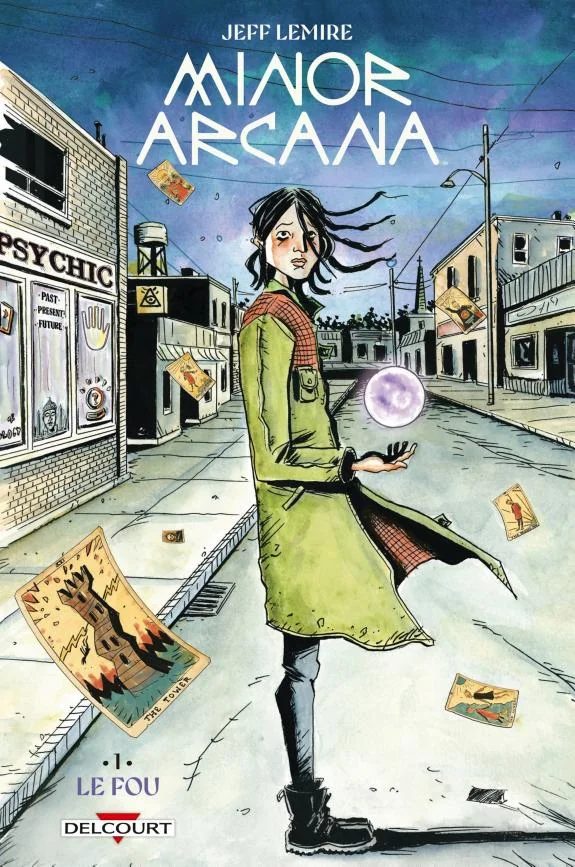
Minor Arcana T01 Le Fou
 72
72

Minor Arcana T01 Le Fou
Jeff Lemire’s "Minor Arcana T01 Le Fou" opens with a narrative hook that is as weary as it is intriguing. Theresa’s return to her hometown, ostensibly to care for her mother, is painted with a palpable sense of obligation rather than affection. Lemire excels at imbuing ordinary settings with an undercurrent of the uncanny, and this series debut is no exception. The initial skepticism surrounding her mother’s psychic abilities provides a grounded counterpoint to the burgeoning, undeniable magic Theresa encounters. A particular strength lies in Lemire's ability to make the supernatural feel both intrusive and disturbingly logical within the narrative's framework. The pacing, however, occasionally falters, lingering perhaps too long on Theresa’s initial cynicism before fully embracing the occult elements. Still, the groundwork laid in this first installment promises a complex exploration of inherited legacies, both magical and familial. It’s a promising, if slightly uneven, start to a potentially compelling occult saga.
📝 Description
72
Jeff Lemire's 2026 series Minor Arcana T01 Le Fou begins with Theresa returning home to a fraudulent psychic mother.
The first volume of Jeff Lemire's Minor Arcana series, Le Fou, introduces Theresa, a woman estranged from her mother, whose psychic abilities are widely dismissed as fake. Theresa's reluctant return to her hometown, prompted by her mother's illness, stirs up old resentments. The narrative immediately grounds its supernatural elements in the gritty realities of small-town life and the complex obligations of family. Lemire's signature character-driven approach is evident, focusing on Theresa's internal struggles and her growing entanglement with hidden, potentially perilous, magical forces. This series is for readers who appreciate stories that bend genres, questioning traditional ideas about magic and family bonds. Fans of Lemire's past work will find his characteristic blend of compelling characters and atmospheric settings here, filtered through a dark, often bleak, realism.
Le Fou distinguishes itself by situating its occult themes within contemporary, mundane anxieties. Unlike literature that focuses on overt spirituality or ritual, Lemire grounds the arcane in the everyday. The story examines the thin line between genuine supernatural phenomena and the psychological mechanisms of self-deception or manipulation. It questions the very nature of psychic powers and the motivations behind them, introducing the concept of 'bidon' abilities. Ultimately, the narrative concerns homecoming, familial duty, and the unexpected pull toward a destiny intertwined with magical realities hidden beneath a seemingly ordinary surface.
Published in 2026, Le Fou engages with occult themes through a modern, secular lens. It moves away from the overt spiritualism or historical pastiche common in earlier occult literature, grounding the mystical in the anxieties of contemporary small-town life and familial duty. Lemire’s approach contrasts with more ritualistic or overtly spiritual depictions, instead focusing on the blurred lines between genuine arcane forces, self-deception, and manipulation. This work reflects a cultural interest in the occult, but frames it within grounded, often bleak, realism, questioning the authenticity of spiritual gifts and the motivations behind them.
💡 Why Read This Book?
• Gain insight into how contemporary comics are reinterpreting occult themes, moving beyond traditional fantasy tropes as seen in Theresa's reluctant engagement with her mother's 'bidon' psychic powers. • Experience a unique blend of dark humor and cynical realism applied to magic, a style characteristic of Jeff Lemire's work exemplified in the initial chapters of "Minor Arcana T01 Le Fou." • Understand the narrative function of small-town settings in occult fiction, as Lemire grounds the supernatural in the familiar yet unsettling atmosphere of Theresa's hometown.
⭐ Reader Reviews
Honest opinions from readers who have explored this book.
❓ Frequently Asked Questions
What is the significance of 'Le Fou' in the context of the Minor Arcana series?
'Le Fou' translates to 'The Fool' in Tarot, representing new beginnings, innocence, and a leap of faith, often with a touch of recklessness. This title likely foreshadows Theresa's own unexpected journey into the occult.
Who is Jeff Lemire and what are his notable works?
Jeff Lemire is a celebrated Canadian comic book author and artist known for his character-driven stories with a melancholic tone. His acclaimed works include 'Sweet Tooth,' 'Essex County,' and 'The Nobody.'
When was 'Minor Arcana T01 Le Fou' first published?
The first publication date for 'Minor Arcana T01 Le Fou' is listed as February 5, 2026.
What are the primary genres mixed in this series?
The series masterfully combines elements of occultism, dark humor, and cynical realism, creating a unique narrative blend that sets it apart from conventional genre fiction.
What is the central conflict for the protagonist, Theresa?
Theresa is drawn back to her hometown to care for her ailing mother, a psychic whose powers are considered fake. She finds herself unexpectedly pulled into a world where magic appears to be very real.
Does this book require prior knowledge of Tarot or occultism?
While familiarity with Tarot (specifically 'The Fool' card) might enhance appreciation, the narrative is designed to introduce its esoteric concepts organically. Prior knowledge is not strictly necessary to follow Theresa's story.
🔮 Key Themes & Symbolism
The Performer's Veil
The narrative interrogates the authenticity of spiritual gifts, embodied by Theresa's mother, whose psychic powers are initially dismissed as 'bidon' (fake). This theme explores the fine line between genuine arcane ability and performance, questioning the motivations of those who claim supernatural insight and the audience's willingness to believe. It explores how societal skepticism can mask or even protect against true, potentially dangerous, occult forces.
Reluctant Inheritance
Theresa's return to her hometown is driven by obligation, not affection, highlighting a deep-seated resentment towards her family and its perceived eccentricities. The story positions her as an unwilling heir to a legacy she actively rejects. As she encounters undeniable magic, she is forced to confront this inheritance, suggesting that destiny, particularly when tied to the esoteric, cannot always be evaded.
Small Town Supernatural
Unlike grand mystical settings, the occult elements in 'Le Fou' manifest within the mundane, often bleak, field of a small town. This juxtaposition grounds the supernatural in relatable anxieties and familiar environments. The town itself becomes a character, harboring secrets and a unique brand of magic that is deeply intertwined with its inhabitants and history, making the extraordinary feel unnervingly close.
The Fool's Leap
The title 'Le Fou' directly references The Fool card of the Tarot, symbolizing a leap into the unknown, a journey of innocence and potential folly. For Theresa, this represents her forced entry into a magical reality she never believed in. The theme explores the consequences of such unprepared plunges, the risks involved, and the transformative power of embracing the unexpected, even when terrified.
💬 Memorable Quotes
Direct passages from the work, attributed to the author.
“Theresa's mother's psychic powers were widely considered 'bidon'.”
— This phrase expresses the initial skepticism and dismissal of the supernatural, setting up the core conflict between perceived fakery and emerging genuine magic. It highlights the narrative's grounded, cynical perspective on spiritual claims.
“The town desperately needed something more.”
— This statement hints at a deeper malaise within the community, suggesting a collective yearning or desperation that the encroaching magic might fulfill, or perhaps exacerbate. It implies the town itself is a character with its own needs.
“Magic might be more real than she ever imagined.”
— This represents the turning point for Theresa, the dawning realization that her cynical worldview is about to be shattered. It signifies her transition from disbelief to confronting an undeniable, potentially dangerous, reality.
“She found herself 'happée' by the town's secrets.”
— The French term 'happée' (sucked in, grabbed) conveys an involuntary and powerful pull. This suggests Theresa is not actively seeking magic but is being consumed by the town's hidden nature, indicating a loss of control.
💡 Key Ideas
Editorial paraphrase of the work's core concepts — not direct quotes.
She returned to her hometown not out of love, but out of duty.
This quote establishes Theresa's core motivation and emotional state upon her return. It immediately signals a strained familial relationship and a reluctance to engage with her past, setting a somber tone for her homecoming.
🌙 Esoteric Significance
Tradition
While not explicitly tied to a single historical lineage like Hermeticism or Kabbalah, 'Le Fou' draws heavily from the archetypal symbolism of the Tarot, specifically the Fool card. Its approach aligns with modern esoteric interpretations that seek to integrate mystical concepts into contemporary psychological and social frameworks, rather than adhering strictly to historical dogma. It represents a secularized, character-driven exploration of arcane themes, where magic is less about ritual and more about inherent, often disruptive, forces within individuals and their environment.
Symbolism
The primary symbol is 'Le Fou' (The Fool), representing innocence, a leap of faith, and the beginning of a journey, often fraught with unawareness of peril. The 'bidon' psychic powers symbolize deception and the unreliable nature of perception, questioning what constitutes true spiritual insight versus performance. The hometown itself functions symbolically as a container for hidden truths and a catalyst for transformation, representing the mundane world that conceals deeper, magical realities.
Modern Relevance
Contemporary creators and practitioners exploring the intersection of psychology, myth, and the uncanny find resonance in Lemire's work. Thinkers interested in how archetypal narratives function in secularized societies, or artists seeking to depict the supernatural not as external spectacle but as an intrinsic, often burdensome, aspect of human experience, draw inspiration from this style. Its blend of psychological realism with occult undertones speaks to a modern audience grappling with disillusionment and seeking meaning in unexpected places.
👥 Who Should Read This Book
• Readers interested in contemporary graphic novels that subvert genre expectations, particularly those who appreciate Jeff Lemire's previous explorations of flawed characters and atmospheric settings. • Students of Tarot and esoteric symbolism seeking modern interpretations of archetypes like The Fool, presented through narrative rather than purely theoretical study. • Fans of dark humor and cynical storytelling who are drawn to narratives where the supernatural intersects with mundane struggles and familial dysfunction.
📜 Historical Context
The early 2020s saw a surge in popular interest in esoteric subjects, fueled by online communities and a desire for meaning outside traditional structures. However, much of this engagement often leaned towards New Age spirituality or historical occultism. Jeff Lemire's "Minor Arcana T01 Le Fou," published in 2026, arrived during this period but distinguished itself by injecting a potent dose of grounded cynicism and dark humor, a departure from the earnestness often found in contemporary occult-themed media. While authors like Alan Moore were exploring the esoteric in comics with works like "Promethea" in the late 1990s and early 2000s, Lemire’s approach focuses less on grand magical theory and more on the messy, personal implications of the supernatural intruding upon ordinary lives. The book's reception likely highlighted its unique tone, appealing to readers weary of purely fantastical escapism and seeking a more complex, character-driven narrative engagement with mystical ideas, contrasting sharply with the more academic or purely fantastical takes on magic prevalent at the time.
📔 Journal Prompts
Theresa's initial cynicism towards her mother's 'bidon' psychic powers.
The symbolic weight of returning to one's hometown in the context of occult discovery.
The potential duality of magic: genuine force versus performance.
Interpreting 'Le Fou' not just as a Tarot card, but as a narrative archetype.
The town's desperation as a fertile ground for supernatural manifestation.
🗂️ Glossary
Le Fou
French for 'The Fool,' the first trump card in many Tarot decks. It typically represents new beginnings, innocence, spontaneity, and a leap of faith into the unknown, sometimes with an element of recklessness.
Bidon
A French slang term meaning fake, bogus, or worthless. In the context of the book, it refers to psychic powers that are perceived as fraudulent or lacking genuine efficacy.
Minor Arcana
In Tarot, the Minor Arcana are the four suits (Wands, Cups, Swords, Pentacles) that typically form the bulk of the deck, representing everyday events and challenges, as opposed to the Major Arcana's more significant life lessons.
Occultism
The study of hidden or secret knowledge, often concerning supernatural, mystical, or magical forces and phenomena. It encompasses a wide range of traditions and practices.
Psychic Powers
Abilities considered to be beyond the scope of currently accepted scientific understanding, such as telepathy, clairvoyance, or precognition. Often a subject of both belief and skepticism.
Hometown
The town where one grew up. In narrative, it often symbolizes roots, past traumas, unresolved issues, and a place from which characters may seek to escape or to which they are inevitably drawn back.
Cynicism
An attitude characterized by a general distrust of others' motives and a belief that people are motivated purely by self-interest. Often involves a bleak outlook on life.
This book appears in 1 collection
🔮 Readers Also Liked
Browse all →









From the “Minor Arcana” Collection
View all →






More Free Occult Philosophy Books
View all →