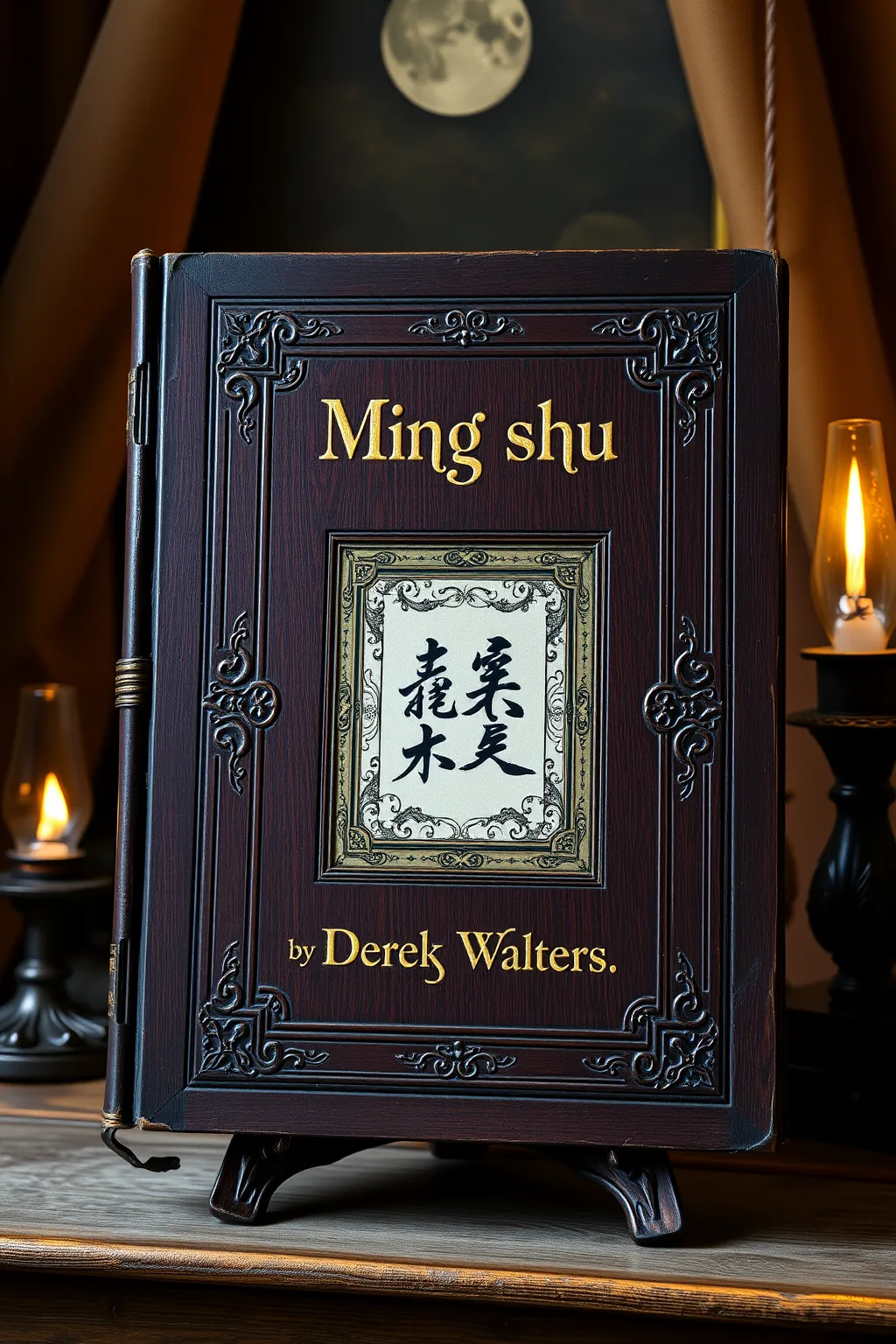
Ming shu
 83
83

Ming shu
Derek Walters' "Ming shu" offers a substantial deep dive into the mechanics of traditional Chinese geomancy that remains remarkably thorough decades after its initial 1987 release. The book's strength lies in its systematic presentation of concepts, particularly its detailed explanations of the Luo Pan's complex dial system and the calculation methods derived from the I Ching. Walters avoids the New Age gloss that often coats modern *feng shui* literature, instead presenting the material with a scholarly rigor. However, this very thoroughness can also be a limitation. The sheer density of information, especially concerning the intricate calculations and symbolisms, can be daunting for newcomers. A passage detailing the precise orientation of the Heavenly and Earthly charts on the Luo Pan, for instance, requires considerable concentration to fully grasp. For dedicated students of Chinese metaphysics, "Ming shu" is an authoritative and valuable reference; for the casual enthusiast, it presents a formidable challenge.
"Ming shu" is an essential reference for serious *feng shui* practitioners.
📝 Description
83
Derek Walters published "Ming shu" in 1987, detailing Chinese divination and feng shui.
First released in 1987, Derek Walters' "Ming shu" examines the principles and applications of Chinese divination and geomancy, with a specific focus on feng shui. The book goes beyond surface aesthetics to explain the environmental energies that influence human lives. It functions as a thorough manual, clarifying the complex systems connecting landscape, architecture, and individual destiny. This work is valuable for anyone wanting a deep grasp of classical feng shui. It addresses serious students of Chinese metaphysics, geomancers, architects, and interior designers aiming to use genuine, proven principles in their projects. Readers interested in the historical progression of esoteric practices or those seeking to apply these concepts for personal or professional growth will find "Ming shu" a crucial resource. The volume particularly suits those who prefer detailed explanations and a scholarly approach to mystical subjects.
"Ming shu" appeared as global interest in Eastern philosophies and esoteric traditions was growing. While Western esotericism had its own established paths, the 1980s saw a rise in translated texts and academic studies concerning Asian spiritual systems. Walters' book offered a detailed look at feng shui, a practice that was starting to become known in the West, often in simplified forms. This work presented a more authentic, historically based viewpoint, contrasting with emerging superficial interpretations. Its release by a respected esoteric publisher at the time signaled a developing demand from academics and practitioners for accurate, in-depth material.
Published in 1987, "Ming shu" entered a period where Western interest in Eastern esoteric systems was increasing. While feng shui was gaining some popularity, Walters' work aimed to provide a more authentic and historically grounded perspective than the simplified versions often presented. It situates itself within the tradition of classical Chinese metaphysics and geomancy, offering a scholarly examination of practices designed to harmonize human environments with natural forces.
💡 Why Read This Book?
• You will learn specific methods for interpreting the Luo Pan, a geomancer's compass, allowing you to engage with *feng shui* beyond superficial interpretations, as detailed in chapters covering its construction and use. • You will gain a concrete understanding of how the Five Elements (*wu xing*) and Yin/Yang principles are applied to analyze landscape formations and architectural layouts, providing practical insight into environmental harmony. • You will discover the historical lineage of *feng shui* practice, understanding its connection to the I Ching and classical Chinese cosmology, offering a grounded perspective distinct from modern adaptations.
⭐ Reader Reviews
Honest opinions from readers who have explored this book.
❓ Frequently Asked Questions
What is the primary focus of Derek Walters' "Ming shu"?
"Ming shu" primarily focuses on traditional Chinese geomancy, specifically the practice of *feng shui*. It details the principles of analyzing environmental energies, using tools like the Luo Pan, and applying concepts such as the Five Elements and the Eight Trigrams to harmonize spaces.
When was "Ming shu" by Derek Walters first published?
Derek Walters' "Ming shu" was first published in 1987, positioning it as an important work during a period of growing Western interest in Eastern esoteric traditions.
What is the Luo Pan mentioned in "Ming shu"?
The Luo Pan is a specialized magnetic compass used in *feng shui* and other Chinese metaphysical arts. "Ming shu" dedicates significant attention to its intricate dials and their application in geomantic analysis.
Does "Ming shu" cover modern interpretations of feng shui?
While "Ming shu" discusses various historical schools of *feng shui*, its strength lies in presenting authentic, classical principles rather than contemporary or Westernized adaptations, offering a scholarly approach.
Who would benefit most from reading "Ming shu"?
Serious students of Chinese metaphysics, practitioners of *feng shui*, architects, and researchers interested in the historical and technical aspects of geomancy will find "Ming shu" particularly beneficial due to its detailed and systematic approach.
What are the Five Elements (*wu xing*) in the context of "Ming shu"?
The Five Elements (Wood, Fire, Earth, Metal, Water) are fundamental forces discussed extensively in "Ming shu". They are used to analyze the energetic qualities of environments and their interactions, influencing health and fortune.
🔮 Key Themes & Symbolism
Luo Pan Geomancy
The book extensively details the Luo Pan, the specialized compass central to *feng shui*. Walters explains its multi-layered dials, including the Heavenly Palace, Earthly Branches, and the 24 Mountains, providing instructions on how to read and utilize its complex information for site analysis. This focus underscores the book's commitment to the technical, computational aspects of classical geomancy, moving beyond purely intuitive or decorative applications and emphasizing the scientific rigor inherent in traditional Chinese practices.
Principles of Qi Flow
Central to "Ming shu" is the concept of *qi*, or vital energy, and its flow through the landscape and built environment. Walters illustrates how natural features like mountains and watercourses, as well as the placement and design of buildings, influence the quality and movement of *qi*. The text elaborates on methods for identifying auspicious and inauspicious *qi* patterns, aiming to guide readers in creating environments that enhance prosperity, health, and well-being by harmonizing with these energetic currents.
The Five Elements and Bagua
Walters meticulously explains the foundational cosmological systems of the Five Elements (*wu xing*: Wood, Fire, Earth, Metal, Water) and the Eight Trigrams (*bagua*). The book demonstrates how these frameworks are applied in *feng shui* to understand the relationships and interactions between different environmental factors and their impact on human affairs. This systematic application of classical Chinese philosophy provides a deep theoretical basis for the geomantic analyses presented throughout the work.
Classical Feng Shui Schools
Rather than presenting a monolithic view, "Ming shu" acknowledges the diversity within *feng shui* practice by discussing different historical schools. It differentiates between the Form School (*xing shi pai*), which emphasizes the physical landscape, and the Compass School (*li qi pai*), which relies on direction and calculations using the Luo Pan. This comparative approach offers readers a more comprehensive and nuanced understanding of the evolution and methodologies within traditional Chinese geomancy.
💬 Memorable Quotes
Direct passages from the work, attributed to the author.
“The Luo Pan is the geomancer's essential tool.”
— This statement highlights the indispensable nature of the Luo Pan in traditional Chinese geomancy. It signifies that accurate analysis and application of *feng shui* principles are impossible without a thorough understanding and correct use of this specialized compass.
“Mountains are the bones, water is the blood of the land.”
— This metaphorical quote from the book captures the Form School's emphasis on landscape. It explains that mountains represent the stable, structural elements of an environment, while water signifies the dynamic, life-giving circulation, both crucial for assessing *qi*.
“The Five Elements are in constant interaction and transformation.”
— This interpretation emphasizes the dynamic nature of the *wu xing* cycle. It points to the interconnectedness of Wood, Fire, Earth, Metal, and Water, and how their generative and destructive cycles are fundamental to understanding and manipulating environmental energies.
“Directional calculations are key to Compass School analysis.”
— This statement underscores the quantitative and directional focus of the Compass School of *feng shui*. It implies that precise calculations based on orientation, often using the Luo Pan, are paramount for determining auspiciousness and making recommendations.
💡 Key Ideas
Editorial paraphrase of the work's core concepts — not direct quotes.
Harmony with the environment leads to prosperity.
This paraphrased concept reflects the core objective of *feng shui* as presented in "Ming shu". It suggests that aligning human habitation with the natural energetic flows of the earth is not merely aesthetic but directly contributes to positive outcomes in life.
🌙 Esoteric Significance
Tradition
"Ming shu" firmly belongs to the tradition of Chinese metaphysics, specifically geomancy or *feng shui*. It draws heavily upon Taoist cosmology, the principles of Yin and Yang, and the I Ching. While distinct from Western esoteric lineages like Hermeticism or the Kabbalah, it shares a common goal of understanding and harmonizing with unseen universal forces to influence terrestrial affairs, representing a vital branch of global esoteric practice.
Symbolism
Key symbols in "Ming shu" include the Luo Pan, a complex cosmological map and compass, representing the structured understanding of cosmic forces. The Eight Trigrams (*bagua*) symbolize fundamental natural forces and directions, serving as a primary interpretive tool. The Five Elements (*wu xing*) represent the dynamic interplay of energies that constitute all phenomena, providing a framework for analyzing environmental interactions and their impact.
Modern Relevance
Contemporary *feng shui* practitioners, particularly those seeking to move beyond simplified Westernized versions, often reference "Ming shu" as a foundational text. Architects and designers interested in sustainable and energetically balanced environments may consult its principles. Furthermore, scholars of comparative religion and cultural history find it important for understanding the historical development and theoretical underpinnings of Chinese geomancy.
👥 Who Should Read This Book
• Aspiring *feng shui* practitioners seeking a rigorous, classical foundation: Readers will gain a deep understanding of the Luo Pan, the Five Elements, and the *bagua*, enabling them to approach geomancy with authentic historical methodology. • Students of Chinese metaphysics and cosmology: This book offers a detailed exploration of core Taoist principles as applied to environmental analysis, providing crucial context for related disciplines like I Ching divination. • Architects and designers focused on harmonious spaces: Professionals can learn to integrate ancient principles of energetic flow and environmental interaction into their design processes, moving beyond purely aesthetic considerations.
📜 Historical Context
Published in 1987, Derek Walters' "Ming shu" arrived during a significant period for Western engagement with Eastern esoteric thought. While figures like Madame Blavatsky and the Theosophical Society had introduced concepts from India and Tibet earlier in the 20th century, the late 1980s saw a burgeoning interest in Chinese metaphysics, including *feng shui*, often filtered through popular interpretations. Walters' work distinguished itself by providing a detailed, scholarly account grounded in classical texts and practices, contrasting with more superficial New Age adaptations. It emerged alongside other scholarly works that sought to present authentic Asian traditions. The book's reception indicated a growing demand for rigorous, unadulterated knowledge of practices like geomancy, moving beyond the mystical currents of Western Hermeticism and Kabbalah that had previously dominated the esoteric landscape.
📔 Journal Prompts
The Luo Pan's intricate dials and their relationship to the celestial and terrestrial realms.
Analyzing the cyclical interactions of the Five Elements in a given environment.
The application of the Eight Trigrams (*bagua*) to a specific location or building.
Identifying sources of auspicious and inauspicious *qi* in natural landscapes.
The historical lineage connecting the I Ching to *feng shui* practice.
🗂️ Glossary
Qi (Chi)
Vital energy or life force that permeates all things. In *feng shui*, the flow and quality of *qi* in an environment are crucial for health, prosperity, and well-being.
Luo Pan
A specialized Chinese magnetic compass used in *feng shui* and other geomantic practices. It features multiple concentric rings or dials displaying various cosmological and directional information.
Wu Xing
The Five Elements or Five Phases: Wood, Fire, Earth, Metal, and Water. They represent fundamental forces and their dynamic interactions, used to analyze relationships and transformations in nature and human affairs.
Bagua
The Eight Trigrams, derived from the I Ching. Each trigram represents a fundamental principle of nature, a direction, a family member, and various other correspondences, used extensively in *feng shui* analysis.
Feng Shui
Literally 'wind-water'. The traditional Chinese art and science of harmonizing human existence with the surrounding environment by analyzing and manipulating the flow of vital energy (*qi*).
Form School (Xing Shi Pai)
A traditional school of *feng shui* that emphasizes the analysis of the physical landscape—mountains, rivers, and landforms—as the primary determinant of auspiciousness.
Compass School (Li Qi Pai)
A traditional school of *feng shui* that relies heavily on directional calculations, astronomical data, and the use of the Luo Pan to determine the energetic qualities of a site.
🔮 Readers Also Liked
Browse all →








More by Derek Walters
All books →




More Free Astrology & Cosmology Books
View all →