Meditations on the Tarot
 73
73

Meditations on the Tarot
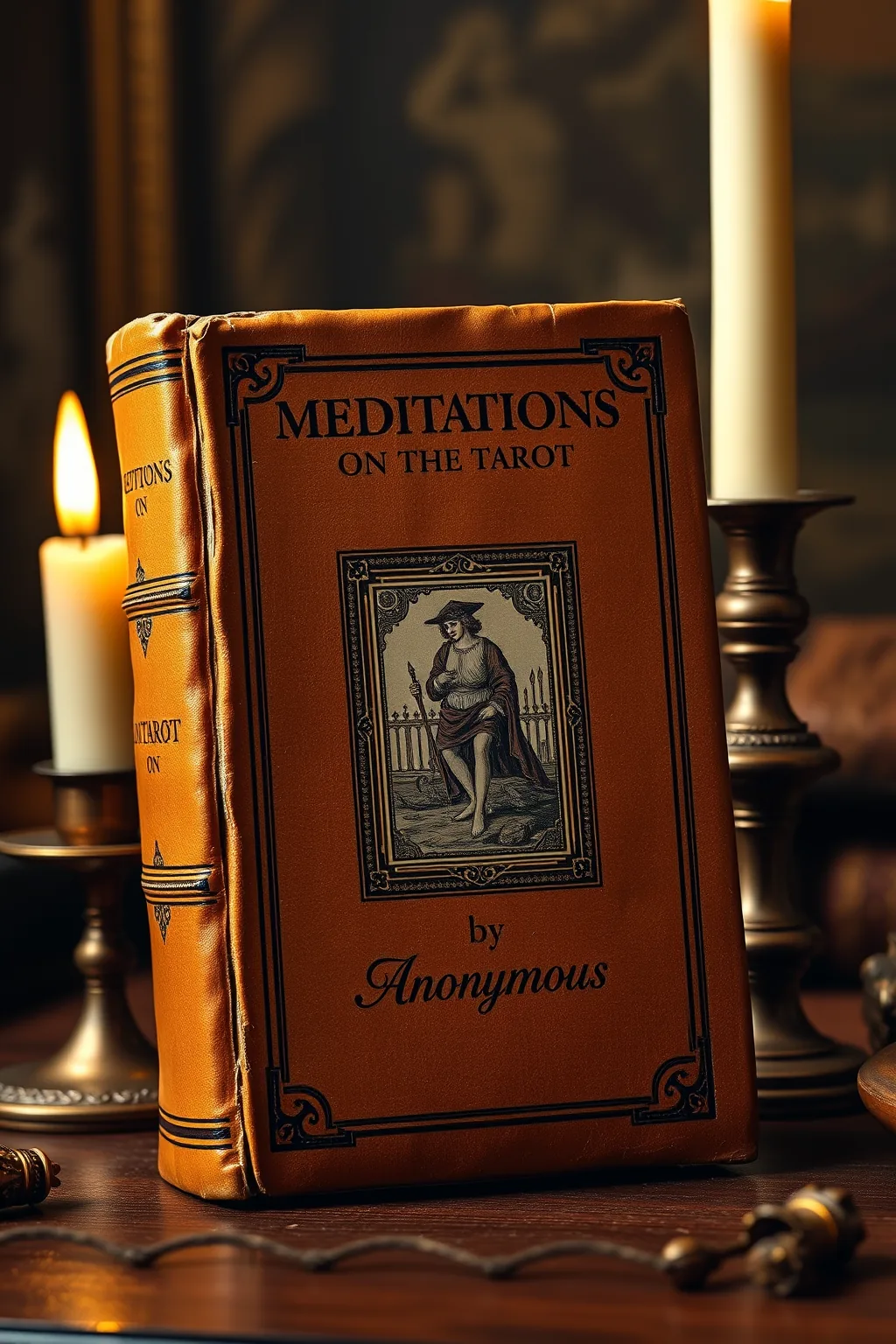
The Anonymous author's Meditations on the Tarot presents the Major Arcana as a profound spiritual syllabus, a stance refreshingly distinct from typical Tarot literature. Robert Powell's expanded edition, published in 2020, clarifies its roots in esoteric Christianity and Hermeticism. Its strength lies in its systematic, philosophical approach, treating the cards as keys to understanding spiritual evolution rather than mere predictive tools. A notable limitation is the dense, sometimes archaic prose, which can make the text challenging for newcomers. The exploration of the Fool's journey through the archetypal figures, particularly the discussion of the Empress as a representation of divine creative force, exemplifies the book's unique interpretive depth. Ultimately, this work offers a rigorous, contemplative framework for engaging with the Tarot's symbolic landscape.
📝 Description
73
First published in its current form in 2020, Meditations on the Tarot applies Hermetic principles to the Major Arcana.
This expanded edition interprets the Tarot, specifically the 22 Major Arcana, not as a tool for fortune-telling, but as a symbolic map for spiritual development. It applies the Hermetic principle of "as above, so below" to understand the relationship between the physical body, soul, and spirit. The work aims to reveal deeper mysteries of human existence through the archetypal imagery of the cards. It is written for serious students of esoteric traditions, particularly Christian esotericism and Hermeticism, who seek a philosophical engagement with the Tarot. The book appeals to those interested in comparative mysticism and integrating ancient spiritual ideas with contemporary understanding.
The text draws on the Hermetic tradition, which traces back to Hellenistic times and Hermes Trismegistus. This approach to the Tarot reflects a trend in late 19th and early 20th-century occultism, influenced by movements like Theosophy and Rosicrucianism. These groups sought to synthesize various spiritual traditions. The 2020 publication of this expanded edition places it within current interest in these historical esoteric currents. The book views the Tarot as a "ladder of the soul," where each Major Arcana card represents a step on the path to divine consciousness.
Meditations on the Tarot is rooted in the Hermetic tradition, a philosophical and spiritual current originating in the Hellenistic period, attributed to Hermes Trismegistus. The book's application of the "as above, so below" principle to the Tarot's Major Arcana aligns with late 19th and early 20th-century occultism. Movements such as Theosophy and Rosicrucianism, which aimed to synthesize diverse spiritual teachings, also influenced this approach. The work situates itself within contemporary renewed interest in these historical esoteric currents.
💡 Why Read This Book?
• You will learn to view the 22 Major Arcana as a map of spiritual progression, a concept central to the book's unique Hermetic interpretation of the Tarot, offering a path beyond simple divination. • You will gain a deeper understanding of esoteric Christianity by exploring how the book applies the "as above, so below" principle to the soul's journey, as detailed in its discussions of destiny and spiritual development. • You will feel a renewed sense of purpose by engaging with the book's interpretation of archetypes, particularly its portrayal of the cards as stages in the evolution of consciousness, as outlined in the expanded 2020 edition.
⭐ Reader Reviews
Honest opinions from readers who have explored this book.
❓ Frequently Asked Questions
What is the core philosophy behind Meditations on the Tarot?
The core philosophy applies the Hermetic principle "as above, so below" to the 22 Major Arcana of the Tarot, viewing them as stages in the soul's spiritual ascent and understanding of destiny.
Is this book for beginners interested in Tarot card readings?
While it uses the Tarot, this book is for advanced students of esoteric traditions. It focuses on philosophical and spiritual interpretation rather than practical divination techniques.
When was the expanded edition of Meditations on the Tarot published?
The expanded edition, edited by Robert Powell, was first published on January 7, 2020, making its comprehensive approach accessible to contemporary readers.
What does the book mean by 'destiny-body'?
The 'destiny-body' refers to the physical existence as intricately linked to spiritual purpose and evolution, a concept explored through the symbolic journey of the Tarot's Major Arcana.
Does the book focus on the Minor Arcana as well?
The primary focus is on the 22 Major Arcana, which the book presents as the essential framework for understanding the spiritual path and the soul's development.
What is the historical tradition referenced in the book?
The book is deeply rooted in the Hermetic tradition, a mystical and philosophical current that influenced Western esotericism from antiquity, particularly concerning the relationship between the microcosm and macrocosm.
🔮 Key Themes & Symbolism
Tarot as Spiritual Ladder
The book presents the 22 Major Arcana as a structured path for spiritual evolution, akin to a ladder ascending towards divine consciousness. Each card represents a distinct stage or challenge in the soul's journey. This interpretive framework moves beyond simple fortune-telling, positioning the Tarot as a profound pedagogical tool for self-understanding and spiritual growth, deeply rooted in esoteric Christian thought and Hermetic philosophy.
Hermeticism and 'As Above, So Below'
A foundational principle of the work is the Hermetic axiom "as above, so below." This concept is applied to the Tarot, suggesting that the macrocosmic order (universal principles, divine realms) is reflected in the microcosm (human consciousness, individual destiny). The book uses the Major Arcana to illustrate how understanding these universal laws can illuminate the path of the soul and the nature of the 'destiny-body'.
The Destiny-Body and Soul Evolution
The text explores the concept of the 'destiny-body,' integrating physical existence with spiritual purpose. It posits that the human form is a vessel for the soul's journey, and understanding the symbolic language of the Tarot can reveal the unfolding of one's destiny. This perspective emphasizes the interconnectedness of material and spiritual realities in the process of soul evolution.
Esoteric Christian Interpretation
Meditations on the Tarot offers a distinct perspective within esoteric Christianity. It reinterprets traditional Christian symbolism and narrative through the lens of the Tarot archetypes, presenting a mystical path of initiation and realization. This approach seeks to uncover deeper spiritual meanings within familiar religious frameworks, aligning them with broader Hermetic and Gnostic currents.
💬 Memorable Quotes
Direct passages from the work, attributed to the author.
“The Tarot is a ladder of the soul.”
— This concise statement captures the book's central thesis, framing the Tarot's Major Arcana not as random symbols but as ordered steps in a spiritual ascent towards higher consciousness.
“The meaning of the cards applies to the destiny-body, soul, and spirit.”
— This highlights the holistic approach of the text, indicating that the Tarot's wisdom is relevant to all facets of human existence, from the physical to the spiritual.
“As above, so below.”
— This classic Hermetic maxim is the hermeneutical key to the book, suggesting that the universal divine order is mirrored in the individual human experience and spiritual journey.
“The cards trace the path of initiation.”
— This interpretation emphasizes the transformative and developmental aspect of the Tarot as presented in the book, viewing it as a guide through stages of spiritual awakening and mastery.
“The Fool represents the beginning of the spiritual quest.”
— This points to the archetypal journey initiated by The Fool card, symbolizing innocence, potential, and the initial step into the unknown on the path of spiritual discovery.
🌙 Esoteric Significance
Tradition
The work is firmly rooted in the Western Esoteric Tradition, specifically drawing from Christian Esotericism and Hermeticism. It synthesizes these streams by applying the core Hermetic principle of "as above, so below" to the structure of the Tarot's Major Arcana. It departs from some Kabbalistic interpretations by emphasizing a Christian narrative of spiritual evolution and divine union, viewing the Tarot as a symbolic map of this journey.
Symbolism
Key symbols include the 22 Major Arcana, each representing a stage or archetype in the soul's journey. The Fool, for instance, signifies pure potential and the beginning of the spiritual quest. The High Priestess often symbolizes hidden knowledge and intuition, while The World represents completion and integration. The book interprets these through a lens of Christian mysticism and Hermetic philosophy, connecting them to concepts of divine creation and the unfolding of destiny.
Modern Relevance
Contemporary practitioners of Western Esotericism, particularly those interested in Hermeticism, Christian mysticism, and symbolic philosophy, continue to engage with this work. Its rigorous, non-divinatory approach to the Tarot appeals to scholars and serious students seeking a deeper understanding of archetypal psychology and spiritual development, influencing modern contemplative practices and esoteric studies.
👥 Who Should Read This Book
• Students of esoteric Christianity seeking to understand the spiritual path through symbolic language, as presented via the Major Arcana. • Practitioners of Hermeticism looking for a text that applies "as above, so below" to a structured esoteric system beyond alchemy or astrology. • Comparative religion scholars interested in how Western esoteric traditions interpret archetypal imagery and spiritual development using the Tarot.
📜 Historical Context
Meditations on the Tarot emerged from a rich soil of late 19th and early 20th-century esoteric revival. While the expanded edition was published in 2020, its core content draws from traditions influenced by Eliphas Lévi and the French occult revival. This period saw a surge in interest in Hermeticism, Kabbalah, and Gnosticism, often synthesized within movements like the Hermetic Order of the Golden Dawn and Theosophy. The book's approach, focusing on the Major Arcana as a spiritual path rather than a predictive tool, distinguished it from more popular divinatory systems. Its esoteric Christian framework positioned it uniquely against more purely Kabbalistic or Egyptian-influenced Tarot interpretations prevalent at the time. The work's profound engagement with Christian mysticism aligns it with figures like Carl Jung, who also explored archetypes in the human psyche, though Jung's approach was primarily psychological rather than explicitly theological.
📔 Journal Prompts
The Fool's initial leap: Reflect on the potential represented by this archetype.
The High Priestess's veiled wisdom: Explore your inner intuitive guidance.
The Emperor's structure: Consider the balance between authority and freedom in your life.
The Hermit's inner journey: Examine a time of solitary introspection and its revelations.
The World's completion: Ponder the integration of diverse aspects of your being.
🗂️ Glossary
Major Arcana
The 22 trump cards of the Tarot deck, traditionally representing significant life lessons, spiritual archetypes, and major stages of the soul's journey.
Hermeticism
A philosophical and religious tradition based on the writings attributed to Hermes Trismegistus, emphasizing esoteric knowledge, spiritual transformation, and the interconnectedness of the cosmos.
As Above, So Below
A fundamental Hermetic principle stating that the microcosm (humanity, the Earth) reflects the macrocosm (the divine, the universe), implying correspondence between different levels of reality.
Destiny-Body
A concept referring to the physical form as an instrument and manifestation of one's spiritual purpose and unfolding destiny throughout life.
Esoteric Christianity
A branch of Christian thought focused on hidden, inner, or mystical teachings, often seeking deeper spiritual meanings beyond literal interpretation, shared with traditions like Gnosticism and Hermeticism.
Archetype
A universal, symbolic pattern or image found in the collective unconscious, representing fundamental human experiences and motivations, such as those depicted in the Tarot's Major Arcana.
Initiation
A ritual or process marking a transition into a new stage of spiritual understanding, knowledge, or membership within a mystery school or esoteric tradition.
![Ancient fragments of the Phœnician, Chaldæan, Egyptian, Tyrian, Carthaginian, Indian, Persian, and other writers; with an introductory dissertation: and an inquiry into the philosophy and trinity of the ancients. By Isaac Preston Cory […]](/img/thumb/ancient-fragments-of-the-ph-nician-chald-an-egyptian-tyrian-carthaginian-indian-persian-and-other-writers-with-an-introductory-dissertation-and-an-inquiry-into-the-philosophy-and-trinity-of-the-ancien.webp)