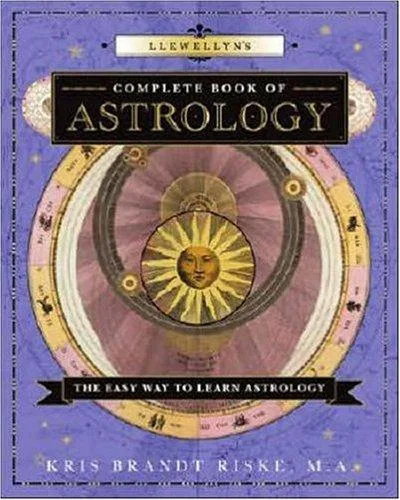
Llewellyn's Complete Book of Astrology
 78
78

Llewellyn's Complete Book of Astrology
Kris Brandt Riske’s Llewellyn’s Complete Book of Astrology offers a commendably straightforward entry point into a field often perceived as arcane. Its strength lies in its unwavering focus on the natal chart as the primary interpretive tool, a strategy that demystifies the process for newcomers. The initial chapters, detailing the Sun, Moon, and Ascendant, provide immediate and tangible insights that many readers will find validating. However, the book occasionally leans towards a somewhat generalized presentation of planetary and sign meanings, which, while accessible, might lack the nuanced psychological depth explored by more advanced texts. A particularly well-executed section is its explanation of the 'houses,' clearly delineating how celestial energies translate into specific life domains. Ultimately, Riske provides a functional, well-organized manual for the aspiring astrologer, prioritizing clarity over esoteric complexity.
📝 Description
78
Kris Brandt Riske's Llewellyn's Complete Book of Astrology was published in September 2010.
This book serves as a thorough introduction to astrological concepts, detailing natal charts, planetary positions, zodiac signs, houses, and aspects. Riske encourages readers to start by examining their own birth charts, seeing this as a way to understand the larger language of the cosmos. The goal is to make abstract astrological ideas more approachable and personally meaningful, which aids in learning and remembering them.
It is aimed at people new to astrology who want a clear path into the subject. The volume is also useful for those with some astrological knowledge who want to improve their chart interpretation skills. Riske's approach suits anyone interested in using celestial mechanics for self understanding, whether for personal growth or to help others.
Published in 2010, Riske's work draws on the psychological astrology that gained prominence in the mid-20th century, influenced by figures like Dane Rudhyar. It synthesizes established astrological principles into a format accessible to a modern audience. This book stands apart from more academic or specialized astrological texts, aiming for clarity and practical application for contemporary readers interested in self discovery through celestial patterns.
💡 Why Read This Book?
• Gain a foundational understanding of your personal astrological blueprint by analyzing the placement of planets within the twelve houses, as detailed in the book's house system explanations. • Decipher the interplay between your Sun, Moon, and Ascendant, understanding how these core components shape your identity and emotional expression, as introduced in the early chapters. • Learn to interpret the angular relationships between planets, known as aspects, to grasp the dynamic energies at play in your natal chart, a concept thoroughly explored in the latter sections.
⭐ Reader Reviews
Honest opinions from readers who have explored this book.
❓ Frequently Asked Questions
What is the primary benefit of starting astrology with one's own birth chart, as suggested by Llewellyn's Complete Book of Astrology?
Starting with your birth chart makes astrology personally meaningful and easier to grasp. By deciphering your unique gifts and challenges, you experience astrological concepts in a way that aids understanding and memory, making it a practical self-discovery tool.
How does Llewellyn's Complete Book of Astrology explain the different parts of a birth chart?
The book breaks down the birth chart into its core components: the twelve zodiac signs, the ten planets, and the twelve houses. It also details aspects, the angles between planets, to explain their interactions and influences on personality and life events.
Is Llewellyn's Complete Book of Astrology suitable for someone with no prior knowledge of astrology?
Yes, the book is specifically designed as a primer for beginners. It adopts a step-by-step approach, beginning with fundamental concepts and encouraging readers to apply them to their own charts, which facilitates learning.
What are 'aspects' in astrology, and how does this book cover them?
Aspects are the geometric relationships between planets in a birth chart. Llewellyn's Complete Book of Astrology explains how these angular connections reveal the dynamics and interplay of different planetary energies, influencing how they express themselves.
Who is Kris Brandt Riske, the author of Llewellyn's Complete Book of Astrology?
Kris Brandt Riske is the author of this comprehensive guide to astrology, first published in 2010. The book is recognized for its accessible approach to natal chart interpretation for new learners.
When was Llewellyn's Complete Book of Astrology first published?
Llewellyn's Complete Book of Astrology was first published on September 8, 2010. This date marks its entry into the contemporary astrological literature landscape.
🔮 Key Themes & Symbolism
Natal Chart as Self-Portrait
The book posits the birth chart not merely as a predictive tool, but as a profound map of the self. It frames the intricate interplay of planetary positions, zodiacal signs, and house placements as a unique blueprint detailing an individual's innate potentials, inherent challenges, and life's overarching purpose. By focusing interpretation on the reader's own chart, Riske anchors abstract astrological concepts in personal experience, fostering a deeper, more intuitive grasp of one's cosmic signature and inherent psychological landscape.
The Language of Planets and Signs
Central to Riske's approach is the systematic exploration of the twelve zodiac signs and the ten classical planets. Each sign is presented as an archetypal energy, and each planet as a distinct psychological function or life force. The book meticulously details the meaning of each planetary placement within each sign, offering insights into how these energies combine and express themselves. This detailed breakdown provides a foundational vocabulary for understanding astrological symbolism and its application to personality and life events.
Navigating Life's Domains (Houses)
The twelve astrological houses are presented as the arenas of life where the energies of the planets and signs play out. Llewellyn's Complete Book of Astrology elucidates how specific houses correspond to distinct areas such as self, possessions, communication, home, creativity, work, relationships, and spirituality. Understanding these house placements is crucial for applying astrological insights to practical, everyday situations, allowing readers to identify where their strengths lie and where potential growth areas exist within their personal life trajectory.
Interpreting Planetary Dynamics (Aspects)
Beyond individual placements, the book emphasizes the critical role of aspects – the angular relationships between planets in the birth chart. These aspects are portrayed as indicators of dynamic interaction, revealing how different parts of the psyche harmonize or create tension. Riske explains the major aspects (conjunction, opposition, square, trine, sextile) and their implications, providing readers with the tools to interpret the complex internal dialogues and energetic patterns that shape their experiences and drive their personal evolution.
💬 Memorable Quotes
Direct passages from the work, attributed to the author.
“Your astrological birth chart is a powerful tool for gaining a deeper understanding of your unique gifts, talents, challenges, and life's purpose.”
— This statement expresses the book's core philosophy: astrology as a personalized guide for self-awareness and existential exploration, moving beyond mere prediction to a deeper understanding of one's inherent nature.
“As you begin to decipher the wealth of information in your own birth chart, you'll experience astrology in a personally meaningful way—which makes it easier to understand and remember.”
— This highlights the pedagogical strategy employed by Riske, emphasizing experiential learning through self-analysis as the most effective route to internalizing astrological principles and their relevance.
“Once you learn the basics of astrology, you'll be able to read the birth charts of yourself and others.”
— This points to the practical outcome of engaging with the book's content, suggesting that the foundational knowledge imparted is sufficient for basic chart interpretation, thereby empowering readers to explore astrology beyond their personal charts.
“The easiest way to learn astrology is to start with yourself.”
— This concise assertion frames the book's entire approach, positioning the individual's natal chart as the most accessible and relevant starting point for anyone starting an astrological study.
“Your astrological birth chart is a map of your life's journey.”
— This metaphor underscores the book's perspective on the birth chart as a comprehensive guide, not just for understanding present personality traits but also for anticipating the contours and potential directions of one's life path.
🌙 Esoteric Significance
Tradition
This work fits within the modern Western esoteric tradition, specifically its psychological and self-help branches. It draws upon the long lineage of Hermeticism and Neoplatonism, which view the cosmos as a reflection of divine order and human consciousness. While not explicitly Kabbalistic or Gnostic, it shares the Hermetic principle of 'As Above, So Below,' interpreting celestial patterns as symbolic representations of terrestrial life and the human psyche. Riske's approach democratizes astrological knowledge, making it a tool for personal empowerment rather than solely a predictive or divinatory art.
Symbolism
Key symbols include the twelve zodiac signs, each representing archetypal human experiences and personality potentials (e.g., Aries as the initiator, Cancer as the nurturer). The ten planets serve as potent symbols for fundamental psychological drives and functions (e.g., Mercury for communication, Venus for attraction). The twelve houses symbolize the distinct spheres of life where these energies manifest, from the self (1st House) to spiritual understanding (12th House). The book interprets these symbols not as fixed destinies but as dynamic energies to be understood and integrated.
Modern Relevance
Contemporary thinkers and practitioners in fields like transpersonal psychology, coaching, and mindfulness often draw upon astrological frameworks like those presented by Riske. The book's emphasis on the natal chart as a tool for self-understanding and personal development appeals to modern therapeutic approaches seeking to empower individuals. Astrologers practicing evolutionary astrology or psychological astrology continue to build upon the foundational interpretive methods Riske outlines, using the birth chart to explore soul purpose and psychological patterns in a contemporary context.
👥 Who Should Read This Book
• Aspiring astrologers seeking a structured, beginner-friendly introduction to natal chart interpretation, who want to understand the basic meanings of planets, signs, and houses. • Individuals interested in self-discovery and personal growth, looking for a framework to explore their unique strengths, challenges, and life purpose through astrological symbolism. • Students of comparative spirituality or esotericism wanting to understand the practical application of Western astrological principles in a modern, accessible format.
📜 Historical Context
The publication of Llewellyn's Complete Book of Astrology in 2010 occurred within a broader cultural milieu where interest in personal growth and esoteric knowledge was substantial, amplified by digital platforms. Riske's work aligns with the modern psychological astrology movement, which gained significant traction from the mid-20th century onwards, influenced by figures like Carl Jung and his emphasis on archetypes and the collective unconscious. While Riske doesn't directly engage with historical astrological traditions like Ptolemaic or Hellenistic astrology, her synthesis draws on the foundational principles established over centuries. The book's accessible, beginner-focused format distinguishes it from more academic or specialized astrological texts that might cater to niche historical research or advanced esoteric practitioners. Its reception was generally positive within popular astrology circles, contributing to the ongoing accessibility of astrological study for a wide audience.
📔 Journal Prompts
Your Sun sign's core expression and how it manifests in your daily life.
The placement of your Moon sign and its connection to your emotional needs.
The meaning of your Ascendant in relation to how you present yourself to the world.
How the energies of the twelve houses illuminate different areas of your experience.
The interplay between two key planets, such as your Mercury and Venus aspects, and their influence on your communication and values.
🗂️ Glossary
Natal Chart
A personalized astrological chart representing the positions of the Sun, Moon, planets, and sensitive points at the exact moment and location of a person's birth. It is used for interpretive analysis of personality and life path.
Zodiac Sign
One of the twelve divisions of the ecliptic (the Sun's apparent path) used in astrology. Each sign (Aries, Taurus, etc.) is associated with a specific set of archetypal qualities and symbolic meanings.
Planet
In astrology, the Sun and Moon are considered 'planets' along with Mercury, Venus, Mars, Jupiter, Saturn, Uranus, Neptune, and Pluto. They represent different psychological functions and energies within the birth chart.
House
One of the twelve divisions of the celestial sphere, determined by the time and location of birth. Each house represents a different area or domain of life experience.
Aspect
The angular relationship between two or more planets or sensitive points in an astrological chart. Aspects describe the dynamics and interplay of the energies involved.
Ruler
The planet that governs a specific zodiac sign. For example, Mars rules Aries, and Venus rules Taurus. The sign a planet rules in your chart indicates its energetic nature.
Degree
A unit of measurement for celestial positions, where a full circle is divided into 360 degrees. Planets and points are located at specific degrees within zodiac signs and houses.