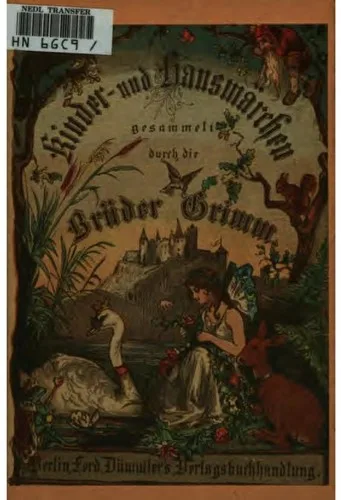
Kinder- und Hausmärchen
 72
72

Kinder- und Hausmärchen
The Grimm brothers' Kinder- und Hausmärchen offers a potent, often unsettling, glimpse into the pre-Victorian European psyche. The raw power of these narratives, stripped of later embellishments, is their primary strength. One is struck by the stark morality and the visceral consequences meted out to characters, a far cry from modern sanitized versions. For instance, the tale of "The Juniper Tree" presents a level of retribution that is both horrifying and deeply resonant with ancient concepts of justice and rebirth. However, the collection's sheer volume and the sometimes-repetitive structural elements can feel daunting to a casual reader. The uncritical presentation of violence and hardship, while historically significant, requires a discerning reader. It stands as a vital, if challenging, source document for understanding the roots of Western narrative.
📝 Description
72
The Brothers Grimm published their Kinder- und Hausmärchen in 1812, aiming to preserve German cultural identity.
The Kinder- und Hausmärchen, first released in 1812 by the Brothers Grimm, is more than a collection of children's stories. It functions as a significant source for folklore studies and a record of European mythic consciousness. The Grimms gathered these tales from oral traditions and existing writings, intending to codify German cultural identity during a time of political change. Their initial goal was scholarly, focusing on preserving linguistic and cultural heritage, rather than solely for juvenile entertainment.
This collection is important for folklorists, comparative mythologists, and students of German cultural history. It also attracts readers interested in the archetypal patterns found in Western narratives and symbolic systems. Those seeking the original forms of familiar tales, prior to later sanitization and adaptation, will find material for analysis. The volume appeals to individuals who value the academic rigor of folklore collection and the historical context that shapes stories.
While the Grimms' primary intent was scholarly preservation, their collection taps into deeper currents of European folklore and consciousness. These tales, drawn from common traditions, reflect ancient motifs and symbolic language that resonate beyond their immediate cultural context. Their survival and transmission illustrate a collective memory, a repository of shared human experiences and psychological structures that can be interpreted through an esoteric lens. The raw, often unvarnished nature of the original versions hints at older, less domesticated layers of meaning present in the European psyche.
💡 Why Read This Book?
• Gain insight into the original, unvarnished narratives that form the bedrock of Western folklore, understanding the specific archetypes present in tales like "Hansel and Gretel" before their modern adaptations. • Analyze the historical and cultural forces shaping German identity in the early 19th century by examining the Grimm brothers' conscious effort to collect and preserve these stories in 1812. • Explore early European symbolic language and morality through specific motifs, such as the transformative power of the enchanted forest, which appears across multiple tales.
⭐ Reader Reviews
Honest opinions from readers who have explored this book.
❓ Frequently Asked Questions
When were the first Grimm fairy tales published?
The first edition of Kinder- und Hausmärchen by the Brothers Grimm was published in 1812, containing 86 stories collected from oral and written sources.
Were the Grimm brothers collecting tales for children initially?
No, the initial intent of the Brothers Grimm was scholarly, to preserve German folklore and language. The stories were later adapted for children, with subsequent editions featuring revisions.
What is the significance of the Brothers Grimm in folklore studies?
Jacob and Wilhelm Grimm are considered pioneers of folklore studies. Their meticulous collection and annotation of these tales established a methodology for studying oral traditions and preserved a vast corpus of European mythic narratives.
Are these the same stories I know from modern fairy tales?
Many are recognizable, but the original versions in Kinder- und Hausmärchen often contain more graphic violence, complex social commentary, and different moral outcomes than their sanitized, modern counterparts.
Where did the Brothers Grimm find these stories?
They gathered stories from various sources, including oral retellings by friends, family, and acquaintances, as well as from existing literary works and chapbooks, aiming for authenticity in their 1812 collection.
What does "Kinder- und Hausmärchen" mean?
"Kinder- und Hausmärchen" translates directly from German to "Children's and Household Tales," reflecting its dual purpose as both a collection of popular stories and a scholarly endeavor.
🔮 Key Themes & Symbolism
Archetypal Journeys
The collection is replete with narratives that follow the structure of a quest or trial. Protagonists, often young and seemingly unprepared, are thrust into challenging circumstances that test their virtue, intelligence, and resilience. These journeys frequently involve encounters with supernatural beings, navigating dangerous landscapes, and overcoming obstacles that reflect internal psychological struggles. The resolution of these journeys, whether through marriage, restoration, or punishment, serves as a powerful commentary on societal values and the consequences of one's actions within the narrative framework.
The Unseen World
A defining characteristic of these tales is the porous boundary between the mundane and the magical. Enchanted forests, hidden cottages, and the intervention of fairies, witches, and talking animals are commonplace. This exploration of the unseen world reflects pre-modern European cosmologies where the supernatural was an integrated part of existence, not separate from it. The tales often serve as allegorical explorations of spiritual or psychological forces, using fantastical elements to represent abstract concepts like temptation, fate, or innate human potential.
Justice and Retribution
The moral field of Kinder- und Hausmärchen is often stark, characterized by clear delineations of good and evil, with swift and often severe consequences. Acts of kindness are rewarded, while cruelty, greed, and deceit are met with fitting punishment, sometimes involving gruesome details. This reflects an older, more direct concept of justice, where balance is restored through direct intervention, whether divine, magical, or communal. The tales function as cautionary narratives, reinforcing societal norms and ethical frameworks through dramatic examples.
Social Hierarchy and Transformation
Many stories implicitly or explicitly address the social structures of the time, often depicting the struggles of the poor or dispossessed against oppressive authority or misfortune. Transformation is a frequent motif, not only in the magical sense (e.g., beasts turning into princes) but also in social mobility. Characters can ascend from poverty to wealth or fall from grace, underscoring the precariousness of social standing and the role of fortune, virtue, or cunning in navigating these shifts.
💬 Memorable Quotes
Direct passages from the work, attributed to the author.
“A bird in the hand is worth two in the bush.”
— This proverb, featured within the tales, expresses a pragmatic worldview emphasizing the value of what one possesses over uncertain future gains, reflecting a grounded approach to life's opportunities.
“The wolf ate her.”
— A stark and direct statement found in several narratives, this phrase signifies the brutal reality of predation and the unforgiving nature of the wild, representing a primal threat.
“And they lived happily ever after.”
— While often a concluding phrase, its original context suggests a resolution to severe trials and hardships, indicating a return to stability and peace after significant struggle.
“He who has not yet been at death's door, knows nothing of the world.”
— This concept suggests that true understanding and wisdom are only gained through profound suffering or near-death experiences, framing hardship as a necessary teacher.
💡 Key Ideas
Editorial paraphrase of the work's core concepts — not direct quotes.
Little mouse, little mouse, your life is in my hand.
This line, often spoken by a character holding power over another, highlights themes of vulnerability and dependence, where the fate of one rests entirely on the mercy or will of another.
🌙 Esoteric Significance
Tradition
While not explicitly aligned with a singular esoteric tradition like Hermeticism or Gnosticism, Kinder- und Hausmärchen functions as a foundational text for understanding the archetypal psychology that underpins many Western esoteric paths. The tales tap into the collective unconscious, drawing from ancient mythologies and pre-Christian European folk beliefs that resonate with animistic and nature-based spiritualities. Their enduring power lies in their ability to communicate profound truths about the human condition through symbolic narrative, a method favored by various esoteric schools seeking to convey wisdom beyond literal interpretation.
Symbolism
The collection is rich with potent symbols. The 'enchanted forest' often represents the subconscious mind or a liminal space of transformation, where ordinary rules do not apply and hidden potentials are revealed. Animals, such as wolves or birds, frequently act as spirit guides or embodiments of primal forces, offering wisdom or posing threats depending on the narrative context. Objects like spinning wheels or mirrors can symbolize fate, illusion, or the revelation of hidden truths, acting as catalysts for crucial plot developments and character revelations.
Modern Relevance
Contemporary depth psychology, particularly the work of Carl Jung and his followers, draws heavily on the archetypal patterns found in these tales. Modern pagan and witchcraft traditions often reinterpret the folkloric elements and nature spirits depicted as guides for understanding the natural world and elemental forces. Furthermore, narrative therapists and storytellers utilize the structures and archetypes within the Grimm collection to explore personal growth, healing, and the universal human journey of overcoming adversity.
👥 Who Should Read This Book
• Students of comparative mythology and folklore seeking the foundational texts of Western narrative traditions and the origins of commonly recognized fairy tales. • Psychologists and individuals interested in archetypal psychology and the collective unconscious, exploring the symbolic language that speaks to universal human experiences. • Cultural historians and scholars of German identity, examining how these tales reflected and shaped national consciousness in the early 19th century.
📜 Historical Context
The early 19th century in Germany was a period of intense nationalistic fervor and cultural self-definition, largely in reaction to French occupation under Napoleon. The Brothers Grimm, Jacob and Wilhelm, were deeply embedded in this intellectual climate, alongside figures like philosopher Johann Gottlieb Fichte, who also advocated for a distinct German identity. Their collection, Kinder- und Hausmärchen, first published in 1812, was conceived as a scholarly endeavor to preserve the authentic voice of the German people, drawing heavily on oral traditions and earlier printed sources. This effort paralleled broader Romantic-era interests in folk culture and national heritage, contrasting with the Enlightenment's focus on universal reason. While lauded by many German nationalists, the collection also faced criticism from some quarters for its perceived lack of literary polish and its sometimes violent or unsettling content, a reception that led to revisions in later editions.
📔 Journal Prompts
The enchanted forest's threshold: what inner landscape does it represent for you?
The deceptive allure of the gingerbread house: how does temptation manifest in your life?
The role of the wise old woman or man: what guidance have you received from unexpected sources?
The transformative power of trials: reflect on a hardship that reshaped your perspective.
Animal helpers and hindrances: what animal symbolism speaks to your current challenges?
🗂️ Glossary
Archetype
A universal, inherited pattern of thought or imagery derived from the collective unconscious, often recurring in myth, literature, and folklore. Examples include the Hero, the Trickster, and the Great Mother.
Liminal Space
A transitional or in-between state or place, often associated with rituals, journeys, or transformations. In folklore, enchanted forests or crossroads can serve as liminal spaces.
Folklore
The traditional beliefs, customs, and stories of a community, passed through the generations by word of mouth. It encompasses myths, legends, folktales, proverbs, and rituals.
Collective Unconscious
A concept proposed by Carl Jung, referring to a layer of the unconscious mind that is shared by all humanity, containing archetypes and universal patterns.
Motif
A recurring element, subject, or idea in a literary, artistic, or musical work. In folklore, a motif can be a specific plot element, character type, or symbol.
Oral Tradition
The transmission of cultural knowledge, history, and stories from one generation to another by spoken word, rather than by writing.
Sanitization
The process of removing or altering elements considered unpleasant, violent, or inappropriate, often applied to older stories to make them more palatable for modern audiences.
🔮 Readers Also Liked
Browse all →








More by Gebrüder Grimm [Brothers Grimm]
All books →




More Free Occult Philosophy Books
View all →