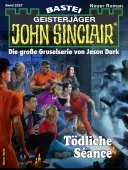
John Sinclair 2257
 74
74

John Sinclair 2257
Marlene Klein’s John Sinclair 2257 opens with an arresting image: Brooke Adams, mere minutes from a séance, is already seized by a dread that feels like a dragon's claw. Klein excels at rendering palpable unease, making the very architecture of the building—a long, unnaturally wide corridor—a source of palpable tension. This early focus on atmosphere and psychological foreboding is the work's significant strength. However, the narrative’s initial promise of exploring deep esoteric currents occasionally falters, becoming more grounded in suspense than metaphysical exploration as the blurb suggests. The concept of the oppressive feeling, a potent symbol of preternatural awareness, is compelling but its full esoteric implications feel underdeveloped by the narrative’s end. Ultimately, John Sinclair 2257 offers a compelling, atmospherically rich, albeit somewhat contained, psychological thriller.
📝 Description
74
John Sinclair 2257, published in October 2021, centers on Brooke Adams' apprehension before a séance.
Marlene Klein's John Sinclair 2257, released in October 2021, builds psychological suspense around Brooke Adams' approaching séance. An unsettling dread colors her experience, amplified by the setting's unnerving details, such as a corridor built for potential conflict. Klein uses these elements to cultivate an atmosphere of anticipation and unease. The narrative focuses on what precedes a significant, possibly dangerous, ritualistic event.
This work suits readers who favor tense, atmospheric narratives driven by psychological unease. Those drawn to characters confronting their own anxieties and the unknown, especially in environments that feel both practical and subtly threatening, will find resonance here. The book appeals to readers who believe the setting significantly shapes the unfolding drama and where a protagonist's internal state is as important as external actions.
Published in 2021, John Sinclair 2257 engages with speculative fiction's ongoing examination of consciousness and societal anxieties. Its emphasis on psychological unease and the anticipation of a ritualistic event connects to a resurgent interest in occult themes. This interest has historical roots stretching back to figures like Helena Blavatsky and the Theosophical Society in the late 19th century. The novel's future setting of 2257 allows for a projection of contemporary fears onto a distant horizon.
💡 Why Read This Book?
• Gain insight into the use of environmental psychology to amplify psychological dread, as seen in the description of the wide corridor, a technique that can inform your understanding of atmospheric writing. • Experience the specific sensation of premonition, termed 'beklemmendes Gefühl,' which serves as a narrative device to explore anxiety and anticipation before a significant event like the séance. • Understand how speculative settings, such as the year 2257, can be employed to project contemporary anxieties onto a future landscape, offering a unique lens on societal unease.
⭐ Reader Reviews
Honest opinions from readers who have explored this book.
❓ Frequently Asked Questions
What is the primary emotional state evoked in John Sinclair 2257?
The primary emotional state is one of profound unease and psychological dread, personified by Brooke Adams's 'beklemmendes Gefühl' (oppressive feeling) as she approaches the séance.
When was John Sinclair 2257 first published?
John Sinclair 2257 was first published on October 12, 2021.
What is the significance of the building's architecture in the story?
The architecture, particularly the long and unusually wide corridor, is designed to heighten the sense of unease and suggest a space prepared for significant, possibly confrontational, events.
Who is the author of John Sinclair 2257?
The author of John Sinclair 2257 is Marlene Klein.
What kind of narrative does John Sinclair 2257 seem to be?
It appears to be a psychological suspense narrative with esoteric undertones, focusing on a character's internal state and anticipation of an unusual event.
Does the book explore specific esoteric traditions?
While the blurb hints at esoteric undertones and a séance, the specific traditions explored are not detailed, suggesting a focus on general atmosphere and psychological impact rather than a deep dive into a particular lineage.
🔮 Key Themes & Symbolism
Anticipatory Dread
The narrative foregrounds the psychological state of 'beklemmendes Gefühl,' an oppressive, anticipatory dread that precedes the séance. This feeling is not merely emotional but seems to possess an intuitive, almost precognitive quality, suggesting an awareness of unseen forces or impending significant events. The work explores how this palpable sense of unease can permeate a character's perception of their surroundings, transforming ordinary spaces into harbingers of the unknown and imbuing the moments before an event with intense psychological weight.
Environmental Psychology
John Sinclair 2257 utilizes the physical environment as a mirror and amplifier of internal states. The description of the building's architecture, specifically the long, unnaturally wide corridor, is not incidental but serves to externalize Brooke Adams's anxiety. Such spaces are presented as conducive to confrontation or significant passage, their functional design imbued with a subtle menace. This theme suggests that the built environment can actively shape psychological experience, contributing to a sense of foreboding and preparing the protagonist, and the reader, for whatever lies beyond.
The Unseen Influence
Central to the book's esoteric undertones is the exploration of unseen influences that shape human experience. The séance itself is the focal point of this, but the pervasive dread suggests that these influences are already at play. The narrative seems to question the boundary between the internal psychological landscape and external, potentially spiritual or energetic, forces. The work probes how individuals perceive and react to these subtle yet powerful dynamics, particularly when on the cusp of engaging with the unknown or the occult.
💬 Memorable Quotes
Direct passages from the work, attributed to the author.
“a beklemmendes Gefühl like the claw of an invisible dragon around her chest”
— This vivid metaphor captures the visceral, suffocating nature of Brooke's pre-séance anxiety, suggesting a primal, almost physical manifestation of unseen dread that grips her.
“The architecture of the building was purposefully thought out.”
— This statement highlights the deliberate design of the setting, implying that the functional aspects of the building are intentionally crafted to contribute to the narrative's atmosphere of suspense and unease.
“Wide enough to pass fellow inmates without touching.”
— This detail about the corridor's width introduces a subtle but disturbing implication of confinement and isolation, even within a shared space, hinting at themes of separation or potential conflict.
“She breathed deeply, trembling.”
— This simple action conveys Brooke's struggle to maintain composure in the face of overwhelming fear, illustrating the physical impact of psychological distress.
“Several minutes and an even greater distance still separated Brooke Adams from the séance.”
— This sentence establishes the temporal and spatial tension, emphasizing the prolonged period of anticipation and escalating dread before the central event.
🌙 Esoteric Significance
Tradition
While John Sinclair 2257 does not explicitly align with a single defined esoteric tradition like Kabbalah or Theosophy, it draws upon the general atmosphere and thematic concerns prevalent in late 19th and early 20th-century spiritualism and occultism. The séance serves as a focal point, suggesting an engagement with mediumship and the potential for communication with non-physical realms, a common practice in early spiritualist movements. The narrative’s emphasis on psychological dread preceding such an event taps into a broader esoteric understanding of psychic sensitivity and the energetic impact of ritualistic gatherings.
Symbolism
The 'beklemmendes Gefühl' (oppressive feeling) functions as a potent symbol of psychic sensitivity or premonition, representing an intuitive awareness of unseen forces or impending danger. The architecture, particularly the 'long and particularly wide' corridor, symbolizes a liminal space or a threshold. Its unusual dimensions suggest it is designed for passage, perhaps ritualistic or confrontational, amplifying the sense of anticipation and potential peril associated with the séance.
Modern Relevance
Contemporary practitioners of esoteric arts and speculative fiction authors continue to explore the intersection of psychology and the supernatural. John Sinclair 2257’s focus on atmospheric dread and the psychological impact of perceived unseen forces speaks to modern explorations of consciousness, anxiety, and the uncanny. It speaks to a contemporary interest in how internal states can be influenced by or interact with subtle environmental and energetic factors, a theme relevant to various forms of modern occultism and psychological studies of fear.
👥 Who Should Read This Book
• Readers interested in psychological thrillers that utilize atmosphere and environmental cues to build suspense, particularly those who appreciate a subtle infusion of the uncanny. • Individuals exploring the thematic connections between psychological states (like dread and anticipation) and potential supernatural or esoteric events, such as séances. • Fans of speculative fiction that sets its narrative in a near-future context (2257) to explore contemporary anxieties through a slightly distanced lens.
📜 Historical Context
Marlene Klein's John Sinclair 2257, published in 2021, arrives in a literary landscape where psychological thrillers often incorporate elements of the uncanny and the esoteric. The work echoes a lineage of speculative fiction that emerged in the late 20th century, influenced by writers like Philip K. Dick, who explored altered states of consciousness and paranoia. The book's focus on a séance and preternatural dread can be traced to the enduring fascination with spiritualism and occult phenomena that peaked in the late 19th and early 20th centuries, championed by figures such as Arthur Conan Doyle. Klein’s 2021 publication places it within a contemporary resurgence of interest in these themes, often filtered through modern psychological frameworks. While not directly engaging with a specific school of thought like Gnosticism or Hermeticism in the provided blurb, its thematic concerns align with broader contemporary explorations of subjective reality and the nature of fear, differentiating it from more rigidly defined esoteric texts.
📔 Journal Prompts
The 'beklemmendes Gefühl' as a premonitory sign: how does it manifest?
Reflect on the symbolism of the wide corridor in relation to psychological states.
Consider the role of environmental design in amplifying suspense.
Analyze the tension between anticipation and the unknown event.
Explore the connection between internal dread and external perception.
🗂️ Glossary
Séance
A meeting where people attempt to make contact with the spirits of the dead, often involving a medium.
Beklemmendes Gefühl
A German term translating to an oppressive, constricting, or deeply unsettling feeling; a palpable sense of dread or anxiety.
Psychological Suspense
A genre of fiction that relies on creating tension and anticipation through the mental and emotional states of characters rather than overt action.
Esoteric Undertones
Elements within a narrative that suggest hidden meanings, occult knowledge, or spiritual/mystical themes not immediately apparent.
Environmental Psychology
The study of the interplay between human beings and their surroundings, focusing on how the environment affects feelings, thoughts, and behaviors.
Premonition
A strong feeling that something is about to happen, especially something unpleasant; foresight of the future.
Liminal Space
A place of transition, waiting, or threshold; a space that is in-between physical or metaphorical states.