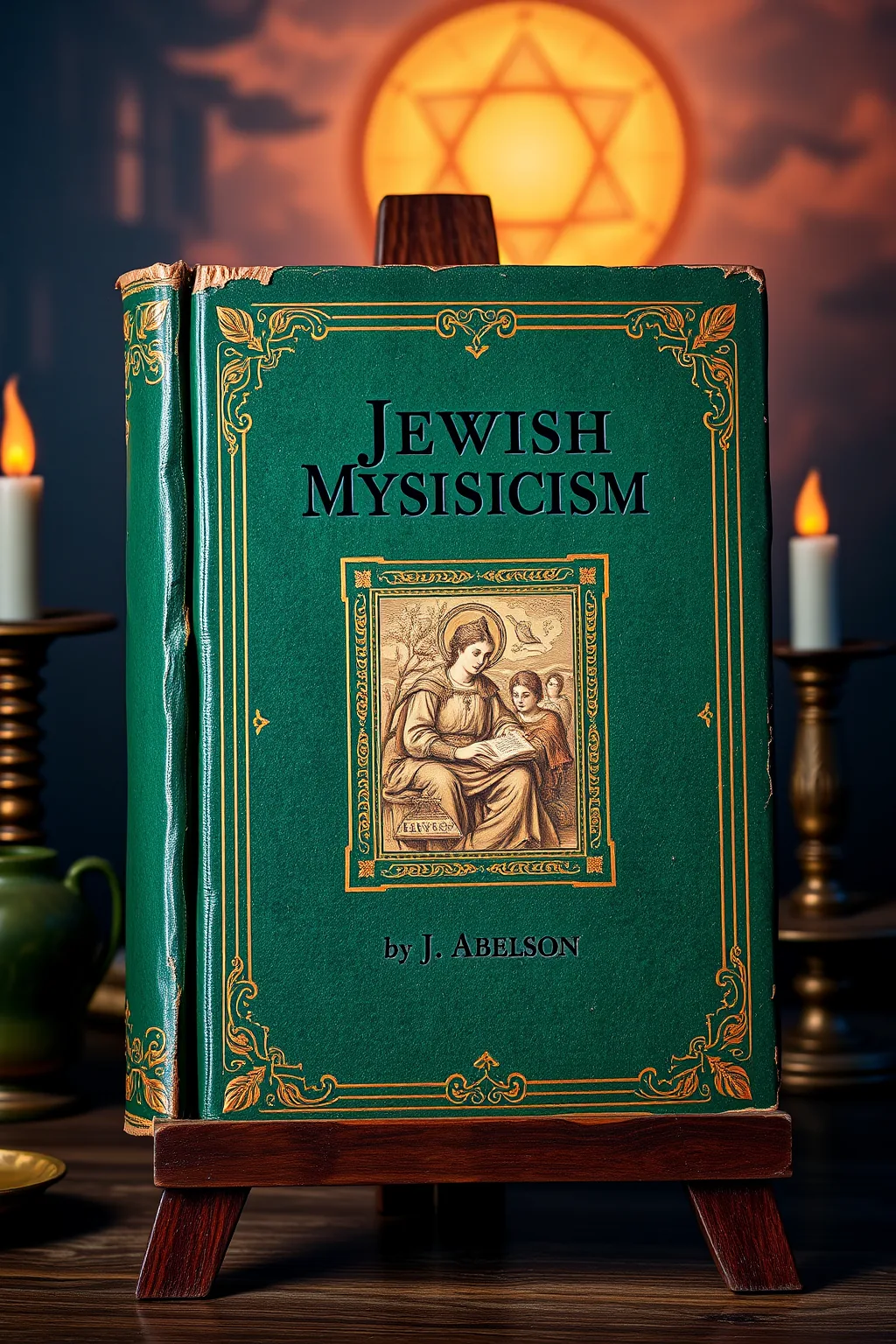
Jewish Mysticism
 82
82

Jewish Mysticism
J. Abelson's "Jewish Mysticism" presents a clear, if somewhat dated, exposition of a profound spiritual tradition. Its strength lies in its systematic approach, laying out the historical progression and core tenets of Jewish esoteric thought with commendable clarity for its 1913 publication. The section detailing the Sefirot, for instance, provides a solid framework for understanding divine manifestation as conceived by Kabbalists. However, the work occasionally feels constrained by the academic conventions of its era, sometimes sacrificing the experiential vibrancy of the tradition for a more detached analysis. While it successfully maps the intellectual terrain, the profound emotional and spiritual weight of the mystical experience itself can feel somewhat muted. Nevertheless, it remains a valuable and accessible primer for anyone seeking to grasp the fundamental architecture of Jewish mysticism.
📝 Description
82
J. Abelson's Jewish Mysticism, published in 1913, examines the historical development and core concepts of Jewish mystical thought.
First released in 1913, J. Abelson's Jewish Mysticism provides an overview of esoteric traditions within Judaism. The book traces the historical growth and main ideas of Jewish mystical thought, from its origins to the rise of Kabbalistic concepts. It offers a scholarly yet accessible look at a complex spiritual area, intending to clarify the philosophical and theological bases of this ancient lineage. The text concentrates on the intellectual movements that shaped Jewish spirituality, detailing how mystics interpreted scripture and the divine. This work is for students of comparative religion, scholars of Jewish history, and those interested in the hidden dimensions of Abrahamic faiths. It is a good introduction for newcomers to mysticism studies, supplying necessary terms and historical background. Readers wanting to grasp the evolution of Kabbalah, the Zohar, and other mystical writings will find a firm starting place here. It particularly suits individuals who prefer a historical and academic perspective on spiritual traditions.
Published in the early 20th century, "Jewish Mysticism" appeared during a time of growing academic interest in religious studies and comparative mysticism. The book joined a scholarly conversation that was starting to analyze Jewish esoteric traditions more rigorously, moving past purely theological explanations. It came after significant Kabbalistic scholarship and during a broader Western esoteric revival, which brought more attention to traditions like the Kabbalah. Abelson's approach reflects the academic standards of its era, aiming to construct a coherent account of mystical development.
Jewish mysticism, or Kabbalah, is a tradition focused on understanding the divine and the nature of reality through esoteric interpretation of Jewish texts and practices. It developed over centuries, with significant periods of growth in medieval Spain and Safed. Key texts like the Zohar are central to its study. Abelson's work situates itself within the academic study of these traditions, aiming to present their development and core ideas to a wider audience, distinguishing it from purely devotional or mystical practice.
💡 Why Read This Book?
• Gain a structured understanding of the ten Sefirot, a core Kabbalistic concept for visualizing divine emanation, which Abelson details in his historical survey. • Learn about the historical development of Jewish mysticism from its early stages through to the medieval period, a timeline crucial for contextualizing texts like the Zohar. • Grasp the foundational esoteric terminology, such as 'Ein Sof' and 'Shekhinah', enabling clearer comprehension of later Kabbalistic literature and its interpretations.
⭐ Reader Reviews
Honest opinions from readers who have explored this book.
❓ Frequently Asked Questions
What is the historical period covered by Abelson's 'Jewish Mysticism'?
The book primarily covers the development of Jewish mystical thought from its early roots, often traced to Merkavah mysticism, through the medieval period, culminating in the Kabbalah and the era of the Zohar.
Does 'Jewish Mysticism' discuss the Kabbalah?
Yes, the Kabbalah is a central focus of the work. Abelson explores its origins, key texts like the Zohar, and its philosophical underpinnings, positioning it as a significant evolution in Jewish esoteric traditions.
Is this book suitable for beginners interested in Jewish mysticism?
Absolutely. Published in 1913, it offers a foundational and systematic introduction to complex concepts, making it accessible for those new to the subject who appreciate a historical overview.
What are the 'Sefirot' mentioned in Jewish mysticism?
The Sefirot are the ten divine emanations described in Kabbalistic tradition, representing attributes or vessels through which God's infinite light (Ein Sof) is expressed and made manifest in creation.
Is J. Abelson's work considered a primary or secondary source for Jewish mysticism?
J. Abelson's work is considered a secondary source. It provides a scholarly analysis and synthesis of primary mystical texts and traditions rather than being a direct mystical text itself.
Can I find this book online for free?
As a work first published in 1913, 'Jewish Mysticism' is in the public domain and is often available for free online through various digital libraries and archives.
🔮 Key Themes & Symbolism
The Divine Emanation
The work meticulously outlines the concept of the Sefirot, the ten divine attributes or vessels through which the infinite and unknowable God (Ein Sof) manifests in the created world. Abelson explains how these emanations form a dynamic structure, bridging the transcendent and immanent aspects of divinity. Understanding the Sefirot is crucial for grasping the Kabbalistic cosmology and the perceived pathways for spiritual ascent and divine interaction, as presented in the text's historical survey.
Symbolic Interpretation of Torah
A significant theme is the Jewish mystical approach to scripture, particularly the Torah. Abelson details how mystics employed allegorical, symbolic, and even numerical methods (Gematria) to uncover hidden layers of meaning beyond the literal text. This interpretive lens reveals a profound engagement with divine wisdom embedded within the sacred writings, transforming the Torah into a living, multi-dimensional map of the cosmos and the divine.
Historical Evolution of Mysticism
The book traces the lineage of Jewish mysticism, charting its course from early visionary experiences (like those of Merkavah mystics) through the development of Kabbalistic thought in medieval Europe. Abelson highlights key periods and intellectual shifts, demonstrating how mystical ideas adapted and transformed over centuries, eventually leading to influential texts and traditions that continue to shape esoteric discourse today.
The Nature of the Soul
Central to Jewish mystical thought, as presented by Abelson, is the concept of the human soul and its relationship to the divine. The work touches upon the soul's journey, its potential for spiritual elevation, and its connection to the cosmic order. This exploration examines how mystics perceived the soul as a microcosm reflecting the macrocosm of divine emanation, capable of union or communion with God.
💬 Memorable Quotes
Direct passages from the work, attributed to the author.
“The Kabbalah is a system of mysticism that seeks to understand the nature of God and the universe through divine emanations.”
— This interpretation highlights the core Kabbalistic doctrine of emanation, where the divine essence, Ein Sof, expresses itself through a series of descending stages or attributes known as the Sefirot.
“Mystical interpretation of the Torah reveals hidden meanings beyond the literal text.”
— This points to the esoteric method of scriptural exegesis employed by Jewish mystics, who believed the Torah contained profound spiritual and cosmological secrets accessible through symbolic and allegorical readings.
“The concept of Ein Sof represents the infinite, unknowable aspect of God.”
— This defines the ultimate divine reality in Kabbalistic thought – an absolute, transcendent, and boundless being that is beyond human comprehension or description.
“Merkavah mysticism focused on visionary experiences of the divine chariot.”
— This refers to an early form of Jewish mysticism centered on ecstatic journeys and visions of God's throne-chariot, as described in Ezekiel's prophecy, preceding the full development of Kabbalah.
“The Sefirot act as divine intermediaries between God and the created world.”
— This captures the function of the Sefirot as channels or vessels through which divine energy and attributes flow from the infinite God to influence and sustain the finite universe.
🌙 Esoteric Significance
Tradition
This work primarily engages with the Kabbalistic tradition, a major stream within Jewish mysticism. It positions Kabbalah as the culmination of centuries of esoteric development within Judaism, exploring its philosophical underpinnings and symbolic language. While acknowledging earlier mystical currents like Merkavah mysticism, Abelson focuses on the structured cosmology and theological framework that define Kabbalah, tracing its lineage and impact.
Symbolism
Key symbols explored include the 'Ein Sof', representing the infinite, absolute Godhead beyond comprehension, and the 'Sefirot', the ten divine emanations that structure creation and mediate divine presence. The 'Tree of Life' diagram, illustrating the relationships between the Sefirot, is implicitly central to understanding the Kabbalistic worldview presented, serving as a map of divine manifestation and spiritual ascent.
Modern Relevance
Abelson's work remains relevant for understanding the historical trajectory and foundational concepts of Kabbalah, which continue to influence various contemporary spiritual movements, including New Age thought and modern esoteric orders. Scholars and practitioners interested in the roots of Western esotericism, the evolution of contemplative practices, and the philosophical depth of Jewish mysticism draw upon such early analyses to contextualize current explorations.
👥 Who Should Read This Book
• Students of comparative religion and Western esotericism seeking foundational knowledge of Jewish mystical traditions and their historical development. • Scholars of Jewish history and philosophy interested in understanding the intellectual and spiritual currents that shaped Jewish thought beyond its normative religious expressions. • Individuals curious about Kabbalah, the Sefirot, and the symbolic language of mysticism, who appreciate a historically grounded and academically oriented introduction.
📜 Historical Context
Published in 1913, J. Abelson's "Jewish Mysticism" emerged during a period of significant academic and public fascination with esoteric traditions. The early 20th century saw a surge in comparative religion studies, with scholars increasingly examining mystical elements across various faiths. Abelson's work contributed to this trend by providing a structured, scholarly overview of Jewish esoteric thought, particularly Kabbalah, which had captured the imagination of Western occultists and philosophers alike. It appeared in the context of burgeoning scholarship on Jewish texts and history, while also engaging with the broader Western esoteric revival. Contemporaries like Gershom Scholem, though later, would revolutionize Kabbalistic studies, building upon and sometimes challenging the foundations laid by earlier works like Abelson's. The book aimed to clarify complex theological and philosophical concepts for an educated audience, presenting Kabbalah not as mere superstition but as a profound spiritual and intellectual tradition.
📔 Journal Prompts
The structure of the ten Sefirot as divine emanations.
The esoteric interpretations of Torah as revealed by mystics.
The historical progression from early Merkavah mysticism to Kabbalah.
The concept of Ein Sof and its implications for understanding the divine.
The role of the soul within the Kabbalistic cosmic framework.
🗂️ Glossary
Ein Sof
The Kabbalistic term for the infinite, absolute, and unknowable aspect of God, the Godhead that exists beyond all manifestation and comprehension.
Sefirot
The ten divine emanations or attributes described in Kabbalah, forming a structure (often depicted as the Tree of Life) through which God interacts with and manifests in the created universe.
Kabbalah
The esoteric tradition of Jewish mysticism, focused on understanding the divine nature, creation, and the relationship between God and humanity through mystical interpretation and contemplation.
Merkavah Mysticism
An early form of Jewish mysticism, prominent in the Talmudic period, characterized by ecstatic visionary journeys to the heavenly realms and contemplation of God's throne-chariot (Merkavah).
Zohar
The foundational text of Kabbalah, a collection of mystical commentaries on the Torah, written primarily in medieval Aramaic, attributed to Rabbi Shimon bar Yochai.
Shekhinah
The feminine aspect of the divine presence, often described as God's immanent dwelling or glory, particularly associated with Israel and the world.
Gematria
A method of biblical interpretation in Jewish mysticism where words or phrases with equal numerical value are considered to be related or equivalent, revealing hidden connections.