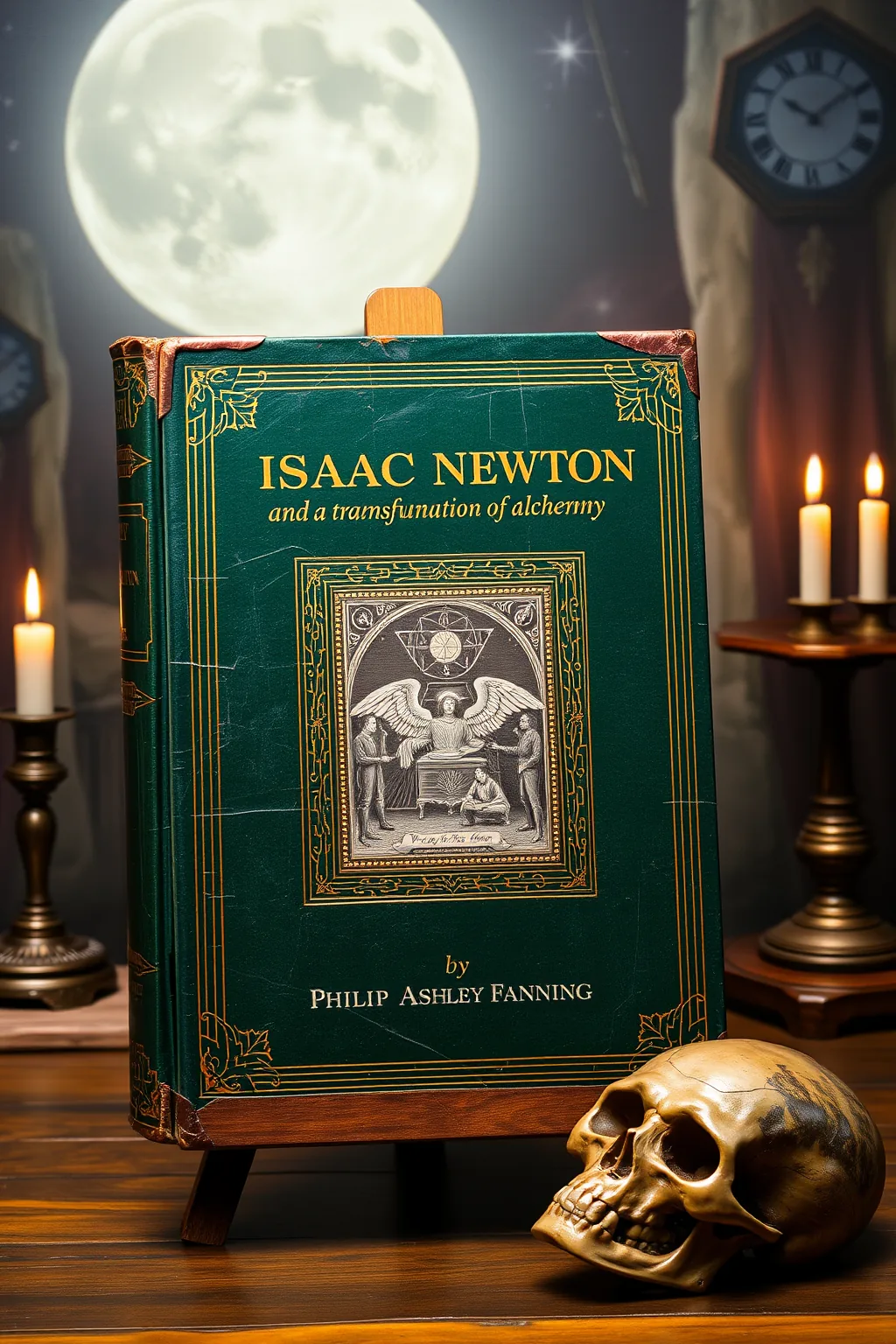
Isaac Newton and the Transmutation of Alchemy
 84
84

Isaac Newton and the Transmutation of Alchemy
Philip Ashley Fanning's "Isaac Newton and the Transmutation of Alchemy" offers a compelling re-evaluation of the scientific giant, positioning his alchemical work not as a peculiar sideline but as integral to his scientific thought. Fanning succeeds in demonstrating the textual and conceptual links between Newton's meticulous laboratory notes on alchemy and his published works. The strength of the book lies in its detailed analysis of Newton's manuscripts, revealing a mind that saw no fundamental division between the mechanical philosophy and the Hermetic arts. A limitation, however, is the occasional speculative leap where textual evidence is sparse, though Fanning generally hedges appropriately. The examination of Newton's concept of 'divine light' as a potential bridge between his physics and alchemy is particularly illuminating. This is a vital corrective to simplistic biographies, urging a more holistic view of Newton's intellectual universe.
📝 Description
84
Philip Ashley Fanning's 2019 book reveals Isaac Newton's alchemical studies were intrinsically linked to his physics.
Philip Ashley Fanning's "Isaac Newton and the Transmutation of Alchemy" examines the alchemical work of Isaac Newton, arguing it was not separate from his physics but rather a connected part of his intellectual life. Fanning presents evidence that the principles of alchemy influenced Newton's public scientific theories and experiments. This challenges the common view of Newton as solely a physicist.
The book is for historians of science interested in the Enlightenment's mystical and philosophical roots, as well as scholars and practitioners of Hermeticism, alchemy, and Western esotericism. Readers curious about Newton beyond his physics will find substantial material. Fanning situates Newton's alchemical writings within the late 17th and early 18th centuries, a time of developing scientific methods alongside persistent alchemical traditions. This was also when the Royal Society was establishing its authority, contrasting with the rise of rationalist philosophies.
This work addresses a critical period in Western esotericism, where ancient alchemical and Hermetic traditions intersected with emerging scientific thought. Newton's private alchemical pursuits, detailed in this book, occurred as figures like Robert Boyle were formalizing experimental science. Fanning places Newton's engagement with transmutation, viewed here as a metaphor for refinement, within this milieu. It highlights how esoteric philosophies continued to inform intellectual figures even as rationalist approaches gained prominence, demonstrating a complex relationship between science and occult traditions.
💡 Why Read This Book?
• Understand how Isaac Newton's alchemical studies, particularly his concept of 'divine light,' may have informed his development of calculus and his theories on gravity, offering a unique perspective on scientific genesis. • Gain insight into the Hermetic traditions prevalent in the late 17th century, revealing how figures like Newton interacted with and were potentially shaped by these esoteric philosophies. • Explore the interconnectedness of science and mysticism during the Scientific Revolution, challenging the modern dichotomy between empirical investigation and spiritual inquiry, as evidenced by Newton's private manuscripts.
⭐ Reader Reviews
Honest opinions from readers who have explored this book.
❓ Frequently Asked Questions
Was Isaac Newton a practicing alchemist?
Yes, Isaac Newton was a dedicated alchemist, spending considerable time and resources on alchemical research. Philip Ashley Fanning's book meticulously examines Newton's extensive alchemical manuscripts, arguing this pursuit was integral to his scientific thinking.
How did alchemy influence Newton's scientific theories?
Fanning argues that alchemical concepts, such as 'transmutation' as a metaphor for refinement and the search for 'divine light,' provided a conceptual framework that influenced Newton's understanding of natural philosophy and his experimental methods.
When was "Isaac Newton and the Transmutation of Alchemy" first published?
The book "Isaac Newton and the Transmutation of Alchemy" by Philip Ashley Fanning was first published on July 7, 2009.
What is the 'Hermetic art' mentioned in relation to Newton?
The 'Hermetic art' refers to alchemy, a complex philosophical and proto-scientific tradition rooted in the writings attributed to Hermes Trismegistus. Newton's engagement with this tradition involved studying its texts and conducting experiments based on its principles.
Does this book present alchemy as a pseudoscience?
No, the book presents alchemy as a serious intellectual pursuit for Newton, integral to his worldview and scientific methodology, rather than a mere superstition or pseudoscience. It highlights the philosophical and theoretical aspects he found compelling.
What evidence does Fanning use to support his claims about Newton's alchemy?
Fanning relies heavily on the extensive collection of Newton's alchemical manuscripts, housed primarily at the University of Cambridge, analyzing his notes, correspondence, and experimental records related to alchemical practices.
🔮 Key Themes & Symbolism
Alchemy as Scientific Foundation
This work posits that Isaac Newton's alchemical investigations were not separate from his scientific endeavors but foundational to them. Fanning details how concepts like the search for a universal solvent or the understanding of 'prima materia' informed Newton's approach to physics and chemistry. The book argues that the meticulous experimentalism characteristic of Newton's scientific method was honed through his alchemical practices, challenging the notion that these pursuits were in conflict.
The 'Divine Light' Concept
A central theme is Newton's concept of 'divine light,' which Fanning interprets as a crucial link between his alchemical and physical theories. This idea, prevalent in Hermetic literature, suggested a fundamental, luminous principle pervading the universe. The book explores how Newton may have integrated this concept into his understanding of light, optics, and even gravitational force, providing a unified vision of cosmic order.
Newton's Hermetic Worldview
Fanning reconstructs Newton's complex worldview, demonstrating his deep engagement with Hermetic philosophy. This includes his study of Rosicrucian texts and his belief in the possibility of recovering ancient wisdom. The book illustrates how this Hermetic framework provided Newton with a conceptual language and a set of goals that extended beyond purely mechanistic explanations, revealing a more holistic and spiritually informed scientist.
Secrecy and Public Persona
The book addresses the deliberate secrecy surrounding Newton's alchemical work, contrasting it with his public image as a rational scientist. Fanning examines the reasons for this concealment, likely due to the potentially controversial nature of alchemy and its association with 'charlatans' during the period. This theme highlights the tension between Newton's private intellectual explorations and his carefully managed public scientific reputation.
💬 Memorable Quotes
Direct passages from the work, attributed to the author.
“The concept of 'transmutation' in Newton's alchemical writings referred not just to chemical change but to a profound transformation of understanding.”
— This highlights Fanning's interpretation that Newton saw alchemy as a path to intellectual and spiritual refinement, mirroring the metaphorical language of transformation common in Hermetic traditions.
“Newton's extensive library contained numerous texts on Hermetic philosophy and alchemy, indicating a serious and systematic study of these subjects.”
— This points to the textual evidence Fanning uses, emphasizing that Newton's engagement with alchemy was scholarly and thorough, drawing upon a wide range of esoteric literature.
“The search for 'divine light' was a recurring theme in Newton's alchemical notes, potentially linking his views on light and energy.”
— This interpretation focuses on a specific concept Fanning analyzes, suggesting its relevance in connecting Newton's physical theories, particularly optics, with his alchemical explorations.
💡 Key Ideas
Editorial paraphrase of the work's core concepts — not direct quotes.
Newton's alchemical work was not a distraction from his scientific studies but rather an integral part of his efforts to understand the fundamental principles of nature.
This paraphrase captures Fanning's core argument: that Newton's alchemy was deeply interwoven with his physics and mathematics, providing a conceptual basis for his scientific breakthroughs, rather than being a separate, esoteric hobby.
Newton's private papers reveal a consistent intellectual framework connecting his mechanical philosophy with his alchemical pursuits.
This paraphrase emphasizes Fanning's central thesis: that Newton possessed a unified intellectual system where seemingly disparate fields like physics and alchemy were harmoniously integrated.
🌙 Esoteric Significance
Tradition
This work is deeply rooted in the Western Esoteric Tradition, specifically Hermeticism and alchemy. It places Isaac Newton within the lineage of Hermetic philosophers who sought to understand the cosmos through symbolic, spiritual, and experimental means. Fanning demonstrates how Newton engaged with the principles of transformation, correspondence, and the search for hidden universal laws that are hallmarks of these traditions, departing from a purely mechanistic interpretation of his work.
Symbolism
Key symbols explored include the 'prima materia,' representing the fundamental substance or chaos from which all matter originates, and the concept of 'transmutation,' symbolizing not just chemical change but spiritual purification and the attainment of higher knowledge. The recurrent motif of 'divine light' is also central, interpreted as a unifying principle connecting the material and spiritual realms, integral to Newton's understanding of both physical phenomena and alchemical processes.
Modern Relevance
Contemporary thinkers in fields ranging from the history of science to comparative mysticism find value in Fanning's work. It informs discussions on the integration of science and spirituality, particularly relevant for modern esoteric practitioners and scholars exploring the philosophical underpinnings of scientific discovery. The book's re-evaluation of Newton speaks to those seeking to understand the holistic nature of consciousness and knowledge acquisition in pre-Enlightenment thought.
👥 Who Should Read This Book
• Scholars of the Scientific Revolution seeking a comprehensive understanding of Isaac Newton's intellectual biography, moving beyond the standard narrative. • Students and practitioners of Hermeticism and Western Esotericism interested in the historical engagement of major scientific figures with these traditions. • Readers curious about the philosophical and spiritual dimensions of early modern science, and how they might have informed empirical investigation.
📜 Historical Context
The late 17th and early 18th centuries marked a key era in Western intellectual history, characterized by the formalization of the Scientific Revolution and the establishment of empirical methodologies. While figures like Isaac Newton, Robert Boyle, and Christiaan Huygens were pioneering new scientific disciplines, the influence of older traditions, including Hermeticism and alchemy, persisted. Newton's own alchemical research, conducted largely in private, existed alongside his public pronouncements on gravity and optics. This period saw a growing distinction between 'natural philosophy' and what were increasingly viewed as less rigorous, more mystical pursuits. Fanning situates Newton's alchemical work within this dynamic, arguing it was not an anomaly but a vital component of his quest for understanding the universe, interacting with contemporaries who might have viewed such studies with skepticism or curiosity.
📔 Journal Prompts
Newton's engagement with the 'prima materia' and its implications for his scientific worldview.
The role of 'divine light' in bridging Newton's alchemical and physical theories.
Reflecting on the tension between Newton's private alchemical studies and his public scientific image.
How did Newton's alchemical 'transmutation' differ from modern chemical transformation?
Connecting the Hermetic principle of correspondence to Newton's diverse scientific inquiries.
🗂️ Glossary
Prima Materia
In alchemy, the fundamental, primordial substance or chaotic matter from which all things are believed to originate. Newton extensively researched this concept in his alchemical studies.
Transmutation
The alchemical process of changing one element or substance into another, often gold. Fanning argues Newton viewed this metaphorically as well, signifying intellectual and spiritual refinement.
Hermeticism
A philosophical and religious tradition based on writings attributed to Hermes Trismegistus. It emphasizes divine knowledge, the interconnectedness of all things, and the pursuit of wisdom through understanding the cosmos.
Divine Light
A concept in alchemical and Hermetic literature representing a fundamental, luminous spiritual or energetic principle pervading the universe. Fanning suggests Newton integrated this into his theories.
Natural Philosophy
The historical term for the study of nature and the physical universe, encompassing what we now call science. Newton operated within this framework, blending empirical observation with philosophical inquiry.
The Royal Society
A prestigious British scientific academy founded in 1660, dedicated to promoting scientific knowledge through experimentation and discussion. Newton was a prominent member.
Manuscripts
Handwritten documents. Fanning's analysis heavily relies on Newton's extensive, unpublished alchemical manuscripts, which reveal the depth of his pursuits in this area.