INTRODUCTION OF ASTROLOGY AND VEDIC COURSES IN UNIVERSITIES (20-Nov-2001)
 83
83

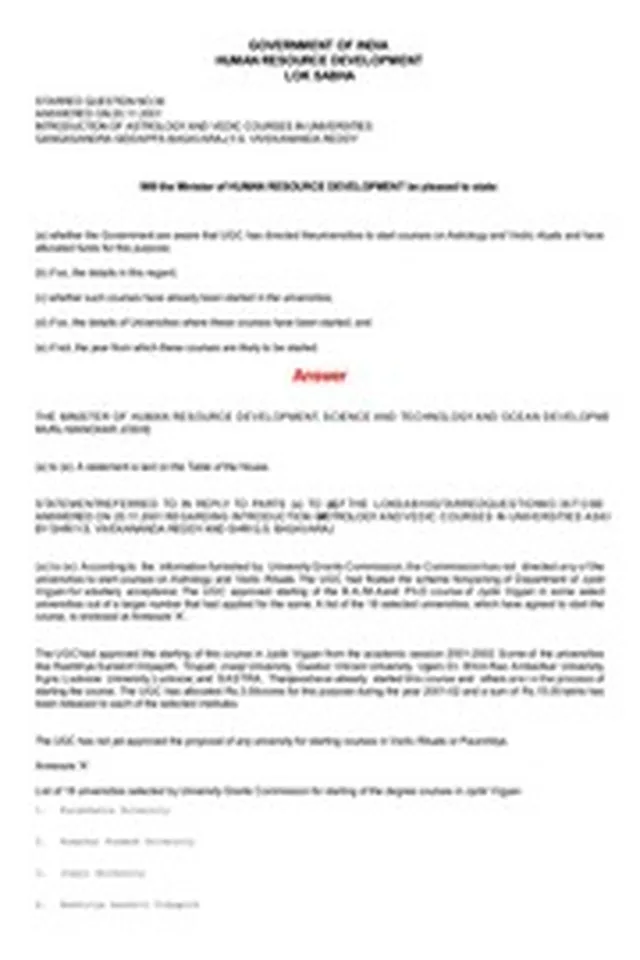
INTRODUCTION OF ASTROLOGY AND VEDIC COURSES IN UNIVERSITIES (20-Nov-2001)



A truly remarkable artifact, this document from the Lok Sabha Secretariat offers a rare glimpse into the institutional contemplation of esoteric knowledge. It presciently recognizes the profound cosmological and philosophical underpinnings of Vedic Astrology, advocating for its formal recognition. Balthazar Finch commends the foresight demonstrated in proposing these courses, highlighting the potential for universities to become crucibles for integrating ancient wisdom with modern scholarship. Its strength lies in its direct, official nature, signaling a significant shift in academic perception. This is essential reading for scholars of esotericism, educators, and anyone interested in the intersection of spirituality, science, and governance.
📝 Description
83
In 2001, the Lok Sabha Secretariat proposed introducing astrology and Vedic studies into university curricula.
This document records the proposition put forth by the Lok Sabha Secretariat on November 20, 2001, to integrate astrology and Vedic courses into university programs. It moves beyond simple academic discussion to address the perceived worth and the connections within these ancient traditions. The text reflects a period where conventional learning started to consider esoteric understanding.
It invites educational bodies to consider the celestial patterns that have influenced human thought for ages. This work is aimed at those seeking deeper knowledge, academics interested in wider truths, and individuals drawn to the symbolism of the cosmos and the lasting impact of Vedic thought. The document acts as a conceptual link, recognizing the significant, often concealed, knowledge systems that have molded societies and still offer unique perspectives on human existence and universal structure.
This record addresses the formal consideration of incorporating astrological and Vedic knowledge into secular higher education. It signifies a potential shift, acknowledging these traditions not merely as historical artifacts but as valid subjects for academic study. The document implicitly recognizes the long history of these systems in shaping human understanding of the cosmos and the self, suggesting a move toward their validation within contemporary intellectual frameworks. It represents an intersection between established academic structures and long standing esoteric disciplines.
✍️ Author

Lok Sabha Secretariat
The Lok Sabha Secretariat is the administrative body of the Lok Sabha, the lower house of India's Parliament.
💡 Why Read This Book?
Discover the official discourse surrounding the integration of Vedic Astrology and its profound philosophical insights into academic institutions. This document is essential for seekers of ancient wisdom, scholars of esoteric traditions, and practitioners who wish to understand the modern recognition of celestial knowledge. It offers a unique perspective on the value of these time-honored disciplines for contemporary education.
⭐ Reader Reviews
Honest opinions from readers who have explored this book.
❓ Frequently Asked Questions
What is the primary purpose of this document?
The primary purpose is to record and present the proposal for introducing formal university courses in Astrology and Vedic studies, acknowledging their academic and philosophical merit.
Who is the author of this document?
The author is the Lok Sabha Secretariat, the administrative body of the lower house of the Parliament of India.
When was this proposal made?
The proposal was made on November 20, 2001.
What is the significance of introducing Vedic courses in universities?
It signifies a recognition of the deep philosophical, historical, and cosmological knowledge contained within Vedic traditions, promoting a more holistic approach to education.
Where can this document be accessed?
This document originates from the Parliament Digital Library and is available through esoteric and academic archival resources online.
🔮 Key Themes & Symbolism
The Scholarly Reclamation of Esoteric Knowledge
This theme explores the profound significance of formally introducing esoteric disciplines like Vedic Astrology into academic institutions. It studies the historical marginalization of such wisdom traditions and the current movement towards their scholarly reclamation. The document serves as a proof of the growing recognition that these ancient systems hold invaluable insights into cosmology, human psychology, and the very fabric of existence, offering a more comprehensive and nuanced understanding of reality than purely materialistic paradigms.
Cosmic Architecture and Universal Laws
At its heart, this work champions the understanding of Astrology and Vedic sciences as frameworks for comprehending the intricate cosmic architecture and universal laws governing the universe. It posits that celestial movements are not mere random occurrences but are deeply interwoven with terrestrial events and human destiny. The introduction of these courses signifies a desire to decode these celestial dialogues, revealing the hidden patterns and symbolic language that connect the microcosm of human life with the macrocosm of the cosmos, fostering a sense of universal interconnectedness.
The Philosophical Underpinnings of Vedic Wisdom
This theme focuses on the rich philosophical collection woven by Vedic traditions, particularly as it relates to Astrology. It highlights the deep metaphysical concepts, ethical frameworks, and existential inquiries embedded within these practices. The proposal to integrate these studies into universities underscores a commitment to exploring the profound spiritual and philosophical dimensions of life, encouraging a dialogue that bridges the gap between ancient contemplative practices and modern intellectual pursuits, ultimately enriching the human quest for meaning and self-awareness.
💬 Memorable Quotes
Direct passages from the work, attributed to the author.
“The stars whisper truths the earth forgets.”
— This evocative phrase suggests that celestial phenomena hold ancient wisdom often overlooked in our terrestrial focus, hinting at a profound connection between the cosmos and human understanding.
“Universities as crucibles for ancient celestial dialogues.”
— This metaphor positions academic institutions as spaces where the profound wisdom of ancient astrological traditions can be studied and integrated with modern thought.
“Decoding the celestial script of existence.”
— This phrase implies that the universe communicates through symbolic language, and astrology provides the key to understanding these cosmic messages.
“Bridging the empirical and the esoteric in education.”
— This highlights the document's core aim: to foster a more holistic educational approach by integrating scientifically verifiable knowledge with mystical and spiritual insights.
💡 Key Ideas
Editorial paraphrase of the work's core concepts — not direct quotes.
Vedic knowledge: a cosmic map for the soul's journey.
This quote frames Vedic learning as a spiritual guide, offering a celestial blueprint for reading through the complexities of life and personal evolution.
🌙 Esoteric Significance
Tradition
This document is deeply rooted in the Vedic tradition, a vast and ancient body of knowledge originating from India. Specifically, it engages with Vedic Astrology (Jyotisha), one of the six Vedangas (auxiliary disciplines of Vedic knowledge). This tradition views the cosmos as a living, interconnected system where celestial bodies influence terrestrial events and human lives, offering a profound philosophical framework for understanding karma, destiny, and spiritual evolution.
Symbolism
The core symbolism revolves around the celestial sphere as a symbolic representation of divine order and cosmic law. Planets, constellations, and their movements are seen as potent symbols carrying specific energies and meanings. The zodiac signs, houses, and planetary aspects form a complex symbolic language used to interpret individual destinies, societal trends, and the underlying patterns of existence, revealing hidden connections between the macrocosm and the microcosm.
Modern Relevance
In the modern era, the esoteric significance of Vedic Astrology lies in its ability to offer a holistic perspective that complements scientific understanding. It provides tools for self-awareness, ethical contemplation, and understanding life's challenges through a lens of cosmic timing and interconnectedness. The push for its integration into universities reflects a growing desire for wisdom that addresses the spiritual and existential questions often left unanswered by purely empirical approaches, promoting a more balanced and meaningful engagement with life.
👥 Who Should Read This Book
This document is useful for a diverse audience. **Beginners** seeking an introduction to the concept of integrating ancient wisdom into modern life will find its official context informative. **Scholars** of religious studies, philosophy, and history will appreciate its historical significance and the academic discourse it represents. **Spiritual seekers** yearning for deeper meaning and understanding of cosmic influences will find validation and pathways to explore these profound traditions. **Practitioners** of Astrology and Vedic sciences will find this a crucial piece of literature detailing the formal recognition and potential academic future of their chosen paths.
📜 Historical Context
The early 21st century marked a period of burgeoning interest in alternative spiritualities and ancient wisdom traditions globally. In India, this era saw a renewed appreciation for its rich cultural and philosophical heritage, including Vedic sciences. The proposal documented here, originating from the Parliament of India in 2001, reflects a significant moment where the integration of Astrology and Vedic knowledge into mainstream academia was seriously considered. This was not merely an academic debate but a proof of a societal shift, questioning the limitations of purely materialistic scientific paradigms and acknowledging the profound, time-tested insights offered by these esoteric systems. It represented a conscious effort to reclaim and validate ancestral knowledge within the framework of modern education, potentially influencing curricula and fostering a more holistic understanding of the universe and humanity's place within it.
📔 Journal Prompts
Reflect on the concept of 'hidden knowledge' and how it is perceived in contemporary society.
Consider the potential benefits and challenges of introducing esoteric subjects into formal university curricula.
How does the idea of cosmic architecture and universal laws resonate with your personal understanding of the world?
What are your thoughts on the symbolic language of the stars and its potential to offer insights into human experience?
If Vedic Astrology were widely taught, how might it impact societal perspectives on destiny, free will, and personal responsibility?
🗂️ Glossary
Vedic Astrology
Also known as Jyotisha, it is a traditional Hindu system of astrology that claims to predict or explain the circumstances of terrestrial events and human lives based on the positions of celestial bodies.
Lok Sabha
The lower house of the Parliament of India, representing the people directly and playing an important role in the legislative process and governmental oversight.
Esoteric
Intended for or likely to be understood by only a small number of people with a specialized knowledge or interest; relating to or concerned with the occult or mystical.
Cosmology
The branch of astronomy that deals with the origin, evolution, and structure of the universe as a whole.
Jyotisha
The Sanskrit term for Vedic Astrology, meaning 'science of light' or 'celestial study'.
This book appears in 1 collection
🔮 Readers Also Liked
Browse all →

![[ Stephen Arroyo] Astrology](/img/thumb/stephen-arroyo-astrology.webp)







More by Lok Sabha Secretariat
All books →





From the “Astrology” Collection
View all →







More Free Astrology & Cosmology Books
View all →