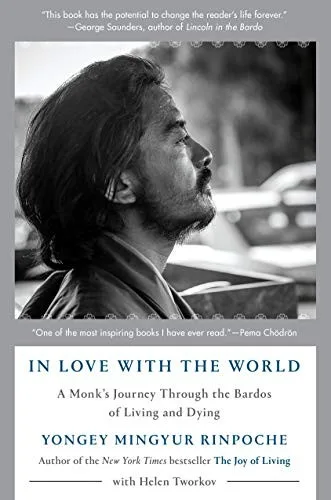
In Love with the World
 78
78

In Love with the World
Yongey Mingyur Rinpoche’s *In Love with the World* is a rare thing: a spiritual autobiography that avoids saccharine platitudes and instead offers a raw, unvarnished account of enlightenment achieved through intense struggle. The book’s strength lies in Rinpoche’s unflinching honesty about his own periods of profound depression and anxiety, making his eventual insights into the nature of suffering deeply credible. His description of his near-fatal illness and subsequent recovery, particularly the moments of realizing the impermanence of his own body, serves as a powerful anchor for his teachings on emptiness. A potential limitation for some readers might be the density of Buddhist terminology, though Tworkov's clear prose largely mitigates this. The passage detailing Rinpoche’s realization that “The world is not a problem to be solved, but a mystery to be lived” encapsulates the book’s core message. This is a vital testament to the possibility of finding peace not by escaping the world, but by embracing it fully.
📝 Description
78
Published in 2019, *In Love with the World* shares Yongey Mingyur Rinpoche's path to finding joy amidst suffering.
This book is not a scholarly treatise but a direct account of Yongey Mingyur Rinpoche's experiences. Helen Tworkov compiled Rinpoche's teachings, focusing on his personal journey through intense suffering and moments of awakening. The text acts as a practical guide for understanding and working with the mind's constant shifts. It asserts that the 'world' is the very arena of our lives, a place where wisdom and compassion can grow, rather than something external to overcome.
The work is intended for those seeking a more grounded approach to Buddhist philosophy and practice. It is particularly suited for individuals interested in Tibetan Buddhism who may find traditional texts difficult to access. Readers who have faced personal challenges and wish to integrate spiritual insights into their daily lives will find resonance here. Those drawn to mindfulness, meditation, and the concept of impermanence will benefit from Rinpoche's straightforward style. The inclusion of autobiographical elements provides a relatable and authentic perspective on spiritual development.
Emerging in 2019, this work situates contemplative practices within the Mahayana Buddhist tradition, specifically the Dzogchen lineage. Unlike secularized mindfulness trends, Rinpoche's teachings remain firmly rooted in Buddhist psychology. The book addresses modern anxieties by framing Buddhist concepts as a relevant framework for well-being. Helen Tworkov's collaboration ensures an authentic presentation of these teachings, connecting them to Tibetan Buddhist communities.
💡 Why Read This Book?
• Gain a practical framework for transforming mental suffering by understanding Rinpoche's concept of 'emptiness' (shunyata) as freedom from attachment, rather than nihilism. • Learn to apply Buddhist principles to everyday challenges through Rinpoche's personal narrative, which details his experiences following his 2009 retreat. • Discover how to engage directly with the present moment, moving beyond conceptual thinking, as illustrated by Rinpoche's teachings on non-dual awareness.
⭐ Reader Reviews
Honest opinions from readers who have explored this book.
❓ Frequently Asked Questions
What is the core message of Yongey Mingyur Rinpoche's 'In Love with the World'?
The core message is that true happiness and peace are found not by changing the world or escaping difficulties, but by transforming our perception of them, embracing the present moment with wisdom and compassion.
When was 'In Love with the World' originally published?
The book was first published in 2019, reflecting contemporary discussions on mindfulness and Buddhist psychology.
What is the significance of Rinpoche's personal struggles in the book?
Rinpoche details his personal battles with anxiety and depression, demonstrating that profound spiritual realization can arise from facing life's most difficult experiences, not just from serene meditation.
What Buddhist tradition does Yongey Mingyur Rinpoche belong to?
Yongey Mingyur Rinpoche belongs to the Tibetan Buddhist tradition, specifically the Dzogchen lineage.
How does 'In Love with the World' differ from other mindfulness books?
It differs by deeply embedding mindfulness practices within the rich philosophical and experiential context of Tibetan Buddhism, using Rinpoche's authentic personal journey as a guide.
What does Rinpoche mean by 'emptiness' in this context?
In this work, 'emptiness' (shunyata) signifies the lack of inherent, fixed existence in all phenomena, which paradoxically leads to greater freedom, clarity, and compassion when understood.
🔮 Key Themes & Symbolism
Embracing Suffering as Path
The book radically reframes suffering not as an obstacle to spiritual progress, but as an integral part of the path to awakening. Rinpoche shares his personal struggles with severe anxiety and depression, illustrating how confronting these difficult states directly, rather than avoiding them, can lead to useful insights. He posits that the very nature of our difficult emotions, when met with awareness, reveals the impermanent and selfless quality of experience. This perspective challenges conventional notions of happiness as the mere absence of pain, suggesting instead that true joy arises from a deeper understanding of the mind and reality.
The Nature of Mind and Reality
Central to Rinpoche's teachings is an exploration of the mind's fundamental nature and its role in constructing our perceived reality. He introduces concepts from the Dzogchen tradition, emphasizing that the ordinary mind, with its constant stream of thoughts and judgments, obscures a more luminous, aware state. The book guides readers to recognize this underlying awareness, characterized by clarity and openness. Rinpoche uses vivid analogies, such as the sky and clouds, to explain how thoughts and emotions arise and dissolve without fundamentally altering the vastness of consciousness itself.
Non-Dual Awareness
A significant theme is the cultivation of non-dual awareness, moving beyond the subject-object split that typically structures our experience. Rinpoche advocates for a direct, unmediated engagement with the world, seeing phenomena not as separate from oneself but as expressions of a unified reality. This involves recognizing the illusory nature of a fixed self and embracing the interconnectedness of all things. The book encourages readers to see the 'world' not as an external problem, but as the very ground of being, a space for cultivating compassion and wisdom.
The Practice of Impermanence
The profound truth of impermanence (anicca) is woven throughout Rinpoche's narrative and teachings. He illustrates this through his own near-fatal illness and recovery, highlighting the transient nature of the body and all physical phenomena. Understanding and accepting impermanence, the book suggests, liberates us from clinging and attachment, which are primary sources of suffering. By recognizing that everything, including our thoughts, emotions, and even life itself, is constantly changing, we can develop a more resilient and accepting relationship with existence.
💬 Memorable Quotes
Direct passages from the work, attributed to the author.
“The world is not a problem to be solved, but a mystery to be lived.”
— This statement expresses the book's central thesis: shifting from a reactive, problem-solving mindset towards one of open curiosity and acceptance regarding life's inherent uncertainties.
“When we are in love with the world, we are in love with our own mind.”
— This highlights the interconnectedness of our internal state and our perception of external reality, suggesting that a positive engagement with life stems from a healthy relationship with our own consciousness.
“Suffering is not the enemy; resistance to suffering is the enemy.”
— This offers a direct reframing of our relationship with pain and difficulty, suggesting that the act of fighting against discomfort is what truly perpetuates our distress.
“The true nature of the mind is like the sky: vast, open, and unchanging, while thoughts and emotions are like clouds passing through.”
— This analogy powerfully illustrates the concept of underlying awareness, distinguishing the stable ground of consciousness from the transient phenomena that arise within it.
“Joy is not found in the absence of problems, but in the presence of wisdom.”
— This emphasizes that genuine happiness is cultivated through inner understanding and perspective, rather than solely through external circumstances or the elimination of challenges.
🌙 Esoteric Significance
Tradition
This work is firmly rooted in the Tibetan Buddhist Vajrayana tradition, particularly the Dzogchen (Great Perfection) teachings. Dzogchen represents the pinnacle of the Nyingma school, emphasizing direct introduction to the nature of mind and primordial awareness. Rinpoche's teachings, while accessible, transmit core Dzogchen principles regarding emptiness (shunyata) and the luminous quality of consciousness, aligning with the tradition's aim of recognizing innate enlightenment.
Symbolism
The 'world' itself functions as a central symbolic concept, representing not merely external circumstances but the totality of conscious experience, a field for both suffering and liberation. The analogy of the 'sky' and 'clouds' is crucial, symbolizing the unchanging, open nature of mind (sky) versus the transient, arising and passing thoughts and emotions (clouds). Rinpoche's personal journey, including his illness, symbolizes the profound truth of impermanence and the potential for awakening within the crucible of intense experience.
Modern Relevance
Contemporary thinkers and practitioners in fields ranging from contemplative neuroscience to positive psychology draw parallels with Rinpoche's insights. His accessible articulation of non-dual awareness and the transformation of suffering appeals to modern therapeutic approaches that integrate mindfulness and acceptance. Movements focused on 'engaged Buddhism' and the application of contemplative practices to social and environmental issues also find alignment with his emphasis on seeing the world as an interconnected whole.
👥 Who Should Read This Book
• Students of Tibetan Buddhism seeking a personal and experiential account of Dzogchen principles, moving beyond purely philosophical study. • Individuals grappling with mental health challenges like anxiety or depression who are looking for spiritual perspectives that integrate personal struggle with wisdom. • Practitioners of mindfulness and meditation interested in deepening their understanding by exploring the philosophical underpinnings and direct insights from a lineage master.
📜 Historical Context
Published in 2019, *In Love with the World* arrived at a moment when Buddhist teachings, particularly mindfulness, had become widely popularized in the West, often secularized and stripped of their traditional context. Yongey Mingyur Rinpoche’s work, however, firmly grounds these practices within the Mahayana tradition, specifically the Tibetan Buddhist Dzogchen lineage. This offered a counterpoint to more generalized mindfulness approaches. The book’s genesis is intrinsically linked to Rinpoche's personal experiences, including a significant period of illness and profound depression around 2009, which he recounts openly. This autobiographical element resonated with contemporary Western readers increasingly interested in the intersection of spirituality and mental well-being, a discourse also explored by authors like Pema Chödrön, though Rinpoche’s specific focus on his own path provided a unique narrative. The work's reception highlighted a sustained interest in authentic, lived spiritual experience from respected Buddhist masters.
📔 Journal Prompts
The arising of difficult emotions during meditation practice.
Recognizing the 'sky-like' nature of awareness amidst passing thoughts.
The world as a field for cultivating compassion.
Moments of profound clarity experienced during personal challenges.
The relationship between perceived suffering and resistance to it.
🗂️ Glossary
Dzogchen
A central teaching of the Nyingma school of Tibetan Buddhism, considered the highest and most direct path to realizing the nature of mind and achieving enlightenment.
Shunyata
A Sanskrit term often translated as 'emptiness,' signifying the lack of inherent, independent existence in all phenomena. It is not nihilism but the recognition of interdependence and the absence of fixed self.
Vajrayana
The 'Diamond Vehicle' or 'Thunderbolt Vehicle,' a branch of Mahayana Buddhism prevalent in Tibet, characterized by tantric practices and accelerated paths to enlightenment.
Anicca
A Pali term meaning 'impermanence' or 'transience.' It is one of the three marks of existence in Buddhism, emphasizing that all conditioned phenomena are in a constant state of flux.
Non-dual awareness
A state of consciousness that transcends the ordinary subject-object duality, perceiving reality as an undivided whole, free from conceptual elaborations and distinctions.
The Three Jewels
The Buddha (the awakened one), the Dharma (the teachings), and the Sangha (the community of practitioners). Taking refuge in the Three Jewels is a foundational act in Buddhism.
Mindfulness
The practice of bringing one's attention to the present moment, often non-judgmentally. In Buddhist contexts, it is a key component of the path to liberation.
🔮 Readers Also Liked
Browse all →








More by Rinpoche Yongey Mingyur, Helen Tworkov
All books →
More Free Occult Philosophy Books
View all →