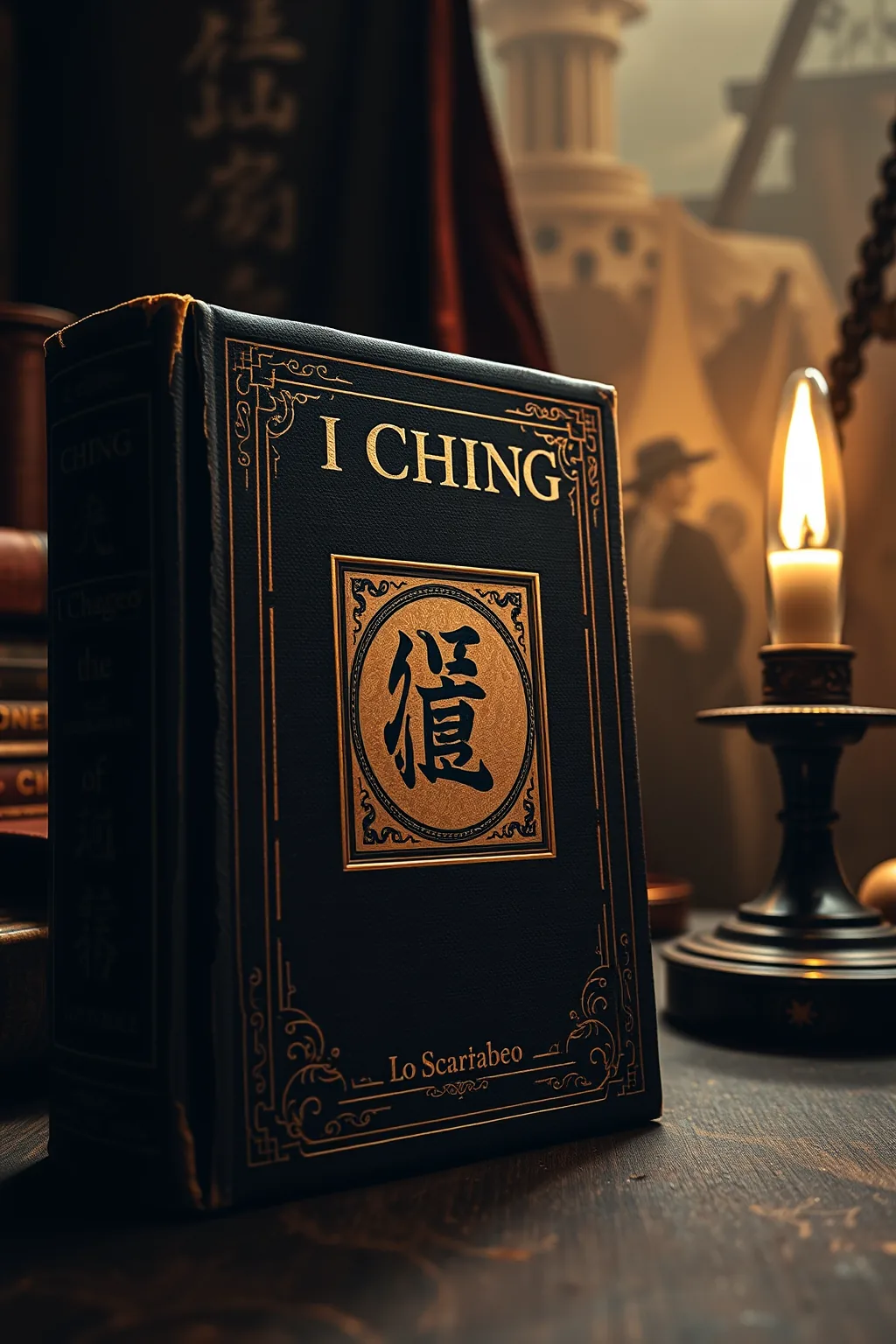
I Ching
 61
61

I Ching



Ophelia Vance, Mystical Literature Reviewer — Lo Scarabeo's rendition of the I Ching is a masterful portal into one of humanity's most enduring systems of wisdom. This edition transcends mere fortune-telling, offering profound esoteric insights into the cyclical nature of change and the underlying principles of the cosmos. Its strength lies in its clarity of presentation, making the complex symbolism accessible to both neophytes and seasoned practitioners. The evocative language and carefully curated hexagram interpretations foster a deep sense of connection with the text's ancient roots. This is an essential acquisition for any serious student of divination, philosophy, or esoteric studies seeking to unlock profound truths about life and destiny.
📝 Description
61
Lo Scarabeo's edition of the I Ching presents the Chinese Book of Changes, a text with origins dating back to the Zhou Dynasty.
This edition of the I Ching, the ancient Chinese Book of Changes, functions as more than just a method for divination. It offers a framework for understanding universal patterns and the dynamics of change. The text is organized around 64 hexagrams, each composed of six lines. These hexagrams serve as symbolic representations of various situations, archetypes, and processes of transformation.
The I Ching provides a perspective on existence, highlighting the interconnectedness of phenomena and the cyclical patterns of change. Its pronouncements and imagery encourage personal reflection, assisting individuals in gaining a better grasp of themselves and their position within a larger order. This particular edition is designed for those interested in esoteric traditions and the philosophical concepts embedded within this classical Chinese text. Consulting the I Ching can become a practice for aligning oneself with the Tao and seeking deeper understanding.
The I Ching is a foundational text within Taoist philosophy and Chinese esoteric traditions. Its use extends beyond fortune-telling to a system for understanding the principles of change in the cosmos and human affairs. For centuries, practitioners have used its hexagrams and accompanying text to gain insight into current situations and potential future developments. The text is believed to reflect the underlying order of the universe, the Tao, and consulting it is seen as a way to align one's actions and understanding with this natural flow.
💡 Why Read This Book?
Embark on a profound journey of self-discovery with the I Ching. This ancient oracle offers unparalleled wisdom for navigating life's challenges and opportunities, revealing the hidden currents of destiny. Ideal for seekers of esoteric knowledge, scholars of ancient philosophy, and practitioners of divination who wish to deepen their understanding of universal patterns and personal growth.
⭐ Reader Reviews
Honest opinions from readers who have explored this book.
❓ Frequently Asked Questions
What is the I Ching?
The I Ching, or 'Book of Changes,' is an ancient Chinese divination text and philosophical classic, revered for its profound insights into the cycles of change and the fundamental principles of the universe.
How does the I Ching work?
It is typically consulted using methods like yarrow stalks or coins to generate hexagrams, which are then interpreted based on their symbolism and accompanying texts to offer guidance.
Who wrote the I Ching?
Its origins are attributed to ancient Chinese sages, with significant contributions from King Wen and the Duke of Zhou, and commentary by Confucius and his disciples.
What are hexagrams?
Hexagrams are the core visual symbols of the I Ching, each composed of six stacked lines, representing specific archetypal situations and energetic configurations.
Is the I Ching a form of fortune-telling?
While it can be used for divination, the I Ching is primarily a philosophical and wisdom text, offering guidance for decision-making and self-understanding rather than rigid predictions.
🔮 Key Themes & Symbolism
The Alchemy of Change
The I Ching is fundamentally about the ceaseless transformation that governs all existence. It posits that change is the only constant, and understanding its patterns is key to harmonious living. This theme explores how events unfold, how situations evolve, and how to adapt with wisdom and foresight. It explores the dynamic interplay of Yin and Yang, the foundational forces that drive all metamorphosis, offering insights into how to align oneself with these cosmic currents to foster growth and avoid stagnation. It's an invitation to embrace flux, not as a source of anxiety, but as an opportunity for profound personal and spiritual evolution.
The Language of Symbols
At its heart, the I Ching is a sophisticated system of symbolic language, primarily expressed through its 64 hexagrams. Each hexagram is a complex emblem, a cosmic glyph representing archetypal situations, human experiences, and universal forces. The lines (broken for Yin, solid for Yang) within these hexagrams are not arbitrary; they are precise elements that, when combined, speak volumes. Understanding these symbols unlocks a deeper perception of reality, allowing for a more intuitive grasp of complex circumstances. This theme emphasizes the power of visual and conceptual symbolism to convey profound truths that transcend ordinary language, making the I Ching a visual and philosophical masterpiece.
Cosmic Harmony and the Tao
The I Ching is deeply intertwined with the Taoist concept of the Tao – the ineffable, underlying principle that governs the universe. It teaches how to live in accordance with this natural order, emphasizing balance, moderation, and alignment with the flow of life. Through its pronouncements, the text guides the practitioner towards achieving inner harmony and external synchronicity, suggesting that by understanding and respecting universal principles, one can navigate life's complexities with grace and efficacy. This theme is about finding one's place within the grand cosmic dance, cultivating a sense of interconnectedness, and living a life of profound purpose and peace.
💬 Memorable Quotes
Direct passages from the work, attributed to the author.
“Stillness leads to clarity.”
— Emphasizes the importance of quiet contemplation and inner peace as a pathway to discerning truth and making wise decisions, highlighting the power of introspection.
“He who knows does not speak; he who speaks does not know.”
— A profound statement on the limitations of language to express ultimate truths, suggesting that true wisdom often lies beyond articulation and verbal expression.
“The superior man makes himself busy.”
— This encourages proactive engagement with life's challenges and opportunities, advocating for diligent effort and purposeful action rather than passive observation.
“A little doubt leads to a little wisdom.”
— Suggests that questioning and intellectual curiosity are essential catalysts for learning and growth, implying that a lack of doubt can lead to stagnation.
💡 Key Ideas
Editorial paraphrase of the work's core concepts — not direct quotes.
The superior man acts, but does not possess.
This quote speaks to the essence of detachment and selfless action, suggesting that true power lies in contributing without claiming ownership, fostering a state of non-attachment to outcomes.
🌙 Esoteric Significance
Tradition
The I Ching is a core part of Chinese esoteric traditions, particularly Taoism and Confucianism, though its influence extends to broader metaphysical and philosophical systems. It embodies the principle of 'wu wei' (non-action or effortless action) within Taoism and the importance of ethical cultivation and cosmic order within Confucianism. Esoterically, it is viewed as a living oracle, a cosmic blueprint that maps the energetic currents of existence, offering useful insights into karma, destiny, and the interconnectedness of all phenomena. It is a key text for understanding the subtle energies that govern the universe and our place within them.
Symbolism
The hexagrams are the primary symbolic language of the I Ching. Composed of six lines, each either solid (Yang) or broken (Yin), they represent fundamental archetypes and dynamic forces. These symbols are not static; they represent stages of transformation, offering a visual and conceptual map of how situations evolve. The trigrams (three-line combinations) within the hexagrams further enrich this symbolic depth, representing elements, natural phenomena, and human relationships. Understanding this rich, layered symbolism allows practitioners to decode the universe's messages and gain useful insights into the underlying causes and potential outcomes of events.
Modern Relevance
In our rapidly changing world, the I Ching's wisdom on navigating transformation and embracing flux is more relevant than ever. It offers a timeless framework for understanding personal and societal shifts, encouraging adaptability, foresight, and inner resilience. Its principles of balance, cyclical understanding, and mindful action provide invaluable guidance for decision-making, personal growth, and fostering a sense of harmony amidst uncertainty. The I Ching remains a powerful tool for self-reflection, offering profound spiritual and philosophical insights that resonate deeply with contemporary seekers of wisdom and meaning.
👥 Who Should Read This Book
This edition of the I Ching is a treasure for a diverse range of individuals. Beginners will find it an accessible yet profound introduction to this ancient oracle, offering clear pathways to understanding its core principles. Scholars of philosophy and ancient cultures will appreciate its historical depth and intricate symbolic system. Esoteric practitioners and seekers of spiritual wisdom will discover a potent tool for self-exploration, divination, and aligning with universal energies. Those grappling with life's decisions or seeking a deeper understanding of destiny will find its counsel invaluable, making it a vital addition to any discerning library.
📜 Historical Context
Emerging from the mists of ancient China, the I Ching, or 'Book of Changes,' is a proof of millennia of philosophical and divinatory inquiry. Its origins are rooted in the Shang Dynasty (c. 1600–1046 BCE) and its development continued through the Zhou Dynasty (1046–256 BCE), with seminal commentaries attributed to King Wen, the Duke of Zhou, and later, Confucius and his disciples. This period was a crucible of intellectual ferment, witnessing the birth of major philosophical schools that sought to understand the cosmos, human nature, and the principles of governance. The I Ching, with its intricate system of hexagrams, was a central text in this intellectual landscape, serving not only as a tool for divination but as a profound guide to understanding the cyclical nature of reality, ethical conduct, and the art of living in harmony with the universe. Its enduring influence has shaped East Asian thought and spirituality for over three thousand years.
📔 Journal Prompts
Reflect on a recent significant change in your life. Which hexagram might represent this transition, and what insights does it offer?
Consider a recurring challenge you face. How might the principles of balance and adaptability, as taught by the I Ching, help you navigate it?
Meditate on the concept of 'wu wei' (effortless action). How can you apply this principle to a task or situation currently causing you stress?
Explore the symbolism of a favorite hexagram. What personal meaning or message does it convey to you at this moment?
If the I Ching were to offer you a single piece of advice for your immediate future, what do you imagine it would be, and why?
🗂️ Glossary
Hexagram
A symbol composed of six stacked lines, either solid (Yang) or broken (Yin), representing a fundamental archetype or situation in the I Ching.
Trigram
A three-line symbol, which forms the building blocks of hexagrams, often representing elements, natural forces, or family relationships.
Yin
The passive, receptive, dark, and feminine principle in Chinese philosophy, represented by a broken line in the I Ching.
Yang
The active, creative, light, and masculine principle in Chinese philosophy, represented by a solid line in the I Ching.
Tao
The fundamental, ineffable principle that underlies and governs all existence in Chinese philosophy, often translated as 'The Way'.
This book appears in 3 collections
🔮 Readers Also Liked
Browse all →








More by Lo Scarabeo
All books →





From the “Tarot” Collection
View all →








More Free Divination & Tarot Books
View all →