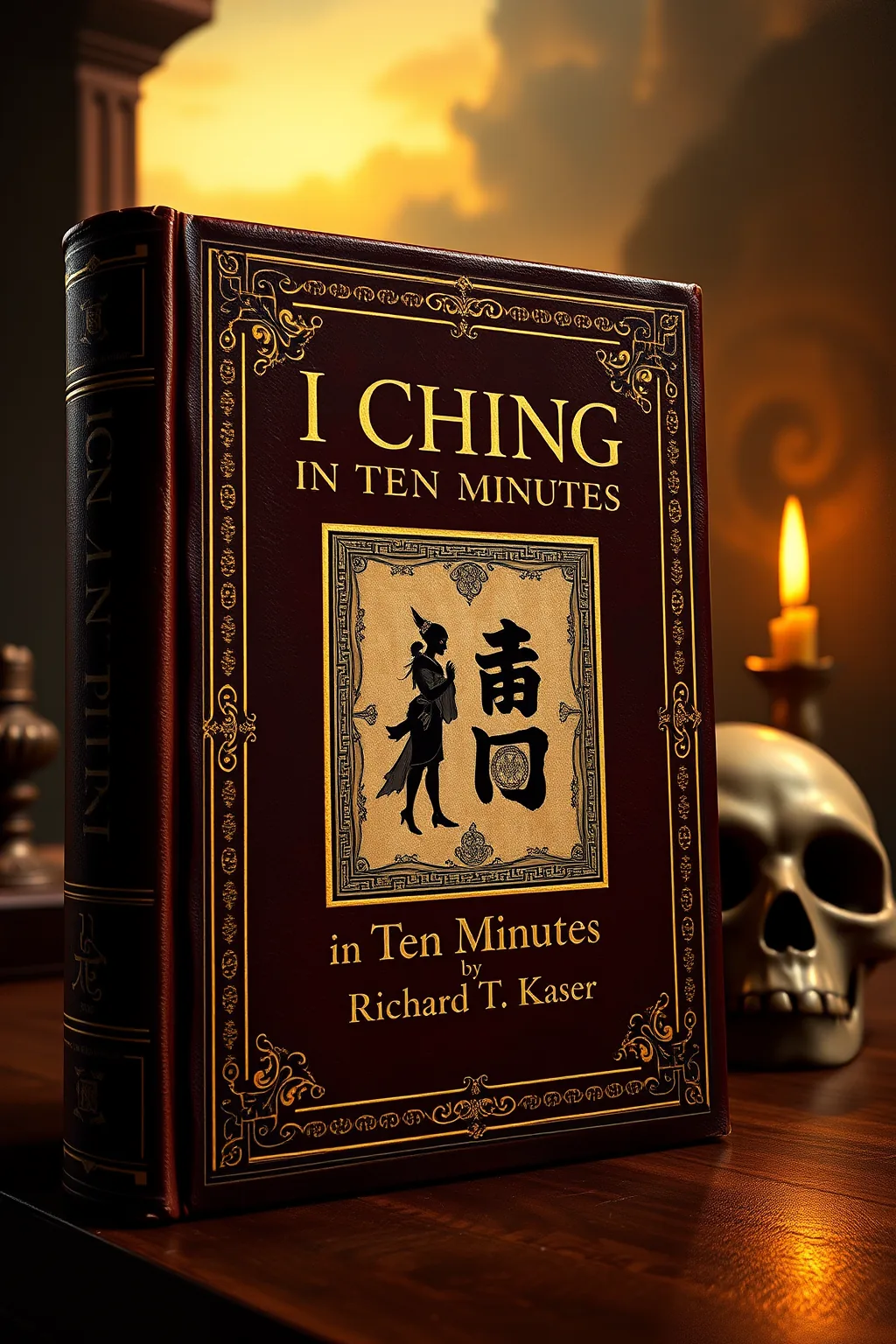
I Ching in Ten Minutes
 71
71

I Ching in Ten Minutes
Richard T. Kaser's "I Ching in Ten Minutes" tackles the formidable task of making the *Book of Changes* accessible, a goal it largely achieves through radical simplification. The book’s strength lies in its directness; it bypasses lengthy philosophical discourse to offer a functional method for obtaining and understanding hexagram readings. For instance, the explanation of how to interpret the interaction of primary and secondary trigrams within a hexagram is presented with a clarity that avoids the obfuscation found in many traditional commentaries. However, this very simplification is also its limitation. In stripping away the layers of philosophical and historical context, the work risks presenting the I Ching as merely a predictive tool, potentially losing the profound ethical and cosmological dimensions that have sustained its study for millennia. The 2010 publication date places it in a modern wave of self-help-oriented esoteric guides. Ultimately, "I Ching in Ten Minutes" serves as an efficient, if shallow, gateway for the utterly new to the *Book of Changes*.
📝 Description
71
Richard T. Kaser's 2010 book simplifies the ancient Chinese divination text, the I Ching.
Published in 2010, "I Ching in Ten Minutes" by Richard T. Kaser offers a simplified method for consulting the *Book of Changes*. The book explains how to cast and interpret hexagrams, aiming to make the system accessible without requiring years of study. Kaser breaks down the meanings of the trigrams and hexagrams into straightforward explanations for a modern audience.
This text is for anyone seeking a quick introduction to the I Ching, especially those who find traditional commentaries too lengthy or complex. It appeals to readers interested in practical divination, gaining rapid insights, or a new approach to decision-making. The book addresses those curious about the I Ching but daunted by its traditional depth.
The I Ching, or *Book of Changes*, has a long history in Chinese culture, influencing philosophy and strategy. Its introduction to the West in the 19th and 20th centuries drew esoteric and academic attention. Kaser's work represents a modern attempt to clarify this ancient text, adapting its interpretive methods for a contemporary, fast-paced world. This contrasts with earlier Western engagement, which often focused on deeper philosophical or scholarly analysis.
💡 Why Read This Book?
• You will learn a method for casting the I Ching quickly, moving from initial question to hexagram interpretation in minutes, as demonstrated by the book's direct approach to interpreting trigrams and hexagrams. • You will gain practical interpretations of the 64 hexagrams that are explicitly relevant to contemporary societal issues, as Kaser focuses on modern applicability. • You will discover a simplified entry into the *Book of Changes*, bypassing the extensive study typical of traditional commentaries, making its insights accessible even if you've never encountered the I Ching before 2010.
⭐ Reader Reviews
Honest opinions from readers who have explored this book.
❓ Frequently Asked Questions
Can I really learn to use the I Ching in just ten minutes?
While the title suggests extreme speed, "I Ching in Ten Minutes" provides a method to cast and get a basic interpretation quickly. True mastery of the I Ching, like any complex system, requires ongoing practice and reflection beyond the initial learning phase, which began with its first publication in 2010.
What makes Richard T. Kaser's method different from traditional I Ching study?
Kaser's method prioritizes speed and contemporary relevance, simplifying the interpretation of trigrams and hexagrams. Unlike traditional approaches that delve into extensive commentaries and historical context, this book offers direct, easily digestible meanings for modern application.
Are the interpretations in this book accurate to the original I Ching?
The book offers interpretations designed for modern understanding and quick use, focusing on accessible meanings for each of the 64 hexagrams. While it simplifies the complex layers of traditional I Ching philosophy, it retains the core structure of trigrams and hexagrams.
What are trigrams and hexagrams in the I Ching?
Trigrams are three-line symbols (composed of yin and yang lines), and hexagrams are six-line symbols formed by combining two trigrams. The I Ching uses these 64 hexagrams to represent different states or situations, offering guidance, as explained in the book published in 2010.
Is this book suitable for someone with no prior knowledge of Chinese philosophy?
Yes, the book is specifically designed for beginners. It uses straightforward language to explain the meanings of trigrams and hexagrams, making the I Ching accessible to those unfamiliar with its ancient origins or associated philosophical traditions.
How does the book help with decision-making?
By providing a quick method to consult the I Ching and interpret the resulting hexagrams, the book aims to offer clarity on present situations and potential future developments. The interpretations are framed to assist in making contemporary choices.
🔮 Key Themes & Symbolism
Accessible Divination
The central theme is democratizing the I Ching, making its ancient wisdom accessible without years of dedicated study. The book provides a direct method for casting hexagrams and offers interpretations that are easily understood by contemporary readers. This approach aims to remove the perceived barrier of complexity, allowing individuals to engage with the *Book of Changes* for practical guidance in their daily lives, as evidenced by its 2010 publication date and focus on speed.
Trigram & Hexagram Meanings
This theme focuses on the core symbolic language of the I Ching: the eight trigrams and the 64 hexagrams. Kaser's work deciphers these fundamental building blocks, presenting their meanings in straightforward terms. The emphasis is on understanding how combinations of yin and yang lines create distinct symbolic representations relevant to modern challenges, moving beyond purely historical or philosophical contexts.
Contemporary Application
A key aspect is bridging the gap between the ancient I Ching and the modern world. The book's interpretations are tailored to address contemporary societal issues and personal dilemmas. This ensures that the guidance derived from the hexagrams feels relevant and actionable for individuals navigating 21st-century life, distinguishing it from purely academic or historical studies of the text.
Simplified Interpretation Methods
The work champions simplified techniques for consulting and understanding the I Ching. It offers a streamlined process for casting hexagrams and interpreting their messages, contrasting sharply with more traditional, time-intensive methods. This focus on efficiency makes the I Ching a tool for immediate insight rather than a subject of long-term academic pursuit.
💬 Memorable Quotes
Direct passages from the work, attributed to the author.
“This book deciphers the meanings of I Ching's trigrams and hexagrams in easy-to-understand language.”
— This statement emphasizes the book's role as a translator, simplifying the complex symbolic system of the I Ching into accessible terms for a modern audience unfamiliar with its intricacies.
“Offering explanations that are relevant to contemporary society.”
— This highlights the book's focus on practical application in the present day. It suggests that the ancient wisdom of the I Ching is being recontextualized to address modern concerns and decision-making processes.
“Using the unique methods revealed in this book.”
— This points to the novel approach Kaser presents for engaging with the I Ching. It suggests that the methods offered are distinct and proprietary, designed to facilitate a quicker and more direct interaction with the text.
“Gain insights without extensive prior knowledge.”
— This interpretation underscores the book's beginner-friendly nature. It assures potential readers that they do not need a background in Chinese philosophy or divination to benefit from the methods and interpretations provided.
💡 Key Ideas
Editorial paraphrase of the work's core concepts — not direct quotes.
Readers can cast and interpret the I Ching instantly, without countless hours of study and practice.
This quote expresses the book's primary promise: immediate access to the I Ching's wisdom. It highlights the departure from traditional learning curves, positioning the text as a rapid-access guide for those seeking quick insights.
🌙 Esoteric Significance
Tradition
While the I Ching originates from Chinese cosmology and philosophy, Kaser's work adapts it for a Western esoteric context. It draws from the tradition of making ancient wisdom accessible for practical divination and self-reflection, a lineage seen in various Western esoteric movements since the 19th century. It departs from strict Taoist interpretations by prioritizing speed and immediate applicability over deep philosophical immersion.
Symbolism
The core symbolism lies in the yin (broken line) and yang (solid line) principles, representing duality and change. These combine into trigrams (e.g., Heaven, Earth, Fire, Water) and then 64 hexagrams. Each hexagram is a symbolic representation of a situation or dynamic, offering guidance. Kaser focuses on making these symbolic meanings readily comprehensible and applicable to modern life.
Modern Relevance
This work appeals to contemporary practitioners of Western esotericism who seek tools for rapid insight and decision-making. It aligns with the trend of 'fast divination' and accessible metaphysical guides that have gained traction online and in popular culture, making the ancient I Ching a relevant tool for a generation accustomed to instant information.
👥 Who Should Read This Book
• Beginners curious about the I Ching: Those who are intimidated by the complexity of traditional commentaries and seek a fast, straightforward method to start consulting the *Book of Changes*. • Practical occultists: Individuals interested in divination tools that offer quick, actionable insights for decision-making in contemporary situations, as presented by Kaser's 2010 approach. • Comparative philosophy students: Researchers or enthusiasts looking to understand modern, simplified interpretations of ancient philosophical texts, contrasting with more traditional scholarly or esoteric analyses.
📜 Historical Context
Published in 2010, "I Ching in Ten Minutes" emerged during a period of increased interest in accessible esoteric knowledge, often facilitated by the internet and self-help movements. The I Ching itself, a foundational text of Chinese philosophy dating back over two millennia, had seen numerous Western interpretations, from James Legge's scholarly translations in the 19th century to Carl Jung's psychological analyses in the 20th. Kaser's work represents a distinct shift towards practical, time-efficient application, contrasting with the more in-depth, philosophical, or psychological explorations that preceded it. While scholarly figures like Richard Wilhelm provided comprehensive translations and commentaries, Kaser's approach focuses on demystification for the hurried modern reader, sidestepping the rich philosophical debates and historical layers that define earlier engagement with the *Book of Changes*.
📔 Journal Prompts
The process of casting a hexagram for a specific contemporary problem.
Interpreting the meaning of a changing line within a hexagram context.
Comparing a hexagram reading from this book with a previous interpretation.
Reflecting on the balance of yin and yang in a personal challenge.
How the core trigram meanings inform your current life circumstances.
🗂️ Glossary
Yin
In I Ching philosophy, Yin represents the passive, dark, feminine, and receptive principle, often depicted as a broken line (--) in hexagrams.
Yang
In I Ching philosophy, Yang represents the active, light, masculine, and creative principle, depicted as a solid line (—) in hexagrams.
Trigram
A symbol composed of three lines, each either yin or yang. There are eight basic trigrams (e.g., Heaven, Earth, Fire, Water) that form the building blocks of hexagrams.
Hexagram
A symbol composed of six lines, formed by combining two trigrams. There are 64 unique hexagrams in the I Ching, each representing a specific situation or state.
Casting
The process of consulting the I Ching, typically involving methods like coin tossing or yarrow stalks, to generate a hexagram.
Changing Lines
Lines within a hexagram that are in a state of transition, often indicating a shift or transformation. These lines can generate a second hexagram, adding further nuance to the reading.
Book of Changes
The original Chinese name for the I Ching, a foundational text of Chinese philosophy and divination, first compiled over two millennia ago.