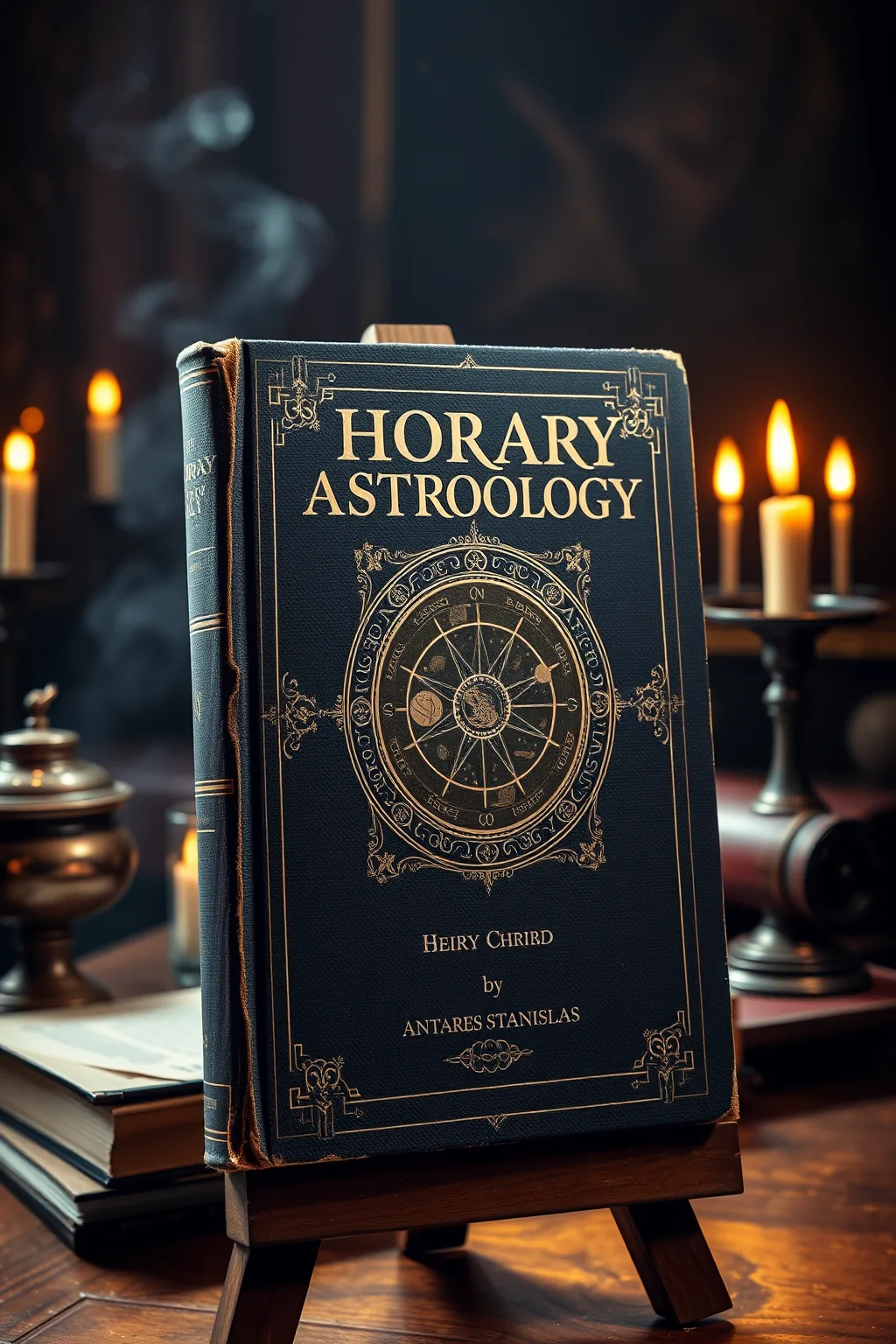
Horary Astrology
 74
74

Horary Astrology
Antares Stanislas’s *Horary Astrology* presents a refreshingly direct approach to a specialized branch of the craft. Rather than succumbing to the often-vague pronouncements found in some astrological texts, Stanislas grounds his work in a personal methodology. He doesn't attempt to cover every conceivable horary technique; instead, he focuses on what he finds reliable, a pragmatic choice that lends the book a certain authority. The section discussing the "Lord of the Ascendant" as a primary significator, for example, is handled with a clarity that benefits newcomers. However, the author's insistence on a highly personal rule set, while making the text original, might leave advanced practitioners wishing for more engagement with established historical debates or alternative interpretations. The brevity of the book, a strength for accessibility, sometimes feels like a missed opportunity to explore nuances. Still, for someone seeking a no-nonsense introduction to asking the stars specific questions, Stanislas offers a functional and grounded perspective.
📝 Description
74
Antares Stanislas's Horary Astrology explains a system for answering direct questions using astrological charts.
Horary astrology operates on a simple premise: it answers direct questions. Unlike natal astrology, which maps a person's entire life, horary casts a chart for the precise moment an astrologer understands a question. This specific timing allows for a focused examination of the querent's situation. The method aims to provide clear answers quickly, cutting through ambiguity to offer actionable insights.
This book suits individuals seeking practical answers to immediate concerns. It appeals to those who find general astrological readings too broad or who need guidance on specific dilemmas, such as locating lost items, understanding relationship dynamics, or assessing career prospects. Readers familiar with divination methods that yield concrete outcomes, perhaps tarot, will find horary astrology’s approach particularly direct. It is for the questioner seeking specific outcomes.
The practice of answering specific questions through celestial interpretation has roots stretching back centuries. Ancient Babylonian priests observed celestial phenomena for omens. Later, Hellenistic practitioners refined techniques for casting charts to address individual queries. This lineage continued through the medieval and Renaissance periods, with figures like William Lilly in the 17th century codifying many of its core principles.
This book fits within the tradition of divinatory arts that use celestial mechanics for specific inquiries. Unlike broader astrological systems that map lifelong potentials, horary astrology focuses on the exact moment a question is formed. This practice connects to ancient methods of omen interpretation and later Hellenistic and medieval techniques for direct consultation. The emphasis is on the immediate reflection of the queried situation in the heavens at the time of inquiry, seeking clear, actionable answers rather than general life patterns.
💡 Why Read This Book?
• Gain a focused method for seeking answers to specific questions, learning how to cast and interpret charts for the precise moment a query is posed, as detailed in the book's initial chapters. • Understand the core significators in horary astrology, particularly the role of the ascendant and its ruler, and how they directly represent the querent and their concerns, a concept central to Stanislas's approach. • Develop a practical skill for divination that relies on concrete astrological principles, allowing for swift, trustable answers without the ambiguity sometimes found in broader interpretive systems like natal astrology.
⭐ Reader Reviews
Honest opinions from readers who have explored this book.
❓ Frequently Asked Questions
What is horary astrology and how does it differ from natal astrology?
Horary astrology answers specific questions by casting a chart for the exact moment the question is understood by the astrologer, unlike natal astrology which uses birth time to map a lifetime potential.
When was Antares Stanislas's Horary Astrology first published?
The first edition of Antares Stanislas's *Horary Astrology* was published on July 25, 2017.
What kind of questions can horary astrology answer?
Horary astrology is designed to address precise questions about relationships, finances, career, lost items, and almost any specific dilemma the querent faces.
Does this book provide a complete system of horary interpretation?
The book presents Antares Stanislas's personal, empirically validated rules for horary reading, focusing on clarity and synthesis rather than an exhaustive survey of all historical techniques.
Is horary astrology considered reliable?
Horary astrology is presented as a trustable method for obtaining direct and often surprisingly accurate answers to pressing questions, based on the celestial configuration at the time of inquiry.
Who would benefit most from reading Horary Astrology?
Individuals seeking quick, actionable answers to specific life questions, those curious about divination methods beyond tarot, and students of astrology interested in practical applications would find this text valuable.
🔮 Key Themes & Symbolism
The Moment of Inquiry
The fundamental principle of horary astrology is its reliance on the precise moment a question is received and understood by the astrologer. This temporal anchor is critical, as the astrological chart cast for this exact time is believed to mirror the dynamics and potential outcomes of the querent's situation. Unlike natal charts, which offer a broader life blueprint, horary charts provide a snapshot focused on a specific query, demanding a close examination of planetary positions, house rulerships, and aspects relevant to the question asked.
Personalized Rule Set
Antares Stanislas distinguishes his work by presenting a curated selection of horary rules and techniques that he has personally validated through experience. This approach eschews a comprehensive historical overview in favor of practical, synthesized guidance. The author focuses on the methods he trusts, aiming for clarity and efficacy, which offers a distinct perspective for readers seeking a direct, no-frills introduction to the practice based on the author's empirical findings.
Direct Questioning and Clarity
The essence of horary astrology lies in its ability to provide straightforward answers to specific questions. The book emphasizes this directness, moving beyond general astrological interpretations to address concrete concerns. Whether the query is about finding a lost object, understanding a relationship's future, or assessing a career move, the horary method aims to cut through ambiguity and deliver a trustable, actionable insight derived from the celestial configuration.
The Astrologer's Role
The astrologer acts as a conduit and interpreter in horary work. The text implicitly highlights the responsibility involved in accurately receiving, understanding, and casting a chart for the question. It also underscores the importance of the astrologer's discernment in selecting and applying interpretive techniques, particularly in Stanislas's model, where personal experience guides the choice of valid astrological rules.
💬 Memorable Quotes
Direct passages from the work, attributed to the author.
“Horary astrology responds to precise questions in a quick, simple, trustable manner.”
— This statement expresses the core promise of horary astrology as presented in the book. It highlights the method's efficiency, accessibility, and reliability, positioning it as a practical tool for seeking direct answers to life's specific dilemmas.
“The author makes the text very original, exposing his own believes and rules for reading with clarity and synthesis.”
— This highlights Stanislas's unique contribution to the field. Instead of a generic survey, he offers a personal, distilled methodology, emphasizing clarity and a synthesized approach based on his own astrological experience and convictions.
“Mentioning only those that, in his experience, are valid.”
— This phrase underscores the empirical and selective nature of Stanislas's horary system. He prioritizes techniques proven effective through his own practice, offering readers a focused and potentially more reliable set of interpretive tools.
“Becoming increasingly appreciated by those who are passionate for the sector and causes curiosity in the lovers of card-reading.”
— This suggests a growing interest in horary astrology, particularly among those already engaged with esoteric practices. It notes its appeal to enthusiasts and draws a parallel with card reading, implying a shared function of divination and guidance.
“Numerous questions that it can answer.”
— This points to the versatility of horary astrology. The method is not limited to a narrow range of inquiries but can be applied to a wide variety of specific concerns, making it a broadly applicable tool for divination.
🌙 Esoteric Significance
Tradition
Horary astrology falls within the broad Hermetic and Hellenistic astrological traditions, which emphasize the principle of 'as above, so below.' It's a practical application of the belief that celestial configurations directly correlate with earthly events and individual circumstances. Unlike more philosophical or psychological branches of astrology, horary is fundamentally divinatory, seeking direct answers rather than exploring latent potentials. Stanislas's approach adds a layer of personal empiricism, filtering traditional techniques through his own experience.
Symbolism
Key symbols in horary include the Ascendant and its ruler, often signifying the querent, and the Descendant and its ruler, potentially representing the 'other' party in a relationship question. The Moon is frequently a crucial significator, representing the querent's emotions or the unfolding of events. Planetary aspects, such as conjunctions, squares, and trines, symbolize the interactions and tensions between different elements of the question, providing a symbolic language for potential outcomes.
Modern Relevance
Contemporary practitioners of horary astrology, like those drawn to Stanislas's direct method, continue to find value in its ability to provide concrete answers in an often uncertain world. It appeals to those seeking practical guidance on specific issues, bridging the gap between esoteric inquiry and everyday concerns. Its straightforward approach also appeals to individuals exploring various divination systems, including tarot and runes, offering a unique astrological perspective for focused questioning.
👥 Who Should Read This Book
• Individuals seeking direct, actionable answers to specific life dilemmas, who appreciate a pragmatic and synthesized approach to astrological interpretation. • Students of astrology looking to expand their skillset beyond natal readings, interested in a method focused on immediate questions and precise outcomes. • Practitioners of other divination arts, such as tarot readers, who are curious about how astrological charts can be used for focused question-answering and comparative divination.
📜 Historical Context
The practice of horary astrology, or 'question astrology,' has a long and distinguished history, flourishing particularly during the medieval and Renaissance periods. Figures like Guido Bonatti in the 13th century and later William Lilly, whose 1647 work *Christian Astrology* included extensive sections on horary, established its methodologies. By the 17th century, horary was a respected, if sometimes controversial, practice among educated individuals, used for everything from locating lost property to advising on political matters. While the Enlightenment saw a decline in overt interest in astrology, the 20th century witnessed a resurgence, with practitioners seeking to refine and adapt ancient techniques. Stanislas's work, published in 2017, arrives during this modern revival, offering a contemporary take on a practice with deep historical roots, distinct from the more generalized natal chart interpretations that often dominate contemporary astrological discourse.
📔 Journal Prompts
The Lord of the Ascendant's placement: Reflect on how its house and sign might symbolize your current approach to a pressing question.
Synthesize the core principles of horary from Stanislas's perspective. What makes this method 'quick, simple, and trustable'?
Consider a recent question you had. How might casting a horary chart at that moment have provided a different kind of insight than your usual thought process?
The role of the Moon: Explore how its condition and aspects in a hypothetical horary chart could reflect emotional undercurrents of a query.
Compare the directness of horary with the broader scope of natal astrology. What are the advantages of each?
🗂️ Glossary
Horary Astrology
A branch of astrology focused on answering specific questions by casting a chart for the precise moment the question is understood by the astrologer.
Querent
The person asking the question in a horary astrology reading.
Significator
A planet or point in the astrological chart that represents a person, thing, or matter relevant to the question being asked.
Ascendant (ASC)
The zodiac sign and degree rising on the eastern horizon at the moment a chart is cast, often representing the querent.
Lord of the Ascendant
The planetary ruler of the sign on the Ascendant; it typically represents the querent in a horary chart.
House System
The method used to divide the celestial sphere into twelve sections (houses), each representing different areas of life.
Aspect
The angular relationship between two or more planets or points in an astrological chart, indicating how their energies interact.