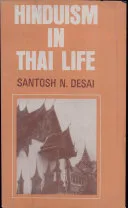
Hinduism in Thai Life
 83
83

Hinduism in Thai Life
S.N. Desai's Hinduism in Thai Life offers a meticulously researched account of how Indic traditions permeated Thai spiritual and political structures. The book's strength lies in its detailed exposition of Brahmanical rituals and their adaptation by the Thai monarchy, particularly the concept of Devaraja. Desai effectively demonstrates that this was not a simple imposition but a dynamic syncretism. However, the narrative occasionally becomes dense, requiring significant background knowledge from the reader. A particularly illuminating section details the incorporation of Hindu deities into Buddhist temple art, showcasing the visual language of this cultural fusion. While Desai's academic rigor is commendable, a more accessible introduction to the core philosophical tenets of both traditions might have broadened its appeal. It provides a valuable, if sometimes challenging, window into a complex religious history.
📝 Description
83
S.N. Desai's 2005 book examines Hinduism's influence on Thai life.
First published in 2005, S.N. Desai's Hinduism in Thai Life details the significant impact of Hindu philosophical and religious ideas on Thailand's culture. The book moves beyond a simple historical account to investigate how Brahmanical rituals, deities, and cosmological ideas were adopted and reshaped within a predominantly Buddhist society. It follows the syncretic development of these traditions, noting their continued presence in royal ceremonies, public festivals, and daily spiritual practices.
The integration of Hindu elements into Thai culture has historical roots extending back many centuries, particularly during the periods of Khmer Empire influence and the Sukhothai Kingdom. Brahmins from India introduced texts and rituals that were adapted to support royal authority and define the cosmology of the Thai kingdoms. Desai places these developments within the larger context of Indianization in Southeast Asia, a process that saw the adoption of Sanskrit, Hindu images, and political theories across the region before European colonization.
This work touches upon the esoteric dimensions of religious syncretism, particularly how concepts of divine kingship and cosmology, originating in Indic traditions, were adapted and reinterpreted in a Southeast Asian context. It illustrates how seemingly distinct religious systems can interact, leading to unique expressions of spiritual and political authority. The book's focus on the integration of Brahmanical elements into a Buddhist framework highlights the fluid nature of religious boundaries and the potential for cross-cultural exchange to create new spiritual understandings.
💡 Why Read This Book?
• Gain a concrete understanding of the Devaraja concept, a fusion of Hindu divine kingship and Buddhist principles, as explained by Desai, which offers a unique perspective on statecraft and spirituality. • Discover the specific ways the Ramakien epic was integrated into Thai society, providing actionable insights into how foundational myths shape national identity and moral frameworks. • Learn about the adaptation of Hindu deities like Shiva and Vishnu within the Thai Buddhist pantheon, revealing a practical model for cross-cultural religious syncretism beyond theoretical discussions.
⭐ Reader Reviews
Honest opinions from readers who have explored this book.
❓ Frequently Asked Questions
What is the historical period covered by Hinduism in Thai Life?
The book examines the influence of Hindu traditions on Thai life from its early integration, particularly during the Sukhothai Kingdom and the era of Khmer influence, up to the modern period, highlighting the continuity of these practices.
How did Hinduism influence Thai royalty?
Desai details the concept of Devaraja, where Hindu notions of divine kingship were adopted and adapted by Thai monarchs to legitimize their rule and imbue their reign with sacred authority.
Are there specific Hindu deities discussed in the book's context?
Yes, the work explores the presence and reinterpretation of major Hindu deities such as Shiva and Vishnu within the predominantly Buddhist spiritual landscape of Thailand.
What is the Ramakien and its significance according to the book?
The book discusses the Ramakien, the Thai adaptation of the Indian Ramayana epic, as a significant cultural and narrative force that shaped moral values and social understanding in Thailand.
Does the book focus solely on religious aspects or also cultural ones?
It encompasses both, examining how Hindu philosophical and religious concepts influenced not only spiritual practices but also royal ceremonies, popular festivals, and broader social narratives in Thailand.
When was Hinduism in Thai Life first published?
The book by S.N. Desai was first published in 2005, making it a relatively contemporary academic study on the subject.
🔮 Key Themes & Symbolism
Brahmanical Rituals in Siam
This theme focuses on the adoption and adaptation of Brahmanical rituals by the Thai court and society. Desai meticulously details ceremonies, priestly roles, and the symbolic significance of practices that originated in India but found a unique expression in Thailand. The work highlights how these rituals, often linked to state power and cosmic order, were integrated into existing Buddhist frameworks, demonstrating a sophisticated form of religious syncretism that persisted for centuries and continues to influence national ceremonies.
The Devaraja Concept
Central to the book is the exploration of the Devaraja, or 'god-king' concept. This theme examines how Hindu ideas of divine kingship, coupled with Buddhist concepts of kingship, were synthesized to create a unique political and spiritual ideology for Thai monarchs. Desai analyzes the implications of this concept for royal authority, legitimacy, and the perceived role of the king as a cosmic intermediary, bridging the earthly and divine realms.
Ramakien and Cultural Narrative
The book addresses the profound cultural impact of the Ramakien, the Thai version of the Ramayana epic. This theme investigates how the narrative, its characters, and its moral lessons became deeply embedded in Thai consciousness. Desai illustrates how the epic's stories were not merely entertainment but served as a vehicle for transmitting ethical values, social norms, and a shared cultural identity, often through popular arts and performance.
Syncretism of Deities
A significant aspect explored is the syncretic integration of Hindu deities into the Thai religious landscape. The work details how figures like Shiva, Vishnu, and others were incorporated into Buddhist cosmology and iconography, often reinterpreted to fit local beliefs. This theme underscores Thailand's capacity for religious flexibility, where foreign deities were not replaced but rather accommodated and integrated, enriching the existing spiritual milieu.
💬 Memorable Quotes
Direct passages from the work, attributed to the author.
“Brahmanical traditions were not merely transplanted but were actively reshaped by the Thai environment.”
— This statement emphasizes that the influence of Hinduism in Thailand was not a passive reception but an active process of adaptation and transformation, highlighting the agency of Thai culture in integrating foreign elements.
“The Ramakien served as a moral compass for Thai society.”
— This interpretation conveys that the Thai version of the Ramayana epic played an important role in shaping ethical understanding and guiding social behavior among the populace.
“Hindu deities were often absorbed into the Buddhist pantheon, coexisting rather than competing.”
— This highlights the syncretic nature of Thai religion, illustrating how Hindu gods were incorporated into Buddhist beliefs and practices, fostering a harmonious religious coexistence.
“The influence of Indianization extended beyond religion to encompass language and statecraft.”
— This points to the broader impact of Indian cultural and political systems on Thailand, suggesting that the influence was complex, affecting not just spiritual life but also administrative and linguistic structures.
💡 Key Ideas
Editorial paraphrase of the work's core concepts — not direct quotes.
The concept of Devaraja provided a potent ideological framework for Thai kingship.
This paraphrase suggests that the idea of the god-king was a powerful tool for legitimizing royal power and establishing the king's sacred status within the Thai political system.
🌙 Esoteric Significance
Tradition
This work engages with esoteric themes through the lens of comparative religion and cultural transmission, rather than aligning strictly with a singular Western esoteric lineage like Hermeticism or Theosophy. It examines how concepts often considered esoteric in their originating context—such as divine kingship, cosmic order, and the symbolic power of deities—were integrated into a non-Western societal framework. The significance lies in demonstrating the universal patterns of esoteric thought's infiltration into mainstream culture and governance.
Symbolism
Key symbols explored include the Naga, a mythical serpent often associated with water, fertility, and the underworld, which bridges cosmic realms. The Chakravartin, the 'wheel-turning' universal monarch, represents a divine ideal of rulership deeply influenced by Buddhist and Hindu cosmology. The Lotus, a pervasive symbol in both traditions, signifies purity, enlightenment, and spiritual unfolding, appearing in art and ritual contexts discussed within the book.
Modern Relevance
Contemporary scholars of comparative mythology, religious studies, and cultural anthropology continue to draw upon the insights presented in Desai's work. Thinkers exploring the dynamics of cultural hybridity, post-colonial religious studies, and the enduring influence of ancient cosmologies on modern nation-states find value in its detailed case study. Practitioners interested in the cross-pollination of spiritual traditions, particularly those examining the practical application of ritual and symbolism across cultures, can find precedents here.
👥 Who Should Read This Book
• Scholars of comparative religion and Southeast Asian history seeking a detailed examination of religious syncretism, particularly the Hindu-Buddhist interface in Thailand. • Students of comparative mythology interested in the adaptation of Indian epics like the Ramayana (Ramakien) into distinct cultural narratives. • Individuals exploring the historical evolution of statecraft and divine kingship ideologies, particularly the Devaraja concept and its manifestation in Thai monarchy.
📜 Historical Context
Published in 2005, S.N. Desai's work emerged at a time when academic interest in Southeast Asian cultural history and religious syncretism was well-established. The period following the 1997 Asian financial crisis saw a renewed focus on cultural identity and heritage across the region. Desai's research builds upon decades of scholarship concerning the Indianization of Southeast Asia, a process that saw the significant adoption of Indic scripts, political theories, and religious frameworks by kingdoms like Sukhothai and Ayutthaya, largely predating European colonial encounters. While Buddhism became the dominant religion, the influence of Brahmanism, particularly within the royal court, remained potent. Desai's work engages with scholars like George Cœdès, whose foundational work on Southeast Asian epigraphy and history illuminated the extent of Indian cultural impact. The book implicitly addresses the enduring legacy of these historical interactions, contrasting with the more direct colonial influences studied by scholars of Western imperialism in the region.
📔 Journal Prompts
The integration of Brahmanical rituals into Thai court ceremonies.
Analyzing the Devaraja concept's influence on Thai monarchy.
The Ramakien's role in shaping Thai cultural identity.
Syncretism of Hindu deities within the Buddhist pantheon.
The enduring legacy of Indianization in modern Thai society.
🗂️ Glossary
Devaraja
A concept of divine kingship, merging Hindu notions of god-kingship with Buddhist ideals, historically central to legitimizing Thai monarchy and establishing cosmic order.
Ramakien
The Thai version of the Indian epic Ramayana, which plays a significant role in Thai culture, literature, art, and moral teachings, adapting the original narrative to local contexts.
Brahmanism
The religious and social system originating in ancient India, characterized by the priestly class (Brahmins), rituals, and philosophical concepts, which significantly influenced Southeast Asian cultures.
Indianization
The historical process by which Indian culture, religion, language, and political ideas spread and were adopted by societies in Southeast Asia, including Thailand.
Syncretism
The merging or blending of different, often opposing, religious or cultural beliefs and practices, as seen in Thailand where Hindu and Buddhist elements coexist and intermingle.
Chakravartin
A term for an ideal, righteous ruler in Buddhist and Hindu traditions, often translated as 'wheel-turning monarch,' representing universal sovereignty and moral governance.
Naga
Mythical serpent beings prominent in Hindu, Buddhist, and Jain traditions, often associated with water, fertility, and cosmic symbolism, appearing in Southeast Asian mythology.