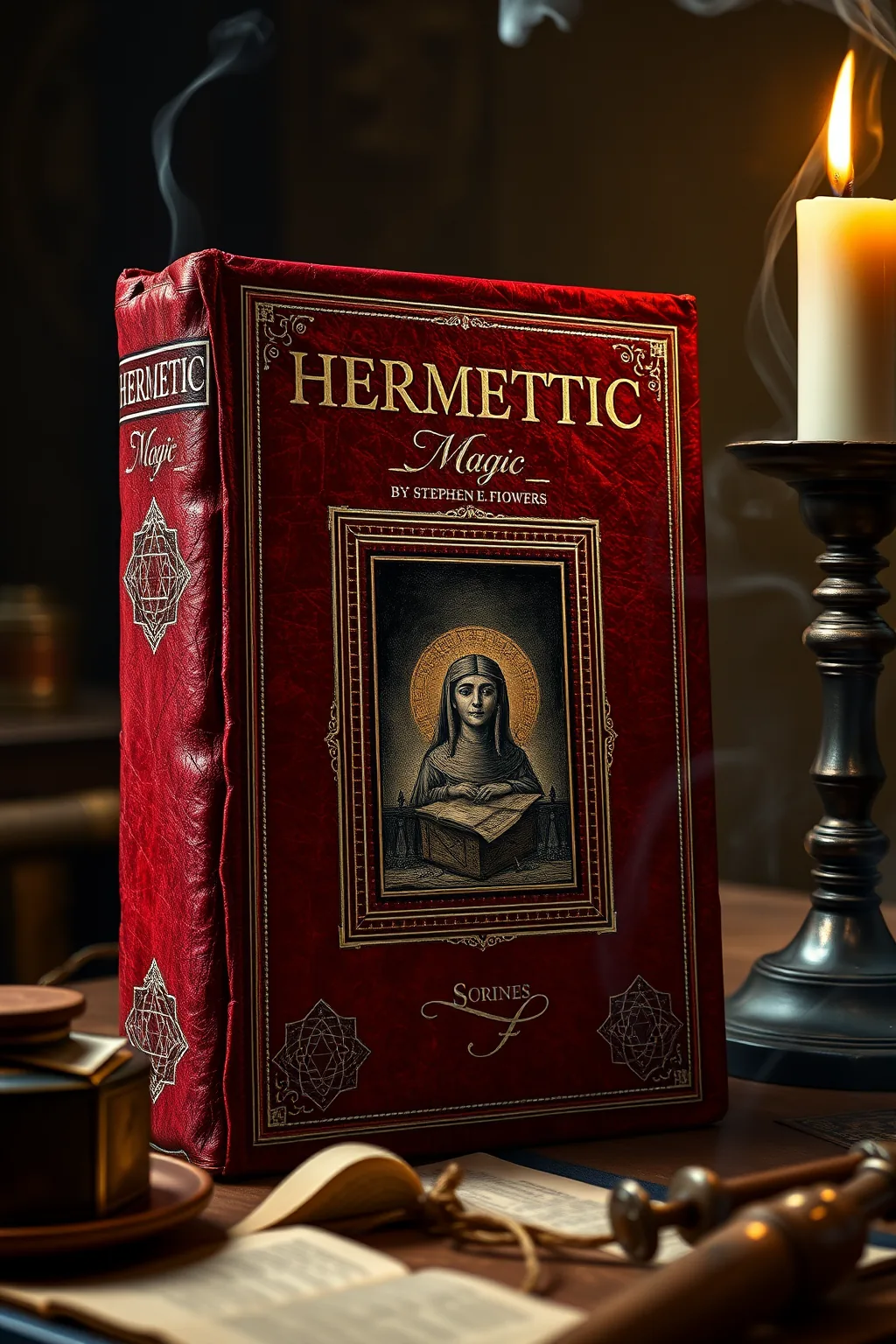
Hermetic Magic
 74
74

Hermetic Magic
Flowers's "Hermetic Magic" offers a welcome, if somewhat austere, distillation of Hermetic philosophy for the dedicated practitioner. Its strength lies in its systematic approach, presenting complex ideas with a clarity that avoids the vagaries often found in occult literature. The chapter on the "Great Work" is particularly effective in outlining the stages of spiritual development. However, the book's academic tone, while precise, can sometimes feel detached, lacking the visceral engagement that some might seek in magical texts. The discussion around the "Emerald Tablet" offers a solid interpretation, but feels more like an analysis than a lived experience. It is a valuable resource for those seeking a structured understanding of Hermeticism's theoretical architecture.
📝 Description
74
Stephen Flowers published 'Hermetic Magic: The Book of Initiation' in 1995 as a practical guide to Hermetic principles.
This book provides a systematic approach to understanding and working with Hermeticism. Flowers moves beyond historical accounts to offer a guide for serious students, detailing the theoretical and practical tools needed for engagement. The work examines the core ideas of Hermetic philosophy, tracing its historical development and its capacity for personal transformation.
'Hermetic Magic' targets individuals dedicated to studying esoteric traditions, especially Western occultism and practical magic. It suits students who have progressed past basic introductions and desire a rigorous method for Hermetic practice. Those curious about the philosophical foundations of magic, alchemy, and gnosis will find considerable content within its pages. Flowers emphasizes the initiatory path, asserting that genuine insight and power arise from disciplined study and the application of these doctrines.
Flowers's work appeared during a resurgence of interest in esoteric studies, aiming to reconnect with the philosophical and scholarly roots of Hermeticism. It distinguishes itself from more sensationalized or less theoretically grounded popular presentations of the occult. The book engages with historical figures and concepts that have influenced Western esotericism for centuries, seeking to re-establish a serious academic and practical engagement with these traditions.
💡 Why Read This Book?
• Gain a structured understanding of the "As Above, So Below" principle, learning how macrocosmic truths can be applied to personal spiritual advancement, a core tenet of Hermeticism since antiquity. • Explore the concept of the "Great Work" as presented by Flowers, understanding its stages and their implications for achieving higher consciousness, moving beyond superficial magical aims. • Grasp the philosophical underpinnings of ritual magic, differentiating between symbolic action and genuine energetic manipulation as detailed in the book's practical sections.
⭐ Reader Reviews
Honest opinions from readers who have explored this book.
❓ Frequently Asked Questions
What is the primary focus of Stephen E. Flowers' "Hermetic Magic"?
The book's primary focus is on providing a practical and systematic framework for understanding and engaging with Hermetic philosophy, emphasizing its initiatory and magical aspects.
When was "Hermetic Magic" first published?
"Hermetic Magic: The Book of Initiation" by Stephen E. Flowers was first published in 1995.
Who is Stephen E. Flowers and what is his background?
Stephen E. Flowers is an author and scholar known for his extensive work in occult philosophy, Germanic paganism, and esoteric traditions, often focusing on practical applications.
Does "Hermetic Magic" require prior knowledge of occult subjects?
While not strictly mandatory, prior familiarity with esoteric or philosophical concepts will enhance comprehension, as the book delves into complex ideas like gnosis and theurgy.
What makes this book different from other books on Hermeticism?
Its distinction lies in its operational, practical approach, aiming to guide the student through the initiatory process rather than just offering historical or theoretical accounts.
What are some of the key concepts discussed in "Hermetic Magic"?
Key concepts include the principle of "As Above, So Below," the nature of the divine mind (Nous), the initiatory path, and the practical application of Hermetic doctrines.
🔮 Key Themes & Symbolism
The Initiatory Path
Flowers frames Hermeticism as an initiatory path, detailing the stages and disciplines required for spiritual ascent. This involves not just intellectual study but a transformation of the self, moving towards a higher state of consciousness. The book emphasizes the internal alchemy that mirrors external magical operations, suggesting that true mastery is an inward journey facilitated by structured practice and understanding of cosmic laws.
Hermetic Cosmology and Gnosis
The work elaborates on the Hermetic worldview, positing a divine mind (Nous) and a structured universe governed by specific principles, most notably "As Above, So Below." It connects these cosmological ideas to the pursuit of gnosis—direct, experiential knowledge of the divine. Flowers argues that this knowledge is attainable through diligent application of Hermetic techniques, leading to a profound understanding of one's place in the cosmos.
Practical Application of Hermeticism
Beyond theory, "Hermetic Magic" stresses the practical application of Hermetic principles. This includes the understanding and execution of ritual, the use of symbolic language, and the cultivation of specific mental states. Flowers provides a framework for how these practices can serve as tools for self-transformation and spiritual development, grounding esoteric philosophy in actionable steps for the dedicated student.
The Emerald Tablet's Legacy
The profound influence of the "Emerald Tablet" is a recurring motif. Flowers explores its enigmatic verses not just as historical artifacts but as foundational texts containing keys to alchemical and spiritual transformation. The book interprets its core messages as instructions for the adept seeking to understand and manipulate the fundamental forces of existence, both within and without.
💬 Memorable Quotes
Direct passages from the work, attributed to the author.
“The adept must become the master of his own being.”
— This highlights the self-directed nature of the Hermetic path. True magical power and spiritual realization are not granted but earned through personal discipline and mastery over one's thoughts, emotions, and actions.
“As Above, So Below; as without, so within.”
— This iconic Hermetic maxim, central to the book's philosophy, underscores the interconnectedness of all realms. It suggests that understanding the microcosm (the individual) provides keys to understanding the macrocosm (the universe), and vice versa.
“Initiation is the process of spiritual birth.”
— Flowers presents initiation not as a one-time event but as an ongoing process of conscious evolution. It signifies a fundamental shift in awareness and being, akin to being reborn into a higher spiritual state.
“Understanding the divine mind unlocks cosmic secrets.”
— This interpretation points to the Hermetic belief in a universal intelligence or consciousness. By aligning one's own mind with this divine Nous, the practitioner can gain insight into the fundamental workings of reality.
💡 Key Ideas
Editorial paraphrase of the work's core concepts — not direct quotes.
The Great Work is the perfection of the soul.
This paraphrased concept emphasizes the ultimate goal of Hermetic practice: not mere external phenomena, but the purification, refinement, and elevation of the practitioner's spiritual essence.
🌙 Esoteric Significance
Tradition
The work is firmly rooted in the Western Esoteric Tradition, specifically Hermeticism, drawing heavily on its philosophical, alchemical, and magical currents. Flowers positions his book as a guide to the initiatory aspects of this lineage, aiming to provide a systematic approach that complements foundational texts like the Corpus Hermeticum and the "Emerald Tablet." It departs from purely philosophical interpretations by emphasizing practical application and the adept's role in achieving gnosis.
Symbolism
Key symbols explored include the Caduceus of Hermes, representing the union of opposites and the flow of vital energy, and the concept of the "Philosopher's Stone," symbolizing not just alchemical transmutation but the spiritual perfection of the individual. The duality of the divine mind (Nous) and its manifestation is also a central symbolic motif, illustrating the relationship between the unmanifest and manifest realms.
Modern Relevance
Contemporary practitioners of Western ceremonial magic, philosophical alchemy, and esoteric psychology often reference Flowers' work for its structured approach. Schools focusing on Hermeticism and Traditionalism, as well as individual esotericists seeking a deeper understanding of magical theory and practice, find "Hermetic Magic" a valuable resource for its methodical presentation of core principles and initiatory techniques.
👥 Who Should Read This Book
• Serious students of Western Esotericism seeking a foundational text on practical Hermeticism, offering a systematic approach beyond introductory material. • Practitioners of magic and alchemy interested in understanding the theoretical underpinnings and initiatory stages of the "Great Work" as interpreted through a Hermetic lens. • Scholars of comparative religion and philosophy looking for a detailed examination of Hermetic cosmology, gnosis, and their historical influence on esoteric thought.
📜 Historical Context
Stephen Flowers' "Hermetic Magic," published in 1995, arrived during a resurgence of interest in Western esotericism, a period that saw both academic study and popular fascination with occult traditions. The book sought to provide a more rigorous, operationally focused perspective on Hermeticism, differentiating itself from the more syncretic or New Age approaches that had become prevalent. It engaged with the intellectual currents stemming from figures like Julius Evola, who explored Hermeticism and traditionalist philosophy, and contrasted with the burgeoning Wiccan and Neo-Pagan movements that often focused on nature worship. Flowers' work aimed to reconnect with the more ancient, philosophical, and alchemical roots of the tradition, emphasizing a disciplined, initiatory path that required significant study and practice, rather than solely relying on rediscovered ancient texts or simplified rituals.
📔 Journal Prompts
The concept of Nous: How might understanding the divine mind alter your perception of everyday reality?
The "As Above, So Below" principle: Identify a personal challenge and analyze its potential macrocosmic parallels.
Spiritual birth: Reflect on moments of profound personal transformation that felt like a rebirth.
The adept's self-mastery: In what specific area of your life could you exercise greater control?
The Great Work: What does "perfection of the soul" mean to you in practical terms?
🗂️ Glossary
Nous
In Hermetic philosophy, the divine mind or intellect; the ultimate source of creation and knowledge, from which all things emanate.
Gnosis
Direct, intuitive, and experiential knowledge of spiritual truths, often considered a higher form of understanding than intellectual comprehension.
The Great Work (Major work)
The ultimate goal of Hermeticism and alchemy, referring to the spiritual transformation and perfection of the individual, often mirrored by the alchemical creation of the Philosopher's Stone.
Adeptus
A practitioner who has achieved a certain level of mastery or initiation within an esoteric order or tradition; one who has attained a higher degree of knowledge and power.
Corpus Hermeticum
A collection of ancient Greek philosophical and religious texts attributed to Hermes Trismegistus, forming the core of Hermetic doctrine.
Emerald Tablet
A short, cryptic text attributed to Hermes Trismegistus, considered a foundational document in alchemy and Hermetic philosophy, containing principles of transformation.
Theurgy
A system of ritual magic aimed at invoking divine presence or achieving union with the divine, often involving purification and symbolic actions.
🔮 Readers Also Liked
Browse all →







More by Stephen E. Flowers
All books →



More Free Magic & Ritual Books
View all →