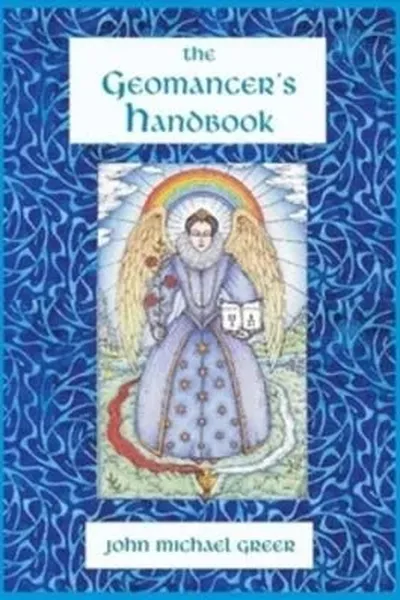
Geomancer's Handbook

 78
78

Geomancer's Handbook
Greer's "Geomancer's Handbook" offers a refreshingly lucid exposition of a divinatory art often shrouded in arcane jargon. The strength of this work lies in its systematic breakdown of the 16 geomantic figures, presenting their construction and symbolic language with admirable clarity. Greer avoids the common pitfall of presenting geomancy as an opaque mystery, instead offering practical methods for interpretation. A particularly effective section details the "Ptolemaic" method of figure construction, making a complex process accessible. However, the work could benefit from more extensive examples of actual readings, moving beyond theoretical explanations to demonstrate the application of the principles in diverse scenarios. The book serves as a solid primer, but its depth might leave practitioners yearning for more nuanced case studies.
"The Geomancer's Handbook" is a competent and well-structured introduction to geomancy.
📝 Description
78
John Michael Greer's 2007 book systematizes the ancient art of geomancy.
The Geomancer's Handbook details the practice of geomancy, a divination method using earth patterns and random marks. John Michael Greer, an author known for his work in occult and esoteric subjects, organizes this ancient system into a clear framework. The book traces geomancy's history from its origins in the Arab world and its spread through medieval and Renaissance Europe.
Greer explains the 16 geomantic figures, how they are formed, and their meanings. He also covers the geomantic house system, astrological influences, and how to apply the practice to specific questions. The text focuses on the symbolic language of the figures, connecting them to elements, planets, and archetypes to aid in interpreting divinatory results. This makes the book useful for both new students and experienced practitioners.
Geomancy, originating in the Arab world around the 10th century, became a recognized divinatory art across Europe by the High Middle Ages. It was integrated into Renaissance magical and astrological systems. Greer situates geomancy within the Western esoteric tradition, noting its parallel development with other occult practices. This book connects geomantic symbols to elemental forces, astrological correspondences, and archetypal patterns, placing it within a broader framework of symbolic interpretation common in esoteric studies.
💡 Why Read This Book?
• Gain a structured understanding of the 16 geomantic figures and their symbolic language, allowing you to interpret their meanings with greater accuracy, as detailed in the section on "The Figures". • Learn a practical method for constructing geomantic charts, moving beyond abstract theory to hands-on divination, directly referencing the "construction of figures" techniques. • Explore the historical lineage of geomancy within Western esotericism, understanding its development from the medieval period to its place in contemporary occult studies.
⭐ Reader Reviews
Honest opinions from readers who have explored this book.
❓ Frequently Asked Questions
What is the historical origin of geomancy as discussed in "Geomancer's Handbook"?
According to "Geomancer's Handbook," geomancy originated in the Arab world and gained significant traction around the 10th century, later spreading throughout Europe during the Middle Ages.
How does John Michael Greer explain the 16 geomantic figures?
Greer details the construction and symbolic meanings of each of the 16 geomantic figures, explaining their elemental and astrological correspondences and how they interact within a reading.
What are the main applications of geomancy presented in the book?
The book outlines geomancy's use as a divinatory tool for answering specific questions, assessing situations, and providing guidance, emphasizing its role in understanding earthly and celestial influences.
Is "Geomancer's Handbook" suitable for beginners in esoteric studies?
Yes, the handbook is designed to be accessible for beginners, offering a systematic and clear introduction to the principles and practice of geomancy.
Does the book cover different methods of geomantic chart construction?
The book explores various methods for constructing geomantic charts, including the "Ptolemaic" method, providing readers with practical techniques for generating the divinatory figures.
What is the historical period most associated with geomancy's spread in Europe?
Geomancy became widespread in Europe during the High Middle Ages and saw further integration into Renaissance magic and astrological practices.
🔮 Key Themes & Symbolism
The Sixteen Figures
The core of geomancy lies in the 16 unique figures derived from a systematic process of random marks. Greer meticulously outlines each figure, assigning them elemental qualities (Fire, Air, Water, Earth), planetary rulership, and symbolic associations. For instance, 'Puer' (Boy) often signifies a young male or a new beginning, while 'Fortuna Major' (Greater Fortune) indicates success and good outcomes. Understanding these figures is paramount, as their arrangement within the geomantic chart dictates the interpretation of a reading, revealing patterns of influence and potential resolutions to queries.
Geomantic Houses
Similar to astrological houses, geomantic houses provide a framework for interpreting the figures within a specific context of a question. The handbook details the 12 houses, each representing different aspects of life such as self, possessions, siblings, home, children, and enemies. The placement of the geomantic figures within these houses offers a nuanced layer of meaning, allowing for a more precise and targeted divination. The interplay between a figure and the house it occupies is crucial for deciphering the subtle energies at play.
Historical Lineage
Greer situates geomancy within its historical trajectory, tracing its development from its origins in the Arab world through its adoption and adaptation in medieval and Renaissance Europe. The book acknowledges the significant contributions of scholars and practitioners who codified and disseminated geomantic knowledge. This historical perspective is vital, as it connects the practice to a broader stream of Western esoteric traditions, demonstrating its evolution and enduring relevance across centuries and cultures.
Earth Divination
At its heart, geomancy is a form of earth divination, drawing wisdom from the patterns and energies of the terrestrial realm. The book emphasizes the connection between the diviner, the earth, and the cosmos. The act of casting the figures is presented not merely as a mechanical process but as a way to tap into the subtle currents of the earth's consciousness. This connection imbues the practice with a grounded, yet mystical, quality, offering insights that resonate with the natural world.
💬 Memorable Quotes
Direct passages from the work, attributed to the author.
“The sixteen figures are the alphabet of geomancy.”
— This concise statement highlights the fundamental building blocks of the practice. Just as letters form words and sentences, these figures are the essential elements that, when combined and interpreted, form the complete message of a geomantic reading.
“The structure of a geomantic chart mirrors the structure of the question asked.”
— This interpretation suggests that the divinatory process is inherently aligned with the querent's inquiry. The resulting pattern of figures is not arbitrary but a symbolic reflection of the problem or situation at hand.
“The houses provide context for the figures' meanings.”
— This highlights the systematic approach to interpretation. The houses act as lenses through which the general meaning of a figure is applied to specific areas of the querent's life, providing practical and relevant answers.
💡 Key Ideas
Editorial paraphrase of the work's core concepts — not direct quotes.
Geomancy offers a direct means of consulting the oracles of the earth.
This paraphrase emphasizes the practice's connection to terrestrial energies. It suggests that geomancy is a method for receiving guidance not from abstract spiritual realms, but from the very ground beneath our feet.
Planetary influences and elemental qualities are assigned to each figure.
This paraphrase points to the complex symbolic system underlying geomancy. Each figure is imbued with astrological and elemental correspondences that enrich its interpretative potential and connect it to broader cosmic patterns.
🌙 Esoteric Significance
Tradition
Geomancy belongs to the broad category of divinatory arts within Western esotericism, often associated with Hermetic and astrological traditions due to its use of planetary and elemental correspondences. While not strictly Kabbalistic or Gnostic, it shares with these traditions a belief in symbolic systems that reflect cosmic order and provide insight into hidden patterns. Greer's work fits within the modern revival of practical occultism, offering a systematic approach that appeals to those seeking tangible methods of spiritual inquiry, distinct from more philosophical or theoretical esoteric studies.
Symbolism
The 16 geomantic figures are central symbols, each representing archetypal forces and concepts. For example, 'Rubeus' (Red) often signifies conflict or aggression, tied to Mars and the element of Fire, while 'Acquisitio' (Acquisition) signifies gain and good fortune, linked to Jupiter and Air. The arrangement of these figures within the 12 geomantic houses further develops this symbolism, mapping cosmic influences onto specific areas of human life, from personal finances to relationships and spiritual growth.
Modern Relevance
Contemporary practitioners of Western esotericism, particularly those interested in divination and earth-based spirituality, draw heavily on Greer's systematic approach. Geomancy is integrated into modern magical curricula and personal practice, often alongside astrology and tarot. Thinkers and practitioners focused on ecological spirituality or finding correspondences between the earth and the cosmos find geomancy a valuable tool for attuning to natural cycles and energies, making Greer's work a relevant resource for current esoteric explorations.
👥 Who Should Read This Book
• Aspiring diviners seeking a comprehensive and systematic introduction to a historical form of earth divination, learning the mechanics and symbolism of geomantic figures. • Students of Western Esotericism interested in the historical development and practical application of occult arts, understanding geomancy's place alongside astrology and other predictive systems. • Occult practitioners looking to expand their divinatory toolkit with a method known for its directness and connection to terrestrial energies, offering unique insights.
📜 Historical Context
Published in 2010, John Michael Greer's "Geomancer's Handbook" emerges at a time of renewed interest in Western esoteric traditions, including divination. Geomancy itself boasts a long history, flourishing in the Arab world from the 10th century onwards and arriving in Europe around the 12th century, becoming a common practice among scholars and mystics. It was integrated into the magical and astrological systems of the Renaissance, appearing in works by figures like Agrippa. While contemporary occultism often grappled with Theosophical or ceremonial magic frameworks, Greer's work focuses on the more grounded, earth-divination aspect, differentiating it from immediate spiritualist or ceremonial trends. The book acknowledges its lineage from medieval Arabic texts and Renaissance European grimoires, positioning it within a continuous, albeit sometimes subterranean, stream of magical practice that predates and often runs parallel to more widely publicized occult movements.
📔 Journal Prompts
The geomantic figure 'Fortuna Major' and its appearance in a reading.
Interpretation of the 'Puer' figure in relation to new beginnings.
The symbolic language of the 16 geomantic figures.
How the 'Ptolemaic' method of figure construction relates to your own process.
The geomantic houses and their significance for personal questions.
🗂️ Glossary
Geomantic Figure
One of the 16 unique patterns formed by a specific process, representing archetypal forces and serving as the basic units of interpretation in geomancy.
The Sixteen
A common shorthand for the 16 geomantic figures, referring to the fundamental set of symbols used in geomantic divination.
Geomantic Houses
Twelve divisions within a geomantic chart, analogous to astrological houses, each representing a specific area of life or inquiry for interpretation.
Ptolemaic Method
A specific technique described for the systematic construction of the 16 geomantic figures, involving a series of calculations or pairings.
Element (Geomancy)
The assignment of Fire, Air, Water, or Earth to each geomantic figure, reflecting its energetic quality and influencing its interpretation.
Planet (Geomancy)
The association of each geomantic figure with one of the traditional planets (Sun, Moon, Mercury, Venus, Mars, Jupiter, Saturn), adding astrological layers to its meaning.
Querent
The person asking a question for which a geomantic reading is performed; the chart is interpreted in relation to their query.
🔮 Readers Also Liked
Browse all →







More by John Michael Greer
All books →




More Free Astrology & Cosmology Books
View all →