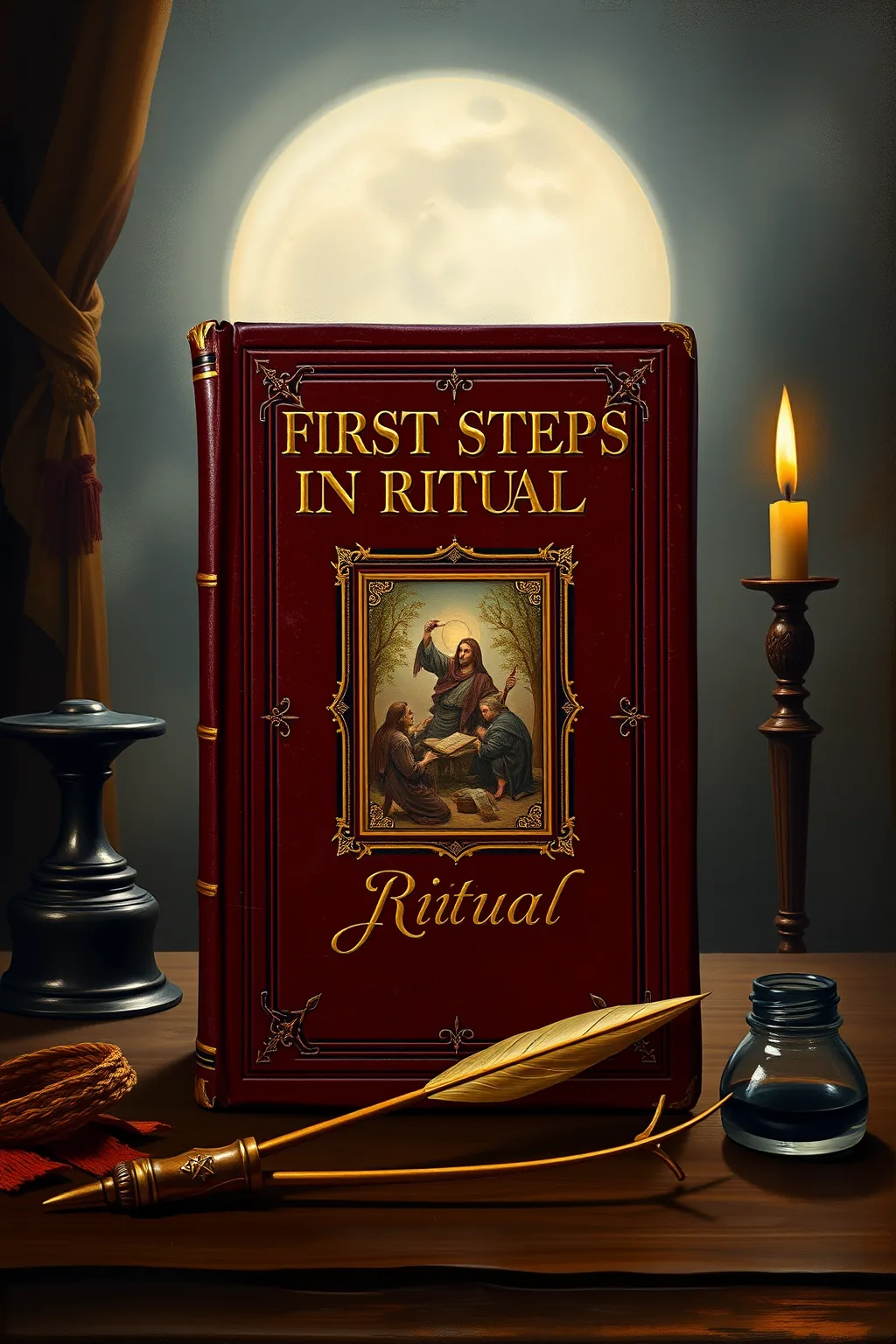
First Steps in Ritual
 71
71

First Steps in Ritual
Dolores Ashcroft-Nowicki's *First Steps in Ritual* offers a welcome antidote to overly complex or arcane introductions to ritual practice. Its strength lies in its direct, no-nonsense approach, stripping away jargon to reveal the underlying psychological and energetic principles. Ashcroft-Nowicki’s emphasis on personal responsibility and the power of focused will is particularly well-articulated, especially in discussions concerning the creation of sacred space. A notable limitation, however, is the book's brevity; while aiming for accessibility, some readers might find certain topics, such as the deeper theoretical underpinnings of specific symbolic elements, are touched upon rather than thoroughly explored. The section on the 'Lesser Banishing Ritual of the Pentagram' provides a concrete example of how the book translates theory into practice, though a more extensive glossary of esoteric terms would have been beneficial. Ultimately, *First Steps in Ritual* succeeds as an introductory text for those ready to engage with the mechanics of ritual.
📝 Description
71
Dolores Ashcroft-Nowicki published *First Steps in Ritual* in 2008, aiming to simplify ceremonial magic.
Dolores Ashcroft-Nowicki's *First Steps in Ritual*, published in 2008, acts as a guide for people wanting to practice ritual. The book breaks down ceremonial magic and spiritual work into its basic principles, making them easier to grasp. It concentrates on how to actually use ritual for personal growth and spiritual development, rather than just discussing the ideas behind it. This book is for those new to studying or doing ritual, especially those who feel drawn to structured spiritual practices but don't know where to start. It is helpful for readers interested in Western esoteric traditions, neopaganism, or spiritual ideas rooted in psychology. The clear method works well for people who practice alone or in groups, giving them a solid basis for creating and performing rituals. Ashcroft-Nowicki's work draws on centuries of Western ceremonial magic, but its focus on practical application reflects a modern trend in esoteric books that encourages direct experience and personal interpretation, moving away from older, more rigid texts.
Published in 2008, *First Steps in Ritual* arrived as interest in practical esotericism grew, partly due to online communities. While not directly linked to specific groups like the Hermetic Order of the Golden Dawn or Theosophy, Ashcroft-Nowicki's book draws from the long history of Western ceremonial magic. Its emphasis on practical application aligns with a pedagogical shift in esoteric publishing, favoring personal experience and interpretation over strict adherence to historical doctrines.
💡 Why Read This Book?
• Gain a practical framework for personal ritual, learning how to establish sacred space and focus intention, directly from Ashcroft-Nowicki's methods outlined in the book. • Understand the fundamental role of visualization and symbolic objects in ritual work, as detailed in the book's explanations of creating ritual tools and atmospheres. • Develop a personal approach to ritual practice grounded in the psychological and energetic principles discussed, informed by the book's 2008 publication context and its focus on experiential learning.
⭐ Reader Reviews
Honest opinions from readers who have explored this book.
❓ Frequently Asked Questions
What is the primary focus of Dolores Ashcroft-Nowicki's *First Steps in Ritual*?
The book's primary focus is on providing a clear, practical introduction to the principles and techniques of ritualistic practice for beginners. It emphasizes personal engagement and understanding the underlying energetic and psychological aspects of ritual work.
When was *First Steps in Ritual* first published?
*First Steps in Ritual* by Dolores Ashcroft-Nowicki was first published in 2008.
Who is Dolores Ashcroft-Nowicki?
Dolores Ashcroft-Nowicki was a renowned British occultist, author, and teacher known for her extensive work in ceremonial magic and esoteric psychology. She founded the Servants of the Light (SOL) school.
Does the book require prior knowledge of esoteric traditions?
No, the book is specifically designed for beginners and aims to introduce core concepts without assuming prior esoteric knowledge, making it accessible to newcomers.
What kind of rituals does the book cover?
The book covers foundational ritualistic techniques applicable to personal spiritual development, including creating sacred space, focusing intention, and the use of symbolic elements, rather than specific religious or cultural rites.
What is the Servants of the Light (SOL) school?
The Servants of the Light (SOL) is an international esoteric school founded by Dolores Ashcroft-Nowicki and W.E. Butler, dedicated to teaching practical occultism and ceremonial magic through correspondence courses.
🔮 Key Themes & Symbolism
Intent and Visualization
The work meticulously details the crucial role of focused intention as the driving force behind any ritual. Ashcroft-Nowicki explains how visualization acts as the architect, shaping the energetic field of the ritual space and directing the flow of power. This theme is explored through practical exercises designed to hone the practitioner's mental focus and imaginative capacity, crucial for manifesting desired outcomes or achieving altered states of consciousness. The book emphasizes that clear intent, coupled with vivid visualization, transforms abstract desires into tangible energetic patterns.
Sacred Space Creation
A significant portion of *First Steps in Ritual* is dedicated to the practicalities of establishing a consecrated or sacred space. This is presented not just as a physical location, but as a psychically charged environment conducive to spiritual work. The book offers methods for 'cleansing' and 'consecrating' an area, often employing symbolic gestures, elemental correspondences, and focused will. The importance of this concept lies in its ability to create a boundary between the mundane and the sacred, providing a secure and potent setting for ritual operations.
Symbolic Language
Ashcroft-Nowicki underscores that ritual operates through a language of symbols, which bypasses the rational mind to communicate directly with the subconscious and the deeper psyche. The book introduces fundamental symbolic correspondences, such as those related to the elements (Earth, Air, Fire, Water), directions, and basic geometric shapes like the pentagram. Understanding and employing these symbols effectively is presented as essential for constructing meaningful rituals and for interpreting the energetic currents at play during practice.
Personal Agency in Ritual
This theme highlights the practitioner's central role and responsibility in ritual work. *First Steps in Ritual* posits that the efficacy of a ritual is largely dependent on the individual's commitment, understanding, and energetic contribution. It moves away from the idea of external authorities dictating ritual practice, instead empowering the reader to become an active co-creator of their spiritual experiences. This emphasis on personal agency is a central to the book's accessible and empowering approach to esoteric practice.
💬 Memorable Quotes
Direct passages from the work, attributed to the author.
“Ritual is the art of consciously directing the forces of nature and consciousness.”
— This statement captures the essence of Ashcroft-Nowicki's practical approach, emphasizing that ritual is not passive observance but an active, skilled application of will and understanding to influence both external energies and internal states.
“The circle is not merely a drawing; it is a sphere of influence.”
— This highlights the symbolic power of ritual tools. The circle, often drawn or visualized, is presented as a potent energetic construct that defines and protects the ritual space, separating it from ordinary reality.
“Symbolism speaks directly to the soul, bypassing the logical mind.”
— This interpretation underscores the non-rational communication inherent in ritual. It explains why symbols are so powerful in esoteric work: they access deeper levels of consciousness where symbolic meaning is readily understood.
“Begin with what you understand and build from there.”
— This advice reflects the book's pedagogical structure. It encourages a gradual learning process, starting with fundamental concepts and building complexity, ensuring the practitioner develops a solid foundation before venturing into more advanced techniques.
💡 Key Ideas
Editorial paraphrase of the work's core concepts — not direct quotes.
Your will is the engine of the ritual.
This paraphrase emphasizes the book's focus on personal power and focused intent. It suggests that the practitioner's conscious volition is the primary force that animates and drives the ritual process towards its intended outcome.
🌙 Esoteric Significance
Tradition
Ashcroft-Nowicki's work is firmly rooted in the Western Esoteric Tradition, particularly its ceremonial magic and practical occult branches. It draws heavily from the lineage exemplified by figures like Aleister Crowley and Dion Fortune, focusing on the mechanics of ritual, energy work, and psychological application. However, *First Steps in Ritual* departs from some older traditions by prioritizing a more personalized and less dogmatic approach, emphasizing individual experience and interpretation over strict adherence to established formulae, aligning with the pedagogical aims of her SOL school.
Symbolism
The book frequently employs fundamental esoteric symbols such as the circle, the pentagram, and elemental correspondences (Earth, Air, Fire, Water). The circle is presented as a protective and consecrating boundary, creating a sacred space. The pentagram, often used in banishing and invoking rituals, symbolizes the microcosm of humanity and the elements. Elemental symbolism is used to structure ritual actions and correspondences, providing a framework for understanding and manipulating energetic forces within the ritual context.
Modern Relevance
Contemporary practitioners of modern witchcraft, chaos magic, and eclectic paganism often find Ashcroft-Nowicki's direct approach to ritual foundational. Her emphasis on intention, visualization, and personal energetic management remains highly relevant for those seeking structured yet adaptable spiritual practices. Thinkers and practitioners focusing on esoteric psychology and the practical application of consciousness studies also draw upon her clear methodologies for personal development and spiritual exploration.
👥 Who Should Read This Book
• Aspiring practitioners of Western ceremonial magic seeking a clear, step-by-step introduction to fundamental ritual techniques and theory. • Individuals interested in personal spiritual development who want to understand how to consciously direct their inner energies through structured practice. • Students of comparative religion or esoteric studies looking for practical examples of ritual construction and its psychological underpinnings, particularly from the early 21st century.
📜 Historical Context
Published in 2008, Dolores Ashcroft-Nowicki's *First Steps in Ritual* arrived at a time when esoteric studies were increasingly accessible through digital media, yet often lacked structured, practical guidance. The early 21st century saw a surge in interest in practical magic and personal spirituality, often drawing from the wellsprings of Western esotericism but seeking contemporary applications. Ashcroft-Nowicki, a significant figure through her Servants of the Light (SOL) school founded with W.E. Butler, represented a lineage that emphasized experiential learning and psychological depth within ceremonial magic. Her work provided a counterpoint to the more academically focused or historically dense texts that dominated some circles, offering a direct, user-friendly manual. While not directly engaging with specific academic debates of the era, its emphasis on personal gnosis and practical application resonated with a broader Neopagan and New Age spiritual milieu, contrasting with the resurgence of more traditionalist Golden Dawn or Thelemic interpretations that also gained traction.
📔 Journal Prompts
Reflect on the concept of 'sacred space' as defined in the book.
Consider the role of 'intention' in a recent personal endeavor.
Analyze the practical application of 'visualization' for a specific goal.
Explore the potential power of 'symbolic objects' in your daily life.
Evaluate how 'personal agency' can enhance your spiritual practice.
🗂️ Glossary
Consecration
The act of dedicating a space, object, or oneself to a sacred purpose. In ritual, it involves charging an area or item with specific energetic qualities and intent.
Sacred Space
An area designated and energetically prepared for ritual work, acting as a boundary between the mundane and the spiritual realms, conducive to focused practice.
Intention
The focused will and clear purpose behind a ritual action. It is considered the primary driving force that directs energy and influences outcomes.
Visualization
The mental act of creating clear and detailed images or scenes in the mind's eye. Crucial in ritual for shaping energetic patterns and invoking specific forces or states.
Symbolism
The use of signs, images, or objects that represent deeper meanings or concepts, often employed in ritual to communicate with the subconscious and influence energy.
Lesser Banishing Ritual of the Pentagram
A foundational ritual technique used in Western ceremonial magic for clearing and protecting space, and for centering the practitioner's energy.
Esoteric
Relating to or accessible only by a select group of people initiated into special knowledge; pertaining to the inner or hidden spiritual truths.
🔮 Readers Also Liked
Browse all →









More by Dolores Ashcroft-Nowicki
All books →




More Free Magic & Ritual Books
View all →