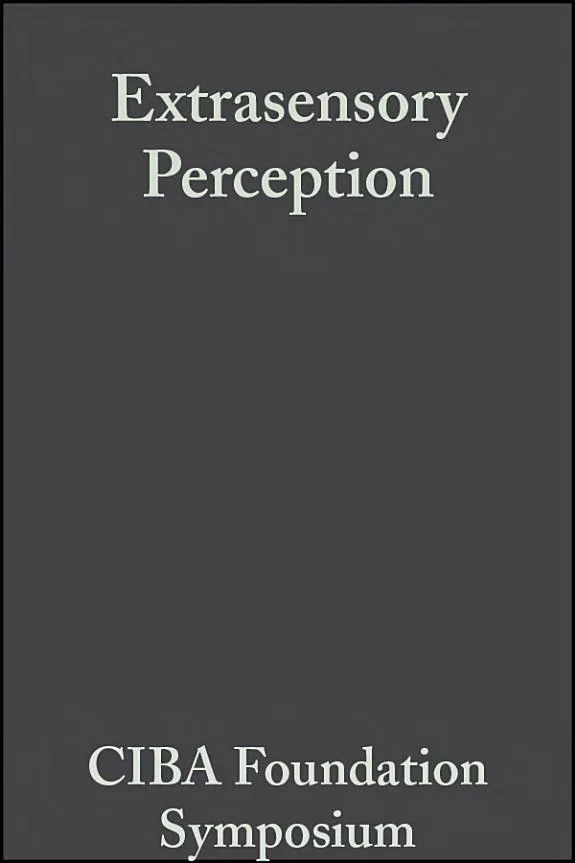
Extrasensory Perception
 71
71

Extrasensory Perception
Wolstenholme and Millar's 'Extrasensory Perception' presents a fascinating, albeit dense, compilation of scientific discourse. The strength lies in its commitment to presenting parapsychological research through the lens of rigorous scientific inquiry, a welcome contrast to more sensationalist treatments of the subject. The discussions on experimental methodology, particularly concerning the challenges of controlling for fraud and bias in psi research, are illuminating. However, the volume's primary limitation is its academic density; it is not introductory material and requires a significant background in scientific methodology and statistical analysis to fully appreciate. The exploration of Ganzfeld experiments, for instance, is thorough but demands careful attention. Ultimately, this collection serves as a valuable, if demanding, record of scientific engagement with the ESP question.
📝 Description
71
The 2009 Novartis Foundation Symposium gathered scientists to examine psychic abilities and consciousness.
This volume collects the proceedings from a 2009 Novartis Foundation Symposium focused on extrasensory perception. Leading scientists convened to discuss research and theoretical frameworks concerning psychic abilities and consciousness that extend beyond conventional sensory perception. The symposium aimed to establish empirical findings and rigorous academic discussion, moving past anecdotal accounts to investigate the scientific underpinnings of ESP.
The work is suited for researchers, academics, and students specializing in parapsychology, consciousness studies, and the philosophy of mind. It will appeal to those who approach ESP with a critical, scientific perspective, interested in the methodologies and outcomes of empirical investigations rather than purely speculative theories. Individuals engaged with the connections between neuroscience, psychology, and anomalous experiences will find this collection valuable.
The Novartis Foundation Symposia, formerly the Ciba Foundation, has a history of encouraging interdisciplinary scientific conversations. This 2009 event on ESP occurred during a time when parapsychology saw some academic interest, building on earlier work in psi phenomena. The symposium series consistently provides a venue for discussing complex biological and medical subjects.
This symposium reflects a specific moment in the scientific study of phenomena often relegated to esoteric traditions. While the proceedings focus on empirical data and academic rigor, the subject matter itself – telepathy, clairvoyance, and precognition – directly engages with concepts long present in spiritualist and occult literature. It represents an attempt to bridge the gap between subjective experience and objective measurement, a challenge that has historically occupied both mystics and materialists.
💡 Why Read This Book?
• Gain an understanding of the scientific methodologies employed in testing ESP, as detailed in the 2009 symposium proceedings, moving beyond anecdotal claims. • Explore specific experimental designs like the Ganzfeld experiment, which are critically examined within the text for their validity and limitations. • Appreciate the challenges and nuances of parapsychological research as discussed by leading scientists, offering a grounded perspective on consciousness studies.
⭐ Reader Reviews
Honest opinions from readers who have explored this book.
❓ Frequently Asked Questions
What is the primary focus of the 2009 Novartis Foundation Symposium on Extrasensory Perception?
The symposium, documented in 'Extrasensory Perception', focused on presenting and discussing empirical research and theoretical frameworks related to psychic abilities, aiming for a scientific rather than anecdotal approach to phenomena like telepathy and clairvoyance.
Who organized the Novartis Foundation Symposia, and what is their background?
The Novartis Foundation, formerly known as the Ciba Foundation, has a long-standing reputation for organizing symposia that bring together leading scientists across various disciplines, including biology, chemistry, and medicine, to discuss complex research topics.
What types of extrasensory perception might be discussed in this book?
The book likely covers various forms of ESP, including telepathy (mind-to-mind communication), clairvoyance (perceiving distant events), precognition (knowing future events), and psychokinesis (mind influencing physical objects).
Is 'Extrasensory Perception' suitable for beginners interested in psychic phenomena?
No, this volume is geared towards a scientifically literate audience, including researchers and academics. Its rigorous, methodological approach requires familiarity with scientific research principles and statistical analysis.
What is the significance of the Novartis Foundation Series?
The Novartis Foundation Series is known for publishing proceedings from symposia where top scientists present and debate research findings, contributing to scholarly discourse in specialized fields like parapsychology and consciousness studies.
What historical scientific movements or figures might be relevant to the discussions in 'Extrasensory Perception'?
Discussions might reference earlier parapsychological research by figures like J.B. Rhine and engage with experimental paradigms developed over decades of psi research.
🔮 Key Themes & Symbolism
Empirical Investigation of Psi
The core of this work lies in its commitment to empirical investigation. It moves beyond philosophical speculation to detail experimental protocols designed to detect and measure extrasensory perception. The focus is on replicability, statistical significance, and the rigorous examination of potential confounding factors. This approach seeks to establish a scientific basis for phenomena traditionally relegated to anecdotal evidence or pseudoscience, demanding critical evaluation of data and methodology from its contributors.
Methodological Challenges in Parapsychology
A significant theme is the inherent difficulty in conducting reliable parapsychological research. The volume likely addresses the intricate experimental designs needed to isolate psi effects from conventional sensory leakage, experimenter bias, and subject selection. Discussions will revolve around the statistical hurdles, the problem of replication, and the philosophical implications of results that challenge established scientific paradigms, particularly in the study of consciousness.
Consciousness and Its Limits
The exploration of extrasensory perception inherently probes the nature of consciousness itself. This work questions the traditional materialistic view that consciousness is solely a product of the physical brain. By examining phenomena that appear to transcend spatial and temporal limitations, the contributing scientists engage with the possibility that consciousness may possess properties not yet understood by mainstream neuroscience, prompting a re-evaluation of mind-body interactions.
Scientific Dialogue and Debate
As proceedings from a Novartis Foundation Symposium, a central theme is the structured scientific debate. Experts from diverse backgrounds convene to present their research, challenge existing theories, and propose new directions. This format allows for a critical examination of evidence and interpretation, fostering intellectual exchange and pushing the boundaries of understanding within the complex and often controversial field of parapsychology.
💬 Memorable Quotes
Direct passages from the work, attributed to the author.
“The challenge of establishing psi phenomena lies in rigorous experimental design and statistical analysis.”
— This sentiment underscores the book's commitment to a scientific approach, highlighting the need for meticulously crafted experiments that can withstand scrutiny and produce statistically significant results to validate claims of extrasensory perception.
“Investigating consciousness requires methods that extend beyond conventional sensory perception.”
— This idea suggests that to truly understand consciousness, researchers must explore avenues that bypass normal sensory channels, implying that phenomena like telepathy or clairvoyance might offer unique insights into the mind's capabilities.
“The boundary between subjective experience and objective measurement in psi research is often blurred.”
— This highlights the complex nature of studying consciousness and psychic phenomena, where the line between internal states and external, verifiable data can be difficult to discern, posing significant challenges for researchers.
“Theoretical frameworks must evolve to accommodate anomalous findings in consciousness studies.”
— This suggests that current scientific models may be insufficient to explain all observed phenomena related to consciousness and ESP, advocating for a more open and adaptive theoretical landscape.
💡 Key Ideas
Editorial paraphrase of the work's core concepts — not direct quotes.
Replication remains a critical hurdle for validating parapsychological findings.
This quote points to a recurring issue in the field: the difficulty in consistently reproducing experimental results. It emphasizes the scientific community's demand for reliable, repeatable evidence before accepting extraordinary claims about ESP.
🌙 Esoteric Significance
Tradition
While not strictly tied to a single esoteric lineage like Hermeticism or Kabbalah, this work engages with themes that intersect with esoteric traditions concerning the mind's potential beyond the physical. It approaches these concepts through the framework of Western scientific inquiry, attempting to bridge empirical investigation with phenomena often explored in mystical and occult literature. It departs from tradition by demanding empirical proof rather than faith or direct spiritual experience as validation.
Symbolism
The primary 'symbol' here is the concept of ESP itself, representing the potential for consciousness to operate independently of known physical laws. Specific experimental paradigms, such as the Ganzfeld setup, become symbolic representations of the controlled attempt to access or measure these non-physical aspects of mind. The very act of scientific investigation into these areas can be seen as a modern, secular ritual aimed at unveiling hidden realities.
Modern Relevance
Contemporary thinkers in consciousness studies, neurophilosophy, and even certain branches of quantum physics echo the questions raised in this volume. Researchers exploring altered states of consciousness, the placebo effect, and the mind-body connection, as well as those investigating near-death experiences, implicitly or explicitly engage with the possibility of non-local consciousness that this book attempts to quantify through scientific means.
👥 Who Should Read This Book
• Academic researchers and graduate students in parapsychology, psychology, and neuroscience seeking to understand the latest empirical approaches to ESP. • Philosophers of mind and consciousness interested in the scientific challenges to materialistic explanations of mental phenomena. • Critical thinkers and skeptics who wish to engage with the scientific methodology applied to controversial subjects, rather than relying on popular accounts.
📜 Historical Context
The 2009 Novartis Foundation Symposium on Extrasensory Perception convened at a time when parapsychology continued to exist on the fringes of mainstream scientific acceptance. While figures like J.B. Rhine had established experimental approaches in the mid-20th century, the field struggled with consistent replication and widespread skepticism. This symposium, part of a series initiated by the Ciba Foundation, aimed to bring rigorous scientific scrutiny to bear on psi phenomena, a domain often dominated by anecdotal accounts. The intellectual currents of the era included ongoing debates in neuroscience about consciousness, quantum mechanics' implications for reality, and the philosophical challenges posed by subjective experience. Unlike purely speculative works, the Novartis Foundation Symposia series historically provided a platform for evidence-based discussion, though reception of such focused inquiry into ESP often remained divided within the broader scientific community.
📔 Journal Prompts
The rigorous methodology required for testing ESP, as discussed in the 2009 symposium.
The concept of consciousness transcending physical limitations.
The statistical analysis of psi experiments and potential biases.
The challenges of replicating results in parapsychological research.
The implications of findings for the mind-body problem.
🗂️ Glossary
Extrasensory Perception (ESP)
The purported ability to acquire information or influence events through means not involving the known physical senses. It encompasses phenomena like telepathy, clairvoyance, precognition, and psychokinesis.
Telepathy
The direct transmission of thoughts, feelings, or information from one person's mind to another without the use of the normal senses.
Clairvoyance
The alleged ability to perceive objects, events, or information that is not perceived through the physical senses, often by extrasensory means.
Precognition
The claimed ability to foresee future events through means beyond the normal range of human perception or understanding.
Psychokinesis (PK)
The supposed ability to influence physical objects or processes through mental effort alone, without physical interaction.
Ganzfeld experiment
A sensory deprivation technique used in parapsychology research to create a state of reduced sensory input, intended to increase the probability of detecting psi phenomena.
Psi phenomena
A general term used in parapsychology to refer to anomalous psychological or physical phenomena, including ESP and psychokinesis.