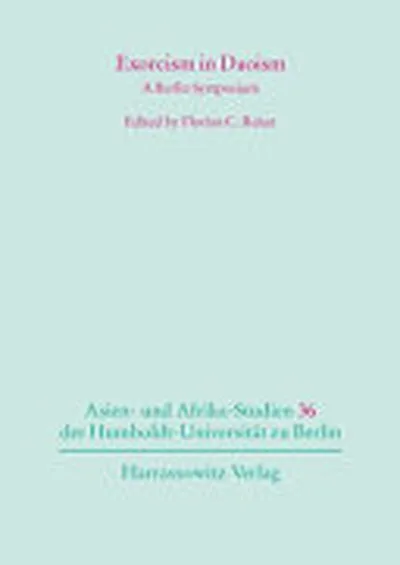
Exorcism in Daoism
 76
76

Exorcism in Daoism
Florian C. Reiter's compilation, 'Exorcism in Daoism,' offers a scholarly, if occasionally dry, exploration of a vital but often misunderstood aspect of Chinese religious practice. The strength lies in its academic rigor, presenting findings from a 2009 Humboldt University symposium that bring diverse scholarly perspectives to bear on the subject. One limitation is that, as a collection of symposium papers, the thematic coherence can sometimes falter, with individual contributions varying in accessibility and depth. However, the section detailing the use of specific Daoist talismans (fù) for warding off negative influences provides a concrete example of the ritualistic efficacy discussed. The work serves as a valuable academic resource for understanding the practicalities of Daoist spiritual warfare.
📝 Description
76
In 2009, scholars met at Humboldt University to examine Daoist exorcism.
This volume collects papers presented at a 2009 symposium on exorcism within Daoism, moving beyond simplified views to analyze the ritualistic and theological aspects of spiritual healing. The studies focus on how these practices were applied, the theories behind them, and their historical changes. They consider the nature of spirits in Daoist thought, the functions of the exorcist, and the use of talismans and chants. The research examines how exorcism works to remove harmful spirits, but also to reestablish harmony for individuals and groups.
The collected essays discuss the theoretical basis of exorcism in Daoism, its historical development, and its practical application. The papers detail the cosmology of spirits and demons, the role of the ritual specialist, and the effectiveness of specific rites and utterances. The volume shows how these rituals aim not only to banish negative forces but also to restore well-being and social order. It offers a scholarly look at a complex aspect of Chinese religious practice.
Daoism, with origins in China centuries before the Common Era, has a long history of interacting with spiritual forces and developing methods for their management. The exorcistic traditions discussed in this book are deeply embedded in this lineage, evolving across dynasties and adapting to varied social and philosophical environments. This collection reassesses these historical practices, situating them within a contemporary academic perspective and detailing their specific ritualistic and theological frameworks.
💡 Why Read This Book?
• Understand the intricate cosmology behind Daoist exorcism, learning about the types of spirits and their perceived influence, as detailed in the symposium's discussions on spiritual entities. • Gain insight into the practical application of Daoist ritual, such as the efficacy of specific incantations and talismans for spiritual cleansing, as explored by the contributing scholars. • Appreciate the historical development of these practices within Daoism, recognizing how rituals evolved over centuries to address perceived supernatural disturbances, a context provided by the 2009 symposium's focus.
⭐ Reader Reviews
Honest opinions from readers who have explored this book.
❓ Frequently Asked Questions
What is the primary focus of 'Exorcism in Daoism'?
The book centers on scholarly papers presented at a 2009 international symposium at Humboldt University, Berlin, exploring the ritualistic, theological, and historical dimensions of exorcism within Daoism.
Who organized the symposium that produced this book?
The International Symposium on Exorcism in Daoism was staged by the Department of Sinology at Humboldt University in Berlin, Germany.
What year was the international symposium held?
The symposium that generated the papers in 'Exorcism in Daoism' took place in the year 2009.
Does the book cover contemporary Daoist exorcism practices?
While rooted in historical context, the papers analyze the enduring theoretical and practical aspects of Daoist exorcism, offering insights relevant to understanding its continued practice.
What kind of academic disciplines are represented in the book?
The contributors represent fields such as Sinology, comparative religion, and the study of ritual, providing a multidisciplinary approach to the subject.
Is this book suitable for casual readers interested in ghost stories?
While the topic involves spiritual entities, this is an academic collection focused on ritual theory and historical analysis, rather than narrative ghost stories.
🔮 Key Themes & Symbolism
Ritual Efficacy and Theory
The papers investigate the theoretical frameworks underpinning Daoist exorcistic rituals, examining how concepts of spiritual pollution, malevolent influences, and cosmic balance inform practice. They analyze the efficacy attributed to specific rites, incantations, and the use of talismans (fù) in dispelling negative forces and restoring order. The work probes the symbolic language and performative actions that constitute these spiritual interventions, moving beyond mere superstition to understand their role within a complex religious system.
Cosmology of Spirits and Demons
Central to Daoist exorcism is a detailed understanding of the spirit world. This collection explores the Daoist pantheon, including celestial beings, earth spirits, and various classes of demons or malevolent entities. The papers discuss how these beings are perceived, categorized, and how their influence can affect human well-being. Understanding this cosmology is presented as fundamental to the exorcist's ability to identify, confront, and banish disruptive forces effectively.
The Role of the Exorcist
The figure of the Daoist exorcist—often a priest, ritual specialist, or shamanic practitioner—is examined in detail. Contributors discuss the training, authority, and specific techniques employed by these individuals. Their role extends beyond mere expulsion; it involves mediation between the human and spirit realms, purification, and the re-establishment of harmonious relationships within the cosmos. The papers highlight the social and spiritual authority vested in the exorcist.
Historical and Cultural Adaptation
The volume traces the historical trajectory of Daoist exorcism, showing how practices have evolved and adapted across different dynasties and regions of China. It addresses the integration of local beliefs and the influence of other philosophical and religious traditions. The symposium's papers consider how these rituals functioned within various social contexts, serving not only spiritual but also psychological and communal needs, as evidenced by their persistence through centuries.
💬 Memorable Quotes
Direct passages from the work, attributed to the author.
“Talismans (fù) are more than mere symbols; they are active conduits of spiritual power for protection and expulsion.”
— This statement emphasizes the functional aspect of Daoist talismans, presenting them as dynamic tools imbued with spiritual energy rather than static representations.
“Understanding the nature of affliction requires a deep dive into the Daoist cosmology of spirits and their motivations.”
— This interpretation underscores the necessity of grasping the intricate Daoist worldview concerning spirits and their potential impact on human affairs to effectively address ailments attributed to them.
“The historical continuity of exorcism rituals indicates their enduring relevance in addressing human anxieties about the unseen.”
— This concept suggests that the long presence of exorcism practices within Daoism speaks to their persistent utility in providing comfort and solutions for deep-seated fears concerning the supernatural.
💡 Key Ideas
Editorial paraphrase of the work's core concepts — not direct quotes.
The efficacy of Daoist exorcism lies in its precise engagement with the spirit world's established hierarchies and rules.
This paraphrased concept highlights that Daoist spiritual practices are not haphazard but rely on a codified understanding of cosmic order and the proper protocols for interacting with various spiritual entities.
The Daoist exorcist acts as a mediator, restoring balance through ritualized confrontation.
This paraphrase points to the dual role of the exorcist: engaging with spiritual disturbances while simultaneously working to re-establish harmony in the human and cosmic spheres.
🌙 Esoteric Significance
Tradition
This work engages with the esoteric dimensions of Daoism, a tradition deeply rooted in the pursuit of spiritual immortality, cosmic harmony, and the understanding of primordial forces. While distinct from Western Hermeticism or Kabbalah, Daoism shares common ground in its exploration of energetic principles, correspondences between macrocosm and microcosm, and the use of ritualistic techniques to influence spiritual realities. The exorcistic practices discussed can be seen as a practical application of Daoist cosmology, aimed at maintaining energetic purity and balance.
Symbolism
Key symbols in Daoist exorcism include talismans (fù), often inscribed with potent characters or diagrams, which act as spiritual seals or wards. The Five Emperors (Wǔdì), celestial guardians, are frequently invoked to repel demons. Another significant motif is the use of specific gestures and incantations that mimic or command spiritual forces, reflecting a belief in the power of symbolic language and ritual action to directly influence the unseen world and its inhabitants.
Modern Relevance
Contemporary practitioners and scholars of Daoism, as well as those in comparative religious studies, continue to draw upon the long history of exorcistic practices. The work's analysis of ritual efficacy, symbolic power, and the management of spiritual energies remains relevant for understanding the living traditions of Daoism. Furthermore, its examination of how religious systems address societal anxieties and perceived threats from the unseen speaks to ongoing discussions in the anthropology of religion and the study of folk beliefs worldwide.
👥 Who Should Read This Book
• Scholars of East Asian religions and comparative ritual studies seeking in-depth academic analysis of Daoist exorcism, its theoretical foundations, and historical manifestations. • Students of Daoism interested in understanding the practical application of ritual, the roles of spiritual practitioners, and the cosmology of spirits within this tradition. • Researchers in the anthropology of religion and psychology of belief who study how cultures address supernatural phenomena and spiritual afflictions.
📜 Historical Context
The papers gathered here stem from a 2009 symposium at Humboldt University, Berlin, reflecting a modern academic engagement with Daoist exorcism, a practice with roots stretching back over two millennia. Daoism, developing alongside Confucianism and Buddhism in China, established its own complex cosmology and pantheon, within which the management of spirits and the expulsion of malevolent influences became a significant aspect of ritual life. By the time of the Song Dynasty (960-1279), Daoist monasteries were well-established centers for performing such rituals. The academic study of Daoism gained momentum in the West during the 20th century, with scholars like Holmes Welch and Kristofer Schipper useful its diverse traditions. This collection builds upon that foundation, offering detailed analyses of specific exorcistic practices, their theoretical underpinnings, and their historical adaptations, situating them within broader patterns of religious ritual and belief in China.
📔 Journal Prompts
The Daoist concept of spiritual balance and its relation to exorcism.
Analyze the symbolic function of talismans (fù) in ritualistic practice.
Consider the role of the exorcist as a mediator between realms.
Reflect on the historical evolution of Daoist exorcism rituals.
Compare the Daoist approach to spiritual affliction with other traditions.
🗂️ Glossary
Daoism
A philosophical and religious tradition originating in China, emphasizing living in harmony with the 'Dao' (the Way), often involving practices for spiritual cultivation, longevity, and understanding the natural world.
Exorcism
A ritual practice intended to expel demons or other malevolent spiritual entities from a person, place, or object.
Sinology
The academic study of China, its language, history, culture, and society.
Talismans (fù)
Objects, often inscribed with characters or symbols, believed to possess protective or magical powers, used in Daoist rituals to ward off evil or invoke blessings.
Cosmology
A system of beliefs that explains the origin, structure, and workings of the universe, including the relationships between humans, the natural world, and spiritual entities.
Ritual
A set of actions, performed according to a prescribed order, often with a symbolic meaning, used in religious or ceremonial contexts.
Spiritual Affliction
A condition believed to be caused by the influence or possession of malevolent spirits or negative supernatural forces.