Norman Rufus Colin Cohn, Norman Cohn, Norman Cohn
Samuel Beckett's "Waiting for Godot" explores existential uncertainty and the human condition through two men waiting endlessly for an absent figure.
Samuel Beckett's renowned play, "Waiting for Godot," originally written in French as "En attendant Godot" between 1948 and 1949, is a significant work of modern literature. First published in French in 1952 and performed in 1953, its English version followed in 1954 and 1955. The play, subtitled "tragicomedy in two acts," depicts the characters Vladimir and Estragon as they pass their time waiting for a mysterious individual named Godot, who never arrives. Their existence is marked by repetitive conversations, physical routines, and philosophical musings, highlighting themes of cyclical existence and existential doubt.
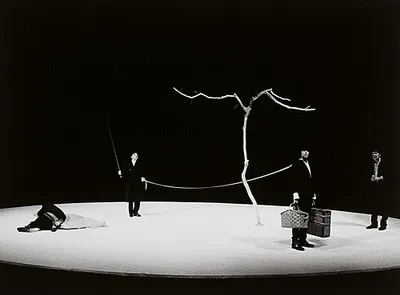
The narrative unfolds with Vladimir and Estragon encountering Pozzo, a master, and his servant Lucky. These interactions, along with messages from a boy indicating Godot's perpetual delay, emphasize the characters' inability to escape their predicament. The play's setting, often interpreted as a dreamlike landscape or purgatory, features a single, unchanging scene despite its two-act structure. Beckett famously avoided detailed character descriptions, stating that all pertinent information was contained within the text itself, underscoring the play's focus on universal human experience rather than individual biography.
Existential Waiting and the Human Condition
"Waiting for Godot" centers on the profound human experience of waiting and the uncertainty that accompanies it. Vladimir and Estragon embody this state, their lives defined by the anticipation of Godot's arrival, a figure who represents hope, salvation, or perhaps meaning. Their days are filled with repetitive actions and dialogues, suggesting a cyclical and seemingly futile existence. The play delves into philosophical and existential themes, questioning the purpose of life and the nature of human connection when faced with an absent or unknowable entity. The arrival and departure of Pozzo and Lucky, who themselves are trapped in their own forms of servitude and control, further complicates the characters' understanding of their situation and the world around them.
Symbolism and Interpretation
The play's enduring power lies in its rich symbolism and open-ended interpretations. The leafless tree, the constant waiting, and the never-arriving Godot can be seen as metaphors for various aspects of the human condition, including spiritual longing, the search for meaning, and the fear of the unknown. Critics have noted influences ranging from religious and classical to psychoanalytical and biographical settings, reflecting the multifaceted nature of the work. Beckett himself offered limited explanations, famously stating that all knowledge about the characters was present in the text, thereby encouraging audiences and readers to engage with the play's deeper, often ambiguous, meanings. The work has been lauded for its profound exploration of themes, earning it a reputation as a cornerstone of modern dramatic literature.
Character Dynamics and Philosophical Musings
The dynamic between Vladimir and Estragon is central to the play's exploration of human relationships and contrasting perspectives. Vladimir, more restless and prone to philosophical contemplation, often engages with abstract ideas and the sky, while Estragon, more grounded and physically focused, grapples with immediate discomforts and a poor memory. Their interdependence highlights how different psychological states—the mental (Vladimir) and the physical (Estragon)—can coexist and define a shared reality. Their conversations, though seemingly nonsensical, serve as a mechanism for passing time and momentarily warding off the existential dread of their unending wait. This contrast, coupled with their shared Irish heritage evident in their speech, provides a nuanced portrayal of companionship amidst profound uncertainty.
Key Ideas
- Existential uncertainty
- The human condition
- The nature of waiting
- Cyclical existence
- Absence of meaning
- Human interdependence
Books by Norman Rufus Colin Cohn, Norman Cohn, Norman Cohn
2 free public domain books · Read online or download