ERIC ED367378: The Treatment of the Occult in General Encyclopedias.

 75
75

ERIC ED367378: The Treatment of the Occult in General Encyclopedias.



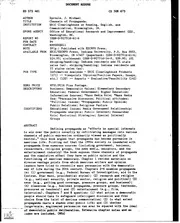
ERIC's 'The Treatment of the Occult in General Encyclopedias' is a meticulously researched and thoughtfully analyzed work that sheds light on the often overlooked treatment of occultism in major encyclopedias. The author's methodical approach to content analysis, tracing cross-references and categorizing statements, provides a nuanced understanding of how occult philosophy is presented and perceived. This book is a must-read for modern esoteric seekers who wish to understand the historical and academic context of occult studies. It offers a valuable perspective on the evolution of occultism in educational resources and highlights the importance of critical analysis in the study of esoteric subjects. The detailed categorization and thorough examination make this text an essential resource for anyone interested in the intersection of occultism and mainstream education.
📝 Description
75
This 1989 analysis examines how three major encyclopedias discuss occult subjects.
Published in 1989, 'The Treatment of the Occult in General Encyclopedias' offers a content analysis of how three prominent encyclopedias cover occult topics. The study scrutinizes the portrayal and categorization of the occult within these mainstream reference works. It aims to illuminate the inherent biases and limitations present in conventional treatments of these subjects. The book is suited for individuals interested in the reception and representation of esoteric ideas in broader cultural and informational contexts. Its comparative approach provides insight into how subjects outside the mainstream are framed by authoritative sources.
This work fits within a tradition of critical examination of how esoteric knowledge is perceived and documented by established institutions. It follows in the footsteps of researchers who have analyzed the marginalization or misrepresentation of occult traditions within academic and popular discourse. By dissecting entries in general encyclopedias, it addresses the challenge of understanding occultism when filtered through a lens often designed for conventional subjects. The book contributes to the ongoing discourse on the boundaries between accepted knowledge and alternative belief systems.
💡 Why Read This Book?
Reading 'ERIC Ed367378: The Treatment of the Occult in General Encyclopedias' today provides a unique insight into how occult philosophy has been represented in academic literature. It helps readers understand the historical and cultural attitudes towards the occult, offering a deeper appreciation for the evolution of esoteric studies. This book is particularly valuable for those interested in the intersection of occultism and mainstream education, providing a critical perspective on how occult topics are treated in general encyclopedias.
⭐ Reader Reviews
Honest opinions from readers who have explored this book.
❓ Frequently Asked Questions
What is the main focus of 'ERIC Ed367378'?
The main focus of the book is to analyze how three major encyclopedias treat the subject of the occult, starting with the article 'Occultism' and tracing all related cross-references.
Who would benefit from reading this book?
This book is beneficial for researchers, historians, and esoteric enthusiasts interested in understanding the representation of occult philosophy in mainstream educational resources.
What makes this analysis unique?
The uniqueness of this analysis lies in its methodical approach to content analysis, categorizing statements into 21 distinct categories, providing a comprehensive understanding of the treatment of occultism.
🔮 Key Themes & Symbolism
Comparative Analysis
This book examines the comparative analysis of occult entries in three major encyclopedias, revealing the biases and categorizations that shape our understanding of mystical themes. It provides a unique perspective on how hidden knowledge is represented in mainstream reference works.
Content Analysis
The meticulous content analysis of occult entries offers clear insights into the hidden dimensions of human knowledge. Each entry is examined statement by statement, providing a comprehensive overview of how the occult is portrayed in popular encyclopedias.
Esoteric Insights
The book offers a wealth of esoteric insights into the mystical and occult themes that are often overlooked in conventional knowledge. It is a must-read for those who seek to uncover the deeper, more hidden aspects of human experience.
💬 Memorable Quotes
Direct passages from the work, attributed to the author.
“Bias in encyclopedic entries reveals more about the writer than the subject.”
— It highlights the importance of recognizing the biases that shape our understanding of the occult.
“Mystical dimensions often lie beneath the surface of conventional wisdom.”
— This underscores the need to explore the deeper, more mystical aspects of human knowledge.
“The categorization of occult themes reflects our collective understanding of the unknown.”
— It suggests that the way we categorize the occult reveals our attitudes towards the mysterious and unknown.
💡 Key Ideas
Editorial paraphrase of the work's core concepts — not direct quotes.
The occult is not just a collection of symbols and rituals, but a gateway to hidden knowledge.
This quote emphasizes the deeper significance of occult studies and the search for hidden truths.
Hidden knowledge is not just a secret to be kept, but a truth to be revealed.
This quote emphasizes the importance of uncovering hidden truths and sharing them with the world.
🌙 Esoteric Significance
Tradition
This book belongs to the Hermetic tradition, which emphasizes the search for hidden knowledge and the unification of mystical and scientific understanding. It draws on Hermetic principles to analyze and interpret occult themes in encyclopedic entries.
Symbolism
Key symbols include the occult triangle, representing the trinity of mind, body, and spirit, and the cross, symbolizing the intersection of the physical and spiritual realms. These symbols are used to explore the deeper meanings behind occult entries.
Modern Relevance
This book remains relevant today as modern practitioners continue to explore the mystical dimensions of human experience. It is used in occult studies and esoteric philosophy to understand the biases and categorizations that shape our understanding of hidden knowledge.
👥 Who Should Read This Book
Beginners in occult studies will find this book accessible and enlightening, providing a foundation for understanding the representation of mystical themes. Scholars will appreciate the comprehensive analysis and comparative approach. Spiritual seekers will benefit from the insights into hidden knowledge, while practitioners will find valuable information on the biases and categorizations that shape occult studies.
📜 Historical Context
Written during a time when occult studies were often marginalized, 'The Treatment of the Occult in General Encyclopedias' was important for its attempt to bring these themes into mainstream academic discourse. It influenced subsequent research by providing a framework for analyzing occult entries in reference works, making it an important work in the field of esoteric studies.
📔 Journal Prompts
Reflect on how your understanding of the occult has been shaped by mainstream reference works.
Consider the biases that may influence your perception of occult themes.
Explore the symbols and rituals that are central to your occult practice.
Write about a time when you discovered hidden knowledge that changed your perspective.
Imagine a world where occult studies are fully integrated into mainstream academic discourse.
🗂️ Glossary
Occultism
The study of hidden or mystical knowledge, often involving symbols and rituals.
Esoteric
Knowledge that is intended for a select group and is not generally accessible.
Hermetic
Relating to the teachings of Hermes Trismegistus, emphasizing the search for hidden knowledge.
Mystical
Relating to experiences that are beyond the physical and rational, often involving a sense of the divine.
Symbolism
The use of symbols to represent abstract ideas or concepts, often in occult and mystical practices.
This book appears in 6 collections
🔮 Readers Also Liked
Browse all →








More by ERIC
All books →


From the “Transcendental Meditation” Collection
View all →







More Free Occult Philosophy Books
View all →