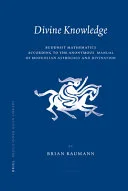
Divine Knowledge
 80
80

Divine Knowledge
Brian Gregory Baumann’s "Divine Knowledge" offers a sharp, analytical lens through which to view the problematic division of knowledge that has characterized Western thought since the Enlightenment. The book’s strength lies in its meticulous dissection of the "Manual of Mongolian Astrology and Divination," revealing how its structure and language both reflect and challenge prevailing intellectual hierarchies. Baumann’s examination of the manual's rhetoric is particularly compelling, showing how seemingly disparate elements like astrological observation and ritual practice are integrated into a coherent, albeit contested, system of understanding. The author's critique of how post-Enlightenment thought has marginalized non-Western or esoteric knowledge systems is well-argued, though at times the dense academic prose can make the central thesis feel somewhat obscured. A passage that particularly stands out is the detailed breakdown of how the manual links celestial phenomena to terrestrial events, illustrating a holistic worldview that modern science often dismisses. This work is a valuable contribution to the history of ideas, offering a nuanced perspective on the historical construction of what we deem 'knowledge'. Baumann provides a critical engagement with esoteric texts, urging a re-evaluation of their intellectual frameworks.
📝 Description
80
Brian Gregory Baumann's Divine Knowledge analyzes the 1969 Manual of Mongolian Astrology and Divination.
Divine Knowledge examines the structure and categorization of knowledge, focusing on occult and esoteric traditions. Brian Gregory Baumann's study critically analyzes the "Manual of Mongolian Astrology and Divination," first published in 1969. The book questions how post-Enlightenment thought separated disciplines such as religion, science, medicine, ritual, and magic, often hindering an understanding of their connections.
Baumann dissects the rhetoric and logic within the manual. He reveals the underlying assumptions and epistemological frameworks that shape its content. This work is for scholars of comparative religion, the history of science, and anthropology. It is particularly relevant for those interested in non-Western ways of knowing and the study of magical or divinatory practices. Advanced students of Hermeticism and esoteric philosophy will also find value, as will anyone interested in how knowledge systems are built and debated.
This book situates itself within the study of esoteric philosophy by dissecting a specific text often relegated to the margins of Western academic discourse. It addresses how traditions like Mongolian astrology and divination represent complex knowledge systems. These systems do not always fit neatly into modern disciplinary boundaries. Baumann's work engages with the historical separation of magic, religion, and science, a common theme in esoteric studies seeking to reintegrate these domains.
💡 Why Read This Book?
• Gain a critical understanding of how the Enlightenment's categorization of knowledge influenced the study of esoteric traditions, specifically through analyzing the "Manual of Mongolian Astrology and Divination." • Learn to deconstruct the rhetoric and logic within historical esoteric texts, recognizing how they construct meaning and authority, as demonstrated by Baumann's 2008 analysis. • Explore the intricate relationship between science, religion, medicine, ritual, and magic as presented in pre-modern systems, challenging contemporary disciplinary boundaries.
⭐ Reader Reviews
Honest opinions from readers who have explored this book.
❓ Frequently Asked Questions
What is the primary focus of Brian Gregory Baumann's "Divine Knowledge"?
The book critically examines the "Manual of Mongolian Astrology and Divination" (1969) to analyze the post-Enlightenment categorization of knowledge, particularly the separation of religion and science, medicine, ritual, and magic.
When was "Divine Knowledge" first published?
Brian Gregory Baumann's "Divine Knowledge" was first published in 2008, offering a contemporary analysis of historical esoteric texts.
Does "Divine Knowledge" offer practical instructions on astrology or divination?
No, the book is an academic study and critical examination of the rhetoric and logic within the "Manual of Mongolian Astrology and Divination," not a practical guide.
What historical period's intellectual framework does the book critique?
The book specifically critiques the intellectual framework established by the Enlightenment, which led to the post-Enlightenment categorization and separation of knowledge domains.
What specific text serves as the central case study in "Divine Knowledge"?
The central case study is the "Manual of Mongolian Astrology and Divination," a text originally published by A. Mostaert in 1969.
Who is A. Mostaert in relation to the "Manual of Mongolian Astrology and Divination"?
A. Mostaert is credited with publishing the "Manual of Mongolian Astrology and Divination" in 1969, making it accessible for analysis in Baumann's later work.
🔮 Key Themes & Symbolism
Epistemological Boundaries
The work meticulously probes the historical construction of 'knowledge' itself, focusing on how the post-Enlightenment era created rigid divisions between scientific, religious, and occult domains. Baumann's analysis of the "Manual of Mongolian Astrology and Divination" illustrates how these boundaries were enforced, often marginalizing systems that integrated diverse forms of knowing. The book argues that this separation hinders a holistic understanding of reality, particularly evident in pre-modern esoteric traditions that seamlessly blended observation, ritual, and spiritual insight.
Rhetoric of Esotericism
Baumann investigates the linguistic and logical structures that lend authority and coherence to esoteric texts. By dissecting the rhetoric within the "Manual of Mongolian Astrology and Divination," he reveals how meaning is constructed and how these texts communicate complex ideas across different epistemological frameworks. This approach moves beyond simply cataloging esoteric beliefs to understanding the persuasive and intellectual mechanisms that underpin them, showing how logic and narrative shape the perception of divine knowledge.
Integration of Disciplines
A central argument concerns the artificial separation of fields like medicine, ritual, and magic. The "Manual of Mongolian Astrology and Divination," as analyzed in "Divine Knowledge," exemplifies a worldview where these elements were intrinsically linked. Baumann demonstrates how understanding these historical integrations is crucial for appreciating the holistic nature of many esoteric traditions and for challenging the fragmented perspective often imposed by modern academic disciplines.
Critique of Modern Categorization
The book serves as a pointed critique of the intellectual legacy of the Enlightenment, which categorized knowledge in ways that often excluded or denigrated esoteric and non-Western traditions. Baumann uses the "Manual of Mongolian Astrology and Divination" as a lens to expose the limitations of this categorization, arguing for a more inclusive and nuanced approach to understanding diverse systems of knowledge and belief. The work advocates for a re-evaluation of how we classify and value different forms of human inquiry.
💬 Memorable Quotes
Direct passages from the work, attributed to the author.
“The post-Enlightenment categorization of knowledge inherently problematizes the study of religion and science.”
— This statement captures the book's core argument: that modern academic divisions artificially separate fields that were once understood more holistically, impacting our understanding of historical belief systems.
“The rhetoric and logic shaping this manual reveal underlying assumptions about the nature of reality.”
— This highlights Baumann's method of textual analysis, focusing on how the structure and language of esoteric texts like the 'Manual of Mongolian Astrology and Divination' communicate their worldview.
“Traditional mathematics and divination are examined in relation to their epistemological frameworks.”
— This indicates the book's scope, bridging seemingly disparate fields through an examination of the underlying theories of knowledge that connect them, particularly within esoteric traditions.
“The study interrogates the separation of medicine, ritual, and magic.”
— This points to a key analytical focus: how historical traditions often viewed these practices as interconnected, a perspective often lost in modern, compartmentalized study.
“Baumann examines the 'Manual of Mongolian Astrology and Divination' (1969).”
— This fact anchors the book's specific subject matter, identifying the primary text under scrutiny and its publication year as a point of reference.
🌙 Esoteric Significance
Tradition
This work fits within the broader tradition of Hermetic studies and the history of consciousness, focusing on how esoteric knowledge systems are constructed and perceived. It departs from purely devotional or practitioner-oriented texts by applying critical academic methods to esoteric literature. Baumann's approach aligns with contemporary scholarship that seeks to understand the intellectual history and philosophical underpinnings of traditions often marginalized by mainstream academia, viewing them as legitimate systems of thought.
Symbolism
While the book focuses on rhetoric and logic, it implicitly engages with the symbolic nature of esoteric knowledge. The 'Manual of Mongolian Astrology and Divination' itself is a repository of symbols linking celestial events to terrestrial phenomena and human fate. Baumann's analysis of this manual would likely explore how these symbols function not merely as decorative elements but as integral components of a complex system for understanding the divine or cosmic order.
Modern Relevance
In an era where interdisciplinary studies are increasingly valued and the limitations of rigid categorization are being recognized, Baumann's work holds significant relevance. Thinkers and practitioners interested in integral spirituality, comparative mysticism, and the philosophy of science find value in his critique of Enlightenment epistemology. The book encourages a more holistic approach to understanding knowledge, resonating with contemporary movements that seek to bridge the perceived gap between the scientific and the spiritual.
👥 Who Should Read This Book
• Academic researchers in religious studies, anthropology, and history of science, seeking to understand the epistemological frameworks of non-Western esoteric traditions. • Students of Hermeticism and comparative philosophy, who wish to critically engage with how esoteric texts construct knowledge and meaning. • Intellectual historians and philosophers of science, interested in analyzing the impact of Enlightenment thought on the categorization of knowledge and the marginalization of alternative systems.
📜 Historical Context
Published in 2008, "Divine Knowledge" emerged during a period of increasing academic interest in the history of science, comparative religion, and the deconstruction of knowledge systems. Brian Gregory Baumann's work engages with the legacy of the Enlightenment, a period that profoundly reshaped how knowledge was classified, often creating a divide between empirical science and esoteric or religious traditions. The book's focus on the "Manual of Mongolian Astrology and Divination" (first published 1969) situates it within 20th-century scholarship on Eastern spiritual practices and texts, a field that sought to understand non-Western epistemologies on their own terms. Baumann implicitly critiques the positivist approaches prevalent in earlier anthropology and history of religion, which tended to dismiss esoteric practices as mere superstition. His work aligns with later intellectual currents, influenced by figures like Michel Foucault, that emphasize the social and historical construction of knowledge. The reception of such studies often involves debates about maintaining academic rigor while respecting the internal logic of esoteric systems.
📔 Journal Prompts
The post-Enlightenment categorization of knowledge's impact on your understanding of the Manual of Mongolian Astrology and Divination.
The rhetoric and logic used in esoteric texts: identify an example from your reading.
How does the Manual of Mongolian Astrology and Divination integrate medicine, ritual, and magic?
Reflect on a concept of 'divine knowledge' presented in the book.
The separation of religion and science: how does the Manual challenge this dichotomy?
🗂️ Glossary
Epistemology
The branch of philosophy concerned with the theory of knowledge, investigating its nature, origin, and limits. It explores how we know what we know.
Post-Enlightenment
The period following the Age of Enlightenment (roughly 17th-18th centuries), characterized by the development and critique of Enlightenment ideals, including reason, science, and secularism.
Hermeticism
A religious, philosophical, and esoteric tradition based on writings attributed to Hermes Trismegistus, emphasizing the unity of all things and the possibility of attaining divine knowledge.
Rhetoric
The art of effective or persuasive speaking or writing, especially the use of figures of speech and other compositional techniques.
Logic
Reasoning conducted or assessed according to strict principles of validity; the system or principles of reasoning, especially of the structure of propositions, their mutual relations, and the inferences that can be made from them.
Esotericism
Beliefs and practices that are esoteric, meaning they are intended for or likely to be understood by only a small number of people with a specialized knowledge or interest.
Categorization of Knowledge
The process of classifying and organizing different fields of study and information into distinct categories, often reflecting prevailing intellectual and cultural paradigms.