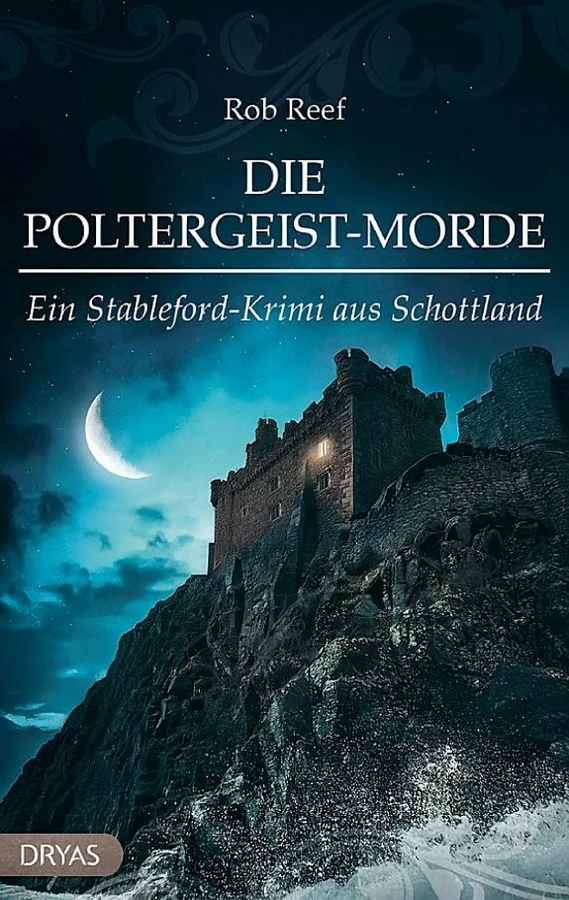
Die Poltergeist-Morde
 73
73

Die Poltergeist-Morde
Rob Reef's 'Die Poltergeist-Morde' presents a chilling premise: a séance intended to locate a missing person devolves into a terrifying exchange of death threats. The setting of Dundounie in 1939 Scotland provides a perfect gothic atmosphere for this tale. Reef skillfully builds tension as the arrival of the Stablefords and the Holmes couple, intent on rational investigation, is immediately challenged by a gruesome discovery. The interplay between the rational and the irrational is where the novel truly shines, particularly in the initial stages of the investigation.
A notable strength is the author's ability to evoke the era's specific blend of scientific skepticism and widespread occult interest. The limitation, however, lies in the pacing during the middle section, where the momentum established by the séance occasionally falters. A particularly striking element is the description of the séance itself, where the veil between the material and spectral worlds seems to thin precariously, leading to unexpected threats. The work ultimately offers a compelling, albeit occasionally uneven, exploration of how the unknown can disrupt the most ordered of minds.
📝 Description
73
In 1939 Scotland, a séance intended to find a missing guest at Dundounie estate results in death threats.
Rob Reef's Die Poltergeist-Morde is set in Scotland during 1939. The story begins with the perplexing disappearance of a guest from Dundounie, the estate owned by Rune Dahl, a writer with a keen interest in the occult. Dahl attempts to summon spirits to uncover the truth behind the vanishing. However, the séance does not reveal the guest's location; instead, it produces chilling death threats. This turn of events shifts the focus from a missing person case to a more sinister mystery.
The novel appeals to readers who enjoy historical mysteries with supernatural undertones. It is particularly suited for those interested in early 20th-century occult investigations and the psychological strain that occurs when rational thought encounters the inexplicable. The gothic atmosphere and classic detective story elements will draw in readers who appreciate these genres.
Set against the backdrop of pre-World War II Scotland, a time when spiritualism and occult interests surged, especially after World War I's devastation, Die Poltergeist-Morde taps into a period where scientific curiosity mingled with a widespread fascination for the paranormal. This era saw such themes frequently explored in literature and private investigations, reflecting a societal grappling with the unseen.
💡 Why Read This Book?
• You will experience the disorientation of rational investigators confronting spectral phenomena, as seen when the Holmes couple attempts to apply causality to the inexplicable events at Dundounie in 1939. • You will feel the chilling tension of occult investigation when Rune Dahl's séance, meant to find a missing guest, instead yields murder threats, highlighting the dangers of tampering with unseen forces. • You will gain insight into the pre-war fascination with spiritualism, examining how the era's anxieties and beliefs are reflected in the blend of detective work and paranormal questioning within the novel.
⭐ Reader Reviews
Honest opinions from readers who have explored this book.
❓ Frequently Asked Questions
What is the central mystery in 'Die Poltergeist-Morde'?
The book's central mystery begins with the unexplained disappearance of a guest from Dundounie in 1939, which escalates when an occult séance intended to find the guest instead produces death threats.
Who is Rune Dahl and what is his role?
Rune Dahl is the owner of Dundounie and a writer with a penchant for the occult. He initiates the séance in an attempt to discover the fate of the missing guest, inadvertently uncovering more sinister forces.
When was 'Die Poltergeist-Morde' first published?
The book was first published on April 28, 2026.
What is the significance of the year 1939 in the novel?
The year 1939 sets the historical context for the novel, placing it in pre-World War II Scotland, an era marked by significant interest in spiritualism and the paranormal.
Does the book focus on actual poltergeist phenomena?
Yes, the book's title and plot suggest a focus on poltergeist activity, exploring the concept of psychic energy potentially linked to criminal acts and supernatural disturbances.
What is the primary setting of the novel?
The primary setting is Dundounie, a Scottish estate, which serves as the focal point for the mysterious disappearance and subsequent occult investigation.
🔮 Key Themes & Symbolism
Occult Investigation vs. Rationality
The narrative keenly contrasts the empirical methods of detectives like the Stablefords and the Holmes couple with Rune Dahl's embrace of occult practices. This collision is starkly evident during the séance, where the expected spectral communication yields only threats, forcing the characters to question the limits of their understanding and the nature of reality itself. The book explores how the unexplained can shatter conventional logic.
The Nature of Poltergeist Activity
Central to the plot is the concept of poltergeist phenomena, often viewed in esoteric circles as manifestations of intense psychic energy or disturbances. The book uses this to explore whether such activity can be a byproduct or even a catalyst for violent human acts. It questions whether the 'haunting' is a separate entity or a projection of internal turmoil, particularly in the tense atmosphere of Dundounie.
Pre-War Esoteric Fascination
Set in 1939 Scotland, the novel taps into the historical period's widespread interest in spiritualism and the occult, a trend amplified by the societal anxieties preceding World War II. This context allows for a narrative where characters might readily turn to séances and paranormal investigation when faced with inexplicable events, reflecting the intellectual currents of the time.
The Unseen Threat
The initial disappearance of a guest is compounded by the chilling death threats received during Rune Dahl's séance. This introduces an 'unseen threat' that looms over the characters, blurring the lines between a physical crime and a supernatural menace. The tension arises from the uncertainty of the source of these threats, whether human or spectral.
💬 Memorable Quotes
Direct passages from the work, attributed to the author.
“Rational minds confronted the inexplicable.”
— This interpretation highlights the core conflict of the novel: the struggle of characters like the Stablefords and the Holmes couple to reconcile their belief in causality with the supernatural events unfolding at Dundounie.
“Scotland, 1939: a time of hidden anxieties and open spiritualism.”
— This concept frames the historical setting, suggesting that the era's societal unease and concurrent fascination with the paranormal provide fertile ground for the novel's blend of mystery and the supernatural.
“The estate held secrets beyond the physical.”
— This interpretation speaks to the gothic atmosphere and the central theme that Dundounie is not merely the scene of a crime, but a place where the veil between the mundane and the spectral is thin.
💡 Key Ideas
Editorial paraphrase of the work's core concepts — not direct quotes.
The séance yielded murder threats instead of clues.
This paraphrased concept captures the key moment where Rune Dahl's attempt at occult investigation backfires, transforming a search for a missing person into a confrontation with immediate, personal danger from an unknown source.
Dahl sought answers from the beyond, finding only peril.
This paraphrased concept expresses Rune Dahl's initial motivation for the séance and the dangerous outcome, emphasizing the perilous nature of occult inquiry when directly confronted with malevolent forces.
🌙 Esoteric Significance
Tradition
The work aligns with the broader tradition of Western esotericism, particularly its manifestation in the early 20th century, which saw a surge in interest in mediumship, spiritualism, and the potential for unseen forces to interact with the material world. It draws upon the popular understanding of poltergeists as energetic disturbances, often linked to psychological states, fitting within a lineage that explores the interface between mind, spirit, and physical manifestation.
Symbolism
The estate of Dundounie itself functions as a potent symbol, representing a confined space where the rational and irrational clash, much like the human psyche under duress. The séance, a ritualistic attempt to bridge worlds, symbolizes the human desire to penetrate the unknown, while the death threats received represent the perilous nature of such forbidden knowledge and the potential for malevolence to manifest through spiritual means.
Modern Relevance
Contemporary practitioners of parapsychology and occult studies may find resonance in the novel's exploration of psychic energy and its potential link to physical events. Thinkers interested in the intersection of psychology and the paranormal, or those examining the historical evolution of spiritualist thought, can use this work as a case study in how these themes were dramatized in fiction during a period of intense esoteric interest.
👥 Who Should Read This Book
• Students of early 20th-century occult fiction interested in how spiritualism was depicted in popular narratives before the full impact of World War II. • Mystery readers seeking a departure from conventional detective stories, who enjoy supernatural elements and gothic atmosphere. • Researchers of historical parapsychology and the societal fascination with the paranormal during the interwar period, looking for fictionalized explorations of these themes.
📜 Historical Context
Published in 2026, 'Die Poltergeist-Morde' is set in Scotland during 1939, a key year on the cusp of global conflict. This period was characterized by a significant public engagement with spiritualism and occult phenomena, a trend that intensified after the trauma of World War I and continued through the interwar years. Many sought solace or answers in the paranormal amid growing political uncertainty. The novel's narrative, which pits rational investigation against supernatural occurrences at Dundounie, reflects this cultural milieu. It implicitly engages with the broader movement of psychic research and theosophy that captivated many intellectuals and laypeople alike. The era's fascination with ghosts, mediums, and unexplained phenomena provided fertile ground for such narratives, contrasting sharply with the emerging logical positivism in philosophical circles which emphasized empirical evidence.
📔 Journal Prompts
Rune Dahl's séance and its perilous outcome.
The clash between rationality and the inexplicable at Dundounie.
The symbolism of the Scottish estate in 1939.
The nature of the 'unseen threat' in the narrative.
The historical context of pre-war esoteric interests.
🗂️ Glossary
Poltergeist
A phenomenon characterized by physical disturbances such as loud noises, objects being moved, or physical attacks, attributed to a discarnate spirit or entity, often associated with a specific person.
Séance
A meeting at which people attempt to make contact with the spirit world, typically through a medium.
Dundounie
The fictional Scottish estate serving as the primary setting for the novel's mysterious events and occult investigations.
Causality
The principle that everything has a cause; the relationship between cause and effect, central to rational and scientific investigation.
Spiritualism
A religious movement based on the belief that the spirits of the dead can be communicated with, prominent in the 19th and early 20th centuries.
Occult
Relating to or concerned with magic, the supernatural, or the mystical; beyond ordinary knowledge.
Rune Dahl
The owner of Dundounie and a character with an interest in the occult who initiates the séance central to the plot.
This book appears in 1 collection
🔮 Readers Also Liked
Browse all →








From the “Poltergeist” Collection
View all →








More Free Occult Philosophy Books
View all →