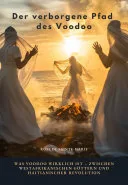
Der verborgene Pfad des Voodoo
 82
82

Der verborgene Pfad des Voodoo
Rose de Sainte-Marie’s "Der verborgene Pfad des Voodoo" offers a much-needed corrective to popular, often lurid, understandings of this complex tradition. The author diligently excavates Voodoo from beneath layers of Hollywood-induced fear and misrepresentation, presenting it as a legitimate and historically rich spiritual path. Sainte-Marie's exploration of the Lwa, particularly their role as intermediaries, is a standout section, clearly articulating their function without resorting to anthropomorphic simplification. A notable limitation, however, is the book's density; while commendable for its academic rigor, some passages might prove challenging for readers entirely new to esoteric studies. The discussion concerning the syncretism of Catholic saints with Lwa during the colonial era, specifically referencing the identification of Ezili Dantor with the Virgin Mary, provides a concrete example of Voodoo’s adaptive genius. Ultimately, "Der verborgene Pfad des Voodoo" serves as a valuable, if occasionally demanding, introduction to a vital spiritual heritage.
📝 Description
82
Rose de Sainte-Marie's 2017 book traces Voodoo's path from West Africa to the Americas.
Rose de Sainte-Marie's "Der verborgene Pfad des Voodoo" seeks to correct misunderstandings about Voodoo by presenting it as a complex spiritual system rather than a sensationalized topic. The work details Voodoo's origins in West African religions, such as those of the Fon, Ewe, and Yoruba peoples. It follows the religion's transformation through the transatlantic slave trade and its adaptation in places like Saint-Domingue, preceding the Haitian Revolution.
The book focuses on Voodoo's role in maintaining community and serving as a tool for resistance among enslaved populations. It explains the importance of the Lwa, spirits that act as intermediaries, and the supreme creator, Bondye. Key rituals, sacred objects, and ancestor veneration are also discussed as essential elements of a coherent spiritual framework.
This book situates itself within the study of African diasporic religions, specifically Voodoo. It aims to provide a clear explanation of the spiritual principles and historical development of Voodoo, moving beyond superficial or sensationalized accounts. By detailing its roots in West African cosmologies and its evolution under the pressures of slavery and cultural exchange, the work clarifies Voodoo's position as a distinct spiritual tradition with its own internal logic and practices, relevant to those interested in comparative religion and the resilience of spiritual systems.
💡 Why Read This Book?
• Gain a nuanced understanding of the Lwa, the spirits central to Voodoo, moving beyond simplistic depictions to grasp their role as intermediaries and their connection to specific aspects of life, as detailed in the section on "Core Spiritual Tenets." • Appreciate the historical resilience of Voodoo by learning how its practices were preserved and adapted under the extreme duress of the transatlantic slave trade, a process the book traces from West African origins to the Caribbean. • Explore the intricate symbolism and ritual practices of Voodoo, understanding their function within a coherent spiritual framework rather than as mere superstition, as presented in the historical context of its development before the 1791 Haitian Revolution.
⭐ Reader Reviews
Honest opinions from readers who have explored this book.
❓ Frequently Asked Questions
What are the primary misconceptions about Voodoo that Rose de Sainte-Marie addresses?
The book tackles widespread myths, often perpetuated by media, that portray Voodoo as inherently evil or solely focused on dark magic. Sainte-Marie debunks these by presenting Voodoo as a complex, historically rooted spiritual system with a rich cosmology and ethical framework.
How does "Der verborgene Pfad des Voodoo" connect Voodoo to its West African origins?
The work meticulously traces Voodoo's lineage back to the religious practices of West African groups such as the Fon and Ewe. It details how core beliefs and spiritual concepts were carried across the Atlantic and adapted by enslaved populations.
What is the significance of the Lwa in Voodoo according to the book?
Sainte-Marie explains that the Lwa are spirits or deities that act as intermediaries between the supreme creator, Bondye, and humanity. They are invoked in rituals to assist with various aspects of life, from healing to prosperity.
Does the book discuss the syncretism of Voodoo with Catholicism?
Yes, "Der verborgene Pfad des Voodoo" examines the historical syncretism where certain Lwa were associated with Catholic saints. This adaptation was a survival strategy employed by enslaved people to maintain their spiritual traditions under colonial oppression.
Who would benefit most from reading "Der verborgene Pfad des Voodoo"?
This book is ideal for students of comparative religion, those interested in African diasporic spiritual traditions, and individuals seeking an accurate, scholarly understanding of Voodoo beyond sensationalized stereotypes.
When was "Der verborgene Pfad des Voodoo" first published?
The book was first published on April 17, 2025, making it a recent exploration into the depths of Voodoo traditions.
🔮 Key Themes & Symbolism
The Lwa as Intermediaries
The work provides a detailed examination of the Lwa, the pantheon of spirits central to Voodoo. Unlike simplistic portrayals, Sainte-Marie explains their function as vital conduits connecting the human realm to the supreme creator, Bondye. The book clarifies that the Lwa are not worshipped as gods in themselves but are honored and invoked for guidance and assistance in earthly matters, reflecting a sophisticated understanding of divine hierarchy and intercession within the Voodoo cosmology.
Resilience Through Transatlantic Slavery
A significant focus is placed on Voodoo's remarkable endurance and adaptation amidst the brutal conditions of the transatlantic slave trade. The text illustrates how enslaved Africans, particularly in Saint-Domingue, ingeniously preserved and fused elements of their West African spiritual heritage with other influences. This section highlights Voodoo's role not only as a spiritual practice but as a crucial cultural anchor and a force for community cohesion and resistance.
Historical Syncretism and Adaptation
The book looks at the historical process of syncretism, where Voodoo practices and beliefs were often cloaked in Catholic imagery to evade persecution. Sainte-Marie analyzes how specific Lwa became associated with Catholic saints, a strategic adaptation that allowed for the continuation of traditional worship. This demonstrates the dynamic and resilient nature of Voodoo in navigating oppressive colonial environments.
Ritual and Ancestral Veneration
"Der verborgene Pfad des Voodoo" explores the importance of ritual and the veneration of ancestors within the Voodoo tradition. It explains that rituals are not mere performances but are essential mechanisms for communion with the Lwa and ancestors, facilitating spiritual balance and community well-being. Ancestors are presented as vital presences who continue to influence the lives of the living, requiring respect and remembrance.
💬 Memorable Quotes
Direct passages from the work, attributed to the author.
“Voodoo is a living tradition, not a relic of the past.”
— This statement underscores the author's intent to portray Voodoo as a dynamic and ongoing spiritual practice, countering the common misconception that it is a primitive or outdated belief system confined to historical accounts.
“Survival demanded adaptation; adaptation preserved the spirit.”
— This conceptual interpretation highlights the resilience of Voodoo. It suggests that the spiritual core of the tradition was maintained and transmitted through ingenious adaptations made in response to oppressive historical circumstances, particularly slavery.
“The drumbeat carries the heartbeat of the ancestors.”
— This evocative phrase captures the deep connection between Voodoo ritual, particularly drumming, and the veneration of ancestors. It suggests that the rhythms serve as a living link to those who came before, maintaining their presence and influence.
“Hollywood's Voodoo is a phantom, not the real path.”
— This interpretation directly confronts the sensationalized and inaccurate depictions of Voodoo in popular media. It asserts that the true essence and practice of Voodoo are vastly different from the fictionalized, often fear-mongering, portrayals seen on screen.
💡 Key Ideas
Editorial paraphrase of the work's core concepts — not direct quotes.
The Lwa are the messengers, the bridge between Bondye and the people.
This paraphrase emphasizes the crucial intermediary role of the Lwa in Voodoo cosmology. It clarifies that while Bondye is the supreme creator, the Lwa are the active spiritual forces with whom practitioners engage directly for assistance and guidance.
🌙 Esoteric Significance
Tradition
While Voodoo is primarily an African diasporic religion, "Der verborgene Pfad des Voodoo" frames it within a broader esoteric context by highlighting its sophisticated cosmology, intricate spiritual hierarchy, and emphasis on direct spiritual experience. It aligns with esoteric traditions that value non-dogmatic spiritual paths and the exploration of unseen forces. The work positions Voodoo not as a fringe belief, but as a profound system of metaphysics and spiritual technology, akin to how Hermeticism or Kabbalah explore divine principles and human potential.
Symbolism
Key symbols explored include the *asson* (a sacred gourd rattle used in rituals, symbolizing spiritual authority and connection to the Lwa) and the *poto mitan* (the central sacred pole in the *hounfor*, or temple, representing the spiritual axis connecting the earthly and spiritual realms). The association of Lwa with Catholic saints, like Ezili Dantor with the Virgin Mary, also functions as a potent symbolic layer, representing the hidden continuity of African spiritual traditions beneath a veneer of imposed religion.
Modern Relevance
Contemporary practitioners of African diasporic traditions, scholars of religion, and even those in Western esoteric circles interested in shamanic practices and spirit work draw upon the understanding presented in works like Sainte-Marie's. The book's emphasis on embodied spirituality, community ritual, and the direct engagement with non-physical entities offers valuable perspectives for modern spiritual seekers seeking alternatives to purely intellectual or materialistic worldviews.
👥 Who Should Read This Book
• Students of comparative religion and African diasporic studies seeking an academically rigorous and culturally sensitive introduction to Voodoo's history and practice. • Individuals interested in esoteric traditions who wish to understand Voodoo beyond sensationalized stereotypes and explore its complex cosmology and spiritual technology. • Practitioners of other spiritual paths looking to broaden their understanding of diverse religious expressions and the resilience of belief systems under historical oppression.
📜 Historical Context
Published in 2025, Rose de Sainte-Marie's "Der verborgene Pfad des Voodoo" enters a contemporary discourse still heavily influenced by colonial-era misrepresentations and sensationalism. The book contextualizes Voodoo's origins within the vibrant spiritual field of 18th-century West Africa, particularly the Fon and Ewe cultures, contrasting sharply with simplistic narratives. It meticulously details the religion's survival and evolution during the brutal era of chattel slavery in Saint-Domingue, leading up to the Haitian Revolution of 1791. This historical grounding refutes the notion of Voodoo as a mere superstition, instead presenting it as a complex system of belief and practice that offered solace, identity, and resistance. The work implicitly engages with figures like Maya Deren, whose earlier ethnographic work sought to legitimize Vodou, but Sainte-Marie's text offers a more comprehensive historical and theological analysis, aiming to dismantle the persistent biases that have plagued the tradition for centuries.
📔 Journal Prompts
The historical adaptation of Voodoo during slavery: Reflect on the spiritual strategies employed for preservation.
Veneration of ancestors: How might this practice inform contemporary relationships with lineage and heritage?
The role of the Lwa: Consider the concept of intermediaries in spiritual traditions you are familiar with.
Symbolism in "Der verborgene Pfad des Voodoo": Analyze the meaning behind the *asson* or *poto mitan*.
Distinguishing Voodoo from its media portrayal: What are the most significant differences highlighted in the text?
🗂️ Glossary
Lwa
Spirits or deities in Haitian Vodou, serving as intermediaries between the supreme creator (Bondye) and humanity. They represent various forces of nature and aspects of human life.
Bondye
The supreme creator God in Haitian Vodou. Often considered distant, Bondye is not directly worshipped but acknowledged as the ultimate source of all.
Asson
A sacred ritual rattle, often made from a calabash gourd covered in beads or cowrie shells. It is a symbol of authority and is used by priests (*houngan*) and priestesses (*mambo*) to invoke the Lwa.
Poto Mitan
The central pillar or pole in a Vodou temple (*hounfor*), considered the spiritual axis connecting the earthly realm to the spirit world. It is a sacred space where the Lwa are believed to descend.
Houngan
A priest in Haitian Vodou, responsible for leading ceremonies, healing, and spiritual guidance for the community.
Mambo
A priestess in Haitian Vodou, holding similar responsibilities to a *houngan*, often specializing in different aspects of spiritual work.
Syncretism
The blending of different religious beliefs and practices. In Vodou, this often refers to the merging of West African deities (Lwa) with Catholic saints.