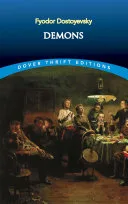
Demons
 84
84

Demons
The true power of Dostoyevsky's "Demons" lies not in its plot, which can feel sprawling and episodic, but in its unflinching dissection of intellectual rot. The character of Pyotr Verkhovensky, a Machiavellian manipulator disguised as a revolutionary ideologue, is chillingly realized. His ability to exploit the weaknesses and vanities of his followers, particularly the tormented Nikolai Stavrogin, reveals the hollowness at the heart of movements that profess grand societal change but are fueled by personal demons. A particular strength is Dostoyevsky's portrayal of how abstract philosophical ideas, divorced from any moral grounding, can become instruments of profound destruction, a concept he lays bare during the fevered discussions among the revolutionaries. Its limitation, for some readers, might be the sheer density of philosophical and theological debate, which can occasionally overshadow the narrative momentum. Nevertheless, "Demons" remains a vital, albeit unsettling, examination of the corrosive effects of ideological extremism. It is a stark warning about the perils of intellectual vanity divorced from ethical responsibility.
📝 Description
84
Fyodor Dostoyevsky published "Demons" in 1872, a novel dissecting political radicalism and nihilistic ideology.
Published in 1872, Fyodor Dostoyevsky's "Demons" examines the volatile intersection of political radicalism and nihilistic ideology. The novel follows a clandestine revolutionary cell, led by Pyotr Verkhovensky, whose members seek to remake society through chaos and violence. Set against a backdrop of provincial unrest, the narrative exposes the seductive nature of extremist thought and its power to corrupt individuals and destabilize communities. Dostoyevsky wrote "Demons" in response to the rise of revolutionary populism and nihilism in Russia, particularly the assassination of a student by members of the Nechayevtsy group. The novel also critiques Western European socialist and anarchist ideas that were being radicalized by Russian intellectuals. Its publication generated controversy, with some viewing it as reactionary and others as prescient.
The book appeals to readers interested in the psychological roots of political extremism and the philosophical currents influencing 19th-century revolutionary movements. It also speaks to those who study the darker aspects of human nature and the societal effects of unchecked rhetoric. Scholars of Russian literature and political theory may find its allegorical depth and character studies particularly valuable. Those who wish to understand ideologies that prioritize destruction over construction will find it relevant. The novel grapples with potent concepts such as nihilism, the rejection of religious and moral absolutes, and the destructive potential of intellectual pride.
While not strictly an occult text, "Demons" engages with themes of destructive ideology and the corruption of the soul that resonate with certain esoteric traditions concerned with the darker potentials of human consciousness and societal transformation. Dostoyevsky's exploration of nihilism, the void left by the rejection of traditional moral and religious frameworks, touches upon spiritual desolation. The novel examines how abstract, destructive ideas can take hold of individuals and groups, leading to societal upheaval, a concept familiar in traditions that analyze the influence of lower psychic forces or the dangers of unchecked intellectualism divorced from spiritual grounding.
💡 Why Read This Book?
• Understand the psychological mechanics of radicalization, as Dostoyevsky meticulously details how charismatic demagogues like Pyotr Verkhovensky exploit societal anxieties and individual despair to recruit followers, a process vividly illustrated in the novel's depiction of the revolutionary cell's formation. • Grasp the philosophical underpinnings of nihilism and its potential societal consequences, examining how the rejection of traditional moral and religious frameworks, as explored through characters like Kirillov, can lead to destructive ideologies. • Analyze the dangers of unchecked rhetoric and intellectual arrogance, observing how abstract utopian ideals, when detached from ethical considerations and human empathy, can pave the way for political chaos and personal ruin, as seen in the novel's tragic trajectory.
⭐ Reader Reviews
Honest opinions from readers who have explored this book.
❓ Frequently Asked Questions
Is "Demons" by Fyodor Dostoyevsky a literal account of a historical event?
While "Demons" draws inspiration from real-life radical groups like the Nechayevtsy, it is a fictionalized, allegorical work. Dostoyevsky used the historical context of 1860s Russia and the rise of nihilism to explore broader themes of political extremism and spiritual decay.
What is the primary philosophical concept explored in Dostoyevsky's "Demons"?
The primary concept is nihilism, the rejection of established laws, morals, and religious beliefs. The novel examines how this philosophical stance can lead to destructive behavior and societal upheaval when embraced by revolutionary movements.
Who is Pyotr Verkhovensky in "Demons"?
Pyotr Verkhovensky is the central antagonist, a manipulative and amoral revolutionary organizer. He embodies demagoguery, using rhetoric and psychological manipulation to control his followers and advance his destructive agenda.
What historical period does "Demons" reflect?
The novel reflects the intellectual and political climate of 1860s Russia, a period marked by the emergence of radical populist and nihilist movements challenging the Tsarist autocracy and traditional societal values.
Is "Demons" considered a religious or political novel?
It is both. "Demons" is deeply concerned with the spiritual void created by the rejection of faith and the subsequent rise of atheistic, revolutionary ideologies. Dostoyevsky viewed the political radicalism of his time as intrinsically linked to a spiritual crisis.
When was Fyodor Dostoyevsky's "Demons" originally published?
Fyodor Dostoyevsky's "Demons" was originally published in 1872, though its first English translation and wider international recognition came later.
🔮 Key Themes & Symbolism
Nihilism's Destructive Logic
The novel meticulously illustrates the practical application of nihilistic philosophy, where the rejection of all moral absolutes and established truths leads inevitably to destruction. Characters like Kirillov, who seeks to prove his freedom by committing suicide to become God, exemplify the logical, albeit horrifying, endpoint of this ideology. Dostoyevsky shows how nihilism, when translated into political action, dismantles societal structures and corrupts individual morality, leading to chaos rather than the promised utopia.
The Perils of Demagoguery
Pyotr Verkhovensky serves as a potent archetype of the modern demagogue. He manipulates followers not through genuine conviction, but through calculated appeals to their vanity, desires, and fears. His leadership style, characterized by deceit, blackmail, and the creation of a cult of personality around himself and the abstract revolutionary cause, highlights how charismatic manipulation can fuel extremist movements. The narrative exposes how such leaders thrive in environments where critical thinking is suppressed.
Spiritual Void and Ideological Filling
Dostoyevsky argues that the abandonment of religious faith and traditional morality creates a dangerous spiritual vacuum. This void, he contends, is readily filled by radical ideologies that offer simplistic answers and a sense of purpose, even if that purpose is destructive. The novel portrays characters adrift without spiritual anchors, easily swayed by the promises of revolution, suggesting that a society without God is susceptible to succumbing to its basest impulses.
The Corrupting Influence of Revolution
The pursuit of revolution in "Demons" is depicted as a corrupting force that contaminates all who engage with it. The clandestine revolutionary cell operates outside the bounds of law and morality, leading its members into acts of betrayal, violence, and ultimately, self-destruction. Dostoyevsky suggests that the means employed by revolutionaries, often brutal and deceitful, inevitably shape the ends they achieve, resulting in a new form of tyranny rather than liberation.
💬 Memorable Quotes
Direct passages from the work, attributed to the author.
“The most important thing is to love others. The most important thing is to love. That's all there is.”
— This sentiment, expressed by Shatov, represents a counterpoint to the nihilistic worldview. It suggests that genuine human connection and compassion are the true anchors against the destructive forces of ideology and despair, offering a path toward spiritual and social healing.
“I want to put my tongue out at him.”
— This impulsive, almost childish desire attributed to Stavrogin reflects his profound ennui and detachment. It signifies a rejection of social norms and a contempt for authority, stemming from a deep internal emptiness and a lack of meaningful engagement with the world.
“What is a man without a country? He is nothing. A phantom.”
— Shatov’s passionate declaration highlights the importance of national identity and belonging, contrasting sharply with the rootless, internationalist rhetoric of the revolutionaries. It underscores Dostoyevsky's view that human identity is deeply intertwined with one's cultural and national context.
“We are all good, simple folk. We are not wicked.”
— This self-deception, uttered by members of the revolutionary cell, reveals their capacity to rationalize their destructive actions. It demonstrates how individuals can convince themselves of their own virtue even while engaging in morally reprehensible behavior, a key aspect of ideological delusion.
💡 Key Ideas
Editorial paraphrase of the work's core concepts — not direct quotes.
We shall declare that we deny Christ, deny immortality, deny everything. We shall go to perdition.
This quote, embodying the revolutionary fervor of the time, illustrates the deliberate embrace of nihilism. It signifies a conscious choice to reject established values and embrace destruction, viewing damnation not as a consequence but as a defiant act of liberation from perceived societal constraints.
🌙 Esoteric Significance
Tradition
While "Demons" is not explicitly an esoteric text, its profound exploration of the human psyche, spiritual voids, and the battle between destructive and constructive forces aligns with themes found in Gnostic and Manichaean thought. The stark dualism between light and darkness, order and chaos, and the idea of spiritual possession by malevolent influences (demons) can be interpreted through an esoteric lens, viewing the novel as a cautionary allegory about the dangers of succumbing to inner or outer forces that lead away from spiritual wholeness.
Symbolism
The "demons" themselves are potent symbols, representing not just literal entities but also the destructive ideologies, psychological obsessions, and spiritual emptiness that possess individuals and society. Nikolai Stavrogin, the enigmatic central figure, embodies a soul afflicted by a profound inner void, susceptible to various corrupting influences. The recurring motif of fire and destruction symbolizes the purifying yet annihilating force of radical change, while the pervasive sense of spiritual malaise and the search for meaning in a godless world points to a crisis of faith that resonates within many esoteric traditions.
Modern Relevance
Contemporary thinkers exploring the psychology of political extremism, cult dynamics, and the impact of disinformation often reference "Demons." Its analysis of how ideologies can take hold of individuals, leading them to commit acts of violence in the name of abstract ideals, remains acutely relevant. Schools of thought concerned with spiritual warfare, the nature of evil, and the psychological mechanisms of societal breakdown find in Dostoyevsky's work a powerful literary exploration of these enduring themes.
👥 Who Should Read This Book
• Students of political philosophy and history: Those seeking to understand the historical roots and psychological drivers of 19th-century revolutionary movements and their echoes in contemporary extremism will find a rich, critical analysis. • Readers interested in existential and psychological literature: Individuals drawn to works that explore the depths of human nature, moral ambiguity, and the struggle with meaninglessness will appreciate Dostoyevsky's complex characters and their inner turmoil. • Those examining the relationship between ideology and spirituality: Readers curious about how radical ideas can fill a spiritual void and lead to destructive consequences will find "Demons" a profound, albeit unsettling, case study.
📜 Historical Context
Published in 1872, Fyodor Dostoyevsky's "Demons" (also known as "The Possessed") emerged during a turbulent period in Russian history, characterized by the rise of radical political ideologies like nihilism and populism. The novel was a direct artistic and intellectual response to the growing influence of Western European socialist and anarchist thought, often adapted and radicalized by Russian intellectuals. Dostoyevsky, a staunch conservative and Orthodox Christian, viewed these movements with profound alarm. The book was particularly spurred by the 1869 assassination of a student by followers of the radical Sergey Nechayev, a figure whose ruthless pragmatism and manipulative tactics served as a partial model for the character Pyotr Verkhovensky. The intellectual milieu was also dominated by thinkers like Nikolai Chernyshevsky, whose utilitarian and materialist philosophies Dostoyevsky vehemently opposed. "Demons" was met with controversy, criticized by some for its perceived reactionary politics and praised by others for its prescient analysis of revolutionary psychology.
📔 Journal Prompts
Pyotr Verkhovensky's manipulative tactics, reflect on their modern manifestations.
Nikolai Stavrogin's spiritual paralysis, explore its potential sources.
The concept of 'possessing demons,' analyze its symbolic meaning in your life.
Shatov's belief in the Russian people, consider its ideological implications.
The revolutionary cell's descent into chaos, identify contributing factors.
🗂️ Glossary
Nihilism
A philosophical viewpoint that denies any meaning or purpose to life, rejecting all religious and moral principles. In the context of the novel, it fuels revolutionary fervor and a desire for societal destruction.
Demagoguery
The art of using popular prejudice and false oratory to gain power. Pyotr Verkhovensky exemplifies this, manipulating his followers through rhetoric and deceit rather than genuine conviction.
Populism
A political approach that appeals to the interests or concerns of ordinary people, often by contrasting them with the perceived elite. In 19th-century Russia, it fueled revolutionary movements seeking radical societal change.
Tsarist Autocracy
The absolute monarchy of the Russian Empire, ruled by a Tsar. The novel's revolutionary characters sought to overthrow this system of government.
Spiritual Void
A sense of emptiness or lack of purpose resulting from a loss of faith or traditional values. Dostoyevsky suggests this void makes individuals susceptible to radical ideologies.
Nechayevtsy
A radical revolutionary group active in Russia in the late 1860s, known for its conspiratorial methods and commitment to revolutionary violence. Their leader, Sergey Nechayev, influenced Dostoyevsky's portrayal of Verkhovensky.
Provincial Society
The social environment outside of major urban centers. Dostoyevsky uses the setting of a provincial town to show how revolutionary ideas can infiltrate and destabilize seemingly ordinary communities.