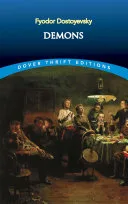
Demons
 75
75

Demons
Dostoyevsky's "Demons" presents a chillingly prescient examination of ideological fervor and its destructive potential. The novel excels in its intricate portrayal of characters teetering on the brink of nihilism, their intellectual pronouncements masking profound personal and spiritual crises. The opening sections, focusing on Stepan Trofimovitch Verhovensky, are masterfully crafted, establishing a sense of unease and foreshadowing the chaos to come. The work's strength lies in its unflinching depiction of how abstract ideas, when untethered from empathy, can fuel monstrous actions. However, the sheer density of philosophical discourse and the sprawling cast of characters, while contributing to the novel's depth, can at times feel overwhelming, demanding considerable reader engagement. A particularly striking passage involves the character of Stavrogin, whose enigmatic presence and moral vacuity serve as a focal point for the novel's exploration of spiritual decay. Ultimately, "Demons" remains a powerful, albeit challenging, literary dissection of the human psyche under the sway of radicalism.
📝 Description
75
Fyodor Dostoyevsky's 1872 novel 'Demons' depicts the social and spiritual chaos stemming from radical ideologies.
Written in 1872, Fyodor Dostoyevsky's "Demons" uses a first-person narrator to chronicle unsettling events in a provincial town. The narrative begins by introducing Stepan Trofimovitch Verhovensky, presenting biographical details as a gateway to understanding the stranger occurrences that follow. The novel builds suspense, suggesting the core story will emerge later, with Verhovensky's character serving as an initial point of contact for the unfolding peculiar incidents. The opening establishes the book as an attempt to articulate the unexplainable, creating an atmosphere of anticipation and societal breakdown.
This work is for readers interested in psychological fiction and the subtle workings of society. Those who enjoy character studies that slowly reveal complex relationships and concealed intentions will find depth here. It suits individuals drawn to literary examinations of the human condition, particularly themes of shattered idealism, loss of faith, and the repercussions of extreme beliefs. The novel also appeals to those intrigued by the intellectual and philosophical currents of 19th-century Russia, a recurring focus in Dostoyevsky's writings.
While not overtly occult, "Demons" engages with spiritual and philosophical anxieties prevalent in 19th-century Russia. Dostoyevsky critically examines the rise of socialist and atheist thought, seeing in these movements a potential for destructive spiritual and social upheaval. The novel reflects a concern with the 'demonic' possession of ideas, where radical ideologies can consume individuals and society, leading to a breakdown of moral and religious foundations. It addresses the dark undercurrents of intellectual movements that sought to dismantle established orders, portraying a world susceptible to possession by destructive utopian visions.
💡 Why Read This Book?
• Understand the psychological underpinnings of ideological extremism, as depicted through characters like Stavrogin and their descent into nihilism, offering a nuanced view of radicalization predating many modern analyses. • Gain insight into 19th-century Russian intellectual currents, particularly the debates surrounding socialism and atheism that Dostoyevsky critiques, providing historical context for contemporary societal divisions. • Explore the consequences of spiritual and moral vacuum, examining how a rejection of traditional values and a pursuit of abstract ideals can lead to societal breakdown and personal ruin, as illustrated by the town's unraveling events.
⭐ Reader Reviews
Honest opinions from readers who have explored this book.
❓ Frequently Asked Questions
Is 'Demons' a literal depiction of supernatural demons?
No, the title 'Demons' refers metaphorically to destructive ideologies, radical political ideas, and the inner psychological turmoil that drives characters to destructive actions, rather than literal supernatural entities.
What is the significance of Stepan Trofimovitch Verhovensky in the novel?
Stepan Trofimovitch Verhovensky serves as an initial focal point and a representation of an older generation of intellectuals whose abstract idealism inadvertently paved the way for the more dangerous radicalism of the younger generation.
When was Fyodor Dostoyevsky's 'Demons' originally published?
Fyodor Dostoyevsky's novel 'Demons,' also known as 'The Possessed,' was originally published in serial form between 1871 and 1872.
How does 'Demons' relate to Dostoyevsky's other works?
Like 'Crime and Punishment' and 'The Brothers Karamazov,' 'Demons' delves into profound philosophical and religious questions, exploring themes of faith, doubt, morality, and the human struggle with sin and redemption.
What historical events influenced the writing of 'Demons'?
The novel was heavily influenced by the rise of revolutionary and nihilist movements in Russia during the 1860s, including the Nechayev affair, which Dostoyevsky used as inspiration for the plot.
What is the primary message Dostoyevsky intended with 'Demons'?
Dostoyevsky intended to warn against the dangers of atheistic socialism and radical ideologies that he believed threatened to destroy Russian society and its spiritual foundations.
🔮 Key Themes & Symbolism
Ideological Possession
The work profoundly explores how abstract political and philosophical ideas can take root in individuals, transforming them into agents of destruction. It depicts characters consumed by nihilism and revolutionary fervor, losing their moral compass in pursuit of utopian visions. This possession is shown to be a spiritual sickness, leading to societal breakdown and personal ruin, as characters become detached from empathy and accountability. The narrative suggests these 'demons' are not supernatural but the product of intellectual and moral perversion, infecting minds and actions.
Spiritual Nihilism
A central theme is the void left by the rejection of traditional faith and morality. The characters often grapple with a profound lack of meaning, seeking solace or purpose in radical ideologies that ultimately prove hollow. This spiritual vacuum breeds despair, cynicism, and a dangerous detachment from human suffering. Dostoyevsky illustrates how the absence of God or a guiding moral framework can lead individuals to embrace chaos and violence as a form of liberation or a response to existential dread.
The Corrupting Influence of Intellect
The novel critiques intellectualism that becomes divorced from ethical considerations. It portrays intellectuals whose abstract theories and pronouncements, disconnected from practical consequences or humanistic concerns, incite dangerous actions. The narrative questions the responsibility of thinkers and the potential for their ideas to become destructive forces when not tempered by wisdom and moral grounding. This theme highlights the peril of unchecked intellectual ambition and its capacity to rationalize evil.
Social and Political Chaos
The book serves as a powerful allegory for the potential for social and political upheaval when radical ideologies take hold. It depicts the disintegration of community and order as characters act out their destructive impulses, fueled by a collective susceptibility to divisive ideas. Dostoyevsky examines the fragility of societal structures and the ease with which they can be undermined by charismatic demagogues and fanatical followers, leading to widespread disruption and violence.
💬 Memorable Quotes
Direct passages from the work, attributed to the author.
“I find myself forced in absence of literary skill to begin my story rather far back, that is to say, with certain biographical details concerning that talented and highly-esteemed gentleman, Stepan Trofimovitch Verhovensky.”
— This opening sets the stage for a narrative that prioritizes character exposition and gradual unfolding. It signals the narrator's intent to build context meticulously before revealing the central events, emphasizing the importance of understanding the people involved.
“The work explores the concept of ideological possession, where individuals become consumed by radical beliefs.”
— This interpretation highlights the novel's central metaphorical concern: how abstract political and social doctrines can psychologically dominate individuals, leading them to commit acts driven by fanaticism rather than reason or empathy.
“He would have preferred to believe in hell, but he couldn't.”
— This reflects the spiritual crisis of many characters in the novel, who struggle with faith and doubt. The inability to believe, even in damnation, points to a profound existential void and a loss of traditional moral anchors.
“The most terrible thing is to have no one to tell anything to.”
— This poignant observation speaks to the theme of isolation and the breakdown of genuine human connection within the society depicted. It underscores the psychological toll of living in an environment where trust and intimacy are eroded by suspicion and ideological division.
“The narrative scrutinizes the role of intellectualism divorced from practical morality.”
— This phrase captures Dostoyevsky's critique of thinkers whose abstract theories, detached from ethical consequences, can indirectly foster dangerous social and political movements, highlighting the author's concern with intellectual responsibility.
🌙 Esoteric Significance
Tradition
While "Demons" is primarily a socio-political commentary, its exploration of internal spiritual battles and the nature of belief systems aligns with Gnostic themes of hidden knowledge and the struggle against destructive forces that operate unseen. The novel's focus on ideological 'possession' can be interpreted through an esoteric lens as a form of psychic or spiritual infestation, where external doctrines overwhelm individual consciousness and agency.
Symbolism
The 'demons' themselves are potent symbols, representing not literal entities but the insidious influence of destructive ideologies and psychological corruption. The recurring motif of fire, often associated with destruction and purification, symbolizes the chaotic forces unleashed by radicalism. Furthermore, the characters' internal struggles and the pervasive sense of moral ambiguity can be seen as representing the descent into a spiritual 'underworld,' a state of profound disconnection from divine order.
Modern Relevance
Contemporary discussions on radicalization, political polarization, and the spread of misinformation often draw parallels with "Demons." Thinkers and commentators examining the psychological mechanisms behind extremism, cult dynamics, and the impact of ideological echo chambers find resonance in Dostoyevsky's depiction of societal susceptibility. The novel's insights into the spiritual void and the human search for meaning in chaotic times remain relevant to modern psychological and philosophical inquiries.
👥 Who Should Read This Book
• Students of 19th-century Russian literature and intellectual history, who will find a critical engagement with the revolutionary movements and philosophical debates of the era. • Readers interested in psychological realism and the darker aspects of human motivation, seeking to understand how ideology can shape and corrupt individual consciousness. • Those exploring themes of faith, doubt, and existentialism, who will find a profound literary examination of spiritual crisis and the search for meaning in a seemingly godless world.
📜 Historical Context
Dostoyevsky's "Demons," published in 1872, emerged from a Russia grappling with profound social and political ferment. The late 1860s and early 1870s witnessed the rise of radical intellectual circles, including nihilists and nascent socialist groups, whose ideas challenged the autocratic Tsarist regime and traditional Orthodox Christian values. Dostoyevsky, deeply disturbed by these trends, penned "Demons" as a stark warning. He was particularly reacting to the "Nechayev affair," a real-life political murder case involving a revolutionary named Sergey Nechayev, which seemed to embody the very dangers he foresaw. The novel engaged directly with contemporary debates, serving as a literary counter-argument to the revolutionary fervor championed by figures like Nikolai Chernyshevsky, whose utilitarian and atheist philosophy Dostoyevsky vehemently opposed. The book's reception was divided, with some recognizing its prescience and others denouncing its perceived reactionary stance.
📔 Journal Prompts
Stepan Trofimovitch Verhovensky's idealism as a precursor to radicalism.
The psychological impact of spiritual nihilism on individual characters.
The narrative's portrayal of intellectual discourse versus moral action.
Stavrogin's enigmatic presence and its role in the unfolding chaos.
The town's susceptibility to destructive ideologies.
🗂️ Glossary
Nihilism
A philosophical stance that rejects all religious and moral principles, often in the belief that life is meaningless. In the context of the novel, it represents a destructive ideology that undermines societal and personal values.
Radicalism
Advocacy for or the implementation of fundamental or revolutionary political, social, or economic changes. In 'Demons,' this refers to the extreme ideologies that sought to overthrow existing social orders.
Ideological Possession
A state where an individual's thoughts, beliefs, and actions are dominated by a particular ideology, often to the exclusion of critical thinking or personal morality. This term captures the novel's metaphorical 'demons'.
Spiritual Void
A feeling of emptiness or lack of meaning resulting from a loss of faith, purpose, or connection to transcendent values. This is a recurring theme for many characters in the novel.
The Nechayev Affair
A real-life event in 1869 involving the revolutionary Sergey Nechayev, who orchestrated the murder of a fellow student he suspected of disloyalty. This incident heavily influenced Dostoyevsky's plot for 'Demons'.
Utilitarianism
A philosophy advocating that the best action is the one that maximizes utility, often defined as maximizing happiness and well-being. Dostoyevsky critiques its potential to disregard individual morality for perceived collective good.
Atheism
Disbelief or lack of belief in the existence of God or gods. The novel explores the societal and psychological consequences when atheistic ideas become prevalent.