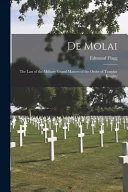
De Molai
 78
78

De Molai
Edmund Flagg's 'De Molai,' as presented here, is a curious artifact, less a gripping narrative and more a scholarly document rescued from obscurity. Its value lies in its preservation of a specific historical perspective on esoteric thought. The sections detailing the supposed rituals and philosophical underpinnings of the Order of the Temple, as interpreted by Flagg in the late 19th century, offer a fascinating, if somewhat dry, glimpse into the era's occult revival. A particular strength is the meticulous scholarly apparatus that contextualizes the text, situating it within the broader landscape of 19th-century esoteric societies. However, the prose can be dense, and the argument, at times, feels more like an assertion of belief than a rigorously defended thesis. The work's central thesis regarding the continuity of Templar traditions through Masonic rites, while historically significant for understanding the period, requires considerable critical engagement from the modern reader. Flagg's 'De Molai' is a valuable resource for specialists, but its appeal is admittedly niche.
📝 Description
78
Edmund Flagg's 'De Molai' was compiled from writings spanning 1815-1890.
This edition presents 'De Molai', a compilation of writings by Edmund Flagg (1815-1890). The text is important for understanding historical esoteric thought, particularly concerning Freemasonry and related philosophical currents of the 19th century. Flagg's work emerged during a time of renewed interest in occult philosophies and secret societies. It engages with the intellectual climate where figures like Eliphas Lévi were also active.
Scholars, researchers, and students of esoteric traditions will find this volume useful. It offers primary source material on historical occultism and the philosophical ideas shaping societal beliefs. Those studying comparative religion or intellectual history may use it to trace the development of certain concepts. The book is in the public domain in the United States, ensuring accessibility.
The work addresses core themes within historical esoteric groups and their symbolic systems. Readers can expect discussions on allegorical stories, ritual frameworks, and the philosophical underpinnings of clandestine orders. It provides insight into how individuals sought deeper meaning through symbols and spiritual investigation.
Edmund Flagg's 'De Molai' originates from the 19th century, a period marked by a significant revival and reinterpretation of esoteric philosophies. This era saw a resurgence of interest in Freemasonry, Rosicrucianism, and other occult societies, often interwoven with philosophical movements such as Transcendentalism. Flagg's writings likely interacted with the intellectual environment of his time, a period when influential esoteric authors like Eliphas Lévi were also publishing their works. The text offers a view into the conceptual world of those who pursued deeper understanding through symbolic language and spiritual exploration.
💡 Why Read This Book?
• Understand the 19th-century esoteric landscape by examining Edmund Flagg's perspective on Templar continuity, offering insights into the intellectual climate of his era. • Engage with primary source material on historical occult societies, providing a direct link to the symbolic language and philosophical inquiries prevalent in the late 1800s. • Explore the connections drawn between Masonic rites and older chivalric orders, a concept central to esoteric interpretations of the period.
⭐ Reader Reviews
Honest opinions from readers who have explored this book.
❓ Frequently Asked Questions
What is the primary subject matter of 'De Molai' by Edmund Flagg?
'De Molai' primarily focuses on the historical and esoteric interpretations of the Knights Templar and their alleged continuation through Masonic traditions, reflecting 19th-century occult scholarship.
When was Edmund Flagg's 'De Molai' originally published?
While this edition was first published on September 10, 2021, the original work is attributed to Edmund Flagg, who was active between 1815 and 1890, indicating the content originates from the late 19th century.
Is 'De Molai' available for free?
Yes, 'De Molai' is in the public domain in the United States, making it freely available to copy and distribute. This edition serves to preserve and make accessible this culturally important work.
Who would benefit most from reading 'De Molai'?
Scholars, researchers of esoteric history, students of Freemasonry and occultism, and anyone interested in the intellectual currents of the 19th-century esoteric revival would find this work beneficial.
What is the significance of this work being in the public domain?
Its public domain status ensures that 'De Molai' is preserved and can be freely studied, reproduced, and distributed, contributing to the accessible knowledge base of civilization without copyright restrictions in the US.
🔮 Key Themes & Symbolism
Templar Legacy
The text explores the enduring mystique of the Knights Templar, particularly focusing on theories linking their traditions and secrets to later esoteric orders. It examines how the Templars' history was reinterpreted and mythologized during the 19th century's occult revival, presenting them not merely as historical figures but as custodians of hidden knowledge passed down through secret societies.
Masonic Symbolism
Central to Flagg's thesis is the exploration of Masonic ritual and symbolism as a potential conduit for Templar heritage. The work dissects specific degrees and allegories within Freemasonry, seeking to uncover parallels and direct lineages to the Templar Order. This involves an analysis of symbolic language used to convey spiritual and philosophical truths, suggesting a continuous esoteric tradition.
Esoteric Transmission
This theme addresses the mechanisms by which esoteric knowledge is believed to be preserved and transmitted across generations. 'De Molai' investigates how secret societies, through initiation, ritual, and symbolic instruction, act as vessels for ancient wisdom. It frames the study of these orders as an investigation into a hidden current of spiritual and philosophical development distinct from mainstream religious and intellectual history.
Historical Reinterpretation
The work represents a specific instance of historical reinterpretation prevalent in the 19th century, where scholars and occultists sought to find hidden meanings and ancient roots in historical events and institutions. Flagg's approach exemplifies the tendency of the era to construct elaborate theories about secret histories and the evolution of mystical traditions, often blending fact with speculative interpretation.
💬 Memorable Quotes
Direct passages from the work, attributed to the author.
“Symbolism serves as the language of hidden truths.”
— This interpretation underscores the book's view of symbols not as mere decoration, but as essential tools for conveying profound, often esoteric, knowledge that is inaccessible through ordinary discourse or rational analysis.
“The 19th century saw a resurgence of interest in ancient chivalric orders.”
— This highlights the historical milieu in which Flagg was writing, pointing to a broader cultural phenomenon of the 1800s where scholars and mystics actively investigated and often romanticized historical knightly orders like the Templars.
“The legend of Jacques de Molay is central to understanding the Templar mythos.”
— This concept emphasizes the importance of the last Grand Master of the Knights Templar, Jacques de Molay, as a focal point for later esoteric interpretations and legends surrounding the order's alleged secrets and continuation.
💡 Key Ideas
Editorial paraphrase of the work's core concepts — not direct quotes.
The work explores the continuity of certain Templar principles within Masonic degrees.
This paraphrased concept highlights the book's core argument: that the philosophical and perhaps spiritual legacy of the Knights Templar was not lost but actively preserved and transmitted through the symbolic systems and rituals of Freemasonry.
Initiation into secret societies offers access to deeper understanding.
This paraphrase reflects the book's perspective on the role of secret societies in preserving and imparting knowledge. It suggests that the process of initiation is designed to unlock a level of comprehension not attainable through external study alone.
🌙 Esoteric Significance
Tradition
This work aligns with the Western Esoteric Tradition, particularly its Hermetic and Rosicrucian branches, which often seek to uncover hidden continuities between ancient orders and medieval chivalric bodies. Flagg's exploration of the Knights Templar and their alleged transmission of knowledge through Freemasonry fits within this lineage of seeking a unified esoteric history.
Symbolism
Key symbols likely explored include the double-headed eagle, often associated with Templar and Masonic lore, representing duality and universal sovereignty. The concept of the 'Holy Grail,' as a vessel of spiritual knowledge or attainment, is also a recurring motif in Templar and Grail romances, which often intersect with esoteric interpretations of chivalry.
Modern Relevance
Contemporary practitioners of Traditionalism, such as René Guénon's followers, and certain Masonic scholars continue to engage with the historical and symbolic questions raised by works like Flagg's. The ongoing fascination with the Knights Templar in popular culture and esoteric circles ensures that discussions about their legacy, as articulated in texts from the 19th century, remain relevant.
👥 Who Should Read This Book
• Students of 19th-century occultism: Gain direct insight into the speculative historical theories and esoteric interpretations prevalent during this key period of revival. • Masonic researchers: Explore the connections and symbolic parallels drawn between Templar history and various Masonic rites and degrees, offering a specific lens on Masonic symbolism. • Historians of Western Esotericism: Utilize this text as a primary source to understand how foundational myths and historical narratives surrounding secret societies were constructed and disseminated.
📜 Historical Context
Edmund Flagg's 'De Molai' emerges from the fertile ground of 19th-century esoteric revivalism. This period, roughly spanning from the early 1800s through the turn of the 20th century, witnessed a profound resurgence of interest in Hermeticism, Kabbalah, Rosicrucianism, and Freemasonry. Scholars and mystics alike sought to uncover hidden spiritual lineages, often connecting contemporary esoteric orders to ancient mystery traditions or alleged secret societies like the Knights Templar. Flagg's work likely engaged with the speculative histories popular at the time, a milieu where figures such as Eliphas Lévi were redefining occult philosophy. The intellectual currents included a reaction against pure rationalism, a romantic fascination with the medieval past, and a desire for spiritual enlightenment outside established religious frameworks. While specific reception details for Flagg's original publication are scarce, the broader context reveals a vibrant, albeit often controversial, range of occult scholarship, sometimes met with skepticism by mainstream academia but eagerly consumed by a growing readership.
📔 Journal Prompts
The Templar legacy as interpreted by Flagg: What modern parallels exist?
Analyze the function of symbolism in transmitting esoteric knowledge within 'De Molai'.
Reflect on the 19th-century impulse to link chivalric orders with Masonic traditions.
Consider the role of Jacques de Molay in the mythology of esoteric orders.
How does Flagg's work define the transmission of hidden truths?
🗂️ Glossary
Knights Templar
A medieval Catholic military order, founded around 1119, known for its role in the Crusades. After its suppression in the early 14th century, it became the subject of numerous legends and esoteric theories.
Freemasonry
A fraternal organization that traces its origins to the late 16th and early 17th centuries. It is known for its use of allegorical rituals and symbols derived from stonemasonry and chivalric traditions.
Esotericism
Belief systems, practices, and teachings that focus on inner, spiritual knowledge and often involve initiation into secret doctrines, typically distinct from exoteric or public teachings.
Chivalry
The medieval knightly system of code of conduct, with its associated religious, moral, and social code. It often carries symbolic meaning in esoteric traditions.
Hermeticism
A religious, philosophical, and esoteric tradition based primarily upon writings attributed to Hermes Trismegistus. It emphasizes spiritual knowledge and the correspondence between the macrocosm and the microcosm.
Public Domain
Creative works that are not protected by intellectual property laws such as copyright, patent, or trade secret. Anyone can use them without permission.
Occult Revival
A period, particularly prominent in the 19th century, marked by renewed widespread interest in magic, mysticism, and esoteric philosophies, often seeking connections to ancient wisdom traditions.
This book appears in 1 collection
🔮 Readers Also Liked
Browse all →









From the “Templar Knights” Collection
View all →





More Free Occult Philosophy Books
View all →