Cosmic Explorers
 76
76

Cosmic Explorers
Courtney Brown’s Cosmic Explorers attempts to map the uncharted territories of consciousness and its potential cosmic connections. The author's commitment to the concept of remote viewing as a tool for understanding extraterrestrial life is evident throughout. A particular strength lies in Brown's consistent articulation of his personal research methodology, offering a degree of transparency rare in such speculative works. However, the book’s primary limitation is its reliance on anecdotal evidence and theoretical extrapolation, often presenting complex, unverified hypotheses as established fact. The discussion surrounding the "conscious interaction" with off-world entities, while intriguing, frequently lacks the rigorous empirical grounding that would satisfy a skeptical reader. The work’s exploration of the idea that consciousness itself is the primary medium for communication with non-terrestrial beings is its most compelling, yet most challenging, assertion. While it stimulates thought about the nature of reality, its definitive conclusions often outpace the presented evidence. Cosmic Explorers offers a fascinating, albeit speculative, perspective on consciousness and the cosmos.
📝 Description
76
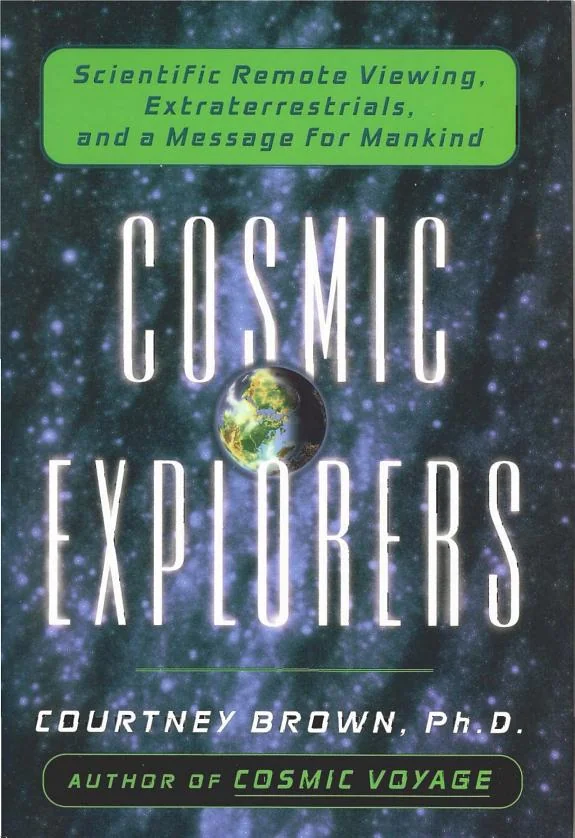
Courtney Brown's 2000 book, Cosmic Explorers, details theories on consciousness interacting with the cosmos.
Cosmic Explorers, published in 2000 by Courtney Brown, examines consciousness and its connection to the wider universe. This is not fiction; it discusses ideas surrounding remote viewing and extraterrestrial contact. Brown, known for his remote viewing research, shares his theories and findings, proposing that consciousness can engage with realities beyond normal perception. The book lays out methods and philosophical ideas for these kinds of investigations, acting as a guide for readers wanting to broaden their understanding of existence.
This work is mainly for people already familiar with or keenly interested in remote viewing, consciousness studies, and ufology. It appeals to those looking for theories that link personal experience with objective events, especially concerning non-Earthly beings. Readers interested in experimental metaphysics and different views of reality will find its subject matter interesting. It is less suitable for those seeking standard scientific discussion or historical accounts of alien encounters, as its focus is on speculation and personal experience.
Published in 2000, Cosmic Explorers appeared during a time of growing interest in consciousness research and unconventional science. The late 20th and early 21st centuries saw increased public and academic attention toward subjects like quantum physics, meditation, and altered states of awareness, often overlapping with paranormal phenomena. Brown's book fits into this environment, drawing connections between controlled remote viewing methods, previously studied by institutions like SRI International, and the potential for conscious engagement with non-terrestrial intelligences. The book reflects a wider cultural shift.
💡 Why Read This Book?
• Understand the principles of directed consciousness as a tool for exploring non-terrestrial intelligence, as detailed in Courtney Brown's unique research framework. • Gain insight into the concept of "off-world intelligences" as entities of consciousness, rather than purely physical beings, as presented in the book's speculative models. • Explore the idea of a "cosmic mind" and its potential role in facilitating interdimensional communication, a core tenet of the work's metaphysical outlook.
⭐ Reader Reviews
Honest opinions from readers who have explored this book.
❓ Frequently Asked Questions
What is the primary focus of Courtney Brown's 'Cosmic Explorers'?
The book primarily focuses on the concept of directed consciousness and its potential for interacting with off-world intelligences, particularly through methodologies like remote viewing. It explores theories about consciousness transcending physical limitations.
When was 'Cosmic Explorers' first published?
Cosmic Explorers was first published in the year 2000. This places its initial release at the beginning of a period marked by increased public interest in consciousness studies and extraterrestrial theories.
Does the book present scientific proof of extraterrestrial contact?
No, 'Cosmic Explorers' does not present scientific proof. Instead, it offers speculative theories and interpretations based on the author's research into consciousness and remote viewing, suggesting potential avenues for interaction.
Who is Courtney Brown and what is his background?
Courtney Brown is known for his work in the field of remote viewing, a purported psychic ability. He founded the Farsight Institute and has written extensively on consciousness, remote viewing, and extraterrestrial subjects.
What is the concept of 'off-world intelligences' as discussed in the book?
In 'Cosmic Explorers,' 'off-world intelligences' are often presented not just as physical beings but as forms of consciousness that can be perceived and potentially interacted with through focused mental states.
Is 'Cosmic Explorers' considered a work of fiction or non-fiction?
The book is considered non-fiction, falling within the speculative and esoteric categories. It presents the author's theories, research, and interpretations of consciousness and potential extraterrestrial interactions.
🔮 Key Themes & Symbolism
Directed Consciousness Exploration
The central theme revolves around the idea that human consciousness is not confined by physical proximity or conventional limitations. Brown posits that consciousness can be intentionally directed, much like a focused beam of light, to perceive and interact with distant phenomena. This directed consciousness is presented as the primary tool for exploring realities beyond our immediate sensory input. The book details the theoretical framework and practical considerations for honing this ability, suggesting that through specific mental disciplines, individuals can engage with aspects of the universe previously considered inaccessible, including non-terrestrial consciousness.
Off-World Intelligence Interaction
Cosmic Explorers proposes a unique perspective on extraterrestrial life, characterizing 'off-world intelligences' not solely as biological entities but as conscious entities. The work suggests that these intelligences can be contacted and understood through the directed consciousness of human observers. It moves beyond typical UFO abduction narratives to explore a more nuanced form of interaction, one based on mental and energetic exchange. The book explores the nature of these intelligences, their potential forms of existence, and the implications of conscious dialogue with beings from beyond Earth.
The Nature of Reality
Underpinning the book's explorations is a profound questioning of the conventional understanding of reality. Brown suggests that our perceived physical universe is merely one facet of a larger, more complex, and interconnected consciousness field. This 'cosmic mind' is seen as the ultimate substrate from which all existence arises and through which communication and perception can occur across vast distances and dimensions. The work encourages readers to consider that reality is more fluid and malleable than commonly assumed, influenced by conscious observation and intent.
Remote Viewing as a Cosmic Tool
The practical application of remote viewing is presented as a vital methodology for the explorations discussed. Brown outlines how the principles and techniques of remote viewing, as developed and researched, can be adapted and expanded to investigate cosmic phenomena and non-terrestrial consciousness. The book frames remote viewing not just as a method for gathering information about terrestrial targets but as a bridge to understanding the wider cosmos. It emphasizes the disciplined application of mental focus required to achieve accurate and meaningful perceptions in these advanced applications.
💬 Memorable Quotes
Direct passages from the work, attributed to the author.
“Consciousness is the fundamental medium through which reality is experienced and potentially shaped.”
— This interpretation highlights the book's core assertion that consciousness is not merely a byproduct of the brain but an active, fundamental force. It implies that our perception and interaction with the universe are intrinsically linked to our conscious state, suggesting a more participatory role in existence.
“Directed mental focus allows access to information and realities beyond ordinary perception.”
— This interpretation underscores the practical aspect of the book's theories. It points to the idea that through discipline and specific mental techniques, such as remote viewing, individuals can extend their awareness to perceive phenomena that are not normally accessible through the five senses.
“The cosmos is a vast network of interconnected consciousness, offering potential for dialogue.”
— This interpretation captures the book's vision of a unified cosmic field. It suggests that all consciousness, human and potentially non-human, is part of a larger interconnected web, implying that communication and understanding across different forms of existence are not only possible but inherent to the structure of the universe.
💡 Key Ideas
Editorial paraphrase of the work's core concepts — not direct quotes.
The universe may be populated by intelligences that exist primarily as consciousness, not physical bodies.
This paraphrase emphasizes the book's unconventional view of extraterrestrial life. It suggests that our search for alien beings should extend beyond physical forms to consider entities that might exist on purely energetic or conscious planes, challenging traditional definitions of life and intelligence.
Our understanding of 'space' and 'time' may be limited by our current biological and conscious frameworks.
This paraphrased concept suggests that the book challenges fundamental assumptions about the nature of space and time. It implies that these concepts might be relative or subject to interpretation by consciousness, opening the door to understanding phenomena that appear to defy conventional physics.
🌙 Esoteric Significance
Tradition
Cosmic Explorers engages with a modern interpretation of esoteric thought, drawing loosely from traditions that posit a universal consciousness or Akashic field, akin to concepts found in Theosophy and certain branches of Hermeticism. It departs from strict adherence to any single lineage by focusing on the practical application of directed consciousness, particularly through remote viewing, as a means of empirical (albeit unconventional) investigation. The work aligns with a contemporary esoteric impulse to synthesize scientific inquiry with metaphysical exploration, seeking to validate subjective experiences through structured, albeit non-traditional, methodologies.
Symbolism
The book doesn't rely heavily on traditional symbolic imagery but rather on conceptual symbolism. The "Cosmic Mind" functions as a symbol for an all-encompassing, interconnected universal consciousness, representing unity and potential. "Off-world intelligences" symbolize the unknown and the possibility of life beyond human experience, challenging anthropocentric views. The concept of "directed consciousness" itself acts as a symbol for human agency and the power of focused intent to interact with and comprehend a larger reality, representing a bridge between the subjective and the objective.
Modern Relevance
Contemporary practitioners in fields like consciousness studies, advanced remote viewing, and fringe ufology often reference Courtney Brown's work. His theories about the nature of consciousness as a primary medium for interaction with non-terrestrial entities continue to influence discussions within these communities. Researchers exploring theoretical physics and the role of the observer in quantum mechanics may find parallels in his ideas about consciousness shaping reality. The Farsight Institute, founded by Brown, continues to produce material that expands on these concepts, maintaining relevance for those interested in unconventional explorations of consciousness and the cosmos.
👥 Who Should Read This Book
• Individuals interested in advanced remote viewing techniques and their application to exploring extraterrestrial phenomena, seeking to understand Brown's specific theoretical frameworks. • Students of consciousness studies and parapsychology who are open to speculative models that bridge subjective experience with potential objective realities beyond current scientific paradigms. • Enthusiasts of ufology and speculative cosmology looking for an alternative perspective that emphasizes consciousness as a primary means of understanding and interacting with non-terrestrial intelligences.
📜 Historical Context
Published in 2000, Courtney Brown’s Cosmic Explorers emerged at the cusp of a new millennium, a period ripe with both technological advancement and a persistent cultural fascination with the unknown. The late 20th century had seen a surge in interest in consciousness research, spurred by earlier government-funded remote viewing programs like Project Stargate, which had explored psychic phenomena for intelligence gathering. Brown's work built upon this foundation, positioning remote viewing not just as a spy tool but as a gateway to understanding extraterrestrial contact. This era also saw the popularization of New Age philosophies and a growing acceptance of non-materialistic worldviews, creating fertile ground for theories about consciousness interacting with off-world entities. While competing schools of thought focused on empirical validation and materialistic explanations for consciousness, Brown’s approach offered a more speculative, experiential avenue, drawing from a lineage of esoteric thought that posits a fundamental consciousness pervading the universe.
📔 Journal Prompts
The concept of 'directed consciousness' and its potential applications in exploring cosmic phenomena.
Reflect on the implications of 'off-world intelligences' existing as consciousness rather than physical beings.
Consider how the idea of a 'cosmic mind' might alter one's perception of personal reality.
Analyze the role of disciplined mental focus in accessing information beyond normal sensory input.
Evaluate the potential of remote viewing to bridge the gap between human perception and universal truths.
🗂️ Glossary
Directed Consciousness
The theory that consciousness can be intentionally focused and guided to perceive or interact with specific targets, locations, or phenomena, transcending conventional physical limitations.
Off-World Intelligences
Entities believed to originate from beyond Earth, which in this context are often conceptualized as forms of consciousness rather than solely biological organisms.
Cosmic Mind
A theoretical universal consciousness field or intelligence that underlies all existence, connecting all beings and phenomena within the cosmos.
Remote Viewing (RV)
A purported psychic ability to perceive information about a distant or unseen target using extrasensory perception, often through disciplined mental focus.
Perceptual Framework
The established mental and biological structures through which an individual or species interprets and understands reality; the book suggests these can be expanded.
Substrate of Existence
The fundamental underlying reality or medium from which all phenomena, including consciousness and matter, are believed to arise.
Energetic Exchange
A form of communication or interaction proposed in the book that occurs on a non-physical, conscious, or energetic level between intelligences.
🔮 Readers Also Liked
Browse all →









More by Courtney Brown
All books →

More Free Occult Philosophy Books
View all →