Conjuration
 77
77

Conjuration
Talia Felix's Conjuration offers a direct conduit to historical magical practices, eschewing lengthy theoretical preamble for actionable spellcraft. The strength of this collection lies in its unvarnished presentation of Hoodoo, Voodoo, Obeah, and witchcraft spells, providing a raw look at operational magic. However, the sheer breadth of traditions covered means that any single element receives only brief attention, leaving practitioners to undertake considerable personal research to fully grasp the nuances of, for example, a specific Obeah rite. The section on "Protection Charms" is particularly potent, detailing methods that feel authentically rooted in historical folk practice. While valuable for its directness, the lack of extensive scholarly annotation or contextualization might leave some readers wanting deeper understanding. Conjuration serves as a functional grimoire, best suited for those already familiar with the general landscape of these traditions.
📝 Description
77
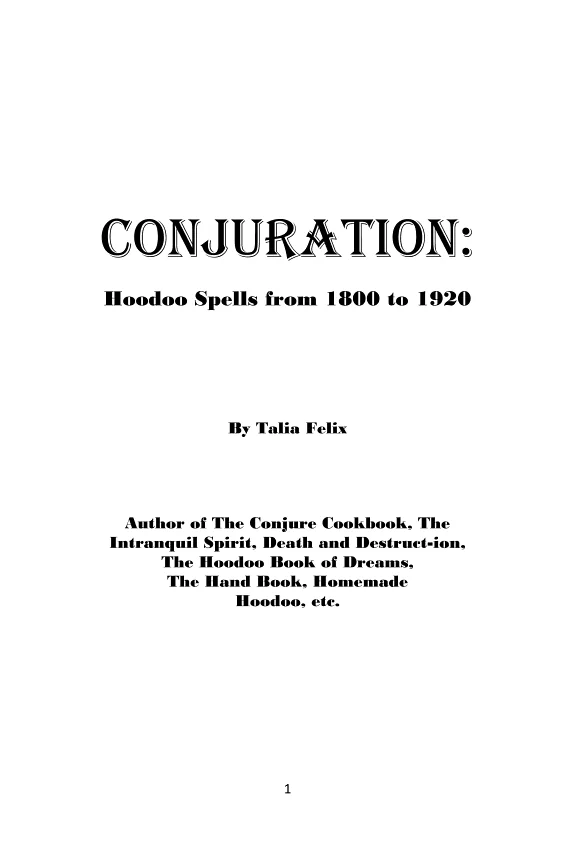
Talia Felix's Conjuration compiles practical magical formulae and rites from Hoodoo, Voodoo, Obeah, and European witchcraft.
This book gathers specific magical formulae and rites from Hoodoo, Voodoo, Obeah, and European witchcraft. It provides direct access to the operational methods within these spiritual and magical systems, often interconnected. The text functions as a guide for practitioners interested in historical spellcasting techniques. It is suited for students of folk magic, occult history, and comparative religion. The book favors working with primary source material and historical spell structures over theoretical discussions. Readers focused on the practical use of rootwork, charm casting, and ritual invocation will find substantial content.
The compilation draws from practices with roots in the African diaspora's syncretic religious expressions and European folk magical traditions. Hoodoo, with its African and European roots, developed significantly in the American South. Obeah, prevalent in Caribbean cultures, shares similar historical origins. Voodoo, as practiced in Haiti, represents a complex synthesis of West African religions and Catholicism. The collection reflects a time when such traditions are increasingly documented and studied, often removed from their original socio-cultural contexts.
The core of Conjuration lies in its presentation of specific magical operations. This includes the use of correspondences (herbs, colors, days), the invocation of spiritual entities or forces, and the construction of talismans or charms for particular ends. It emphasizes the direct manipulation of sympathetic and contagious magic, grounded in the belief that like affects like and that objects once connected continue to influence each other.
Conjuration situates itself within traditions that blend African diasporic spiritualism with European folk magic. Hoodoo, Obeah, and Voodoo represent syncretic systems that developed in response to historical circumstances, particularly in the Americas. These practices often involve direct engagement with spiritual forces and the use of material objects imbued with power. The book focuses on the operational aspects of these traditions, highlighting techniques like correspondence magic, talisman construction, and the invocation of entities. This approach grounds the reader in the practical application of magical principles derived from these distinct yet related lineages.
💡 Why Read This Book?
• You will learn specific, historical spell structures from Hoodoo and Obeah, such as the construction of protective amulets detailed in the "Protection Charms" section, offering practical techniques distinct from modern magical interpretations. • You can directly engage with the operational methods of Voodoo as presented in this collection, including specific invocations or ritual actions, providing a tangible link to diasporic religious practices. • You will discover historical witchcraft spell formulations, including the use of sympathetic magic and correspondences, giving you concrete examples of European folk magic that predate many contemporary neopagan approaches.
⭐ Reader Reviews
Honest opinions from readers who have explored this book.
❓ Frequently Asked Questions
What are the primary magical traditions covered in Conjuration by Talia Felix?
Conjuration by Talia Felix primarily covers spells and practices from Hoodoo, Voodoo, Obeah, and European witchcraft traditions. It aims to provide a direct look at the operational methods within these distinct but sometimes overlapping folk magical systems.
Is Conjuration suitable for absolute beginners in magic?
While Conjuration provides practical spells, its strength lies in its historical compilation. Beginners might benefit from some foundational knowledge of the covered traditions before diving into its more direct, less explanatory format.
What is the historical significance of the traditions mentioned in Conjuration?
Hoodoo, Voodoo, and Obeah have deep roots in the African diaspora, often blending West African spiritual practices with elements of European and Catholic traditions. European witchcraft spells also draw from ancient folk magic and ceremonial practices.
Does Conjuration explain the theoretical underpinnings of these spells?
Conjuration focuses more on the operational aspects – the spells themselves – rather than extensive theoretical explanations. It assumes a reader interested in the practical application of these historical magical systems.
When was Conjuration first published?
Conjuration by Talia Felix was first published on September 13, 2016. This date places it within a period of increased interest and documentation of various folk magic traditions.
What kind of magic is typically found in Obeah practices mentioned in the book?
Obeah, as represented in Conjuration, often involves the use of charms, spells, and spiritual work for various purposes, including protection, healing, and influencing outcomes, drawing from a complex history in Caribbean cultures.
🔮 Key Themes & Symbolism
Diasporic Folk Magic
The collection deeply engages with the syncretic magical practices that emerged from the African diaspora, particularly Hoodoo and Obeah. These traditions represent a complex fusion of West African spiritual beliefs, European folk magic, and elements of Christianity, developed under the conditions of slavery and post-emancipation. The spells presented offer a glimpse into how these communities preserved and adapted their spiritual technologies for survival, healing, and empowerment.
European Witchcraft Traditions
Conjuration also includes spells drawn from historical European witchcraft. These are not necessarily the theatrical portrayals but rather the practical, often localized, forms of folk magic that coexisted with or were sometimes demonized by formal religious structures. The inclusion of these rites alongside diasporic traditions highlights shared magical principles and potential cross-pollination.
Operational Spellcraft
The central theme is the practical application of magic. The book emphasizes the 'how-to' of spellcasting, focusing on the ingredients, actions, and intentions required to enact magical change. This approach grounds the esoteric in the tangible, offering concrete methods for practitioners interested in the mechanics of ritual and enchantment as historically practiced.
Sympathetic and Contagious Magic
Underpinning many of the spells is the principle of sympathetic magic – the idea that like produces like – and contagious magic, where things once connected continue to influence each other. The book illustrates these concepts through the use of effigies, personal concerns (hair, nails), and the careful selection of natural elements believed to possess specific energies.
💬 Memorable Quotes
Direct passages from the work, attributed to the author.
“The efficacy of a spell often relies on the practitioner's conviction and the precise application of correspondences.”
— This highlights a core tenet of practical magic: the psychological state of the caster is as crucial as the ritual components. It suggests that belief and meticulous execution are intertwined for successful magical outcomes.
“Hoodoo rootwork emphasizes the manipulation of spiritual forces through tangible means, such as prepared powders and gris-gris bags.”
— This interpretation underscores the practical, earth-bound nature of Hoodoo. It suggests that the tradition focuses on utilizing accessible materials and direct spiritual engagement to manifest desired results.
“Voodoo rites may incorporate elements of Catholic saints and iconography, demonstrating a long history of syncretism.”
— This observation points to the complex cultural blending inherent in Voodoo. It illustrates how African spiritual concepts were adapted and expressed through existing European religious frameworks, creating a unique devotional practice.
💡 Key Ideas
Editorial paraphrase of the work's core concepts — not direct quotes.
Protection spells frequently involve boundary setting, both physical and spiritual, using natural elements and symbolic gestures.
This paraphrased concept points to the foundational nature of defensive magic. It implies that safeguarding oneself and one's space is a primary concern in many magical systems, often achieved through ritualistic actions and material components.
Obeah practitioners often work with spirits and utilize natural substances for healing and influence.
This paraphrased concept describes the active engagement with the spirit world and the natural environment characteristic of Obeah. It suggests a practice focused on direct spiritual intervention and the harnessing of natural energies.
🌙 Esoteric Significance
Tradition
Conjuration primarily situates itself within the broad spectrum of folk magic and witchcraft, with significant emphasis on African diasporic traditions like Hoodoo, Voodoo, and Obeah. These traditions are distinct from, though sometimes overlap with, Hermeticism or Kabbalah. They are characterized by their syncretic nature, incorporating elements from various indigenous, African, and European belief systems, and emphasize practical, often immanent, spiritual work rather than purely philosophical or cosmological systems.
Symbolism
Within the book's context, symbols often relate to the natural world and everyday objects imbued with spiritual power. For instance, specific herbs might symbolize protection or prosperity, while colors carry traditional associations (e.g., red for power, black for banishing). Personal concerns like hair or nail clippings are potent symbols of connection, used in contagious magic to establish a link with the target individual.
Modern Relevance
Contemporary practitioners of witchcraft, rootwork, and comparative occultism draw on works like Conjuration for direct access to historical spell formulations. Its relevance lies in providing concrete examples of operational magic that inform modern practices, offering alternatives to more systematized or ritualistic approaches. Thinkers exploring syncretic spirituality and the evolution of folk magic find value in its compilation of diverse, functional magical traditions.
👥 Who Should Read This Book
• Students of comparative religion and folklore interested in the practical application of diasporic spiritual systems like Hoodoo and Voodoo. • Practitioners of historical witchcraft seeking authentic spell structures and ritual methods that predate modern paganism. • Occultists and magical researchers focused on folk magic traditions and the direct operational techniques of Obeah and rootwork.
📜 Historical Context
Published in 2016, Talia Felix's Conjuration arrives in an era marked by widespread access to esoteric texts and a renewed academic and popular interest in folk magic. The traditions it compiles—Hoodoo, Voodoo, Obeah, and witchcraft—represent significant currents within both diasporic and European spiritual landscapes. Hoodoo, particularly, gained scholarly attention from figures like Zora Neale Hurston in the early 20th century, though Felix's work focuses on the operational grimoire aspect rather than ethnographic study. The collection's compilation of these distinct practices, without deep theoretical dives, aligns with a growing trend of practitioners seeking direct engagement with historical spellcraft, potentially bypassing more established ceremonial orders or newer neopagan interpretations. Its appearance reflects a contemporary desire to connect with older, more visceral forms of magic, often perceived as less mediated.
📔 Journal Prompts
Analysis of the "Protection Charms" section and its application in contemporary contexts.
Reflection on the use of specific correspondences mentioned in the Hoodoo spells.
Comparison of the ritual actions described in Voodoo rites versus European witchcraft spells.
The role of personal concerns in Obeah practices as detailed in the text.
Evaluation of the historical effectiveness of the compiled spell structures.
🗂️ Glossary
Hoodoo
A magical tradition originating in the African diaspora, particularly in the Southern United States, blending West African spiritual practices with European folk magic and Christianity. It often involves spellcasting, rootwork, and divination.
Voodoo
A syncretic religion practiced primarily in Haiti, combining West African Vodun beliefs with elements of Roman Catholicism. It involves the veneration of spirits (Loa) and complex ritual practices.
Obeah
A system of spiritual and magical practice found in the Caribbean, sharing roots with West African traditions and European folk magic. It often involves healing, protection, and influencing outcomes through spiritual means.
Witchcraft
In the context of Conjuration, this refers to historical European folk magic traditions involving spells, charms, and ritual practices, distinct from modern Wicca or neopaganism.
Correspondences
The symbolic relationships between different elements (e.g., herbs, colors, planets, deities) used in magical workings to achieve specific effects based on their perceived affinities.
Rootwork
A term often used interchangeably with Hoodoo, referring to the practice of using roots, herbs, and other natural materials in magical spells and rituals.
Gris-gris
A type of magical charm or amulet, often a small bag containing various ingredients, used in Hoodoo and other folk magic traditions for protection, luck, or other specific purposes.
This book appears in 1 collection
🔮 Readers Also Liked
Browse all →









From the “Hoodoo” Collection
View all →






More Free Occult Philosophy Books
View all →