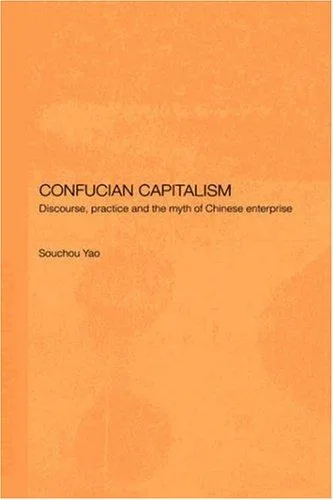
Confucian Capitalism
 84
84

Confucian Capitalism
Souchou Yao’s *Confucian Capitalism* offers a refreshing counter-narrative to the often Western-centric analyses of global economic systems. Rather than viewing Confucianism as a static relic, Yao demonstrates its dynamic adaptability in shaping modern capitalist economies, particularly in East Asia. The strength of the book lies in its meticulous exploration of how concepts like *ren* (benevolence) and *li* (propriety) are not merely philosophical ideals but actively influence business ethics and market behavior. A notable limitation, however, is the dense prose, which can make certain sections challenging for readers less familiar with philosophical discourse. The work's examination of the "calculating self" versus the "relational self" provides a particularly insightful lens through which to understand motivations beyond pure profit. Ultimately, *Confucian Capitalism* is a valuable contribution for understanding the cultural underpinnings of economic success.
📝 Description
84
Souchou Yao's 2002 book analyzes how Confucian ethics interact with capitalist economies.
Published in 2002, Souchou Yao's "Confucian Capitalism" examines the relationship between Confucian ethical principles and modern capitalist economic systems. The book goes beyond superficial comparisons to show how deeply held cultural values affect and are affected by financial structures. Yao investigates the philosophical foundations that contributed to the economic successes in East Asian countries, often linked to a mix of traditional ethics and market practicality.
The work is situated within the discourse following the late 1990s Asian Financial Crisis. It challenges Western economic theories by proposing an alternative view grounded in East Asian intellectual traditions. The book engages with studies on the "East Asian Miracle" and the "Confucian Work Ethic," offering a counterargument to explanations of economic development that focus solely on markets. Yao's analysis considers concepts like *ren* (benevolence), *yi* (righteousness), and *li* (propriety) as they appear in current business practices. It views "Confucian capitalism" not as a fixed system, but as an active adaptation of ancient philosophy to global market demands. The author also discusses the contrast between a "calculating self" and a "relational self," considering how Confucian thought shapes economic behavior.
This book connects to esoteric traditions by examining how foundational philosophical systems, like Confucianism, can inform and shape practical, material pursuits such as economic activity. It suggests that underlying ethical and metaphysical frameworks, often considered 'esoteric' in their depth and origin, have tangible impacts on societal structures and economic outcomes. The work implies that understanding these deeper principles is key to comprehending diverse models of capitalism, moving beyond purely secular or materialistic explanations for economic success. It positions Confucian thought not just as a historical philosophy but as a living influence on contemporary economic behavior.
💡 Why Read This Book?
• Gain insight into how Confucian ethics, specifically the concept of *li* (propriety), can shape market behavior, offering a perspective distinct from Western economic models. • Understand the "East Asian Miracle" through a cultural lens, moving beyond purely financial analyses by examining the adaptation of ancient philosophies to contemporary capitalism. • Explore the tension between the "calculating self" and the "relational self," learning how Confucian thought prioritizes community and obligation over individualism in economic contexts.
⭐ Reader Reviews
Honest opinions from readers who have explored this book.
❓ Frequently Asked Questions
What is the core argument of Souchou Yao's Confucian Capitalism?
The core argument is that Confucian ethical principles, far from being incompatible with capitalism, have actively shaped and continue to influence its practice, particularly in East Asian economies, leading to a distinct form of "Confucian capitalism."
When was Confucian Capitalism first published?
Confucian Capitalism was first published in 2002, reflecting on economic developments and cultural influences in the preceding decades.
Does the book suggest Confucianism is inherently pro-capitalist?
No, the book does not argue that Confucianism is inherently pro-capitalist. Instead, it explores how Confucian values have been adapted and interpreted within capitalist frameworks, creating unique socio-economic dynamics.
What specific Confucian virtues are discussed in relation to capitalism?
Key virtues like *ren* (benevolence), *yi* (righteousness), and *li* (propriety) are discussed, examining how they influence business ethics, social responsibility, and market interactions.
Who is Souchou Yao, and what is his academic background?
Souchou Yao is an academic whose work focuses on Chinese philosophy, ethics, and the intersection of culture and economics. His background provides a strong foundation for analyzing Confucian thought within modern contexts.
How does Confucian Capitalism differ from Western economic theories?
It differs by emphasizing the role of deeply ingrained cultural values and ethical frameworks, such as those found in Confucianism, in shaping economic behavior and outcomes, contrasting with theories that focus primarily on rational self-interest and market mechanisms.
🔮 Key Themes & Symbolism
Confucian Ethics in Markets
This theme explores how core Confucian virtues like *ren* (benevolence) and *yi* (righteousness) are not merely abstract ideals but practical guides for economic conduct. The work examines how these principles can foster trust, long-term relationships, and a sense of social obligation within business dealings, offering a counterpoint to the purely transactional nature often associated with Western capitalism. It investigates how these values contribute to the stability and growth observed in East Asian economies, suggesting a symbiotic relationship rather than a conflict.
The Relational Self
A central theme is the contrast between the "relational self", deeply embedded in Confucian thought, and the "calculating self" often posited in Western economics. The relational self emphasizes interdependence, mutual obligation, and the importance of social harmony. Yao's work details how this perspective influences decision-making in business, prioritizing community welfare and hierarchical respect alongside profit motives. This contrasts with a purely individualistic pursuit of gain, highlighting a fundamental difference in socio-economic orientation.
Adaptation of Tradition
The book critically examines how ancient Confucian traditions have been adapted to the modern capitalist landscape. It moves beyond simplistic notions of a "Confucian work ethic" to analyze the dynamic processes through which philosophical tenets are reinterpreted and applied in contemporary settings. This includes how concepts like *li* (propriety) guide etiquette in business negotiations and corporate governance, demonstrating the resilience and flexibility of cultural values in the face of global economic forces.
Critique of Western Economic Models
Yao's work implicitly and explicitly critiques the universality of Western economic theories. By presenting the case of "Confucian capitalism," the book challenges the assumption that rational self-interest and market liberalization are the sole drivers of economic success. It suggests that cultural and ethical frameworks play a crucial, often underestimated, role in economic development and the functioning of markets, advocating for a more culturally sensitive approach to economic analysis.
💬 Memorable Quotes
Direct passages from the work, attributed to the author.
“The "calculating self" versus the "relational self" in economic decision-making.”
— This highlights a core distinction: Western economic models often assume individuals act purely out of self-interest and calculation, whereas Confucian thought emphasizes the individual's embeddedness in social networks and obligations.
“Confucian virtues like *ren* and *yi* influencing business ethics.”
— This points to the practical application of benevolence (*ren*) and righteousness (*yi*) in commercial activities, suggesting that ethical considerations are not separate from but integral to successful business practices in certain cultural contexts.
“The East Asian "miracle" as a product of adapted ethical systems.”
— This challenges purely economic explanations for rapid growth in East Asia, attributing significant influence to the way Confucian ethical frameworks were reinterpreted and applied within capitalist structures.
“*Li* guiding social interactions and economic exchanges.”
— This emphasizes the role of propriety and ritual (*li*) in governing business etiquette, negotiations, and corporate governance, underscoring the importance of social harmony and respect in economic relationships.
“Capitalism shaped by, not just influencing, cultural values.”
— This suggests a reciprocal relationship where capitalism is not merely imposed upon a culture but is itself molded by pre-existing ethical and social norms, leading to unique regional variations.
🌙 Esoteric Significance
Tradition
While not strictly aligned with a single esoteric lineage like Hermeticism or Kabbalah, *Confucian Capitalism* engages with a philosophical tradition that possesses esoteric dimensions. Confucianism, particularly in its Neo-Confucian interpretations, involves cultivating inner virtue and understanding one's place in the cosmic order, which can be seen as a form of practical, socio-ethical mysticism. Yao's work taps into this by exploring how these inwardly focused ethical principles manifest outwardly in economic behavior.
Symbolism
Key symbolic concepts include the aforementioned virtues: *ren* (benevolence) as the ideal of humaneness, *yi* (righteousness) as the principle of moral duty, and *li* (propriety) as the ritualized expression of social order. These are not merely abstract ideas but symbolic representations of a cultivated self and a harmonious society. The contrast between the "calculating self" and the "relational self" can also be viewed symbolically, representing a tension between materialistic individualism and interconnected, communal being.
Modern Relevance
Contemporary discussions on ethical capitalism, stakeholder theory, and sustainable business practices often echo themes found in Yao's work. Thinkers and practitioners interested in socially responsible investing, corporate governance beyond shareholder primacy, and cross-cultural management find value in understanding how non-Western ethical frameworks can inform modern economic systems. The book remains relevant for those exploring alternatives to purely profit-driven capitalism.
👥 Who Should Read This Book
• Students of comparative economics and East Asian studies seeking to understand the cultural underpinnings of market behavior beyond Western models. • Scholars of philosophy and ethics interested in how ancient traditions like Confucianism adapt and find expression in contemporary global systems. • Business professionals and policymakers aiming to develop a nuanced understanding of international markets and the role of cultural values in economic success.
📜 Historical Context
Published in 2002, Souchou Yao's *Confucian Capitalism* emerged during a period of intense global economic integration and following the 1997 Asian Financial Crisis. The preceding decades had seen significant debate surrounding the "East Asian Miracle," with many Western scholars attributing success primarily to market liberalization and export-oriented policies. Yao's work offered a crucial counter-narrative, engaging with the concept of the "Confucian Work Ethic" but pushing beyond it. He situated his analysis within ongoing intellectual currents that sought to understand the distinctiveness of East Asian economic development, challenging the universal applicability of Western economic models. While not a direct engagement with a single contemporary author in the vein of debate, his work stood in contrast to the prevalent neoliberal economic discourse championed by figures associated with the Chicago School of Economics, offering a culturally grounded perspective.
📔 Journal Prompts
Reflect on the tension between the "calculating self" and the "relational self" in your own economic interactions.
Consider how the virtue of *li* (propriety) might influence professional conduct in your field.
Analyze a specific business practice in East Asia through the lens of Confucian ethics.
Evaluate the potential benefits and drawbacks of integrating Confucian principles into modern capitalism.
How does the concept of *ren* (benevolence) challenge purely profit-driven motivations in business?
🗂️ Glossary
Ren (仁)
A core Confucian virtue signifying benevolence, humaneness, goodness, and compassion. It represents the ideal of fully realized humanity and is central to ethical conduct.
Yi (义)
Another key Confucian virtue, translating to righteousness, justice, or appropriateness. It signifies doing what is morally right and fitting in a given situation, often considered secondary to *ren*.
Li (礼)
Encompasses rites, rituals, propriety, and etiquette. *Li* provides the framework for social order and harmonious interaction, guiding behavior in both personal and public spheres, including economic activities.
East Asian Miracle
A term used to describe the rapid economic growth experienced by several East Asian economies (e.g., Japan, South Korea, Taiwan, Singapore) from the mid-20th century onwards.
Confucian Work Ethic
A concept suggesting that Confucian values, such as diligence, discipline, and respect for authority, contributed significantly to the economic success of East Asian societies.
Calculating Self
A theoretical model of an individual motivated primarily by rational self-interest and the maximization of personal gain, often used in Western economic theory.
Relational Self
A concept emphasizing the individual as defined by their relationships, social roles, and obligations within a community, central to Confucian philosophy.
🔮 Readers Also Liked
Browse all →









More Free Occult Philosophy Books
View all →