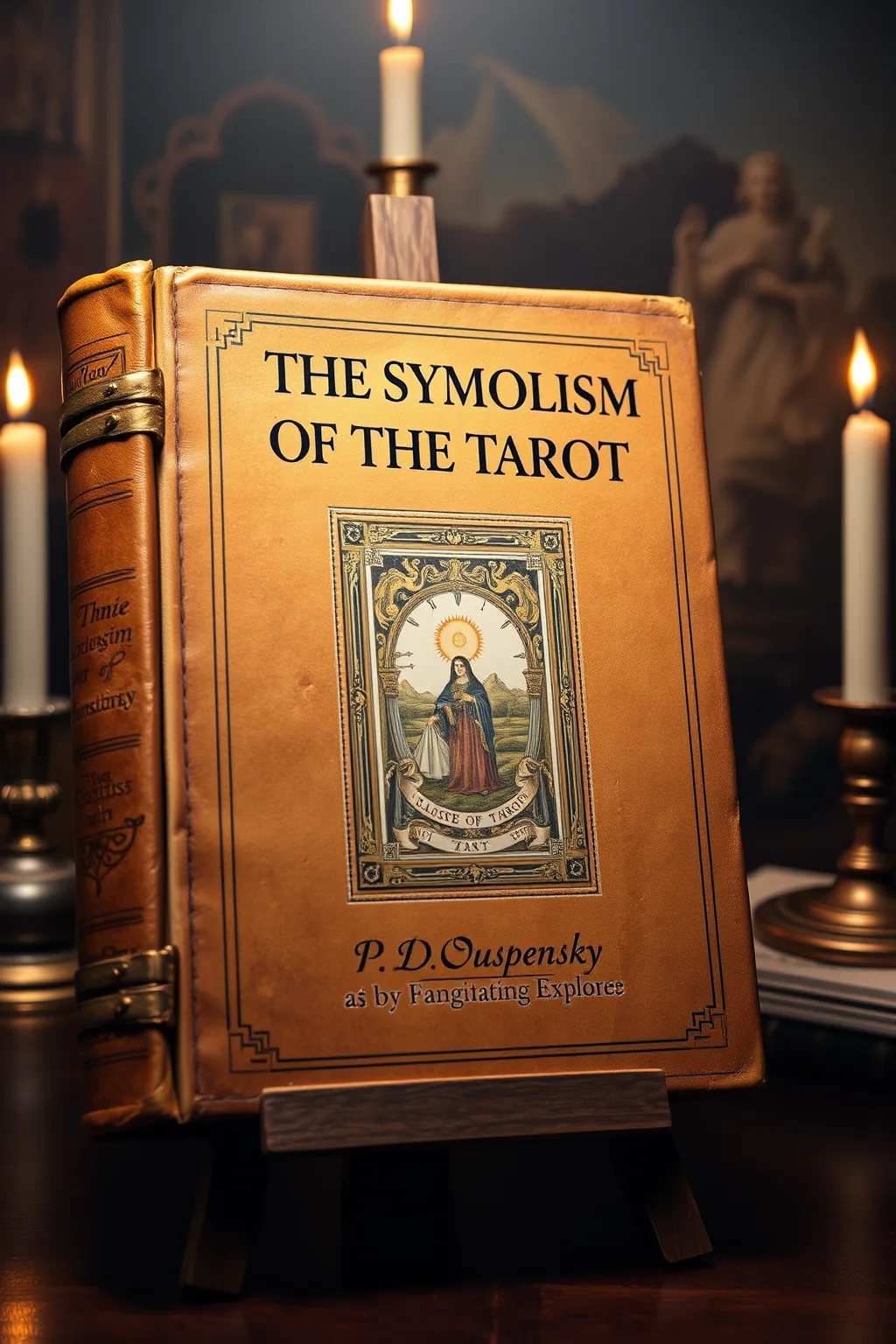
The Symbolism of the Tarot by Ouspensky
 71
71

The Symbolism of the Tarot by Ouspensky


Balthazar Finch (Senior Critic, Occult Philosophy) — P.D. Ouspensky's 'The Symbolism of the Tarot' remains an indispensable cornerstone of esoteric literature. Ouspensky transcends conventional interpretations, presenting the Tarot as a profound philosophical and psychological system. His meticulous analysis of the Major Arcana reveals them as stages of a spiritual ascent, a 'Great Arcanum' of self-discovery. The true strength lies in his ability to connect these ancient symbols to the inner workings of consciousness and the universal quest for enlightenment. This work is not for the casual dabbler but for the dedicated student of occult philosophy and mysticism who seeks a deeper, more meaningful engagement with the Tarot's profound symbolic language. A truly illuminating exploration.
📝 Description
71
P.D. Ouspensky's 1913 work, 'The Symbolism of the Tarot,' interprets the cards as a spiritual map.
In 'The Symbolism of the Tarot,' P.D. Ouspensky presents a unique interpretation of the Major Arcana. Published in 1913, the book argues against viewing the Tarot solely as a tool for fortune-telling. Instead, Ouspensky positions the cards as symbolic representations of spiritual truths and psychological structures.
He frames the Tarot deck, particularly the Major Arcana, as a diagram of spiritual development. Each card, according to Ouspensky, corresponds to a stage or aspect of human consciousness and its potential for growth. The book aims to reveal the hidden meanings within the imagery, connecting them to universal principles and the process of self-awareness. Ouspensky's approach encourages readers to see the Tarot as a system for understanding inner states and the path toward spiritual realization.
Ouspensky's work on the Tarot emerged from the Theosophical milieu and his associations with figures like G.I. Gurdjieff. It sits within a tradition that sought to find universal spiritual laws and psychological truths within ancient symbols and systems. This approach often involved reinterpreting traditional esoteric tools, like the Tarot, not for magical or divinatory ends but as diagrams of consciousness and spiritual progression. His focus was on the ethical and psychological implications of these symbols for human development.
✍️ Author
P.D. Ouspensky is a fascinating explorati
Classic literature author · Public Domain
💡 Why Read This Book?
Uncover the profound, hidden wisdom within the Tarot's Major Arcana. This book transforms the cards from tools of fortune-telling into a map for spiritual evolution and self-discovery. Ideal for serious seekers, occult scholars, and practitioners aiming to deepen their understanding of esoteric symbolism and consciousness.
⭐ Reader Reviews
Honest opinions from readers who have explored this book.
❓ Frequently Asked Questions
Is this book suitable for beginners to Tarot?
While it requires intellectual engagement, Ouspensky's clarity makes it accessible to dedicated beginners seeking a deeper, philosophical understanding beyond basic divination techniques. It lays a robust foundation for advanced study.
Does Ouspensky focus on divination?
No, Ouspensky explicitly frames the Tarot not as a tool for predicting the future, but as a symbolic system representing spiritual truths and the journey of consciousness.
What is the 'Great Arcanum' mentioned in relation to the Tarot?
The 'Great Arcanum' refers to the profound, overarching spiritual and psychological principles embodied by the Major Arcana, representing a complete system of esoteric knowledge and the path to enlightenment.
What is the philosophical background of P.D. Ouspensky?
Ouspensky was a Russian philosopher and mystic, deeply influenced by G.I. Gurdjieff's 'Fourth Way' teachings, focusing on self-awareness, spiritual development, and the nature of consciousness.
Can this book be read alongside other Tarot decks?
Absolutely. Ouspensky's interpretations are based on the Rider-Waite-Smith symbolism but offer universal insights applicable to understanding the archetypal meanings of the Major Arcana across various decks.
🔮 Key Themes & Symbolism
The Tarot as a Spiritual Map
Ouspensky posits the Tarot, particularly the Major Arcana, as a profound symbolic representation of a spiritual journey. Each card is not an isolated image but a crucial step on the path to higher consciousness and self-realization. This perspective elevates the Tarot from a mere divinatory tool to a sophisticated system for understanding universal laws, psychological archetypes, and the unfolding of the human spirit towards ultimate truth. It's a blueprint for the soul's evolution.
Archetypes and Universal Truths
Central to Ouspensky's interpretation is the idea that Tarot cards embody fundamental archetypes that resonate across cultures and time. These symbols are seen as keys to unlocking universal truths about existence, human nature, and the divine. By dissecting the imagery and symbolism of each card, Ouspensky reveals how they reflect the intricate workings of the cosmos and the inner range of the individual, offering useful insights into the spiritual fabric of reality.
The Path of Inner Transformation
This work emphasizes the Tarot's role in facilitating inner transformation. Ouspensky guides readers to perceive the cards as catalysts for personal growth, prompting introspection and the integration of higher spiritual principles into daily life. The book presents a method for using the symbolic language of the Tarot to cultivate self-awareness, overcome limitations, and begin a conscious path of spiritual development, ultimately leading to a more awakened state of being.
💬 Memorable Quotes
Direct passages from the work, attributed to the author.
“Each card is a step on the great path.”
— This highlights the sequential and progressive nature of the Major Arcana, portraying them as distinct but connected stages in a spiritual journey or the evolution of consciousness.
“The Tarot is a language of symbols.”
— This emphasizes the symbolic nature of the Tarot, suggesting it communicates profound truths and concepts through imagery that transcends ordinary language, requiring interpretation and inner understanding.
“We must understand the hidden meaning.”
— This is a call to look beyond the superficial appearance of the Tarot cards, urging the reader to engage in deep contemplation to uncover the esoteric and spiritual significance embedded within their symbolism.
“It is a map of the inner life.”
— This positions the Tarot as a guide to exploring the depths of one's own psyche, consciousness, and spiritual potential, offering insights into internal processes and personal development.
💡 Key Ideas
Editorial paraphrase of the work's core concepts — not direct quotes.
The Tarot is a picture of the world, and of man, and of God.
This quote captures Ouspensky's view of the Tarot as a comprehensive symbolic system, reflecting the interconnectedness of all creation and offering a holistic understanding of existence.
🌙 Esoteric Significance
Tradition
Ouspensky's interpretation is deeply rooted in esoteric Christianity, Hermeticism, and the Gnostic traditions, particularly as filtered through the lens of G.I. Gurdjieff's 'Fourth Way' teachings. He views the Tarot not as a standalone system but as a cosmic diagram reflecting fundamental laws of existence, spiritual evolution, and the nature of consciousness itself, aligning with concepts of inner work and conscious development found in these traditions.
Symbolism
The book meticulously dissects the symbolism of the Major Arcana, viewing each card as a potent representation of spiritual principles, psychological archetypes, and stages of consciousness. Key symbols like The Fool's journey, The Magician's active force, The High Priestess's intuitive wisdom, and The World's completion are interpreted as profound lessons on the path to enlightenment and the interconnectedness of the microcosm and macrocosm.
Modern Relevance
In an age often characterized by distraction and superficiality, Ouspensky's 'The Symbolism of the Tarot' offers a timeless anchor to deeper truths. Its emphasis on consciousness, self-awareness, and the symbolic language of the soul provides invaluable tools for modern seekers navigating personal challenges and seeking spiritual growth. The book's structured approach to esoteric principles remains relevant for personal development, psychological insight, and a more profound understanding of oneself and the universe.
👥 Who Should Read This Book
This important work is essential for dedicated students of occult philosophy, mystics, and spiritual seekers who wish to transcend superficial interpretations of the Tarot. Scholars of esoteric traditions will find Ouspensky's systematic approach useful for understanding the historical and philosophical underpinnings of Tarot symbolism. For practitioners, it offers a profound re-contextualization of the cards, transforming them into tools for deep introspection and spiritual transformation. Beginners drawn to the esoteric depth of the Tarot will find a challenging yet rewarding introduction to its profound symbolic language.
📜 Historical Context
Written during a period of intense interest in esoteric traditions and spiritual exploration in the early 20th century, P.D. Ouspensky's 'The Symbolism of the Tarot' emerged from the fertile ground of European occultism. Ouspensky himself was a central figure, deeply influenced by G.I. Gurdjieff and the development of the 'Fourth Way' teachings, which sought to integrate spiritual practices with psychological understanding. This era saw a resurgence of interest in ancient wisdom, mystical philosophies, and systems of knowledge that offered alternatives to prevailing materialist and rationalist viewpoints. The book reflects this broader intellectual and spiritual climate, where thinkers sought to uncover hidden meanings in ancient symbols and texts, viewing them as keys to understanding the human condition and the universe. Ouspensky's work stands as a significant contribution to this intellectual current, offering a structured and profound interpretation of the Tarot that continues to resonate with seekers today.
📔 Journal Prompts
Reflect on the journey of The Fool in your own life. Where have you been 'led' by an unseen hand?
Consider The Magician: What inner resources or 'tools' do you possess that you can consciously wield to manifest your intentions?
Meditate on The High Priestess: How can you better access and trust your intuition and inner knowing in decision-making?
Analyze The Emperor and The Empress in your life: Where do you need to establish more structure and discipline, and where do you need to foster nurturing and growth?
Contemplate The World card: What does 'completion' or 'wholeness' signify for you at this stage of your spiritual journey?
🗂️ Glossary
Major Arcana
The 22 trump cards of the Tarot deck, traditionally interpreted as representing significant spiritual lessons, archetypal forces, and stages of a spiritual journey or the evolution of consciousness.
Esoteric
Intended for or likely to be understood by only a small number of people with a specialized knowledge or interest; inner, secret, or hidden knowledge.
Archetype
A very typical example of a certain person or thing; in psychology, a universal, archaic pattern and image that derives from the collective unconscious and is inherited.
Consciousness
The state of being aware of and responsive to one's surroundings; in esoteric philosophy, often refers to varying levels of awareness and spiritual awakening.
Divination
The practice of seeking knowledge of the future or the unknown by supernatural means; Ouspensky distinguishes this from the deeper symbolic interpretation of the Tarot.
This book appears in 8 collections
🔮 Readers Also Liked
Browse all →
From the “Occultism” Collection
View all →
More Free Occult Philosophy Books
View all →