Christ, Plato, Hermes Trimegistus

 78
78

Christ, Plato, Hermes Trimegistus
The Bibliotheca Philosophica Hermetica's compilation, *Christ, Plato, Hermes Trismegistus*, offers a compelling examination of shared philosophical and spiritual currents. Its strength lies in meticulously drawing parallels between the teachings attributed to Jesus, the dialogues of Plato, and the Hermetic corpus. The work is particularly adept at highlighting how concepts like the Logos, the ascent of the soul, and divine gnosis manifest across these distinct traditions. However, a limitation surfaces in its academic tone, which, while precise, can occasionally make the intricate connections feel dense for the uninitiated. A passage discussing the Platonic concept of the Demiurge and its echoes in Hermetic cosmology is especially illuminating, demonstrating the book's capacity to bridge disparate philosophical systems. It serves as a valuable resource for those prepared to engage with complex theological and philosophical comparisons.
📝 Description
78
Published in 1990, this collection compares Jesus Christ, Plato, and Hermes Trismegistus.
This book, originating from the Bibliotheca Philosophica Hermetica in Amsterdam, analyzes the teachings of Jesus Christ, Plato, and Hermes Trismegistus. It aims to show the connections between their theological, philosophical, and mystical ideas. The work is intended for scholars and students interested in comparative religion, Western esotericism, Gnosticism, Neoplatonism, and Christian mysticism.
It appeals to those who value detailed textual analysis and want to find common themes across different historical and spiritual traditions. Readers looking to understand the origins of Hermetic philosophy and its relation to early Christian thought will find it useful. The book examines shared ideas about divine wisdom, the soul, cosmology, and spiritual attainment found in the works of Christ, Plato, and Hermes.
The book was published in 1990, a time of growing academic and public interest in esoteric subjects. The Bibliotheca Philosophica Hermetica, the institution behind the work, is important for preserving and studying Hermetic literature. This publication engages with established scholarship on Hermeticism, building on earlier studies and contributing to ongoing discussions about the transmission of ancient spiritual ideas.
💡 Why Read This Book?
• Gain insight into the shared philosophical underpinnings of early Christian thought, Platonic philosophy, and Hermeticism, understanding how figures like Plato influenced later esoteric interpretations. • Explore the concept of the Logos as presented across the teachings of Christ, Plato, and Hermes Trismegistus, revealing a continuity of divine expression. • Appreciate the historical context of esoteric studies, noting the Bibliotheca Philosophica Hermetica's role in disseminating such comparative works since its 1990 publication.
⭐ Reader Reviews
Honest opinions from readers who have explored this book.
❓ Frequently Asked Questions
What is the Bibliotheca Philosophica Hermetica?
The Bibliotheca Philosophica Hermetica, based in Amsterdam, is a research library and foundation dedicated to the study and preservation of Hermetic literature and related esoteric traditions. Its publications, like this one, stem from extensive scholarship.
What are the main figures discussed in Christ, Plato, Hermes Trismegistus?
The book focuses on the theological and philosophical teachings attributed to Jesus Christ, the ancient Greek philosopher Plato, and the legendary Hellenistic figure Hermes Trismegistus.
When was Christ, Plato, Hermes Trismegistus first published?
The work was first published in 1990, reflecting a renewed scholarly interest in esoteric traditions that gained momentum in the late 20th century.
What is the primary focus of the book's comparative analysis?
The book's analysis centers on identifying and exploring shared concepts, philosophical ideas, and spiritual doctrines found within the traditions associated with Christ, Plato, and Hermes Trismegistus.
Is this book suitable for beginners in esoteric studies?
While valuable, the book's academic rigor and comparative depth make it more suitable for students and scholars with some existing background in Western esotericism or comparative philosophy.
Where is the Bibliotheca Philosophica Hermetica located?
The Bibliotheca Philosophica Hermetica is located in Amsterdam, Netherlands, serving as a significant center for the study of Hermeticism.
🔮 Key Themes & Symbolism
The Logos and Divine Wisdom
The work examines the concept of the Logos, or divine reason, as it appears in the teachings of Christ, Plato's philosophy, and the Hermetic tradition. It traces how this principle of divine order and expression is understood, whether as the Word of God, the intelligible area of Forms, or the divine mind of Thoth-Hermes. The exploration highlights a shared notion of a mediating principle between the ultimate divine and the manifest world.
Soul's Ascent and Gnosis
A central theme is the journey of the soul towards spiritual understanding or salvation. The book analyzes how Christ's redemptive path, Plato's ascent from the cave of ignorance to the area of Forms, and the Hermetic pursuit of gnosis (direct spiritual knowledge) offer parallel narratives of liberation. It scrutinizes the methods and goals of achieving this spiritual awakening within each tradition.
Cosmological Parallels
The collection investigates the cosmological frameworks presented by these three figures. It compares Plato's creation myth involving the Demiurge with Hermetic accounts of creation and early Christian theological interpretations of Genesis. The focus is on understanding the structural similarities in how the universe is perceived to have originated and its underlying divine architecture.
Hermetic Influence on Christianity
The book explores the potential cross-pollination and shared archetypes between the Hermetic tradition and early Christian thought. It considers how certain concepts or symbolic language within the Hermetic Corpus might have informed or resonated with the development of Christian theology and mystical practices, particularly in the context of the Hellenistic world.
💬 Memorable Quotes
Direct passages from the work, attributed to the author.
“The Platonic Forms represent an intelligible realm mirroring the divine mind.”
— This interpretation highlights how Plato's theory of Forms, existing in a perfect, unchanging realm, can be seen as analogous to the concept of divine thought or blueprint found in other spiritual systems.
“Christ's teachings provide a paradigm for divine reconciliation.”
— This captures the essence of the Christian narrative focusing on Jesus's role in bridging the gap between humanity and God, offering a path to spiritual wholeness and atonement.
“The work explores the concept of the Demiurge in Platonic and Hermetic thought.”
— This refers to the book's examination of the creator-god figure, comparing Plato's Demiurge with similar creator deities or principles within the Hermetic tradition, seeking commonalities in their function.
“Shared archetypes exist between Hellenistic philosophies and early Christian theology.”
— This interpretation suggests that the book identifies recurring patterns and fundamental ideas across different philosophical and religious systems of the Hellenistic era, including those that influenced early Christianity.
💡 Key Ideas
Editorial paraphrase of the work's core concepts — not direct quotes.
Hermes Trismegistus offers gnosis as the path to spiritual liberation.
This paraphrased concept emphasizes the Hermetic goal of attaining direct, intuitive knowledge of the divine, presented as the primary means for the soul to achieve freedom from material limitations.
🌙 Esoteric Significance
Tradition
This work is firmly rooted in the Western Esoteric Tradition, specifically engaging with Hermeticism, Neoplatonism, and early Christian Gnosticism. It fits within the lineage of comparative esoteric scholarship that seeks to identify universal principles across diverse spiritual expressions. By linking Hermes Trismegistus, Plato, and Christ, it participates in the Hermetic project of synthesizing ancient wisdom traditions.
Symbolism
Key symbols explored likely include the Caduceus (representing Hermes and mediation), the Platonic Forms (as archetypal realities), and the figure of Christ as the divine mediator. The book would interpret these symbols not merely as historical artifacts but as potent expressions of cosmic order, the nature of reality, and the path of spiritual ascent common to these traditions.
Modern Relevance
Contemporary practitioners of Hermeticism, comparative religion scholars, and students of Western esotericism continue to draw upon such comparative analyses. Thinkers exploring integral spirituality or seeking to synthesize diverse philosophical and religious insights find value in tracing these historical lineages and conceptual overlaps, demonstrating the enduring quest for unified spiritual understanding.
👥 Who Should Read This Book
• Students of comparative religion seeking to understand the cross-pollination of ideas in the Hellenistic and early Christian periods. • Practitioners of Western Esotericism interested in the philosophical roots of Hermeticism and its connections to Platonic and Christian thought. • Academic researchers in philosophy and theology looking for nuanced comparisons between foundational figures of Western spirituality.
📜 Historical Context
Published in 1990 by the Bibliotheca Philosophica Hermetica, this work emerged during a period of significant academic re-evaluation of esoteric traditions. The late 20th century saw increased scholarly attention to figures like Frances Yates, whose work had already revitalized interest in Hermeticism and its influence on the Renaissance. This book engages with the intellectual currents that sought to understand the continuities between ancient Greek philosophy, early Christianity, and the Hermetic corpus. It stands in dialogue with, rather than opposition to, competing schools of thought by demonstrating how seemingly disparate systems might share underlying metaphysical principles. Its publication by a dedicated Hermetic research library underscores the growing academic legitimacy and interest in these fields, moving beyond purely historical or theological analyses to explore the philosophical and spiritual connections.
📔 Journal Prompts
The concept of the Logos across Christ, Plato, and Hermes.
Plato's allegory of the cave and the Hermetic pursuit of gnosis.
Comparing the Demiurge figure in Plato's Timaeus and Hermetic cosmology.
Reflecting on the 'divine wisdom' as presented by each figure.
The soul's journey towards spiritual liberation as depicted by these traditions.
🗂️ Glossary
Hermes Trismegistus
A legendary Hellenistic figure, a syncretic combination of the Greek god Hermes and the Egyptian god Thoth. He is credited with the Hermetic texts, a body of esoteric writings on philosophy, magic, and alchemy.
Plato
An influential ancient Greek philosopher (c. 428/427 – 348/347 BC), student of Socrates and founder of the Academy. Known for his theory of Forms, dialogues, and ideas on ideal governance and the soul.
Logos
A Greek term meaning 'word,' 'reason,' or 'divine order.' In philosophy and theology, it refers to the principle that governs the universe, often identified with divine reason or the Word of God.
Gnosis
Greek for 'knowledge.' In esoteric traditions, it refers to intuitive, spiritual knowledge or enlightenment, often seen as a direct apprehension of divine truths, distinct from empirical or rational knowledge.
Demiurge
In Platonic philosophy (especially in the Timaeus), the craftsman or creator god who fashioned the physical universe out of pre-existing chaotic matter, according to the eternal Forms.
Neoplatonism
A philosophical system originating in the 3rd century AD, heavily influenced by Plato, which sought to explain the universe as emanating from a single, transcendent source (The One) through a series of intermediaries.
Hellenistic Period
The period of ancient Greek history and Mediterranean history between the death of Alexander the Great in 323 BC and the emergence of the Roman Empire, marked by significant cultural exchange and philosophical development.
🔮 Readers Also Liked
Browse all →








More by Bibliotheca Philosophica Hermetica (Amsterdam, Netherlands)
All books →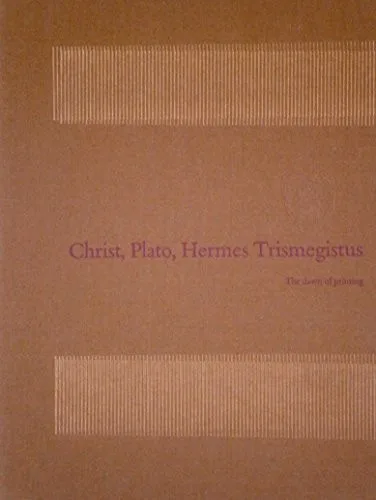

More Free Alchemy & Hermeticism Books
View all →