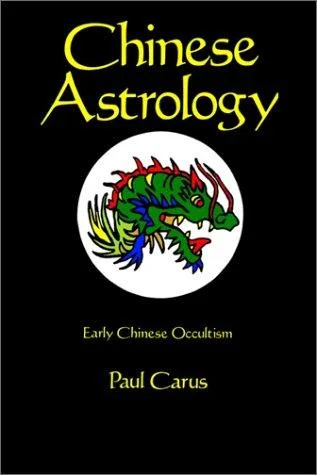
Chinese thought
 67
67

Chinese thought


Review by Balthazar Finch (Senior Critic, Occult Philosophy) — Paul Carus's 'Chinese Thought' remains an indispensable cornerstone for anyone plumbing the depths of Eastern metaphysical traditions. Carus masterfully deciphers the intricate symbolism and philosophical underpinnings, revealing a cosmology deeply intertwined with human destiny and the celestial dance. His exposition of concepts like Yin and Yang, the Five Elements, and the I Ching is both scholarly and imbued with an intuitive grasp of their esoteric significance. This work is a vital resource for serious students of comparative philosophy and occult studies, offering a gateway to understanding the profound spiritual architecture of ancient China, far beyond mere academic curiosity.
📝 Description
67
Paul Carus published 'Chinese Thought' in 1907, aiming to explain Eastern philosophy to a Western audience.
Paul Carus's 1907 book, 'Chinese Thought,' examines the core philosophies and cosmological views that influenced Chinese civilization. The work covers key aspects of Taoism, including its mystical elements and understanding of the cosmos. It also addresses Confucian ethics and the cyclical view of the universe as depicted in Chinese cosmology and astrology.
Carus explains the symbolic language and the concept of Qi, or vital energy, within this tradition. He also discusses the universal principles that form the basis of Chinese thought. The book is aimed at readers interested in esoteric knowledge, scholars seeking greater context, and practitioners who wish to understand ancient concepts of cosmic order. It presents a worldview where humanity, nature, and the divine are interconnected, exploring the subtle forces that shape existence and the pursuit of a balanced life.
Published in the early 20th century, 'Chinese Thought' engaged with a Western interest in Eastern religions and philosophies, often categorized as esoteric or occult at the time. Carus's work sought to bridge cultural understanding by explaining concepts like Qi and cosmic cycles, which were seen as alternative spiritual or philosophical frameworks distinct from mainstream Western thought. It placed Chinese ideas within a broader context of universal spiritual laws, aligning them with other esoteric traditions that sought deeper meaning beyond material existence.
💡 Why Read This Book?
This book is essential for anyone seeking to unlock the profound spiritual and philosophical secrets of ancient China. It offers a unique lens through which to understand cosmic harmony, human purpose, and the subtle energies that govern life. Ideal for students of Eastern philosophy, practitioners of Feng Shui and traditional Chinese medicine, and seekers of universal wisdom who wish to deepen their comprehension of the interconnectedness of all things.
⭐ Reader Reviews
Honest opinions from readers who have explored this book.
❓ Frequently Asked Questions
What are the core philosophical tenets explored in 'Chinese Thought'?
The book delves into foundational concepts like Taoism's emphasis on natural flow and non-action, Confucianism's ethical framework and social harmony, and the cyclical understanding of time and destiny inherent in Chinese cosmology and astrology.
How does Carus connect Chinese philosophy with astrology?
Carus illustrates how ancient Chinese astrology was not merely predictive but deeply integrated into their cosmological worldview, linking celestial movements to terrestrial events and human fate through complex symbolic systems.
Is this book suitable for beginners in Eastern philosophy?
While comprehensive, Carus's lucid prose makes it accessible to dedicated beginners. It provides a solid foundation, though prior exposure to philosophical concepts may enhance comprehension of its more intricate layers.
What is the significance of Yin and Yang in this context?
Yin and Yang are presented as fundamental, complementary forces whose dynamic interplay forms the basis of all existence, governing natural phenomena, human relationships, and the cosmic order.
Does the book discuss practical applications of Chinese thought?
Yes, it touches upon the practical implications for living in harmony with natural cycles, understanding human character through astrological influences, and cultivating inner balance according to ancient wisdom.
🔮 Key Themes & Symbolism
The Tao: The Unseen Current of Existence
Carus illuminates the profound concept of the Tao as the ultimate, ineffable principle that underlies all reality. This is not merely a philosophical abstraction but a mystical force that governs the natural order, the flow of Qi, and the destiny of individuals and the cosmos. The book explores how understanding and aligning oneself with the Tao leads to harmony, balance, and a deeper connection to the universal consciousness. It examines the symbolic language used to describe this elusive yet omnipresent force, inviting readers to perceive the subtle energies that shape our world.
Cosmic Cycles and Astrological Resonance
Dive into the intricate dance of celestial bodies as understood through ancient Chinese cosmology and astrology. Carus reveals how the movements of stars and planets were not seen as external influences but as intrinsic components of a unified cosmic system. The book deciphers the symbolism of zodiacal animals, the Five Elements, and the cyclical patterns that were believed to govern everything from human character and fortune to the rise and fall of dynasties. This section offers a profound look at how the macrocosm reflects the microcosm.
The Harmony of Complementary Forces: Yin and Yang
This volume offers a deep exploration of Yin and Yang, the primal, opposing yet complementary forces that are the bedrock of Chinese philosophy and cosmology. Carus meticulously unpacks how these seemingly disparate energies permeate all aspects of existence, from the natural world to human psychology and social structures. The book emphasizes that true wisdom lies not in the dominance of one over the other, but in the dynamic, balanced interplay between them, leading to creation, transformation, and the maintenance of cosmic equilibrium. It's a key to understanding the inherent duality and unity of the universe.
💬 Memorable Quotes
Direct passages from the work, attributed to the author.
“The Tao that can be told is not the eternal Tao.”
— This iconic opening highlights the ineffable nature of ultimate reality, suggesting that true understanding transcends language and conceptualization.
“Nature is the mother of all things.”
— Emphasizes the profound reverence for the natural world as the source and sustainer of all life, a central tenet of Taoist thought.
“The greatest movements in the world are the result of the smallest actions.”
— Speaks to the principle of subtle influence and interconnectedness, where seemingly minor events can have profound, cascading effects.
“To know others is intelligence; to know yourself is true wisdom.”
— This aphorism underscores the importance of introspection and self-awareness as the highest form of knowledge, essential for inner peace.
“Harmony is the highest good.”
— A concise statement of the ultimate aspiration in Chinese philosophy, advocating for balance in all aspects of life and the cosmos.
🌙 Esoteric Significance
Tradition
The esoteric significance of 'Chinese Thought' lies primarily within the Taoist tradition, but also touches upon Confucian and Buddhist influences. It examines the mystical underpinnings of concepts like Qi (vital energy), the interconnectedness of the cosmos, and the pursuit of spiritual enlightenment through alignment with the natural order. The book offers insights into practices and perspectives that go beyond mere intellectual understanding, pointing towards a lived experience of universal principles and subtle forces.
Symbolism
Carus unravels the rich symbolic language of Chinese thought, from the iconic Yin and Yang to the complex representations of the Five Elements and the twelve zodiacal animals. These symbols are not merely decorative but represent profound cosmological and philosophical truths about balance, transformation, and cyclical processes. Understanding this symbolism is key to unlocking the deeper, esoteric meanings embedded within the texts and practices discussed, revealing a hidden layer of wisdom accessible through intuitive interpretation.
Modern Relevance
In an era increasingly seeking balance, mindfulness, and a deeper connection to nature, the principles outlined in 'Chinese Thought' are remarkably relevant. The emphasis on living in harmony with natural cycles, understanding complementary forces, and cultivating inner peace offers timeless guidance for working through the complexities of modern life. The book provides a framework for understanding human behavior and societal dynamics through a lens of cosmic interconnectedness, offering a profound perspective for personal growth and global harmony.
👥 Who Should Read This Book
This profound exploration is essential for scholars of comparative philosophy, religious studies, and sinology seeking an authoritative yet accessible overview. Spiritual seekers and practitioners of Eastern disciplines such as Tai Chi, Qigong, or Feng Shui will find invaluable insights into the foundational principles guiding their practices. Beginners curious about the collection of Chinese wisdom will benefit from Carus's lucid explanations. Ultimately, anyone yearning for a deeper understanding of the universe's intricate workings, the harmonious interplay of life, and the timeless pursuit of balance will find 'Chinese Thought' a deeply rewarding and informative read.
📜 Historical Context
Paul Carus's 'Chinese Thought,' published in the early 20th century, emerged during a period of intense global interest in Eastern philosophies. Western scholars and thinkers were beginning to look beyond their own traditions for spiritual and intellectual sustenance, a trend amplified by increased global trade and communication. Carus, a philosopher and publisher himself, was a key figure in introducing and contextualizing Asian thought for a Western audience. His work was part of a broader movement to find universal truths and common ground across diverse cultures, aiming to foster a more interconnected and understanding world. This book represents a significant early attempt to synthesize complex Chinese philosophical and cosmological ideas into a coherent narrative accessible to Western readers, bridging cultural divides through intellectual exploration.
📔 Journal Prompts
Reflect on a time you experienced a strong sense of 'flow' or alignment with natural processes. How did this feel, and what parallels can you draw to the concept of Tao?
Consider the interplay of Yin and Yang in your daily life. Identify situations or personal traits where these forces are in tension or harmony. How can you cultivate greater balance?
How do the cyclical patterns of nature (seasons, lunar phases) influence your mood, energy levels, or decisions? Explore this connection through the lens of Chinese cosmology.
If you were to describe a core philosophical principle of your own life using Chinese symbolic language (e.g., elements, opposing forces), what would it be and why?
How can understanding ancient Chinese astrological concepts inform your perception of your own strengths, challenges, and potential life paths?
🗂️ Glossary
Tao (Dao)
The fundamental, ineffable principle of the universe in Chinese philosophy, representing the natural order, the 'Way,' and the source of all existence. It is often described as beyond human comprehension and language.
Qi (Chi)
Vital energy or life force that flows through all things. It is considered the fundamental substance and animating principle of the universe, influencing health, vitality, and the natural world.
Yin
The feminine, passive, dark, cool, and receptive principle in Chinese philosophy. It is one of the two complementary forces that govern the universe, representing qualities like stillness and introspection.
Yang
The masculine, active, light, warm, and assertive principle in Chinese philosophy. It is the counterpart to Yin, representing qualities like motion, expansion, and outward expression.
I Ching (Yijing)
The 'Book of Changes,' an ancient Chinese divination text and wisdom book, comprising a system of hexagrams and their interpretations, used to understand cosmic patterns and make decisions.
This book appears in 2 collections
🔮 Readers Also Liked
Browse all →








More by Paul Carus
All books →





From the “Astrology” Collection
View all →







More Free Astrology & Cosmology Books
View all →