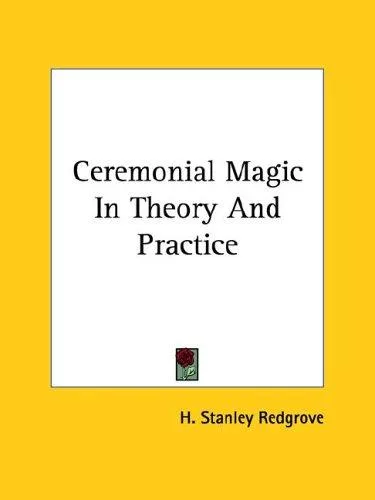
Ceremonial Magic In Theory And Practice
 61
61

Ceremonial Magic In Theory And Practice


Silas Hawthorne, Hermetic Studies Editor: 'Ceremonial Magic In Theory And Practice' stands as a cornerstone for any serious student of the Western Esoteric Tradition. Redgrove's lucid prose pierces through obfuscation, presenting the theoretical framework and practical application of ritual with scholarly rigor and spiritual insight. He illuminates the psychological alchemy inherent in ceremonial work, emphasizing the transformative power of focused intent and symbolic engagement. This text is indispensable for practitioners seeking to deepen their understanding and for scholars wishing to grasp the foundational principles of ritual magic. Its enduring value lies in its comprehensive yet accessible approach, making complex concepts readily digestible.
📝 Description
61
H. Stanley Redgrove's 1911 book examines the theory and practice of ceremonial magic.
Published in 1911, H. Stanley Redgrove's 'Ceremonial Magic In Theory And Practice' addresses the philosophical basis and practical application of ritual magic. Redgrove analyzes the symbolic elements and energetic forces present in ceremonial acts. He explains how focused intent, mental imagery, and ritualistic movements combine to achieve specific results.
This work goes beyond a simple instruction guide. It invites readers to consider the deeper aspects of awareness, the cosmic structure, and the potential within the human mind. The book appeals to individuals seeking genuine knowledge, moving past simplistic doctrines. It is a valuable resource for dedicated students of the occult, providing significant observations on the psychological and spiritual effectiveness of ceremonial magic.
This book is situated within the Western esoteric tradition, specifically the magical currents of the early 20th century. It engages with concepts that were being explored by various occult societies and individual practitioners at the time, such as the relationship between the mind and external manifestation. Redgrove's approach connects theoretical frameworks with the tangible execution of magical rites, reflecting a period where practitioners sought to systematize and understand these practices more thoroughly.
💡 Why Read This Book?
Embark on a transformative journey into the heart of ritualistic power. This book offers a rare glimpse into the theoretical foundations and practical execution of ceremonial magic, demystifying its esoteric principles. Ideal for seekers of hidden knowledge, practitioners aiming to refine their craft, and scholars exploring the rich tapestry of occult philosophy. Uncover the profound connection between mind, spirit, and the manifested world.
⭐ Reader Reviews
Honest opinions from readers who have explored this book.
❓ Frequently Asked Questions
What is the primary focus of this book?
The book's primary focus is on the theoretical underpinnings and practical application of ceremonial magic, exploring its philosophical significance and symbolic language.
Is this book suitable for beginners?
While dense with information, the clear explanations make it accessible to dedicated beginners who are serious about understanding the foundations of ceremonial magic.
What kind of magical practices are discussed?
It delves into the principles behind various forms of ceremonial magic, emphasizing ritual structure, intention, and symbolic correspondences.
Does the book provide step-by-step instructions for spells?
While it explains the principles, it focuses more on the theoretical framework and underlying philosophy rather than providing explicit spell recipes.
What is the author's perspective on magic?
Redgrove presents magic as a profound system of spiritual and psychological development, grounded in ancient wisdom and capable of transformative effects.
🔮 Key Themes & Symbolism
The Architecture of Ritual
This theme explores the intricate construction of magical ceremonies, dissecting the purpose and power behind each element, from preparatory rites to the invocation and banishment. Redgrove emphasizes how the symbolic arrangement of space, time, and tools creates a focused energetic matrix, essential for directing magical will and facilitating communion with higher or subtle forces. It studies the psychological impact of structured ritual, highlighting its role in preparing the magician's mind and soul for profound experiences.
Symbolism and Correspondences
A central to Redgrove's work is the exploration of the universal language of symbolism within magic. This theme illuminates how colors, numbers, planets, elements, and divine names are not arbitrary but represent fundamental forces and principles of the cosmos. Understanding these correspondences allows the practitioner to combine a collection of meaning into their rituals, amplifying their efficacy by aligning the microcosm (the magician) with the macrocosm (the universe) through resonant frequencies.
The Psychology of Magical Manifestation
Redgrove probes the intricate relationship between the magician's inner state and the external manifestation of magical intent. This theme examines how focused visualization, unwavering belief, and emotional resonance are crucial components that empower ritual. It posits that ceremonial magic is not merely about external forces, but also a profound journey of self-mastery and the cultivation of psychic energies, leading to transformative experiences and the realization of one's potential.
💬 Memorable Quotes
Direct passages from the work, attributed to the author.
“The efficacy of a rite depends upon the purity of intention and the clarity of visualization.”
— Highlights the crucial role of the magician's inner state, emphasizing that focused will and mental imagery are paramount for successful ritual.
“Symbolism is the language of the soul, and through it, we communicate with the divine.”
— This profound statement underscores the deeply spiritual aspect of magical symbolism, suggesting it acts as a bridge between the human and the transcendent.
“The circle is a sacred space, a boundary between the mundane and the magical.”
— Explains the fundamental importance of the magical circle as a consecrated area, essential for containing and directing energies during ritual.
“To know is not enough; one must apply. To will is not enough; one must do.”
— A call to action, emphasizing that theoretical knowledge of magic must be coupled with practical application and consistent effort to achieve results.
💡 Key Ideas
Editorial paraphrase of the work's core concepts — not direct quotes.
Magic is the art of manipulating the hidden forces of nature.
This quote captures the core idea that magic is not mere superstition but a potent art form that interacts with the unseen energies shaping reality.
🌙 Esoteric Significance
Tradition
This work is deeply rooted in the Western Esoteric Tradition, drawing heavily from Hermetic philosophy, Kabbalistic principles, and the ritualistic practices of orders like the Hermetic Order of the Golden Dawn. It provides a bridge between theoretical occultism and practical ritual, emphasizing the psychological and spiritual dimensions of magic as a path of personal transformation.
Symbolism
Redgrove meticulously dissects the profound symbolism inherent in ceremonial magic. He explores the meaning behind geometric shapes, divine names, planetary correspondences, and elemental forces, illustrating how these elements function as a potent symbolic language to interact with subtle energies and archetypal realms. The book reveals symbolism not as mere decoration, but as the very mechanism through which magical intent is amplified and directed.
Modern Relevance
In an age often characterized by materialism and a disconnection from the numinous, Redgrove's work offers a vital re-engagement with the power of consciousness and ritual. Its emphasis on intention, visualization, and symbolic interaction remains profoundly relevant for modern practitioners seeking to cultivate inner awareness, harness creative potential, and explore the deeper mysteries of existence beyond the purely empirical.
👥 Who Should Read This Book
This useful text is essential for the dedicated seeker of esoteric knowledge, offering a robust theoretical foundation for understanding the art and science of ceremonial magic. Students of Western Esotericism, occult scholars, and aspiring practitioners will find its clear exposition of principles invaluable. Those interested in the intersection of psychology, spirituality, and ritual will also benefit immensely. It is particularly suited for individuals ready to move beyond superficial understanding and engage with the profound philosophical depths of magical practice.
📜 Historical Context
Written during the early 20th century, a period of intense occult revival and intellectual curiosity in Britain, H. Stanley Redgrove's 'Ceremonial Magic In Theory And Practice' emerged as a significant contribution to the burgeoning field of Western Esotericism. This era saw a fascination with ancient wisdom traditions, Hermeticism, Kabbalah, and the mystical interpretations of existing religions. Influenced by figures like Aleister Crowley and the Golden Dawn, Redgrove sought to provide a rational, yet deeply spiritual, framework for understanding the principles of magic. The book reflects a desire to codify and clarify complex magical systems for a new generation of students, moving beyond mere sensationalism towards a more philosophical and psychological understanding of ritual.
📔 Journal Prompts
Reflect on a personal symbol that holds significant meaning for you. How might this symbol be incorporated into a personal ritual?
Consider the concept of 'purity of intention.' How can you cultivate a clearer and more focused intention in your daily life and any spiritual practices?
Visualize a sacred space. Describe its sensory details and the feeling it evokes. How does this space contribute to a sense of the magical?
What are the 'hidden forces' you perceive in your own life or the world around you? How might ceremonial magic offer a framework for understanding or interacting with them?
How does the idea of 'applying knowledge' resonate with your personal journey of learning and growth, particularly in relation to spiritual or esoteric studies?
🗂️ Glossary
Invocation
A ritual act of calling upon or summoning a spiritual entity, force, or divine power, often for guidance, assistance, or communion.
Banishment
A ritual act performed to dismiss or neutralize spiritual energies, entities, or influences that have been invoked or are considered undesirable.
Correspondences
The symbolic relationships between different elements, such as planets, colors, numbers, and deities, used in magic to create resonant energetic patterns.
Microcosm
The belief that the human being or the Earth reflects the structure and principles of the greater universe (macrocosm).
Macrocosm
The universe as a whole, considered as a vast, ordered system, often seen as being reflected in the microcosm.
This book appears in 3 collections
🔮 Readers Also Liked
Browse all →







More by H. Stanley Redgrove
All books →




From the “Ritual Magic” Collection
View all →







More Free Magic & Ritual Books
View all →