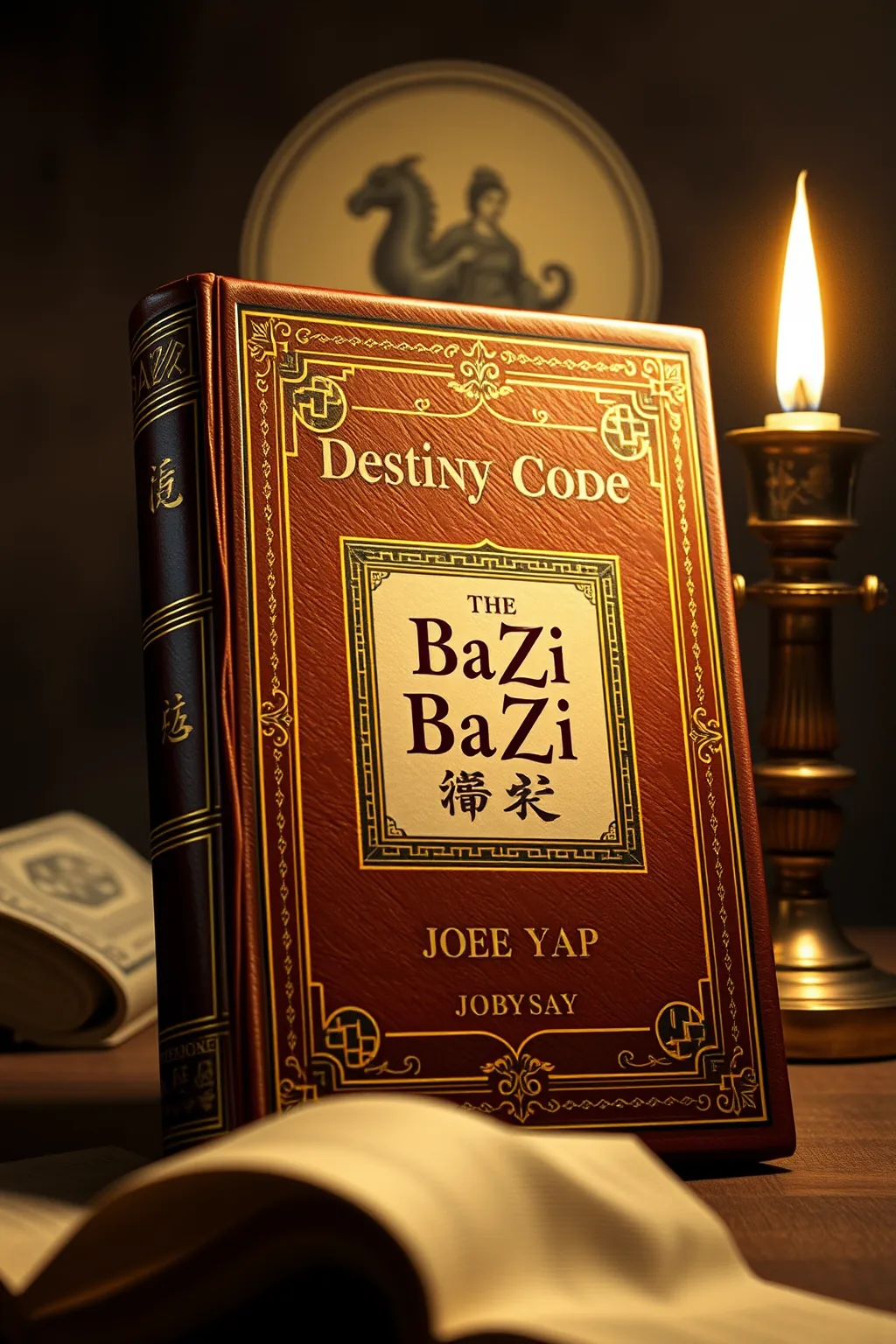
BaZi- The Destiny Code
 73
73

BaZi- The Destiny Code
Joey Yap’s BaZi- The Destiny Code offers a remarkably thorough introduction to the Four Pillars of Destiny system. The author’s strength lies in his ability to systematically break down a complex subject, presenting the intricate relationships between the Five Elements, Heavenly Stems, and Earthly Branches with clarity. For instance, his explanation of how the 'Output' star indicates creativity and resourcefulness, derived from the interaction of specific elements, is particularly well-articulated. However, the sheer volume of detail, while comprehensive, can sometimes feel overwhelming for a complete novice. The book assumes a certain level of commitment to memorization and pattern recognition that might deter casual readers. Despite this, the work provides a solid foundation for anyone serious about understanding this particular facet of Chinese metaphysics. It serves as a functional manual rather than a philosophical treatise. A practical guide to a profound system.
📝 Description
73
Joey Yap's 2005 book, BaZi- The Destiny Code, explains the ancient Chinese Four Pillars of Destiny.
BaZi- The Destiny Code, by Joey Yap, details the Chinese art of Four Pillars of Destiny. This system, which draws from Taoist cosmology, uses a person's birth date and time to create a 'destiny chart'. The book explains how to interpret the interactions between the Heavenly Stems and Earthly Branches in this chart. It presents BaZi as an analytical tool for understanding personality, relationships, and life paths, not just fortune-telling. Yap's work aims to make this complex practice understandable for those interested in Eastern metaphysical systems.
This book is for individuals seeking a structured way to understand destiny and human potential from an Eastern perspective. It appeals to students of metaphysics, philosophy, and psychology interested in comparative systems. Those wanting to gain self-awareness, improve relationships, or explore career options through traditional Chinese cosmology will find its methods useful. It is also beneficial for Feng Shui practitioners looking to understand an individual's energetic blueprint more deeply.
The practice of BaZi, or Four Pillars of Destiny, has ancient roots in Chinese history, developing alongside Taoism and traditional Chinese medicine. Its systematic form became more defined during the Ming and Qing dynasties. Joey Yap's book appeared during a period of renewed global interest in Eastern philosophies, following earlier waves of esoteric study. His work connects to a modern revival of practical applications of ancient Chinese arts, moving beyond purely academic or mystical interpretations.
💡 Why Read This Book?
• Gain a structured method for self-analysis by learning to construct and interpret a BaZi chart, as detailed in the chapter 'Constructing Your BaZi Chart'. • Understand interpersonal dynamics through the lens of the Six Relationships in BaZi, a core concept explored throughout the text. • Discover potential life paths and energetic influences by analyzing the interaction of the Five Elements and Luck Pillars, as explained in sections on Elemental Balance.
⭐ Reader Reviews
Honest opinions from readers who have explored this book.
❓ Frequently Asked Questions
What is the origin of the BaZi system discussed in Joey Yap's book?
The BaZi system, or Four Pillars of Destiny, originates from ancient Chinese cosmology and Taoist philosophy, with its systematic development evolving over centuries, particularly during the Ming and Qing dynasties.
How does BaZi differ from Western astrology?
Unlike Western astrology, which primarily uses the Sun's position relative to constellations, BaZi uses a lunar-based calendar to calculate a chart based on year, month, day, and hour of birth, focusing on the Five Elements and their interactions.
Can BaZi be used for career guidance?
Yes, the BaZi chart can offer insights into an individual's innate talents, strengths, and potential career inclinations by analyzing the 'Power' and 'Wealth' stars within the destiny chart.
What are the 'Luck Pillars' in BaZi?
Luck Pillars represent ten-year cycles of influence within a BaZi chart, indicating periods where specific energetic forces are more prominent, potentially affecting life events and opportunities.
Is Joey Yap's book suitable for absolute beginners in Chinese metaphysics?
Yes, 'BaZi- The Destiny Code' is designed as a comprehensive guide, breaking down complex concepts for beginners, though it requires dedicated study due to the system's depth.
What role do the Five Elements play in a BaZi chart?
The Five Elements (Wood, Fire, Earth, Metal, Water) are fundamental to BaZi, representing core energies that interact to shape personality, relationships, health, and destiny as depicted in the chart.
🔮 Key Themes & Symbolism
Elemental Harmony and Imbalance
The core of BaZi analysis revolves around the interplay of the Five Elements: Wood, Fire, Earth, Metal, and Water. Yap's work meticulously details how these elements are represented in an individual's birth chart, derived from the Heavenly Stems and Earthly Branches. Understanding the 'balance' or 'imbalance' of these elements is crucial, as it dictates personality traits, potential health issues, and the flow of luck. The book explores how cycles of creation and destruction among the elements influence life events, providing a framework for identifying strengths and weaknesses inherent in one's destiny code.
The Structure of Destiny Charts
BaZi- The Destiny Code provides a systematic breakdown of how to construct and read the Four Pillars chart. This involves understanding the significance of the Year Pillar, Month Pillar, Day Pillar, and Hour Pillar, each contributing unique energetic signatures. Central to this structure is the 'Day Master', representing the self, and its relationship to the other Stems and Branches. The book elucidates the concept of 'Palaces', which assign specific influences to different aspects of life (e.g., spouse, parents, career) based on their position within the chart.
Interpreting the Six Relationships
Beyond the basic elemental interactions, Yap looks at the 'Six Relationships' within a BaZi chart. These are symbolic representations of how different energies relate to the Day Master, categorizing them into concepts like Wealth, Power (Officer), Output (Creativity), Resource (Support), and Self-Peck (Friend/Sibling). This interpretive layer allows for a nuanced understanding of an individual's innate inclinations, such as their approach to finances, authority, social interactions, and personal expression, offering practical insights into their behavioral patterns.
The Flow of Luck Pillars
A critical component of BaZi destiny interpretation is the concept of Luck Pillars. Yap explains that a person's destiny is not static but evolves through successive ten-year cycles, each governed by a specific combination of Heavenly Stem and Earthly Branch. These Luck Pillars modify the influences of the natal chart, indicating periods of fortune, challenge, opportunity, or stagnation. Understanding these temporal shifts allows individuals to better anticipate and read through the changing currents of their lives.
💬 Memorable Quotes
Direct passages from the work, attributed to the author.
“The Day Master is the most crucial element in your BaZi chart.”
— This highlights the foundational importance of the 'self' element within the Four Pillars system. It signifies that all other energies and relationships in the chart are interpreted in relation to this core component, defining one's personal energetic signature.
“Luck Pillars reveal the energetic tides of your life.”
— This metaphor emphasizes that life is not fixed but subject to cyclical influences. Luck Pillars provide a roadmap for understanding how these shifting energies might manifest over time.
“The interaction between Stems and Branches forms the energetic language of BaZi.”
— This points to the symbolic and linguistic nature of the BaZi system. The combination of Heavenly Stems and Earthly Branches creates a unique 'vocabulary' that skilled interpreters can read to understand destiny.
“Understanding the Six Relationships offers deeper personality insights.”
— This indicates that a superficial reading of elements is insufficient. The specific relational dynamics – like Wealth or Power – provide a more granular and practical understanding of an individual's psychological makeup and life pursuits.
💡 Key Ideas
Editorial paraphrase of the work's core concepts — not direct quotes.
Elemental balance dictates the harmony of your destiny.
This summarizes the central principle of BaZi: the ideal state is an equilibrium among the Five Elements. Imbalances suggest areas of potential challenge or weakness that can be understood and potentially mitigated.
🌙 Esoteric Significance
Tradition
BaZi belongs to the broad spectrum of Chinese metaphysical arts, deeply rooted in Taoist philosophy and cosmology. It shares foundational principles with Traditional Chinese Medicine (TCM) and Feng Shui, all drawing from the concepts of Qi (vital energy) and the Five Elements. Yap’s work fits within this lineage by presenting a practical, analytical framework for understanding the energetic blueprint of an individual, viewing destiny not as fixed fate but as a dynamic interplay of inherent potentials and external influences.
Symbolism
The primary symbols in BaZi are the Heavenly Stems and Earthly Branches, which combine to form the cycle of 60. The twelve Earthly Branches correspond to the Chinese Zodiac animals (Rat, Ox, Tiger, etc.), each carrying symbolic meanings related to nature, seasons, and inherent qualities. The Five Elements (Wood, Fire, Earth, Metal, Water) are also fundamental symbols, representing different types of energy and their dynamic interactions, forming the core language through which destiny is interpreted.
Modern Relevance
Contemporary practitioners of Chinese metaphysics, including Feng Shui consultants and BaZi analysts, frequently reference Joey Yap’s foundational texts. His systematic approach has influenced modern teaching methodologies and made BaZi more accessible to a global audience. Schools and online platforms dedicated to Chinese metaphysics often build their curriculum upon the principles outlined in works like 'The Destiny Code', demonstrating its continued relevance for those seeking practical applications of ancient wisdom.
👥 Who Should Read This Book
• Aspiring practitioners of Chinese Metaphysics seeking a structured introduction to BaZi analysis, providing a comprehensive guide to chart construction and interpretation. • Individuals interested in self-discovery and personal development through a unique Eastern philosophical lens, offering a framework for understanding innate talents and life patterns. • Comparative philosophy students exploring different systems of divination and destiny interpretation, providing a detailed case study of the Four Pillars of Destiny.
📜 Historical Context
Joey Yap’s BaZi- The Destiny Code, first published in 2005, arrived during a period of burgeoning global interest in practical Eastern metaphysical systems. While BaZi, or Four Pillars of Destiny, has ancient roots in Chinese cosmology, tracing back to its use by figures like Liu Bowen in the 14th century, Yap’s work represents a modern codification aimed at accessibility. It emerged in an intellectual climate where practices like Feng Shui were gaining significant traction in the West, often discussed alongside contemporaries like Lillian Too. Unlike earlier Western engagements with Chinese metaphysics, which could sometimes be more academic or steeped in esoteric societies, Yap’s approach focused on a systematic, almost scientific, breakdown of chart interpretation for personal application. The book's success reflected a broader trend of individuals seeking actionable tools for self-understanding and life planning through traditional Chinese arts.
📔 Journal Prompts
Analyze your Day Master's elemental nature and its primary relationships within your BaZi chart.
Reflect on the symbolism of the Earthly Branches that appear prominently in your natal chart.
Consider the concept of Elemental Balance as it might apply to your current life circumstances.
Map out the potential influences of your current Luck Pillar based on the book's descriptions.
Explore the implications of the Six Relationships for your interpersonal interactions.
🗂️ Glossary
BaZi
Literally 'Eight Characters', referring to the four pairs of Heavenly Stems and Earthly Branches that represent the year, month, day, and hour of birth, forming the Four Pillars of Destiny chart.
Heavenly Stems
Ten celestial stems (Jia, Yi, Bing, Ding, Wu, Ji, Geng, Xin, Ren, Gui) that form the primary energetic components of the BaZi chart, often associated with Yin and Yang principles.
Earthly Branches
Twelve terrestrial branches, corresponding to the animals of the Chinese Zodiac (Rat, Ox, Tiger, etc.), representing cyclical time and carrying specific elemental qualities.
Five Elements
The fundamental forces of Wood (木), Fire (火), Earth (土), Metal (金), and Water (水), which interact in cycles of creation and destruction to influence all aspects of the BaZi chart.
Day Master
The Heavenly Stem of the Day Pillar, representing the self or the core essence of the individual within the BaZi chart.
Luck Pillars
Ten-year cycles of influence determined by specific Stem-Branch combinations that overlay the natal BaZi chart, indicating periods of varying energetic fortune.
Six Relationships
Categories of interaction between the Day Master and other elements in the chart, representing concepts like Wealth, Power, Output, Resource, and Self-Peck (Friend/Sibling).
🔮 Readers Also Liked
Browse all →









More by Joey Yap
All books →




More Free Astrology & Cosmology Books
View all →