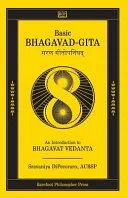
Basic Bhagavad-Gita
 75
75

Basic Bhagavad-Gita
Sravaniya DiPecoraro’s Basic Bhagavad-Gita presents a commendable effort to distill the profound teachings of this ancient scripture for a contemporary audience. DiPecoraro, drawing on her background as an astrologer and occult specialist, notably succeeds in connecting the Gita's yogic philosophy to Western esoteric interests. Her explanation of the five main subjects of the text, particularly concerning karma and the self, is refreshingly direct. However, the work occasionally feels constrained by its own desire for simplicity, sometimes glossing over the deeper allegorical or philosophical nuances that have fueled centuries of commentary. A passage discussing Arjuna's crisis on the battlefield, while clear, could benefit from more exploration of the psychological depths involved. Despite this limitation, the book serves as a solid, approachable primer for those intimidated by more exhaustive scholarly treatments.
📝 Description
75
Sravaniya DiPecoraro published Basic Bhagavad-Gita in 2017 to clarify Hindu scripture.
Authored by yoga teacher Sravaniya DiPecoraro, this 2017 book serves as an entry point to the Bhagavad-Gita. DiPecoraro aims to simplify the scripture's philosophical and spiritual teachings, presenting it as a guide to yoga philosophy. The focus remains on core principles, sidestepping dense theological discussions. This work is suitable for readers new to the Bhagavad-Gita or those seeking a clearer understanding of its yogic and Vedantic foundations. It will appeal to students of esoteric traditions, Western occultism, and comparative religion.
The book addresses fundamental concepts like karma, destiny, and the nature of the self. DiPecoraro stresses the practical application of these ideas for spiritual development. It moves beyond theoretical understanding toward direct experience. The text is positioned against the backdrop of numerous past translations and interpretations, offering a modern, grounded perspective on a central Hindu text.
Published in 2017, Basic Bhagavad-Gita enters a landscape shaped by 19th-century Western engagement with Indian philosophy. DiPecoraro's work situates itself within this history, offering a contemporary interpretation influenced by occult and yoga traditions. It connects the Bhagavad-Gita's teachings to Western esoteric thought, including figures like Helena Blavatsky and the Theosophists, while emphasizing practical spiritual growth.
💡 Why Read This Book?
• Learn the core principles of Vedanta and yoga philosophy as presented in the Bhagavad-Gita, particularly how the five main subjects of the text illuminate karma and fate, as explained by Sravaniya DiPecoraro. • Understand the relationship between the individual self and the Higher Self, a central theme in the Bhagavad-Gita, and how this understanding can be practically applied to spiritual development. • Gain an accessible introduction to a foundational text of Hindu philosophy, making its complex ideas comprehensible without requiring prior deep study of Sanskrit or religious doctrine.
⭐ Reader Reviews
Honest opinions from readers who have explored this book.
❓ Frequently Asked Questions
What is the Bhagavad-Gita described as in this book?
Basic Bhagavad-Gita introduces the scripture as the "Song of God," a comprehensive guide to yoga philosophy that offers practical insights into spiritual living and self-understanding.
Who is Sravaniya DiPecoraro and what is her background?
Sravaniya DiPecoraro is presented as an experienced yoga teacher, astrologer, and occult specialist, bringing a multi-faceted esoteric perspective to her interpretation of the Bhagavad-Gita.
What key philosophical concepts does the book explain?
The book focuses on explaining the basic principles of Vedanta, the nature of karma and fate, and the relationship between the individual self and the Higher Self, among other core ideas.
How does this book differ from other Bhagavad-Gita commentaries?
Basic Bhagavad-Gita aims for accessibility and readability, demystifying complex philosophical elements for beginners and those interested in the yogic and esoteric dimensions of the text.
When was Basic Bhagavad-Gita first published?
The book, Basic Bhagavad-Gita, was first published on August 3, 2017.
What is the primary goal of the book for its readers?
The book aims to help readers penetrate the workings of karma and fate and understand the self's connection to the Higher Self, fostering a deeper comprehension of yoga philosophy.
🔮 Key Themes & Symbolism
Yoga Philosophy Unveiled
This work focuses on the Bhagavad-Gita as a fundamental text for yoga philosophy, moving beyond religious dogma to its practical application for spiritual growth. DiPecoraro breaks down concepts like *dharma* (duty) and *karma* (action and consequence) in a way that is digestible for Western esoteric practitioners. The book explores how the teachings, particularly Krishna's dialogue with Arjuna, offer a roadmap for understanding the mind-body-spirit connection and achieving inner balance.
Karma and Destiny
A central theme is the intricate workings of karma and fate. Basic Bhagavad-Gita attempts to clarify these often-misunderstood concepts, presenting them not as predetermined doom but as the result of actions and intentions. DiPecoraro explains how understanding these principles, as outlined in the five main subjects of the Gita, can empower individuals to navigate life's challenges with greater awareness and less suffering.
The Nature of the Self
The book examines the profound philosophical inquiry concerning the nature of the self (Atman) and its relationship to the supreme reality or Higher Self (Brahman). DiPecoraro guides the reader through the Gita's perspective on the eternal soul, distinct from the temporary physical body and ego. This exploration is crucial for anyone seeking self-realization and a deeper understanding of consciousness.
Vedantic Principles Explained
Basic Bhagavad-Gita serves as an introduction to the core tenets of Vedanta, one of the six orthodox schools of Hindu philosophy. DiPecoraro translates these principles into accessible language, highlighting their relevance to contemporary life and esoteric practices. The emphasis is on the practical wisdom embedded within Vedanta, encouraging readers to integrate its teachings into their daily existence.
💬 Memorable Quotes
Direct passages from the work, attributed to the author.
“Understanding the five main subjects of the text helps the reader to penetrate the often mysterious workings of karma and fate.”
— This highlights the book's practical focus. It suggests that the Gita isn't just theoretical scripture, but a functional guide to understanding cause-and-effect on a cosmic scale, empowering the reader with knowledge of destiny's mechanisms.
“Explains the basic principles of Vedanta, debunks popular myths...”
— This points to the book's role as a corrective and clarifying text. It aims to clear away misconceptions surrounding Hindu philosophy and present the foundational Vedanta teachings in a straightforward, unadorned manner.
“Shows how an understanding of the self and the Higher Self is connected.”
— This emphasizes the book's exploration of consciousness. It suggests that the Gita provides a framework for understanding individual identity in relation to a greater universal presence, a key tenet in many esoteric traditions.
“Provides an accessible and readable introduction to yoga philosophy.”
— This statement positions the book as a gateway. It promises to make the complex world of yoga philosophy, as embodied in the Bhagavad-Gita, understandable and engaging for newcomers and those seeking a simplified overview.
“DiPecoraro, an experienced yoga teacher, astrologer and occult specialist...”
— This describes the author's unique qualifications. It signals that the interpretation offered is informed by a blend of practical spiritual discipline, astrological symbolism, and esoteric knowledge, promising a unique perspective.
🌙 Esoteric Significance
Tradition
This work engages with the Vedanta tradition, a foundational school of Hindu philosophy, but frames it within a Western esoteric context. DiPecoraro, an astrologer and occult specialist, bridges the gap between Eastern spiritual texts and practitioners of Western Hermeticism, Kabbalah, and Theosophy. The book's emphasis on practical application and the understanding of consciousness aligns with the goals of many Western mystical paths seeking self-transformation and gnosis.
Symbolism
While not explicitly detailed in the blurb, the Bhagavad-Gita itself is rich with symbolism. The battlefield of Kurukshetra can be interpreted as the human psyche, the chariot as the body, and the horses as the senses. Krishna, the divine charioteer, represents the Higher Self or divine wisdom guiding the individual soul (Arjuna) through the existential dilemmas of life, symbolizing the internal struggle for spiritual clarity and control.
Modern Relevance
In contemporary spirituality, there's a growing interest in integrating Eastern philosophical concepts with Western psychological and esoteric frameworks. DiPecoraro's work speaks to this trend, offering a digestible entry point to the Bhagavad-Gita for modern seekers. Its focus on practical application of concepts like karma and self-awareness appeals to mindfulness practices and self-help philosophies that draw heavily on ancient wisdom traditions.
👥 Who Should Read This Book
• Beginning students of yoga philosophy and Eastern spirituality seeking a clear, non-academic introduction to a foundational text. • Practitioners of Western esoteric traditions (Hermeticism, Theosophy, astrology) interested in understanding the roots of yogic thought and its parallels to their own paths. • Individuals exploring concepts of karma, fate, and the nature of the self, who desire a practical guide to understanding these principles beyond their popular interpretations.
📜 Historical Context
The Bhagavad-Gita, a scripture central to Hinduism, has been a subject of Western fascination since the late 18th century, with influential translations appearing throughout the 19th and 20th centuries. Thinkers like Arthur Schopenhauer and Ralph Waldo Emerson engaged with its philosophical depth, while movements like Theosophy, founded by Helena Blavatsky in 1875, incorporated its teachings into their syncretic spiritual systems. By 2017, the Gita had spawned countless commentaries, ranging from academic theological analyses to New Age interpretations. Sravaniya DiPecoraro's Basic Bhagavad-Gita emerges in this rich interpretive landscape, seeking to offer a clear, modern approach. It navigates a path between dense scholarly exegesis and overly simplified spiritual affirmations, aiming specifically at those interested in the Gita's yogic and esoteric dimensions, a niche that has seen continuous engagement since the counterculture movements of the 1960s.
📔 Journal Prompts
The nature of the self as distinct from the body: What are your current beliefs, and how might the Gita's perspective challenge them?
Arjuna's dilemma on the battlefield: How do you face your own 'battles' when duty and desire conflict?
Reflecting on karma: Identify one action you took recently and consider its potential karmic repercussions.
The concept of the Higher Self: How do you perceive your connection to this guiding principle in your daily life?
Vedanta's practical application: How can the principles of detachment and duty be integrated into your immediate responsibilities?
🗂️ Glossary
Bhagavad-Gita
A sacred Hindu scripture, literally meaning 'Song of God.' It is a dialogue between Prince Arjuna and Lord Krishna, forming part of the epic Mahabharata.
Yoga Philosophy
The philosophical underpinnings of yoga, focusing on the union of mind, body, and spirit, and the path to self-realization and liberation.
Vedanta
A school of Hindu philosophy that interprets the Upanishads, focusing on concepts of Brahman (ultimate reality) and Atman (the self).
Karma
The principle of cause and effect, where actions and their consequences shape an individual's present and future experiences.
Self
In this context, refers to the individual soul or consciousness (Atman), considered eternal and distinct from the physical body and mind.
Higher Self
The supreme consciousness or divine presence (Brahman) with which the individual self is ultimately one.
Dharma
One's duty, righteousness, or intrinsic nature, often interpreted as fulfilling one's role in accordance with cosmic order.